
 Worksheets
Macroeconomics MCQ Worksheet
Total questions: 60
Worksheet time: 30mins
A country's government runs a budget deficit when which of the following occurs in a given year?
The amount of new loans to developing nations exceeds the amount of loans paid off by developing nations.
Government spending exceeds tax revenues.
The debt owed to foreigners exceeds the debt owed to the country's citizens.
The amount borrowed exceeds the interest payment on the national debt.
Interest payments on the national debt exceed spending on goods and services.
A high marginal propensity to consume implies which of the following?
A small change in consumption when income changes
A high savings rate
A high marginal tax rate
An equilibrium level of income near full employment
A low marginal propensity to save
The transaction demand for money is very closely associated with money's use as a
store of value
standard unit of account
measure of value
medium of exchange
standard of deferred payment
Unlike a market economy, a command economy uses
more centralized planning in economic decision making
consumer sovereignty to make production decisions
its resources more efficiently
price signals in economic decision making
the popular vote in making resource allocation decisions
The value of a country's currency will tend to appreciate if
demand for the country's exports increases
the country's money supply increases
the country's citizens increase their travel abroad
domestic interest rates decrease
tariffs on the country's imports decrease
Which of the following best illustrates an improvement in a country's standard of living?
An increase in real per capita gross domestic product
An increase in nominal per capita gross domestic product
Price stability
A balanced budget
An increase in the consumer price index
Hyperinflation is typically caused by
high tax rates that discourage work effort
continuous expansion of the money supply to finance government budget deficits
trade surpluses that are caused by strong protectionist policies
bad harvests that lead to widespread shortages
a large decline in corporate profits that leads to a decrease in production
All of the following changes will shift the investment demand curve to the right EXCEPT
a decrease in the corporate income tax rate
an increase in the productivity of new capital goods
an increase in the real interest rate
an increase in corporate profits
an increase in real gross domestic product
The official unemployment rate understates the unemployment level in the economy because the official unemployment rate
ignores the duration of unemployment
ignores underemployed and discouraged workers
includes jobs created by the underground economy
excludes all unemployed teenagers
excludes frictionally unemployed workers
If a reduction in aggregate supply is followed by an increase in aggregate demand, which of the following will definitely occur?
Output will increase.
Output will decrease.
Output will not change.
The price level will increase.
The price level will decrease.
Which of the following combinations of changes in government spending and taxes is necessarily expansionary?
Increase in government spending and increase in taxes
Increase in government spending and decrease in taxes
Decrease in government spending and no change in taxes
Decrease in government spending and increase in taxes
Decrease in government spending and decrease in taxes
The amount of money that the public wants to hold in the form of cash will
be unaffected by any change in interest rates or the price level
increase if interest rates increase
decrease if interest rates increase
increase if the price level decreases
decrease if the price level remains constant
For an economy consisting of households and businesses only, which of the following is consistent with the circular flow of income and production?
Households are producers of goods and services and consumers of resources.
Households are users of resources, and businesses are sources of saving.
Households are suppliers of resources and consumers of goods and services.
Businesses are users of taxes, and households are sources of taxes.
Businesses are suppliers of resources and consumers of goods and services.
With an increase in the real interest rate, consumption and real gross domestic product will most likely change in which of the following ways?
Consumption increases and real gross domestic product increases
Consumption increases and real gross domestic product decreases
Consumption decreases and real gross domestic product increases
Consumption decreases and real gross domestic product decreases
Consumption does not change and real gross domestic product increases
According to the short-run Phillips curve, lower inflation rates are associated with
higher unemployment rates
higher government spending
larger budget deficits
greater labor-force participation rates
smaller labor-force participation rates
Which of the following will lead to a decrease in a nation's money supply?
A decrease in income tax rates
A decrease in the discount rate
An open market purchase of government securities by the central bank
An increase in reserve requirements
An increase in government expenditures on goods and services
An increase in which of the following would cause the aggregate demand curve to shift to the left?
Consumer optimism
Population
Cost of resources
Income taxes
Net exports
Which of the following changes in the supply of and the demand for a good will definitely result in a decrease in both the equilibrium price and quantity of the good?
Supply increases and demand increases
Supply increases and demand does not change
Supply does not change and demand decreases
Supply decreases and demand increases
Supply decreases and demand decreases
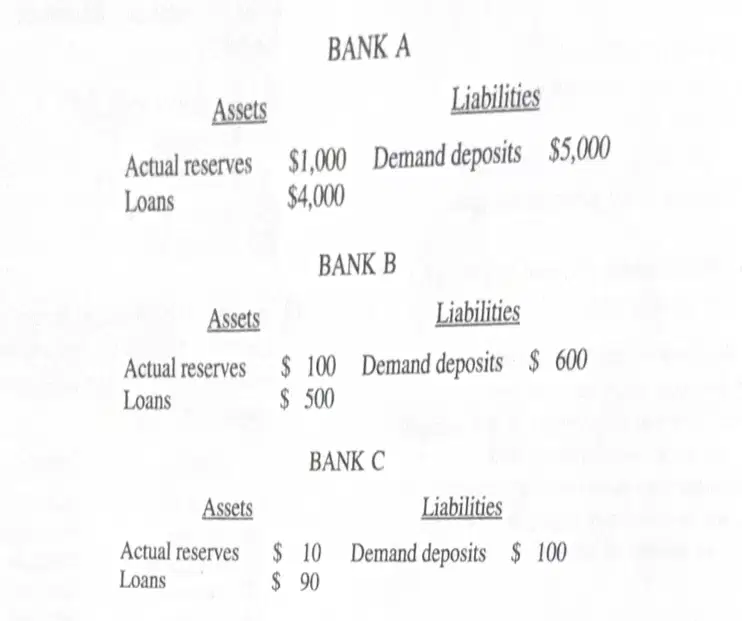
Based on the balance sheets above for three different banks, which of the following is true, if the reserve requirement is 10 percent?
Bank A has no excess reserves.
Bank B has no excess reserves.
Bank B can increase its loans by $500.
Bank B can increase its loans by $40.
Bank C has excess reserves.
Which of the following will most likely lead to a decrease in inflationary expectations?
A decrease in the marginal propensity to save
A decrease in imports
A decrease in the money supply
An increase in the government budget deficit
An increase in the prices of raw materials
With an upward-sloping short-run aggregate supply curve, an increase in government expenditure will most likely
reduce the price level
reduce the level of nominal gross domestic product
increase real gross domestic product
shift the short-run aggregate supply curve to the right
shift both the aggregate demand curve and the long-run aggregate supply curve to the left
Which of the following are the most likely short-run effects of an increase in government expenditures?
Unemployment Rate: Increase; Inflation Rate: Increase; Real Gross Domestic Product: Increase
Unemployment Rate: Increase; Inflation Rate: Increase; Real Gross Domestic Product: Decrease
Unemployment Rate: Decrease; Inflation Rate: Increase; Real Gross Domestic Product: Increase
Unemployment Rate: Decrease; Inflation Rate: Decrease; Real Gross Domestic Product: Increase
Unemployment Rate: No change; Inflation Rate: Decrease; Real Gross Domestic Product: Increase
In the short run, an expansionary monetary policy would most likely result in which of the following changes in the price level and real gross domestic product (GDP)?
Price level decreases; Real GDP increases
Price level has no change; Real GDP decreases
Price level increases; Real GDP has no change
Price level increases; Real GDP decreases
Price level increases; Real GDP increases
A reduction in inflation can best be achieved by which of the following combinations of fiscal and monetary policy?
Increase taxes; Sell government bonds
Decrease taxes; Buy government bonds
Decrease taxes; Lower margin requirements
Decrease government spending; Lower discount rate
Increase government spending; Raise discount rate
Which of the following is likely to occur following the depreciation of the United States dollar?
United States imports will increase.
United States exports will increase.
Demand for the United States dollar will decrease.
United States demand for foreign currencies will increase.
United States goods will become more expensive in foreign markets.
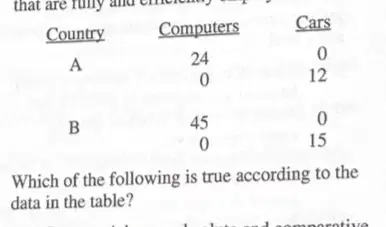
The table below shows the production alternatives of Country A and Country B for producing computers and cars with equal amounts of resources that are fully and efficiently employed. Which of the following is true according to the data in the table?
Country A has an absolute and comparative advantage in the production of computers.
Country B has an absolute and comparative advantage in the production of computers.
Country B should import computers and export cars.
Since Country B has an absolute advantage in the production of both goods, it will not trade with Country A.
Neither country can benefit from trade.
Which of the following individuals is considered officially unemployed?
Chris, who has not worked for more than three years and has given up looking for work
Kim, who is going to school full-time and is waiting until graduation before looking for a job
Pat, who recently left a job to look for a different job in another town
Leslie, who retired after turning 65 only five months ago
Lee, who is working 20 hours per week and is seeking full-time employment
An increase in net investment leads to faster economic growth because capital per worker and output per worker will change in which of the following ways?
Capital per Worker: Increase, Output per Worker: Increase
Capital per Worker: Increase, Output per Worker: Decrease
Capital per Worker: No change, Output per Worker: Increase
Capital per Worker: Decrease, Output per Worker: Increase
Capital per Worker: Decrease, Output per Worker: Decrease
If a country's economy is operating below the full-employment level of output at a very low inflation rate, the central bank of the country is most likely to
pursue an expansionary monetary policy because it is required to do so by law whenever output is below the full-employment level
pursue an expansionary fiscal policy because it is required to do so by law whenever output is below the full-employment level
lower the discount rate and buy bonds on the open market to generate an increase in output
lower the required reserve ratio and sell bonds on the open market to generate an increase in output
raise the discount rate and lower the required reserve ratio to generate an increase in output
Assume that an economy is currently in long-run equilibrium and the short-run aggregate supply curve is upward sloping. An adverse supply shock, such as a drought, will most likely cause which of the following to the economy in the short run?
A decrease in the price level and a decrease in the nominal wage
A decrease in the price level and an increase in the nominal wage
An increase in the price level and an increase in the nominal wage
An increase in the price level and an increase in the real wage
An increase in the price level and a decrease in the real wage
If Country Alpha has been experiencing a higher inflation rate than Country Beta over the past decade, which of the following is true?
Alpha's currency will have appreciated relative to Beta's currency.
Alpha's currency will have depreciated relative to Beta's currency.
Alpha will have had lower nominal interest rates than Beta.
Alpha will have had slower growth in the money supply than Beta.
Alpha's economy will have grown at a faster rate than Beta's.

Based on the economic figures in the table above, what is the value of gross domestic product, in billions of dollars?
$4,500
$4,700
$4,900
$5,150
$5,950
Which of the following best explains the increase in national income that results from equal increases in government spending and taxes?
Consumers do not reduce their spending by the full amount of the tax increase.
The government purchases some goods that consumers would have purchased on their own anyway.
Consumers believe all tax cuts are transitory.
The increase in government spending causes a decrease in investment.
Consumers are aware of tax increases but not of increases in government spending.
Which of the following statements is true of unanticipated inflation?
It decreases the economic well-being of all members of society proportionately.
It decreases the economic well-being of all members of society equally.
It increases the economic well-being of net creditors.
It increases the economic well-being of net debtors.
It increases the economic well-being of workers with long-term labor contracts.
A simultaneous increase in inflation and unemployment could be explained by an increase in which of the following?
Consumer spending
The money supply
Labor productivity
Investment spending
Inflationary expectations
A country can have an increased surplus in its balance of trade as a result of
an increase in domestic inflation
declining imports and rising exports
higher tariffs imposed by its trading partners
an increase in capital inflow
an appreciating currency
Policies intended to reduce demand-pull inflation are most likely to increase which of the following in the short run?
Gross domestic product
The labor force participation rate
The price level
Unemployment
Wage levels
An increase in the government budget deficit is most likely to result in an increase in which of the following?
The marginal propensity to consume
Exports
The real interest rate
The money supply
The simple multiplier
An increase in which of the following would be most likely to increase long-run growth?
Pension payments
Unemployment compensations
Subsidies to businesses for purchases of capital goods
Tariffs on imported capital goods
Tariffs on imported oil
A commercial bank's ability to create money depends on which of the following?
The existence of a central bank
A fractional reserve banking system
Gold or silver reserves backing up the currency
A large national debt
The existence of both checking accounts and savings accounts
The consumer price index (CPI) is designed to measure changes in the
spending patterns of urban consumers only
spending patterns of all consumers
wholesale price of manufactured goods
prices of all goods and services produced in an economy
cost of a select market basket of goods and services
A barter economy is different from a money economy in that a barter economy
encourages specialization and division of labor
involves higher costs for each transaction
eliminates the need for a double coincidence of wants
has only a few assets that serve as a medium of exchange
promotes market exchanges
In the short run, which of the following would occur to bond prices and interest rates if a central bank bought bonds through open-market operations?
Bond Prices: No change, Interest Rates: Increase
Bond Prices: Increase, Interest Rates: Increase
Bond Prices: Increase, Interest Rates: Decrease
Bond Prices: Decrease, Interest Rates: Increase
Bond Prices: Decrease, Interest Rates: Decrease
Suppose that in an economy with lump-sum taxes and no international trade, autonomous investment spending increases by $2 million. If the marginal propensity to consume is 0.75, equilibrium gross domestic product will change by a maximum of
$0.5 million
$1.5 million
$2.0 million
$8.0 million
$15.0 million
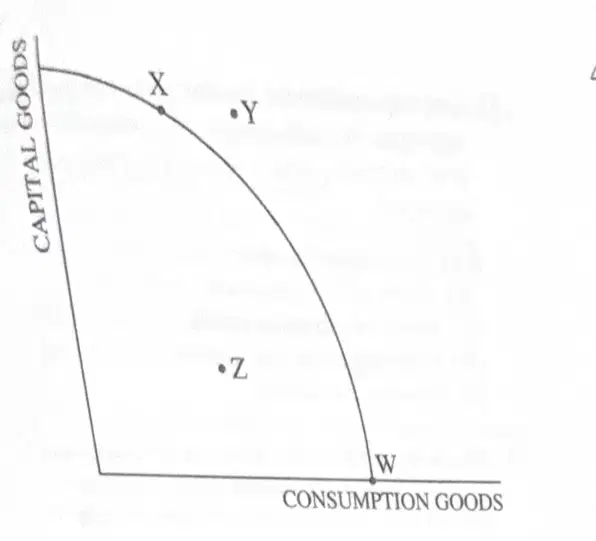
The diagram above shows the production possibilities curve for an economy that produces only consumption and capital goods. All of the following statements about this economy are true EXCEPT:
Producing at point Z results in the underutilization of resources.
The combination represented by point Y is unattainable, given the scarcity of resources.
Resources are fully utilized at points W and X.
Producing at point X will result in greater economic growth than will producing at point W.
Point X represents the most efficient combination of the two goods that can be produced by this economy.
Assume that the required reserve ratio is 10 percent, banks keep no excess reserves, and borrowers deposit all loans made by banks. Suppose you have saved 100$ in cash at home and decide to deposit it in your checking account. As a result of your deposit, the money supply can increase by a maximum of
800$
900$
1{,}000$
1{,}100$
1{,}200$
Which of the following would be the initial impact on an economy if wages were to increase more than worker productivity?
There would be no initial impact, since neither the aggregate supply curve nor the aggregate demand curve would shift.
Employment would increase, causing a rightward shift in the aggregate demand curve.
The price level would increase, resulting in excess aggregate supply.
The short-run aggregate supply curve would shift to the left, increasing the price level.
The aggregate demand curve would shift to the left, increasing the price level.
Under a flexible exchange-rate system, the Indian rupee will appreciate against the Japanese yen when
India's inflation rate exceeds Japan's
India has a trade deficit with Japan
Japan's economy enters a recession, but India's does not
Japan's money supply decreases while India's money supply increases
real interest rates in India increase relative to those in Japan
Which of the following occurs as investment becomes more responsive to changes in the interest rate?
Monetary policy becomes more effective at changing real gross domestic product.
Fiscal policy becomes more effective at changing real gross domestic product.
Monetary policy becomes more effective at changing interest rates.
Fiscal policy becomes more effective at changing interest rates.
There is no change in the effectiveness of either monetary or fiscal policy.
If two nations specialize according to the law of comparative advantage and then trade with each other, which of the following would be true?
A smaller number of goods would be available in each trading nation.
Total world production of goods would decrease.
Everyone within each nation would be better off.
Each nation would increase its consumption possibilities.
One nation would gain at the expense of the other nation.
The shifting of a country's production possibilities curve to the right will most likely cause
net exports to decline
inflation to increase
the aggregate demand curve to shift to the left
the long-run aggregate supply curve to shift to the left
the long-run aggregate supply curve to shift to the right
One explanation for the downward slope of the aggregate demand curve is that when the price level increases, which of the following will decrease?
Real value of assets
Prices of foreign goods
Prices of substitute goods
Expectations of future prices
Government deficit
Which of the following is true about changes in tax rates, changes in the level of government expenditures, and changes in the money supply?
They are automatic stabilizers.
They are tools of discretionary fiscal policy.
They have different lag times between implementation of a policy and its effects on aggregate demand.
They are favored equally by both classical and Keynesian economists to fine-tune the economy.
All are controlled by the Federal Reserve system.
An increase in which of the following would LEAST likely increase labor productivity?
Physical capital
Human capital
Technological improvements
Educational achievement
The labor force
Tariffs are different from assigned import quotas in that tariffs will
restrict imports
increase the price of imported goods
benefit domestic consumers of imported goods
hurt domestic producers of goods facing import competition
generate additional revenue for the domestic government
In the narrowest definition of money, M1, savings accounts are excluded because they are
not a medium of exchange
not insured by federal deposit insurance
available from financial institutions other than banks
a store of purchasing power
interest-paying accounts
Assume that Jane's marginal propensity to consume equals 0.8, and that in 2004 Jane spent $36,000 from her disposable income of $40,000. If her disposable income in 2005 increased to $50,000, her consumption spending increased by
4,000$
8,000$
9,000$
10,000$
14,000$
Advocates of a monetary rule recommend increasing the money supply at a rate that is equal to the rate of increase in which of the following?
Price level
Unemployment rate
Level of exports
Level of imports
Long-run real gross domestic product
If economic agents perfectly anticipate policy changes and if all prices, including wages, are completely flexible, which of the following will be true in the long run?
The price level will be constant.
There will be no trade-off between inflation and unemployment.
The unemployment rate will be less than the natural rate of unemployment.
The unemployment rate will be greater than the natural rate of unemployment.
Changes in the money supply will not lead to changes in the price level.
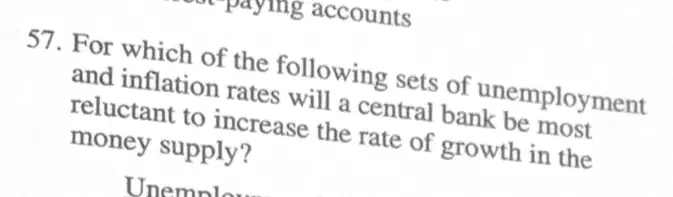
Unemployment rate: 10%, Inflation rate: 2%
Unemployment rate: 10%, Inflation rate: 5%
Unemployment rate: 10%, Inflation rate: 10%
Unemployment rate: 5%, Inflation rate: 5%
Unemployment rate: 5%, Inflation rate: 10%

