
 Worksheets
MST - History of Architecture P2
Total questions: 110
Worksheet time: 55mins
What structure was known in the Classical World as the Treasury of Atreus?
Tomb of Kings
Tomb of Agamemnon
Tomb of the Gods
Tomb of Slaves
Who was the architect of the Temple of Zeus Olympius at Agrigentum?
Antistates
Porinus
Libon
Theron
Where was the Agora built?
Greece
Rome
India
Babylonia
What was the long colonnaded building during Greek times?
Stoa
Thermae
Narthex
Forum
What do you call a structure that is open and colonnaded at the entrance, often extending a considerable distance, and commonly used as a meeting place around public areas?
Peristyle
Stoa
Agora
Acroterium
Who was a Roman architect and engineer during the 1st century BC?
Leonardo da Vinci
Apollodorus of Damascus
Vitruvius
Isidore of Miletus
What was the main purpose of the Roman Colosseum?
Entertainment for ancient Romans
To create a humble structure
To test Roman engineering
All of the above
What is the effect of using a rib vault in architecture?
Additional walls
Additional windows
Additional floors
Additional space
Which temple features a circular plan supporting a dome approximately 140 feet in diameter and was once described by Thomas Jefferson as a model of the spherical arch?
St. Peter's Basilica
Hagia Sophia
Pantheon
Parthenon
What is the total height of the Monticello designed by Thomas Jefferson?
44 feet
46 feet
47 feet
What is the name of the Egyptian structure located in the ancient city of Thebes, known for its grand colonnades and obelisks?
Temple of Lux
Temple of Luxor
Mastaba of Lux
Mastaba of Luxor
What material was primarily used in the construction of the Temple of Luxor?
Limestone
Marble
Sandstone
Adobe
The Temple of Luxor is not dedicated to a cult god. Instead, it is dedicated to what purpose?
Rejuvenation of kings
Triumph of pharaohs
Marriage of kings
Festival of kings
What construction system was employed in the construction of the Parthenon?
Trabeated
Post and lintel
Columns and beams
Conventional
What classical order of columns was used in the Parthenon?
Corinthian order
Ionic order
Doric order
Tuscan order
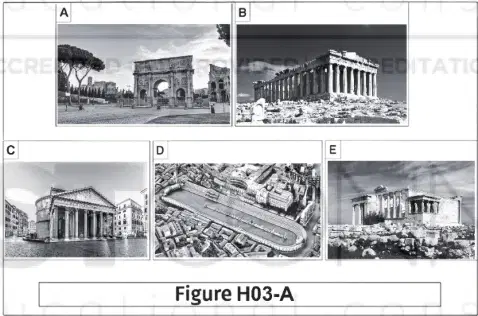
What is the name of Figure A?
Arch of Constantine
Arch of Titus
Arch of Septimius Severus
None of the above
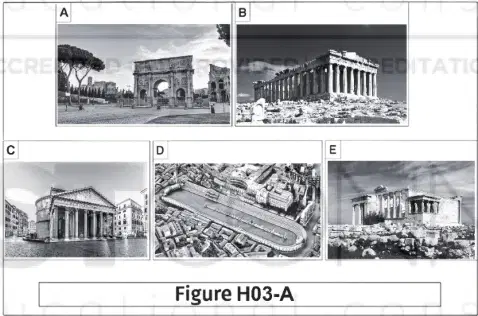
What is the name of Figure B?
Temple of Nike
Temple of Zeus
Erechtheion
Parthenon
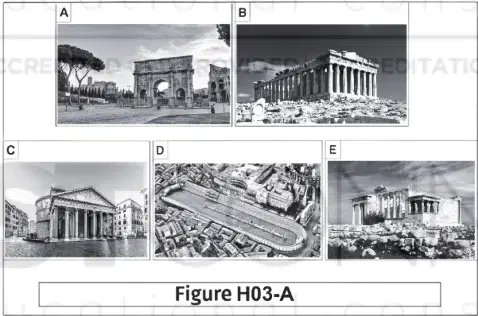
What is the name of Figure C?
Temple of Augustus
Pantheon
Maisson Carree
Temple of Saturn
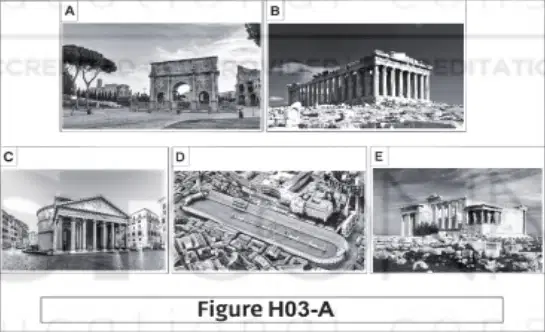
What is the name of Figure D?
Circus of Nero
Circus Maxentius
Circus Maximus
Circus Flaminius
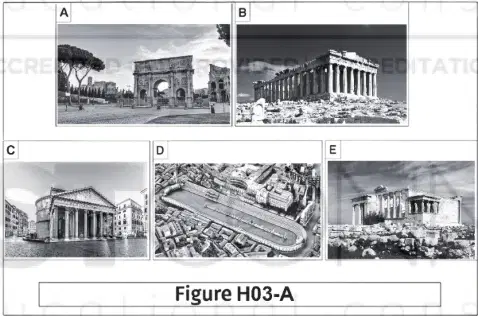
What is the name of Figure E?
Temple of Nike
Temple of Zeus
Erechtheion
Parthenon
What is the usual wall characteristic of Romanesque architecture?
Massive and heavy walls
Decorative imposing block walls
Walls are supported
Brick walls filled with thick mortar
What is the usual arch design of Romanesque architecture?
Pointed
Semi-circular
Circular
Truncated
What is the usual buttress design in Romanesque architecture?
Angled buttresses
Flying buttresses
Flat square buttresses
Rib profile buttresses
What is the usual window characteristic of Romanesque architecture?
Few but large openings
Many and large openings
Few and small openings
Many but small openings
Cathedral churches in the Romanesque style of architecture generally follow the
Octagonal
Latin cross
Greek cross
Polygonal plan
What is the most spectacular example of Byzantine church architecture built in 532 AD?
Hagia Sophia
Basilica of Sant' Apollinare Nuovo
Basilica of San Vitale
Church of Saint Catherine
What is the modern name of Byzantium, which was the capital of the Eastern Roman Empire?
Macedonia
Istanbul
Kiev
Georgia
What is the distinct style of Byzantine church architecture?
Greek cross plan and dome roof
Flying buttress
Pointed arches and vaults
Orthodox dome and rectangular plan
Which was the first church built in Constantinople and defined by its large atrium?
Hagia Irene
St. Mark Basilica
Church of Saint George
Hagia Sophia
What was fully developed by Byzantine architects wherein a triangular segment of a spherical surface is formed over an enclosed square to support a dome?
Squinch
Colonnettes
Pendentive
Vault
The leaning tower in Pisa is known by its Italian name as?
Torre Pendente di Pisa
Torre Pisa
Torre la Pisa
Leniente de Pisa
Who was the architect of the Leaning Tower of Pisa?
Bonanno Pisano
Bramante
Bon de Lara
Bonito Turene
What is its architectural style of the Leaning Tower of Pisa?
Romanesque
Italian Romanesque
Pisan architecture
Italian Gothic
When was the construction of the Leaning Tower of Pisa completed?
1171 - 1370
1172 - 1371
1173 - 1372
1174 - 1373
What is the height of the Leaning Tower of Pisa?
183.33 ft
184.33 ft
185.23 ft
186.43 ft
Characteristic of a Gothic bell tower?
Separated
No bell tower
Tall
Short
What is the usual shape of a Gothic arch?
Flat
Semi circular
Pointed
Circular
Characteristic of a Gothic church interior?
Light and airy
Dark
Barbaric
Eclectic
Characteristic of Gothic buttress?
Flat
Flying
Flushed
No buttress
What period did Gothic architecture flourish?
1240–1400
1140–1400
1440–1600
1410–1500
What supports the dome in a Byzantine church?
Base
Plinth
Zocalo
Pendentive
It is the first Christian church built in Constantinople, by Roman Emperor Constantine I.
Hagia Sophia
Hagia Irene
Hagia Theodosia
Basilica of San Vitale
The original exterior color of this church was white. In present day, its exterior developed to a colorful one.
Hagia Sophia
St. Basil’s Cathedral
Hagia Theodosia
Basilica of San Vitale
Characteristic of Byzantine architecture.
Square plan
Greek cross plan
Without domes
Flying buttress
What period did Byzantine architecture flourish?
Between A.D. 627 and 665
Between A.D. 527 and 565
Between A.D. 427 and 465
Between A.D. 827 and 865
What architectural style is characterized by long pointed arches?
Gothic
Romanesque
Renaissance
Roman
What architectural style is characterized by a reintroduction of classical elements?
Gothic
Romanesque
Renaissance
Roman
What architectural style is characterized by ornamented arcades, walls, windows, and arches?
Gothic
Romanesque
Renaissance
Roman
What architectural style is characterized by rock-like structures and crimped shells put together to create a lavish look?
Rococo
Baroque
Romanesque
Renaissance
What architectural style is characterized by a rich, wild, and full ornamental expression?
Rococo
Baroque
Romanesque
Renaissance
Which church has the loftiest vaulting or highest vaulted ceiling?
Amiens
Chartres
Beauvais
Reims
Which church is known as a famous pilgrimage site?
Amiens
Chartres
Beauvais
Reims
Which cathedral is famously known for its stunning rose windows?
Amiens
Chartres
Beauvais
Reims
Which Gothic cathedral in France is known for having never been completed due to structural collapse?
Amiens
Chartres
Beauvais
Reims
Which Gothic cathedral is considered the coronation site of French kings?
Amiens
Chartres
Beauvais
Reims
What is the defining characteristic of Gothic architecture?
Pointed arches and ornate decorations
Domes
Basilican plan
Semi-circular arches
Which of the following is true about Gothic architecture?
Ceilings were flat
Arches were semi-circular
Church plans were square
Does not feature domes
Flying buttresses were common in which style of architecture?
Gothic
Baroque
Romanesque
Renaissance
Which style is referred to as the architecture of geometry due to its strong emphasis on proportion and symmetry?
Romanesque
Gothic
Baroque
Medieval
In architecture, Gothic art was considered the most ___ of its time.
Intellectual
Dominant
Symmetrical
Extravagant
In Gothic architecture, which English style is considered closest to the French style?
Flamboyant
Decorated
Lancet
Pointed
In French Gothic architecture, what was the most commonly used construction material?
Sandstone
Limestone
Granite stone
Marble
Which description was historically associated with Gothic architecture?
Darkness
Rude and barbaric
Evil and cruelty
Black and white
In French, what does L’architecture Ogivale refer to?
Gothic architecture
Roman architecture
Baroque architecture
Renaissance architecture
Which architectural style is famously known for its use of gargoyles?
Baroque
Gothic
Renaissance
Rococo
What architectural innovation was introduced in Gothic walls?
Stained glass
More glass
Clerestory
Portico
What architectural feature became possible in Gothic cathedrals due to new structural support methods?
Many windows
Clerestory windows
Pointed windows
Nave
Which architectural style is known for reaching new vertical heights?
Gothic
Rococo
Baroque
Roman
What is the term for a continuous row of arches?
Triforium
Colonnade
Arcade
Clerestory
What do you call the upper part of a wall that contains windows above an adjacent roof?
Arcade
Balustrade
Entablature
Clerestory
What is the name of the highly decorated beam developed during the Medieval period and frequently used in English Gothic architecture?
Collar beam
Hammerbeam
Cross braced
Tie beam
Which cathedral, a destination of pilgrimage dedicated to the Virgin Mary, is known for its three portals on the west front?
Chartres Cathedral
Notre Dame de Paris
Reims Cathedral
Amiens Cathedral
What is the name of the interior gallery that opens onto the tall central space of a building from an upper level?
Clerestory
Apse
Triforium
Ambulatory
Which building is a splendid example of Early Gothic architecture?
St. Paul's Cathedral
Westminster Abbey
Notre Dame
None of the above
Which cathedral, designed by Christopher Wren, covers an area of 6,000 square meters and features a large central space under a dome for large congregations?
St. William's Cathedral
St. Paul's Cathedral
St. George Cathedral
St. Francis Cathedral
Which cathedral features the "Five Sisters Window"?
Westminster Cathedral
York Minster Cathedral
Ulm Minster
Nin Cathedral
How many years did it take to build the Notre Dame Cathedral in Paris?
148 years
184 years
182 years
168 years
What is the tallest church in the world as of now?
Ulm Minster
Sagrada Familia
Westminster Cathedral
Nin Cathedral
Which Gothic cathedral has the longest nave among Gothic churches?
Cologne Cathedral
Chartres Cathedral
Amiens Cathedral
Winchester Cathedral
Which cathedral contains 176 stained glass windows?
Sainte-Chapelle
Reims Cathedral
Chartres Cathedral
Notre Dame de Paris
Which Romanesque cathedral features twin towers, a dome, and apses on both ends?
Worms Cathedral
Pisa Cathedral
Angoulême Cathedral
Peterborough Cathedral
Which Italian Renaissance palace is built of brick and features quoining on the corners?
Palazzo Medici
Palazzo Vecchio
Palace of Farnese
Palace of Versailles
Which Romanesque baptistery is known for its eight monolithic columns alternating with four pillars and significant vertical height?
Florence Baptistery
Pisa Baptistery
Siena Baptistery
Ravenna Baptistery
Which church is considered the most important example of Renaissance architecture?
St. Peter’s Basilica
Santa Maria Novella
San Lorenzo
Il Gesù
What is the most influential building of the Byzantine period?
Hagia Sophia
San Vitale
Hagia Irene
St. Mark’s Basilica
Which style of architecture emphasizes symmetry, geometry, and the regularity of parts?
Romanesque
Baroque
Gothic
Renaissance
Which architectural style adapted the classical orders of columns from the Greeks?
Baroque
Gothic
Romanesque
Renaissance
What is considered the birthplace of Italian Renaissance art and architecture?
Sicily
Florence
Venice
Rome
Which period is known as the "rebirth of the classics"?
Renaissance
Classical
Egyptian
Romanesque
Which villa was designed by Andrea Palladio in the tradition of formal symmetry during the Renaissance period?
Villa Santino
Villa Capra
Villa Carlota
Villa Cordoba
Which Renaissance movement is described as vivid, virile, intense, free, decorative, and illogical?
Palladian Architecture
Proto-Baroque Architecture
Baroque Architecture
Rococo Architecture
Which architectural style emerged as a fusion of Romanesque and Byzantine styles in the 12th century?
Classical
Renaissance
Greek
Baroque
What characterizes the Palladian style of architecture?
Ornate and decorative
Asymmetry
Unpredictable proportions
Proportionality
Which of the following is a key characteristic of Renaissance architecture?
Emphasis on verticality and flying buttresses
Use of pointed arches and ribbed vaults
Application of symmetry, proportion, and classical orders
Extensive use of irregular forms and ornate facades
What architectural feature was commonly revived during the Renaissance period from Classical antiquity?
Horseshoe arches
Domes and columns
Gargoyles and grotesques
Pyramidal spires
Cologne Cathedral in Germany is considered the longest construction project in history. How many years did it take to complete?
630 years
631 years
632 years
633 years
Which church is known for being a 'Half Gothic, Half Renaissance' architectural style?
Florence Cathedral
Granada Cathedral
Chartres Cathedral
St. Vitus Cathedral
In which church can the sculpture of the "Smiling Angel" be found at the doorway?
Amiens Cathedral
Notre Dame de Paris
Rouen Cathedral
Reims Cathedral
Which church is known for having two towers with different design?
Notre Dame de Paris
Chartres Cathedral
Cologne Cathedral
Milan Cathedral
Which church features twin towers ofthe same design but different heights?
Chartres Cathedral
Amiens Cathedral
Reims Cathedral
Cologne Cathedral
What is considered the greatest church in allof Christendom?
St. Peter's Basilica
St. William's Cathedral
St. Mary's Basilica
St. Andrew's Basilica
The proposed Latin Cross plan for St. Peter's Basilica was originally the idea of which architect?
Michelangelo
Bernini
Raphael
Bramante
Who was the final architect responsible for completing St. Peter's Basilica?
Michelangelo
Bernini
Raphael
Bramante
Who sculpted the La Pieta, which is housed in St. Peter's Basilica?
Michelangelo
Bernini
Raphael
Bramante
Who designed the entrance piazza of St. Peter's Basilica, surrounded by 284 Tuscan columns?
Moderno
Michelangelo
Bramante
Bernini
Which part of St. Peter's Basilica was designed by Michelangelo?
Piazza
Dome
Facade
Portico
What was Bramante's contribution to St. Peter's Basilica?
First architect of the main building
Designed courtyard paving
Finished the entire church
Fifth architect ofthe building
Who was responsible for designing the side cupolas (small domes) of St. Peter's Basilica?
Raphael
Bernini
Michelangelo
Vignola
Who was responsible for designing the massive façade of St. Peter's Basilica?
Giacomo della Porta
Donato Bramante
Michelangelo
Carlo Maderno
How many architects worked on St. Peter's Basilica throughout its construction history?
10
13
14
12

