
 Worksheets
Yr 8 Geo - Quiz
Total questions: 65
Worksheet time: 32mins
Which planet is the third from the Sun in our Solar System?
Earth
Mars
Venus
Jupiter
What is the Earth's crust primarily made up of?
Large blocks of land called plates
Molten rocks
Liquid layers
Solid iron
Which layer of the Earth is made up of molten rocks and found under the crust?
Mantle
Inner core
Outer core
Crust
Which layer of the Earth is a liquid layer and also very hot?
Outer core
Mantle
Crust
Inner core
What causes earthquakes, volcanoes, and fold mountains according to the text?
Convection currents hitting the earth's crust
Rainfall and erosion
Wind currents
Solar flares
Which of the following best describes the formation and impact of convection currents on the Earth's crust?
Convection currents are formed by heat from the Earth's core, which moves through the mantle and hits the crust, causing earthquakes, volcanoes, and fold mountains.
Convection currents are formed by wind blowing over the surface, causing erosion.
Convection currents are formed by the movement of water in the oceans, causing tides.
Convection currents are formed by the sun heating the atmosphere, causing weather changes.
Which of the following best describes the basic idea behind plate tectonics?
The Earth's surface is made up of a single solid plate.
The Earth's surface is covered by major and minor plates that move constantly.
The Earth's surface is completely stationary.
The Earth's surface is made up only of oceanic plates.
What are the two types of tectonic plates mentioned in the text?
Continental and volcanic
Oceanic and volcanic
Continental and oceanic
Major and minor
At what estimated speed do tectonic plates move each year?
10 to 100 cm per year
1 to 10 cm per year
100 to 1000 cm per year
0.1 to 1 cm per year
Why are tectonic plates compared to the skin of the planet?
Because they are soft and flexible
Because they cover the surface of the Earth
Because they are made of water
Because they do not move
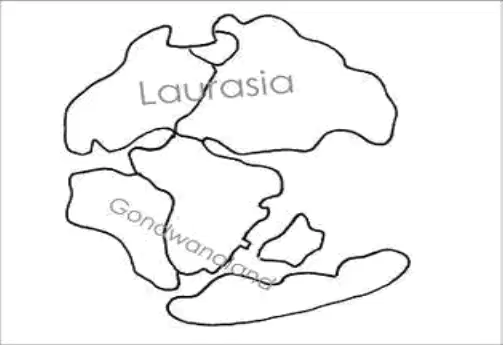
After Pangaea split, what were the names of the two resulting continents?
Laurasia and Gondwanaland
Eurasia and Africa
North America and South America
Asia and Australia
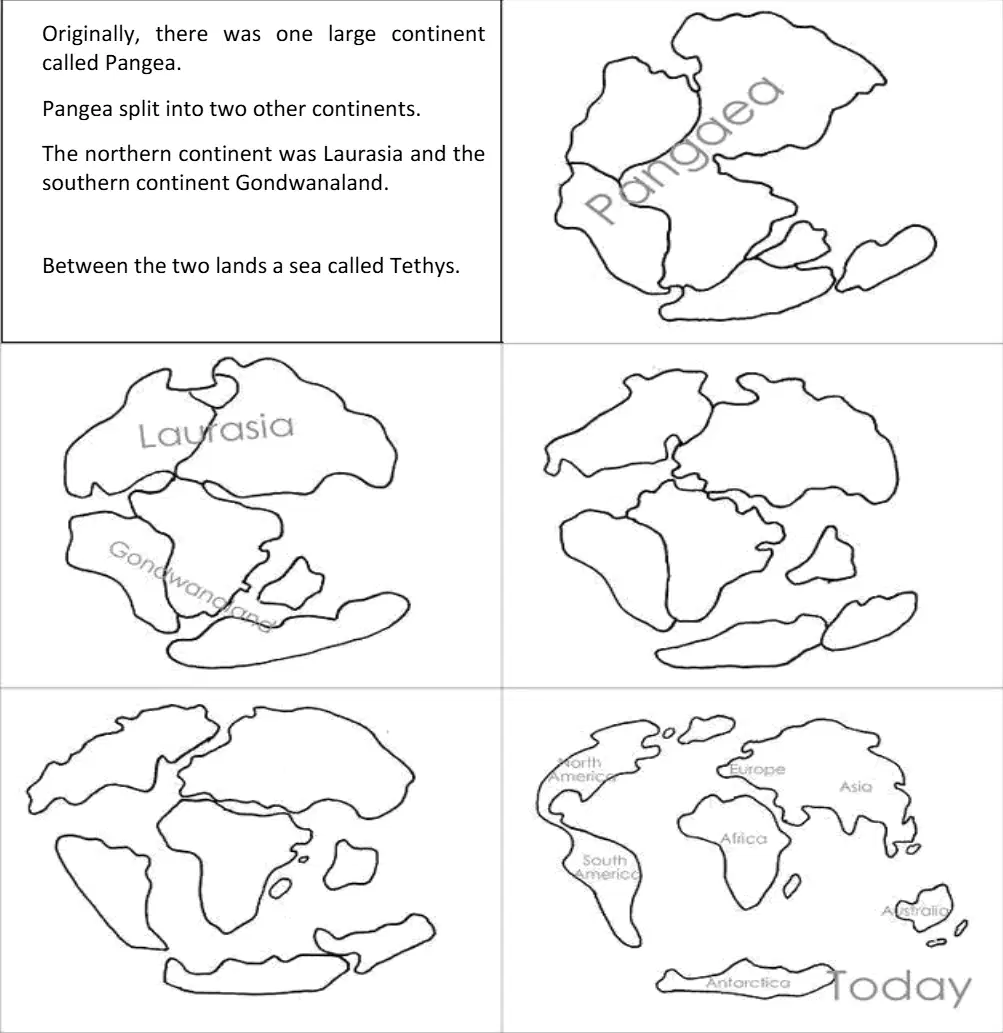
Which of the following best describes the process shown in the diagrams?
The gradual splitting of a supercontinent into today's continents
The formation of mountains
The creation of oceans from volcanic activity
The movement of tectonic plates to form a single landmass
What was the name of the large supercontinent that existed about 300 million years ago?
Gondwanaland
Laurasia
Pangaea
Eurasia
Who first proposed the theory of continental drift in 1915?
Charles Darwin
Alfred Wegener
Isaac Newton
Marie Curie
What caused the supercontinent Pangaea to break up into smaller continents?
Volcanic eruptions
Strong earthquakes
Meteor impacts
Floods
Which ocean existed before the formation of the Mediterranean Sea?
Atlantic Ocean
Pacific Ocean
Tethys Sea
Indian Ocean
According to the theory of continental drift, what causes continents to drift?
Ocean currents
Wind patterns
Movement of tectonic plates
Magnetic fields
Which of the following provides evidence supporting the theory of continental drift?
Fossils of similar species found on different continents
Similar climate patterns across continents
Identical languages spoken on different continents
Same types of crops grown worldwide
What is the second layer of the Earth?
Crust
Mantle
Inner core
Lithosphere
What is the solid, outer part of the Earth called?
Mantle
Crust
Outer core
Inner core
What do we call molten rock below the Earth’s surface?
Lava
Magma
Sediment
Granite
What is molten rock that escapes onto the Earth’s surface called?
Magma
Lava
Sediment
Basalt
What are the three main layers of the Earth?
Crust, Mantle, Core
Atmosphere, Hydrosphere, Lithosphere
Inner Core, Outer Core, Crust
Plate, Rock, Soil
What are the plates made of?
Liquid water
Solid rock
Gas
Ice
What is the name of the weaker layer of partially melted rock under the plates?
Lithosphere
Asthenosphere
Atmosphere
Hydrosphere
Which of the following is NOT one of the three main effects of plate movement?
Volcanoes
Fold mountains
Earthquakes/Tremors
Hurricanes
What is the main cause of plate movement?
Ocean currents
Convection currents in the mantle
Wind erosion
Solar radiation
What is the term for molten rock that reaches the earth’s surface?
Magma
Ash
Lava
Crater
Which type of volcano has erupted within the last 500 years and still shows signs of activity?
Dormant
Extinct
Active
Secondary
A volcano that has not erupted within the last 500 years and shows no signs of activity is called:
Active
Dormant
Extinct
Magma
Which of the following best describes a dormant volcano?
Has erupted within the last 500 years and is still active
Has not erupted within the last 500 years but shows signs of activity such as hot springs
Has never erupted
Has not erupted within the last 500 years and shows no signs of activity
Why do volcanoes form openings (vents) in the ground?
To release water vapor
Because magma from deep inside the earth forces its way to the surface
Due to wind erosion
To create new landforms
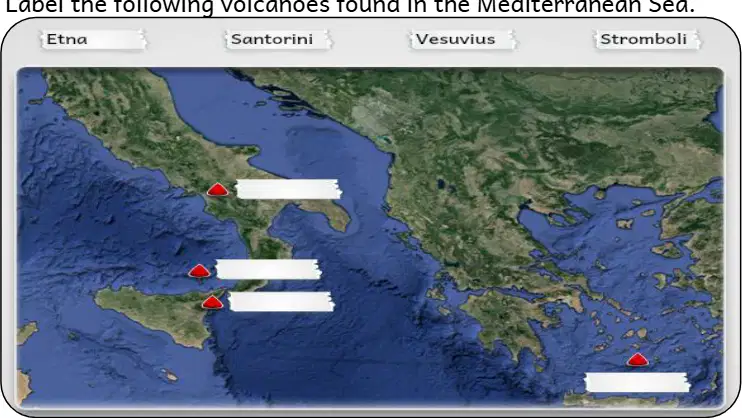
Which of the following volcanoes is found in Italy and is classified as active?
Stromboli
Santorini
Etna
Vesuvius
What is a "magma chamber"?
A collection of magma inside the earth, below the volcano.
A column of gases, ashes, and rock fragments rising out from the volcano.
A volcano that has erupted within the last 500 years and still shows a sign of activity.
A bowl-shaped area that forms at the top of a volcano around a central vent.
Which term refers to a volcano that has not erupted within the last 500 years and shows no signs of activity?
Active volcano
Dormant volcano
Extinct volcano
Lava flow
What is the correct term for molten rock found beneath the Earth's surface?
Lava
Ash
Magma
Crater
When magma reaches the Earth's surface, what is it called?
Ash
Lava
Crater
Vent
Which of the following best describes a "crater"?
A volcano that has erupted within the last 500 years.
A bowl-shaped area that forms at the top of a volcano around a central vent.
A collection of magma inside the earth.
A stream of molten lava flowing down the sides of the volcano.
A volcano that has erupted within the last 500 years but still shows signs such as hot springs is called a:
Dormant volcano
Extinct volcano
Active volcano
Lava flow
Which of the following is a column of gases, ashes, and rock fragments rising out from a volcano?
Lava flow
Ash cloud, volcanic cloud, and bombs
Crater
Magma chamber
What is the opening at the top of a volcano where magma and gases escape called?
Crater
Vent
Lava tube
Caldera
Layers of __________ build up around the volcano during an eruption, creating the structure of the volcano over time.
Water
Lava and ash
Soil
Ice
One __________ of volcanoes is that they create fertile soil for farming.
Disadvantage
Benefit
Hazard
Risk
One __________ of volcanoes is the danger they pose to nearby communities, including lava flows and ashfall.
Benefit
Advantage
Hazard
Opportunity
Why might a volcanic eruption be beneficial to people living nearby?
It provides opportunities for fishing.
It creates fertile soil for farming.
It increases rainfall in the area.
It makes the area colder.
Which of the following is an effect of a volcanic eruption on the environment?
Increase in internet speed
Damage to land and air quality
More shopping malls
Decrease in sunlight
Which of the following is an advantage of living near volcanoes?
Destruction of villages
Warm bathing lakes
Airports are closed
Roads are damaged
What is a disadvantage of living near volcanoes?
Geothermal energy
Mud pools
Airports are closed
Tourists
Blocks of lava from volcanoes are commonly used for which purpose?
Food production
Building material
Water purification
Transportation
Which of the following is a possible change to the landscape caused by volcanic activity?
Landscape can change forever
Increase in rainfall
Decrease in temperature
Growth of forests
How can volcanoes benefit the energy sector?
By providing geothermal energy
By increasing fossil fuel reserves
By reducing electricity demand
By cooling the atmosphere
Which of the following is a disadvantage of living near volcanoes related to transportation?
Tourists visit the area
Roads are damaged
Mud pools form
Granite is found
Why might tourists be attracted to areas near volcanoes?
For destruction of villages
For geothermal energy
For unique natural features and activities
For airport closures
What is one way volcanic activity can negatively impact local communities?
Creation of mud pools
Destruction of villages
Formation of granite
Warm bathing lakes
What is the term used for an earthquake that originates in the sea?
Sub-marine quake
Landquake
Oceanic tremor
Tidal quake
Which waves are produced by a sub-marine quake?
Tsunamis or Tidal waves
Shock waves
Sound waves
Seismic waves
Where do 90% of all tremors occur each year?
The Ring of Fire – Pacific Ocean
The Atlantic Ocean
The Mediterranean Sea
The Indian Ocean
What is the instrument called that measures the strength of an earthquake?
Seismometer
Barometer
Thermometer
Altimeter
Which scale measures the strength of an earthquake with force values from 1 to 9?
Richter Scale
Mercalli Scale
Beaufort Scale
Fujita Scale
In 1972, which area in Malta felt the effects of an earthquake most strongly?
Areas round Imdina
Valletta
Gozo
Sliema
What is the epicentre of an earthquake?
The point on the earth’s crust which receives the worst shock waves
The place where the earthquake starts
The highest point of a mountain
The deepest part of the ocean
According to the Modified Mercalli Scale, what is the effect at level XII?
Total destruction; waves seen on ground surfaces, objects are tumbled and tossed
Felt by almost no one
Some local damage may occur
Many structures destroyed, ground is badly cracked
According to the Richter Scale, what is the description for a quake with a magnitude of 8.0 and up?
Great earthquakes
Some local damage may occur
A destructive earthquake
A minor earthquake
Another word for earthquake.
Tremor
Volcano
Flood
Storm
A seismograph
Measures the strength of earthquakes
Predicts the weather
Measures temperature
Detects volcanoes

