
 Worksheets
Homework #41: Chemical Bonding Quiz 1
Total questions: 20
Worksheet time: 11mins
Which terms identify two different categories of compounds?
ionic and molecular
chemical and physical
metallic and nuclear
solid and liquid
What occurs when potassium reacts with chlorine to form potassium chloride?
Electrons are shared and the bonding is covalent
Electrons are transferred and the bonding is covalent
Electrons are transferred and the bonding is ionic
Electrons are shared and the bonding is ionic
Which atoms will bond when valence electrons are shared with each other?
calcium and chlorine
hydrogen and sulfur
magnesium and oxygen
lithium and fluorine
Element X combines with beryllium to form an ionic bond. In which group of the Periodic Table could element X be found?
Group 1
Group 2
Group 17
Group 12
Which structural formula represents a molecule containing only nonpolar covalent bonds?
H–Cl
H–O–H
O=O
NH₃
Which noble gas will have the same electron configuration as potassium when potassium bonds with sulfur?
He
Ne
Ar
Kr
Which electron configuration represents a polar covalent bond?
2-8-7 and 2-8-7
2-8-1 and 2-8-1
2-5 and 2-8-7
2-8-8 and 2-8-8
Which of the following forms metallic bonds?
H₂
H₂O
NaCl
Na
A substance conducts electricity in the liquid phase but not in the solid phase. This substance is most likely
molecular
metallic
ionic
nonpolar covalent
Which pair of atoms is held together by sharing electrons unequally?
Be–H
Be–O
F–F
F–O
Potassium phosphate, K₃PO₄, contains which two types of chemical bonding?
metallic and covalent
ionic and covalent
ionic and metallic
hydrogen bonding and ionic
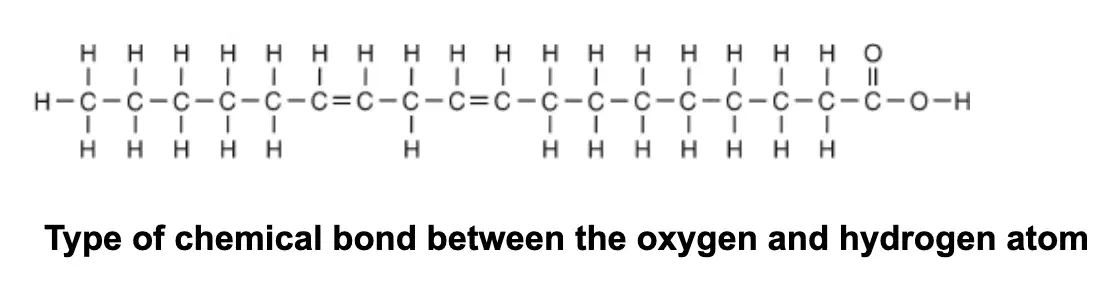
In linoleic acid, what type of bond exists between the oxygen atom and the hydrogen atom?
ionic
nonpolar covalent
polar covalent
metallic
The bond that forms when potassium reacts with bromine to form potassium bromide is
nonpolar covalent
polar covalent
metallic
ionic
A student claims that solid KCl conducts electricity better than KCl dissolved in water. Which statement best evaluates this claim?
The claim is true because solid KCl contains free electrons
The claim is true because ions move freely in solids
The claim is false because ions are fixed in a solid but free to move in solution
The claim is false because covalent bonds prevent conductivity
Which bond is nonpolar because the atoms share electrons equally?
H–Cl
O–H
S–S
N–H
Which bond is polar because electrons are shared unequally?
Cl–Cl
O–O
H–I
N–N
A student claims that the bond between NaCl is polar because it is between two different elements. Evaluate this claim
The claim is correct because all bonds between different elements are polar.
The claim is correct because sodium and chlorine share electrons unequally.
The claim is incorrect because sodium and chlorine form an ionic bond (Metal and nonmetal)
The claim is incorrect because NaCl contains only nonpolar covalent bonds.
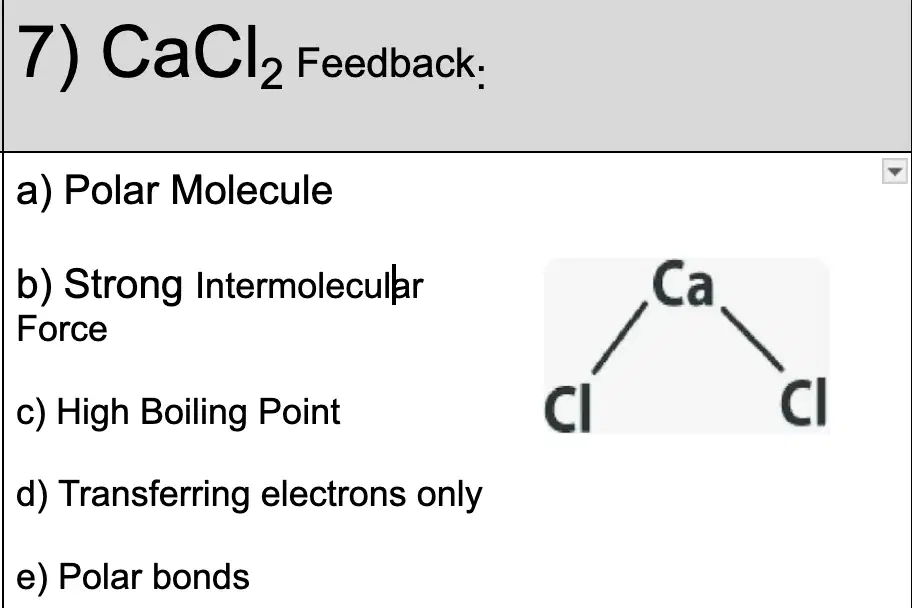
Which two statements are false (choose exactly two)
A
B
C
D
E
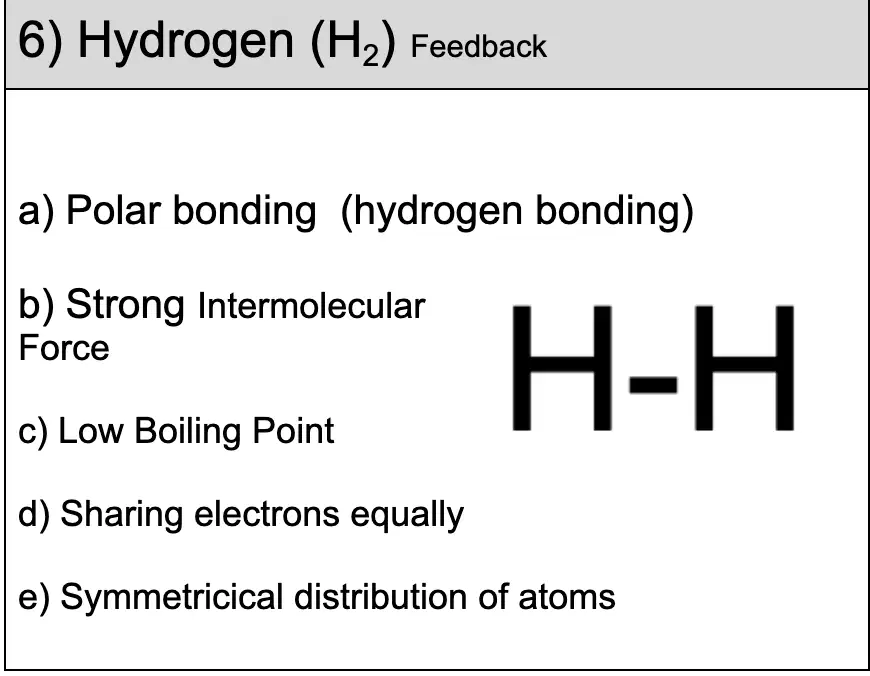
Which two statements are false (choose exactly two)
A
B
C
D
E
Which two substances will dissolve in oil which is a nonpolar substance?
Water (polar molecule)
Ink (nonpolar molecule)
Carbon dioxide (nonpolar molecule)
NH3 (Ammonia and polar molecule )
CH3Br (Polar molecule)

