
 Worksheets
EA Science NBPTS Component 1 - F
Total questions: 32
Worksheet time: 30mins
Name
Class
Date
1.
Which process is the largest contributor to the release of CO2
a)
Citric Acid Cycle or Krebs Cycle
b)
Pyruvate Oxidation
c)
Glycolysis
d)
Oxidative Phosphorylation
2.
Which of the following molecules is NOT a byproduct of cellular respiration?
a)
CO2
b)
Heat
c)
H2O
d)
ATP
3.
If the delta G of a reaction is negative, which response shows the best conclusion for that reaction?
a)
The reaction will release more energy than was needed to form the reaction.
b)
Energy from the reaction can be used to do work.
c)
Energy is absorbed by the reaction which then can be used to power other reactions.
d)
Energy is absorbed within the reaction and distributed unevenly throughout the molecule.
4.
If ADP is phosphorylated then what is this indicating in the reaction?
a)
ADP is forming into ATP
b)
ADP is becoming AMP
c)
ADP is being used to power other reactions
d)
ADP is being created by the reaction
5.
Why is ATP considered the most significant energy carrying molecule?
a)
It's delta G is negative.
b)
ATP has different bond energy between its phosphate groups.
c)
ATP can hold large amounts of energy between all of its bonds.
d)
ATP's positive delta G contributes to the large amounts of energy between its 3rd and 2nd phosphate groups.
6.
Which process least amount of ATP in cells?
a)
Glycolysis
b)
Citric Acid cycle
c)
Lactic acid Fermentation
d)
Pyruvate Oxidation
7.
Which molecule is not an important molecule regarding Cellular Respiration?
a)
H2O
b)
NADH
c)
O2
d)
CO2
8.
After 5 glucose molecules have been broken down in the cell, which pH value would most likely present the in matrix of the mitochondria.
a)
6
b)
2
c)
4
d)
7
9.
When NADH is reduced and oxidized, which response best describes what is lost or gained?
a)
only Electrons
b)
2 stable Hydrogen atoms
c)
Pair of electrons
d)
2 ATP
10.
Pyruvate Oxidation creates a specific numbered carbon molecule at the end of it's process. What is the number of carbons for this molecule?
a)
2
b)
3
c)
6
d)
1
11.
Which process does not occur in aerobic conditions?
a)
Fermentation
b)
Pyruvate Oxidation
c)
Citric Acid Cycle or Krebs cycle
d)
Oxidative Phosphorylation
12.
What is the main job of the electron carriers in cellular respiration?
a)
Transport electrons and hydrogen atoms to the electron transport chain
b)
Capture energy throughout the process of cellular respiration
c)
Provide the reactants for the process of cellular respiration
d)
Pump positive hydrogen ions and shuttle electrons across the electron transport chain and contribute to chemiosmosis
13.

Identify what structure is outlined in the BLACK outline.
a)
Base pair
b)
deoxyribose sugar
c)
phosphate group
d)
hydrogen bonds
e)
Nucleotide
14.
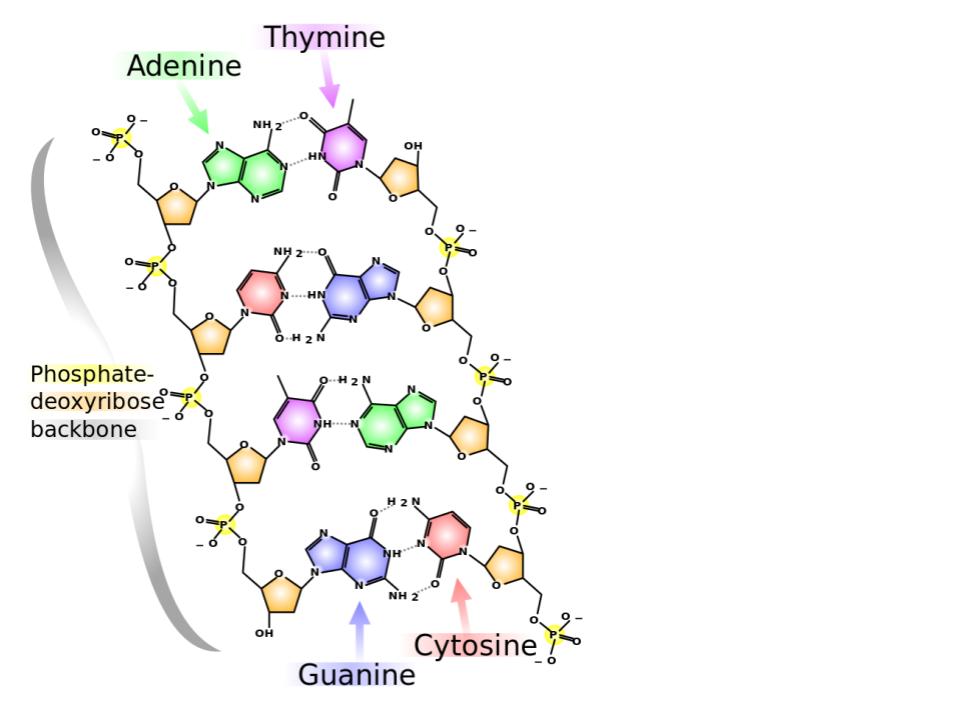
The two strands of DNA are held together by:
a)
Hydrogen Bonds
b)
Phosphodiester Bonds
c)
Glycolsyl Bonds
d)
Glycosidic Linkages
15.

A nucleotide is composed of
a)
A phosphate, sugar and nitrogenous base
b)
A protein, protein and Guanine
c)
A phosphate, Adenine, and nitrogenous base
d)
A protein, Adenine and nitrogenous base
16.
Which 2 molecules form the sides (backbone) of the DNA ladder?
a)
deoxyribose sugar and adenine
b)
deoxyribose sugar and a hydrogen bond
c)
deoxyribose sugar and the nucleus
d)
deoxyribose sugar and phosphate
17.
Which two scientists are accredited with correctly deducing the double helix model of DNA?
a)
Watson and Crick
b)
Wilkins and Franklin
c)
Wilkins and Crick
d)
Watson and Franklin
18.
What sugar is found in a nucleotide of DNA?
a)
deoxyribose
b)
ribose
c)
trioxyribose
19.
Cytosine always pairs with
a)
Adenine
b)
Thymine
c)
Uracil
d)
Guanine
20.
Assume that you have straight hair and your sibling has curly hair. What accounts for this difference?
a)
You have DNA and your sibling does not.
b)
The your sequence of nitrogen bases is different than your sibling.
c)
Your sibling has a weave.
d)
Your sibling has a genetic mutation.
21.
What is the complement to the DNA strand below:
5'-ATGCCAT-3'
5'-ATGCCAT-3'
a)
5'-TACGGTA-3'
b)
3'-TACGGTA-5'
c)
3'-ATGGCAT-5'
d)
5'-ATGGCAT-3'
22.
Suppose a double-stranded DNA molecule was shown to have 15% adenine bases. What would be the expected percentage of guanine bases in that molecule?
a)
15%
b)
35%
c)
85%
d)
Not enough information
23.

DNA codes for...
a)
cholesterol
b)
proteins
c)
fatty acids
d)
a sandwich
24.
One difference between DNA and RNA is that....
a)
Only RNA has the base Uracil
b)
only RNA contains the base Thymine
c)
only RNA contains the base Cytocine
d)
only RNA contained the base Guanine
25.
What are the monomers of DNA?
a)
amino acids
b)
nucleotides
c)
fatty acids
d)
simple sugars
26.

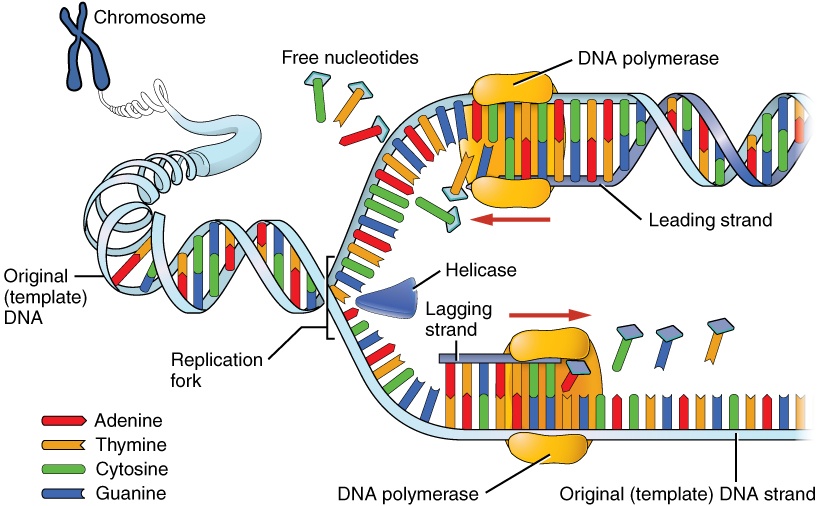
This picture is illustrating the ____ nature of DNA.
a)
antiparallel
b)
semiconservative
c)
helical
d)
radioactive
27.

What group do the "smaller", single ringed bases such as thymine and cytosine belong to?
a)
complementary
b)
enzymes
c)
purine
d)
pyrimidine
28.
This term describes a nitrogenous base made of two rings.
a)
Purine
b)
Pyrimidine
29.
Which of the following is a result of DNA replication?
a)
a new protein
b)
recombination of alleles
c)
messenger RNA
d)
sister chromatids
30.
At what point in the cell cycle does DNA replication occur and why?
a)
before a cell divides, to provide each of the two resulting cells with a complete set of DNA instructions
b)
before a cell divides, to ensure that the DNA will fit into the resulting cells
c)
during cell division, to ensure that the DNA will fit into the resulting cells
d)
after a cell divides, to provide each of the two resulting cells with a complete set of DNA instructions
31.

Base your answer to the following question on the structures represented in the diagram below. What is the relationship between these three structures?
a)
DNA is made up of proteins that are synthesized in the cell.
b)
Protein is composed of DNA that is stored in the cell.
c)
DNA controls the production of protein in the cell.
d)
The cell is composed only of DNA and protein.
32.
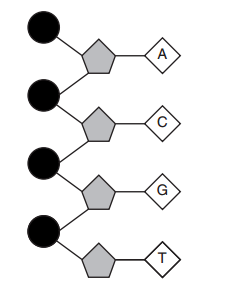
The diagram below represents a portion of a DNA molecule. The letters represent different types of
a)
sugar molecules
b)
nitrogen bases
c)
enzymes
d)
proteins
100 %

