
 Worksheets
Construction and transformation review
Total questions: 62
Worksheet time: 2hrs 9mins
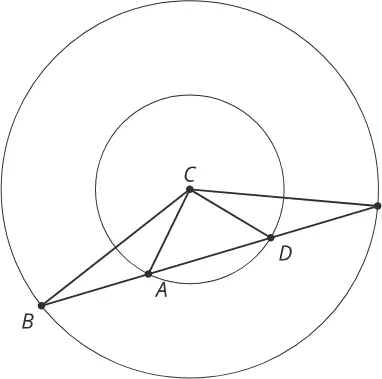
You may use construction tools. This diagram is a straightedge and compass construction. C is the center of both circles. Select all statements that must be true by construction. (2 answers)
Segments AB and AD have the same length.
Segments AC and AD have the same length.
Segments AC and CD have the same length.
Triangle BCE is isosceles.
Triangle CDE is isosceles.
Line CD is the perpendicular bisector of segment AB. The lines intersect at point E. Which of these statements is true?
E is closer to A.
E is closer to B.
E is the same distance from A and B.
There is not enough information to be sure.
A circle is defined as:
A shape with four equal sides
A closed curve where all points are equidistant from a center point
A polygon with three sides
A line segment with two endpoints
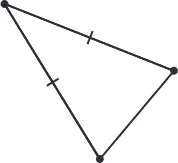
Triangle ABC is isosceles. Which tool is used to construct the perpendicular bisector for segment AB?
Protractor
Straightedge and compass
Ruler
Divider
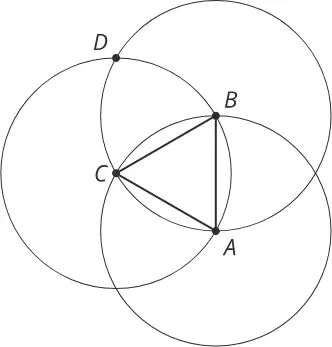
The 3 circles in the diagram have centers A, B, and C. Why do segments AB and AC have the same length?
Because A is not equidistant from B and C.
Because B and C are the same point.
Because the circles are identical.
Because AB and AC are radii of the same circle. Radii is the plural of radius
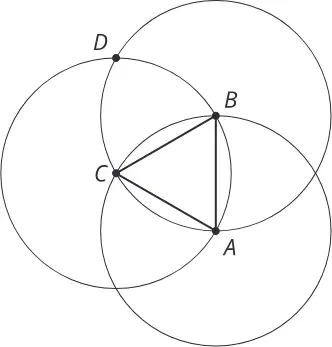
Classify triangle ABC based on the 3 circles in the diagram with centers A, B, and C.
Equilateral
Isosceles
Scalene
Right-angled

Identify the transformation from ABC to A'B'C'.
90o clockwise rotation around the origin
90o counter clockwise rotation around the origin
Reflection across the y-axis
Reflection across the x-axis


Describe the transformation shown in the graph.
Reflect over x-axis
Reflect over y-axis
Rotate 270 degrees CCW around the origin
Rotate 90 degress CCW around the origin
What are lines of Symmetry
A line of symmetry cuts a picture in half such that each half of the figure is the mirror image of the other half of the figure.
A line that cuts any shape down the middle
Any line that crosses a shape at any point.
A line that a cuts a shape diagonally.
What shape has more than one line of symmetry
A
k
C
O
Does all shapes have a line of symmetry?
Yes
No
Which shape has the most lines of symmetry?


What order of rotation and angle of rotation does the picture have?
Order = 0, 360⁰
Order = 1, 360⁰
Order = 2, 180⁰
Order = 3, 120⁰


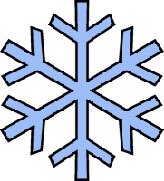
Determine whether the figure has line symmetry, rotational symmetry, both, or neither.
Rotational
Reflectional
Both
Neither




The angles inside an equilateral triangle are all ...
20 degrees
50 degrees
60 degrees
45 degrees
Which image shows the construction of a perpendicular bisector?


Which of the following shows the construction of an angle bisector?


Which of these is a set of perpendicular lines?


Which figure below has 120 degree rotation symmetry?


None of them

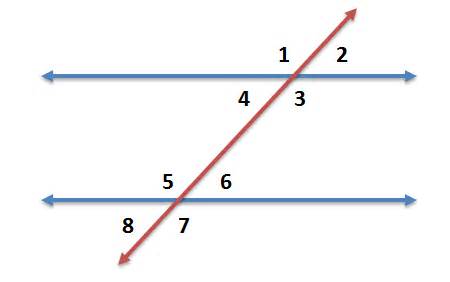
Lines m and n are parallel. Which statement MUST be true?
Angle 1 + Angle 2 = 100
Angle 1 = Angle 6
Angle 5 + Angle 7 = 180
Angle 2 = Angle 8

Select the sequence of transformations that will take Polygon P to Polygon Q.
Rotate 180 degrees about point A.
Translate so that A is taken to J. Then reflect over BA.
Rotate 60 degrees counterclockwise around A, then reflect over FA.
Reflect over line BA, then rotate 60 degrees counterclockwise about point A.
Which figure below has 180 degree rotation symmetry?
None of them
What does congruent mean?
Completely different size and shape
Similar size and shape
Same size and shape
Which diagram shows a dotted line that is not a line of symmetry?


Which pair of angles indicates a corresponding angle relationship?


Which pair of angles indicates an alternate interior angle relationship?
Which pair of angles indicates a vertical angle relationship?
Select all the true statements.
Two rhombuses with the same side lengths are always congruent.
Two rectangles with the same side lengths are always congruent.
Two parallelograms with the same side lengths are always congruent.
Two squares with the same side lengths are always congruent.
Which of these sequences of transformations would not return a shape to its original position? Select your answer.
Reflect over line p, then reflect over line p again.
Rotate 120 counterclockwise around center C, then rotate 220 counterclockwise around C again.
Translate 3 units up, then 3 units down.
Translate 1 unit to the right, then 4 units to the left, then 3 units to the right.
Select all the figures with 180 degree rotation symmetry
Right triangle
Sguare
Regular hexagon
Isosceles triangle
The original object is called
Pre-image
Image

Find the way we could describe the rigid transformation
Reflect across the line segment BC
Rotate around point 𝐵 as the center 𝑑 degrees; then, reflect across line 𝐿𝐵𝐶.
Reflect across the line segment BC then rotate around B as the center d degrees
Rotate 180 degree clockwise around B

Regular hexagon ABCDEF is inscribed in a circle with center H. What is the image of segment AB after a reflection over line BE?
Segment EF
Segment BC
Segment DE

Select all the ways we could describe the rigid transformation that takes AEFB to CFED .
Rotate AEFB 180 degrees clockwise around point G
Reflect AEFB across line FE.
Translate AEFB by the directed line segment from F to E , and then reflect across line FE.

