
 Worksheets
APUSH Semester 1 Final Exam
Total questions: 68
Worksheet time: 34mins
Name
Class
Date
1.

The revivals of the 2nd Great Awakening inspired
a)
many humanitarian crusades
b)
a series of slave revolts
c)
anti-democratic sentiments among American leaders
d)
new religious revivalism that inspired the Protestant doctrine of predestination
2.
Although Congress accepted most of Alexander Hamilton’s economic proposals, it rejected his
a)
Report on the Public Credit
b)
call for direct subsidies to manufacturers
c)
plans for a Bank of the United States
d)
call for a whiskey tax
3.
The Supreme Court established which of the following by its ruling in Marbury v. Madison ?
a)
States have the authority to nullify acts of Congress.
b)
The Bank of the United States is constitutional under the implied powers clause.
c)
States may not interfere with interstate commerce.
d)
The Supreme Court has the authority to determine the constitutionality of congressional acts.
4.

Which of the following was most likely a causal factor in the development of the kind of legislation seen in the excerpt?
a)
Conflicts between European nations led to increasing economic and political regulation of the British colonies.
b)
Settlers on the frontier had different goals and expectations than settlers on the eastern seaboard
c)
Competition for labor sources led to growing mistrust among Europeans and colonists.
d)
British interest in acquiring trade goods declined in this period.
5.
The idea of Manifest Destiny included all of the following beliefs EXCEPT:
a)
Commerce and industry would decline as the nation expanded its agricultural base.
b)
The use of land for settled agriculture was preferable to its use for nomadic hunting.
c)
Westward expansion was both inevitable and beneficial.
d)
God had selected America as a chosen land and people.
6.

The legislation excerpted below reflects which of the following trends?
a)
Colonial attempts to bypass British legislation.
b)
British attempts to develop regional differences in the colonies.
c)
Limited British attempts to regulate colonial economics.
d)
British attempts to appease colonists after numerous civil insurrections.
7.

As seen in the passage, which of the following was a similarity between Spanish and British colonizers?
a)
Neither Spain nor Britain attempted to change the native populations they encountered.
b)
Spain and Britain often resorted to violence to control native populations
c)
Spain and Britain both largely incorporated native cultures into their lifestyles.
d)
Neither Spain nor Britain had any interest in converting native populations.
8.

The passage below best reflects which of the following historical trends between 1607 and 1754?
a)
The cultivation of labor intensive products like tobacco demanded new labor sources
b)
Southern colonies developed close-knit communities of religious believers
c)
Slaves often developed covert means to resist slavery
d)
The lack of indentured servants led colonists to rely on African slavery
9.

Which of the following was not a causal factor in the development of slavery in the British colonies?
a)
The abundance of arable land in North America
b)
The shortage of indentured servants toward the end of the 17th century
c)
Decreasing European demand for colonial goods
d)
The inability of Europeans to enslave Native Americans
10.
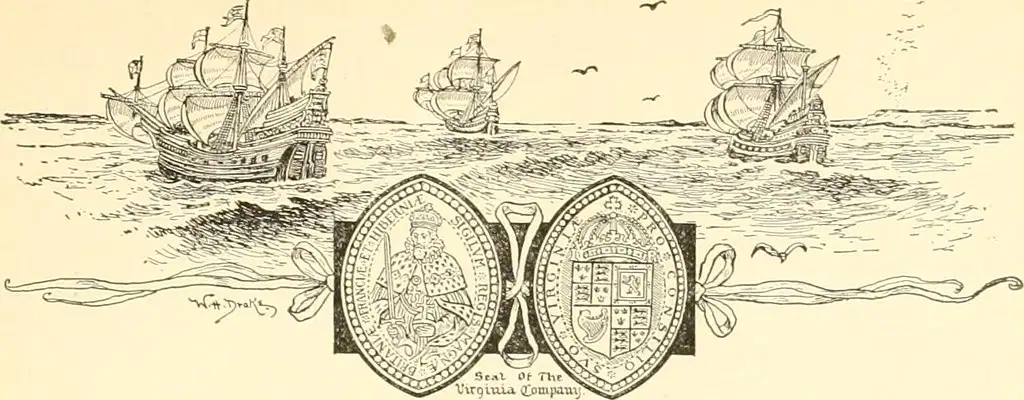
The stockholders who invested in the company portrayed in the source were motivated primarily by
a)
religion
b)
a spirit of adventure
c)
curiosity about the New World personal loyalty to James I
d)
financial profit
11.
The Jamestown colony finally attained a measure of prosperity from:
a)
land sales
b)
trade with Indians
c)
gold discoveries
d)
tobacco
e)
trade with Spanish Florida
12.
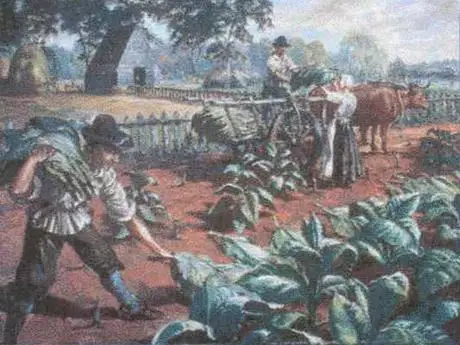
The headright system adopted for the Virginia colony consisted of
a)
giving fifty acres of land to anyone who would transport himself to the colony
b)
"selling" wives to male settlers
c)
auctioning black slaves to settlers
d)
giving free land to all servants who came to the colony
e)
giving free land in return for five years of military service
13.
The economy of the southern colonies centered on which fundamental fact?
a)
Labor was plentiful and land was scarce
b)
The native population must be moved west
c)
The British military had to protects its farms
d)
Land was plentiful and laborers were scarce
e)
The growing season was limited by lack of rain.
14.
The indentured servants who came to the colonies:
a)
were mainly convicts shipped over as part of their sentence
b)
were essentially the same as slaves
c)
usually worked four to seven years to pay off their debt
d)
provided mainly household labor
15.
Relations between the English and the Powhatan were at first conciliatory but remained tense, especially
a)
when the English attempted to capture all the Indians from his tribe
b)
as the Indians attempted to assimilate into the English culture
c)
as the starving colonists took to raiding Indian food supplies.
d)
when the Indians joined tribes in the Powhatan Confederacy
16.
Place the following in order of their colonial period social hierarchy from top to bottom
a)
Landless freedmen, Yeoman, Planters, Servants
b)
Yeoman, Landless freedmen, Planters, Servants
c)
Planters, Yeoman, Landless freedmen, Servants
17.
The Royal Proclamation of 1763
a)
gave Florida back to Spain
b)
imposed new taxes on imports
c)
lowered taxes on the colonies
d)
prohibited American settlement west of the Appalachians
18.
One of the chief objectives of policy under George Grenville was to
a)
require jury trials for American smugglers
b)
challenge the authority of the king
c)
reduce Britain's enormous debt
d)
give colonial assemblies more power
19.
Slavery became the defining characteristic of this region during the 18th century, shaping the region’s economy, society, and politics.
a)
New England
b)
Middle
c)
Southern
20.
How do many historians theorize concerning the origin of the First Americans in North America?
a)
Ice-land bridge
b)
Horses
c)
Evolution
21.
The size and sophistication of Native American civilizations of the Mexica and South American peoples can be attributed to
a)
Spanish influence
b)
their way of life based on hunting and gathering
c)
the development of agriculture
d)
influences brought by early settlers from Siberia
22.
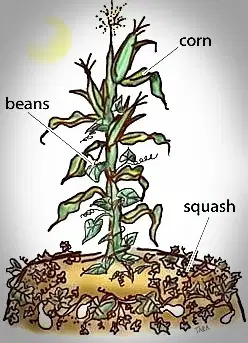
The development of this specialized agricultural technique among various Native American groups
a)
enabled the Anasazis to prosper.
b)
ultimately failed to produce adequate amounts of food.
c)
was attributed to three young women of the Cherokee peoples.
d)
produced a rich diet that led to higher population densities.
23.
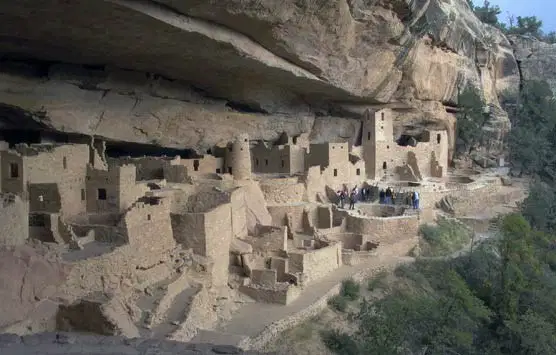
Facing unpredictable rainfall and dry climates, which ancient Americans developed cultures characterized by various types of multiunit dwellings as pictured below?
a)
Eastern Woodland Cultures
b)
Californian Cultures
c)
Northwest Pacific Cultures
d)
Southwestern Cultures
24.
Which of the following reshaped social life by promoting a more settled lifestyle, greater specialization of labor, and more social divisions, including classes based on differences in wealth and power among early Native American groups?
a)
farming
b)
forestry
c)
trade
d)
industry
25.
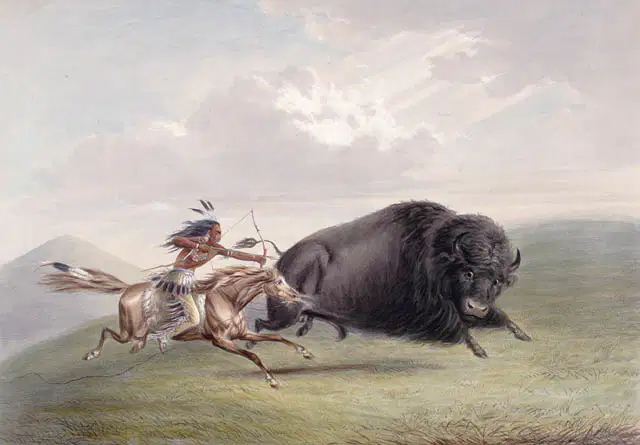
Based on the characteristics seen in this painting, which Native American culture is best represented?
a)
The Great Basin Culture
b)
The Great Plains Culture
c)
The Mississippian Culture
d)
The Adena Culture
26.
Which of the following Native American culture groups were characterized by their utilization of the forest environment of the major river valleys of the Tennessee River, Ohio River, Mississippi River, and the Cumberland River?
a)
Hohokam
b)
Californian
c)
Southwestern
d)
Great Basin
e)
Eastern Woodland
27.
In many ways, trade became a faith, in this colonial region, that competed strongly with Puritanism.
a)
New England
b)
Middle
c)
Southern
28.
The Middle Passage was most beneficial to this region.
a)
New England
b)
Middle
c)
Southern
29.
Small farms, fish, and Atlantic trade characterized this colonial region.
a)
New England
b)
Middle
c)
Southern
30.
Rice, indigo,Tobacco were the most important exports in this colonial region.
a)
New England
b)
Middle
c)
Southern
31.
Besides the booming population what was the second major feature of 18th century colonial society?
a)
An expanding economy
b)
New British taxes
c)
Disease
d)
Religious dissent
32.
The greatest preacher of the (First) Great Awakening was
a)
John Winthrop
b)
George Whitefield
c)
Joel Olsteen
d)
Billy Graham
33.
Americans responded to Britain’s many new taxes in the 1760s with the line, “No taxation without representation.” What did this mean exactly?
a)
Americans wanted their own representatives in Parliament
b)
That only royal colonial legislatures could tax the colonies
c)
That the colonists would accept virtual representatives in fiscal matters only
34.
The main way the colonists protested the Townshend Revenues Act was through:
a)
mob violence
b)
nonimportation and nonconsumption
c)
pamphlets and essays
d)
an all-colony Congress
35.
The Quartering Act
a)
helped to soften the blow of the Intolerable Acts on the colonies
b)
legalized housing of British troops at public expense
c)
ensured that British troops would be confined to military hubs.
d)
ensured that British troops could stay only in taverns and abandoned buildings
36.
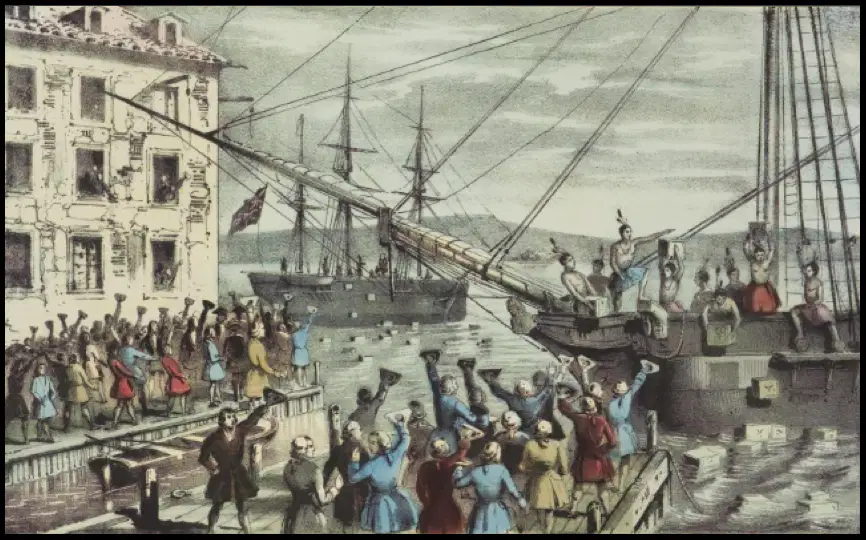
As a consequence of this event the British took which subsequent action?
a)
Passed the Coercive Acts that the colonials called the Intolerable Acts
b)
Petitioned the colonial legislature asking them to pay for the tea
c)
Rescinded the Tea Act because of the success of the Sons of Liberty
d)
Blamed the Mohawk Indians for the destruction of the tea
37.

In this excerpt from a letter written by John Adams which of the following examples best supports Adams’ claim?
a)
The Battle of Lexington & Concord because the Revolution only broke out after the colonies had won the war.
b)
The Stamp Act because it helped unite the colonies.
c)
Shay’s Rebellion because it helped inspired the Constitution.
d)
The Boston Tea Party because it forced King George to sign the Declaration of Independence.
38.

As a result of what is depicted in the image
a)
the Sons of Liberty adopted peaceful methods
b)
Sam Adams was arrested and sent to England
c)
Americans acquired their first martyrs
d)
Americans now quietly paid their taxes
39.
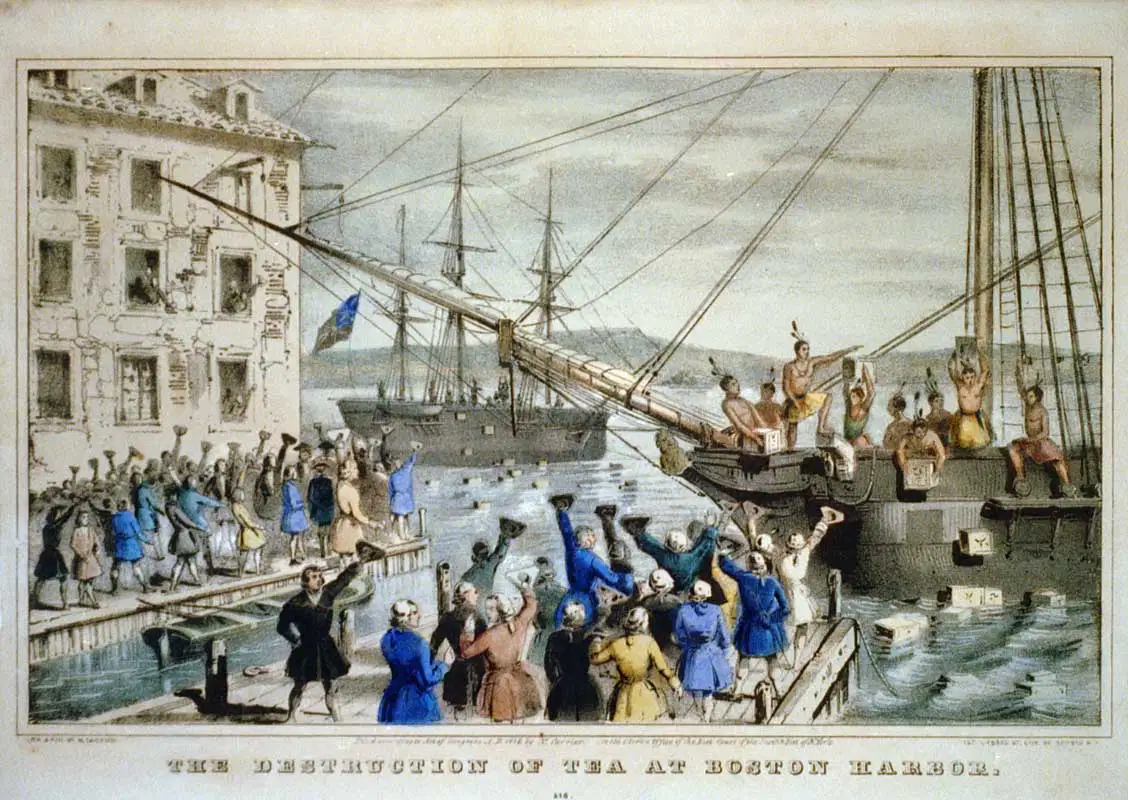
Which of the following is true concerning the incident depicted in the picture below
a)
Mohawk Indians destroyed the tea
b)
Ben Franklin supported it
c)
Americans destroyed a large amount of property
d)
It forced the British to repeal the tea tax
e)
Most Bostonians did not support it
40.
The purpose of the Coercive Acts was to
a)
punish Boston for the Tea Party
b)
arrest the leaders of the Sons of Liberty
c)
abolish colonial assemblies
d)
outlaw any public criticism of British policy
41.
In April 1775, the British marched to Concord, Massachusetts, in an effort to
a)
collect taxes
b)
prevent a town meeting
c)
seize weapons/ammunition and arrest colonial leaders
d)
arrest Paul Revere
42.
At Lexington and Concord, the British fought against the:
a)
Regulators
b)
Minutemen
c)
Sons of Liberty
d)
Continental Army
43.
In the fighting on April 19,1775, the British suffered their greatest casualties:
a)
during their retreat back to Boston
b)
in the initial fight in Lexington
c)
at Concord's North Bridge
d)
from American cannon fire
44.
The 1765 Stamp Act
a)
required revenue stamps on legal and commercial
b)
was approved by colonial assemblies
c)
directly affected only a few Americans
d)
soothed Americans fears of standing armies
45.
In response to American protests, in 1766 Parliament
a)
removed British troops from the colonies
b)
blamed George III for its mistaken policies
c)
issued an apology
d)
repealed the Stamp Act but passed the Declaratory Act
46.
The clash between Britain and France for control of the North American continent sprang from the rivalry for control of
a)
the Ohio River Valley
b)
the Mississippi River
c)
the Great Lakes
d)
the St. Lawrence River
47.
The Seven Years War was also known in America as
a)
the War of Jenkin's Ear.
b)
the French and Indian War.
c)
the War of Austrian Succession
d)
King Williams War
e)
Queen Anne's War
48.
As a result of the Seven Years' War, Great Britain
a)
gained control of Louisiana
b)
became the dominant power in North America
c)
gained exclusive control of the slave trade
d)
All of these
49.
In the wake of the Proclamation of 1763
a)
American colonists obeyed the law they hated
b)
relations with France improved
c)
relations between the American colonies and the British government improved.
d)
American colonists moved west, defying the Proclamation
50.
Thomas Jefferson's “Revolution of 1800” was remarkable in that it
a)
moved the United States away from its democratic ideals.
b)
marked the peaceful and orderly transfer of power on the basis of election results
c)
occurred after he left the presidency.
d)
was in no way a revolution.
51.

Jefferson’s statement “We are all Republicans, we are all Federalists” was meant to
a)
reassure a divided country that we all shared the same American values
b)
keep political parties or factions from forming
c)
send a message to the world to not be involved in the affairs of the U.S.
d)
paved the way for the territorial expansion into the West
52.
In the case of Marbury v. Madison, the Supreme Court
a)
ruled that Marbury should occupy his judicial position.
b)
made itself the government's most powerful branch
c)
proved it was not influenced by politics
d)
declared a federal law unconsitutional
53.
The Louisiana Purchase was a problem for Jefferson because
a)
the cost was too high for the United States to pay.
b)
acquisition of new Indian lands was contrary to his principles and beliefs.
c)
the territory was ideal for slavery, which he opposed.
d)
he believed that the Constitution did not give authority to acquire new land.
54.
To President Jefferson , one major incentive to purchase Louisiana was to
a)
gain the support of the Federalists
b)
secure American access to the Mississippi River
c)
spend some of the surplus money in the treasury
d)
prove that the United States had become a world power
e)
acquire new ports on the Pacific
55.
Jefferson's embargo policy :
a)
forced a change in British policy
b)
had widespread public backing
c)
sought to stop all American exports
d)
ended Jefferson's presidency on a successful note
56.
The most notable aspect of the British assault upon Baltimore was
a)
the large numbers of civilian casualties
b)
the length of the siege that followed
c)
its inspiration for the eventual national anthem
d)
the superb performance of the U.S. navy
57.
The British attack on Ft. McHenry in Baltimore
a)
made a national hero of Andrew Jackson
b)
increased support for the war in New England
c)
resulted in a bombardment that did not force the fort's surrender
d)
resulted in an embarrassing defeat for the Americans
58.
The person most responsible for the British defeat at New Orleans in 1814 was:
a)
John Marshall
b)
Frances Scott Key
c)
Andrew Jackson
d)
James Monroe
59.

The chief advocate for the program of economic development called the American System was:
a)
Henry Clay
b)
John C. Calhoun
c)
Daniel Webster
d)
James Monroe
60.
Missouri's admission to the Union as a slave state was balanced by the admission of the free state of:
a)
Maine
b)
Ohio
c)
Vermont
d)
Minnestoa
61.
The Missouri Compromise stipulated that in the rest of the Louisiana Purchase north of 36º 30':
a)
slavery would be excluded
b)
majority rule would determine whether slavery would be legal
c)
there would be no restrictions on slavery
d)
free blacks could not become citizens
62.
The Jeffersonian Democratic-Republicans believed in and showed themselves as all of the following except
a)
believers in a strong central government
b)
strict constructionists
c)
believers of political and economic liberty
d)
strong supporters of state's rights
63.
Thomas Jefferson and his followers opposed John Adams's last minute appointment of new federal judges mainly because
a)
they believed that the appointments were unconstitutional
b)
they did not want a showdown with the Supreme Court
c)
it was an attempt by a defeated party to entrench itself in the government
d)
these judges were not needed
64.
The Monroe Doctrine was crucial the the future of the United States
a)
All of the above are correct
b)
because it kept us out of European conflicts for 100 years
c)
because it declared that the Americas were no longer open to European colonization
d)
because it warned against European interference in the affairs of American nations
e)
because it announced that the United States would not interfere in European affairs
65.
The Missouri Compromise
a)
maintained a balance in the House of Representatives
b)
resolved the issue of the extension of slavery for a time
c)
allowed the South to protect its interests in the Senate
d)
allowed most of the territory acquired from the Louisiana Purchase to be slave territory.
66.
In the period 1650–1750, all of the following contributed to British North American colonists’ sense of identity as British subjects EXCEPT the
a)
growth of commerce across the Atlantic Ocean
b)
increased circulation of London newspaper articles reprinted in the colonies
c)
expansion of the colonies into western frontier regions
d)
availability of British manufactured goods in the colonies
e)
warfare against the French and their American Indian allies
67.
Which of the following was an outcome of the Columbian Exchange?
a)
The life expectancy of Native Americans increased.
b)
Horses and smallpox were introduced in Europe.
c)
Sugar and rice were introduced in Africa.
d)
The diets of Europeans improved.
e)
The population of Europe decreased.
68.
The president most commonly associated with the "common man" would have most likely been
a)
George Washington
b)
Thomas Jefferson
c)
Andrew Jackson
d)
James Monroe
100 %

