
 Worksheets
The Ankle and Lower Leg Anatomy and Function
Total questions: 97
Worksheet time: 49mins
The ankle joint is composed of which three bones?
Tibia, fibula, talus
Femur, tibia, patella
Fibula, talus, calcaneus
Tibia, fibula, femur
The talocrural joint allows two motions: plantarflexion and _________?
dorsiflexion
eversion
inversion
rotation
The subtalar joint allows two motions: inversion and _________?
eversion
flexion
rotation
extension
Which ligament is included in the medial ligament of the ankle?
Deltoid
Anterior talofibular
Posterior talofibular
Calcaneofibular
The portion of the anatomy below the knee and above the ankle is called the ________.
lower leg
upper arm
forearm
thigh

Which bones form the ankle joint?
Tibia, Fibula, Talus
Tibia, Calcaneus, Navicular
Fibula, Calcaneus, Navicular
Talus, Calcaneus, Navicular
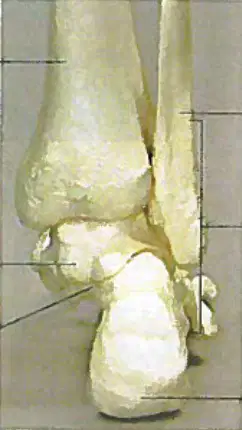
The subtalar joint allows which movements?
Plantarflexion and dorsiflexion
Inversion and eversion
Flexion and extension
Abduction and adduction
Fill in the blank: The muscles that dorsiflex the ankle are contained within the ______ compartment.
anterior
posterior
lateral
deep
According to the text, the muscles that evert the ankle are found in which compartment?
lateral compartment
anterior compartment
posterior compartment
deep compartment
Match the following ankle movements with their corresponding muscles:
Extensor digitorum longus
Ankle dorsiflexion
Soleus
Ankle plantarflexion
Tibialis posterior
Ankle inversion
Peroneus longus
Ankle eversion
Which muscle is the primary dorsiflexor of the ankle joint?
Extensor digitorum longus
Extensor hallucis longus
Tibialis anterior
Soleus
Which of the following is NOT a method for preventing lower leg and ankle injuries?
Heel cord stretching
Strength training
Wearing inappropriate footwear
Neuromuscular control
Fill in the blank: To properly stretch the Achilles tendon complex, the ankle should be _______ and the knee fully extended to stretch the gastrocnemius muscle.
dorsiflexed
plantarflexed
rotated
inverted
Strength training should include both static and dynamic joint stability exercises to prevent ankle injuries.
True
False
List two lateral ligaments of the ankle joint.
Anterior talofibular, posterior talofibular
Deltoid, calcaneonavicular
Tibionavicular, tibiocalcaneal
Plantar calcaneonavicular, spring ligament
Which compartment of the lower leg contains the peroneus longus muscle?
Anterior compartment
Lateral compartment
Deep posterior compartment
Superficial posterior compartment
Name one benefit of proper footwear in preventing lower leg and ankle injuries.
Proper footwear can reduce the risk of injury by providing appropriate support and protection.
Proper footwear increases the risk of injury by making the foot unstable.
Proper footwear has no effect on lower leg and ankle injuries.
Proper footwear is only important for style and not for injury prevention.
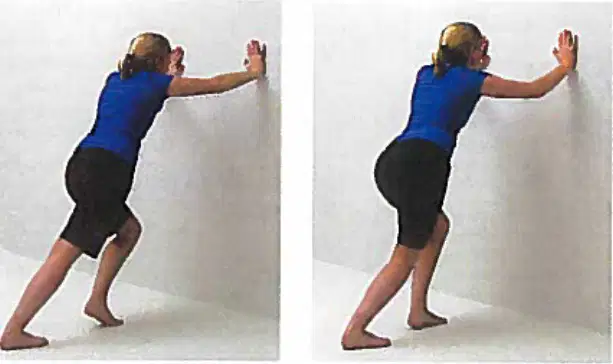
What are the stretching techniques for the right Achilles tendon complex shown in Figure 15-4?
(A) Stretching position for the gastrocnemius muscle. (B) Stretching position for the soleus muscle.
(C) Stretching position for the tibialis anterior muscle. (D) Stretching position for the peroneus longus muscle.
(E) Stretching position for the hamstring muscles.
(F) Stretching position for the quadriceps muscle.
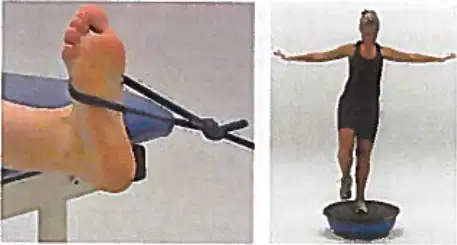
Which strengthening exercises are important in prevention of ankle sprains as shown in Figure 15-5?
(A) Surgical tubing resistance (B) Bosu Balance Trainer
(C) Wrist curls (D) Neck stretches
(E) Shoulder shrugs (F) Finger extensions
(G) Hip abductor machine (H) Triceps dips
What type of exercise is shown in Figure 15-6 for the ankle?
Ankle exercises on a BAPS Board.
Calf raises on a step.
Resistance band dorsiflexion.
Towel scrunches.
According to the passage, is it beneficial to routinely tape ankles that have no history of sprain?
True
False
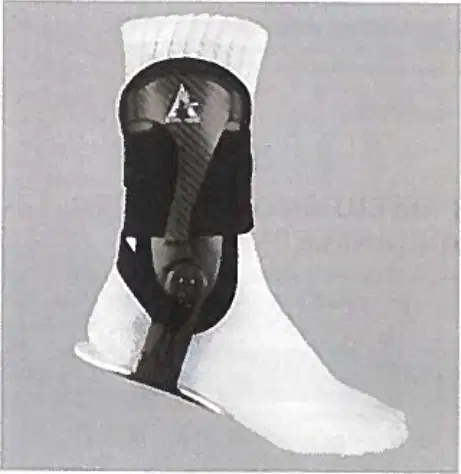
What is the purpose of ankle braces as shown in Figure 15-7?
Ankle braces may be used to support weak ankles.
Ankle braces are used to increase ankle flexibility.
Ankle braces are designed to reduce blood flow to the foot.
Ankle braces are worn to make shoes more comfortable.
Should shoes designed for straight-ahead activity, such as running shoes, be used for playing basketball?
True
False
The athlete's history may vary, depending on whether the problem is the result of sudden trauma or is chronic. The athlete with an acute sudden trauma to the ankle should be asked: What trauma or mechanism occurred?
The specific trauma or mechanism that caused the injury (e.g., twisting, impact, fall).
The athlete's favorite sport to play.
The color of the athlete's shoes during the injury.
The time of day the injury occurred.
The athlete's history may vary, depending on whether the problem is the result of sudden trauma or is chronic. The athlete with an acute sudden trauma to the ankle should be asked: What was heard when the injury occurred?
Crack, snap, or pop (as heard during the injury).
A ringing sound in the ears.
A sudden loss of vision.
A feeling of dizziness.
What were the duration and intensity of pain?
Duration and intensity of pain experienced by the athlete.
Type of medication used for pain relief.
Location of the injury on the athlete's body.
Number of training sessions missed due to pain.
The athlete's history may vary, depending on whether the problem is the result of sudden trauma or is chronic. The athlete with an acute sudden trauma to the ankle should be asked: How disabling was the occurrence?
Whether the athlete could walk right away or was unable to bear weight.
What was the weather like during the incident?
How many people witnessed the injury?
What color were the athlete's shoes?
The athlete with an acute sudden trauma to the ankle should be asked: Has a similar injury occurred before?
Yes or No (whether a similar injury has occurred before).
What is your favorite sport?
How many hours do you sleep?
Do you like running on grass or track?
The athlete's history may vary, depending on whether the problem is the result of sudden trauma or is chronic. The athlete with an acute sudden trauma to the ankle should be asked: Was there immediate swelling, or did the swelling occur later (or at all)? Where did the swelling occur?
Immediate or delayed swelling and location of swelling.
Type of shoes worn during the incident.
Previous unrelated injuries.
Dietary habits before the trauma.
The athlete with an acute sudden trauma to the ankle should be asked: What past ankle injuries have occurred?
Details of any past ankle injuries.
Preferred brand of running shoes.
Dietary preferences before the injury.
Favorite sports team.
Immediately following injury, the athlete should be observed to determine the following: Is there an obvious deformity?
Yes or No (obvious deformity present or not).
Only if the athlete is conscious.
Only after 24 hours have passed.
Only if there is severe bleeding.
Immediately following injury, the athlete should be observed to determine the following: Are the bony contours of the ankle normal and symmetric, or is there a deviation such as a bony deformity?
Normal and symmetric or deviation/bony deformity.
Swelling and redness only.
Muscle spasms and cramps.
Bruising and discoloration only.
Immediately following injury, the athlete should be observed to determine the following: Is there any discoloration?
Yes or No (discoloration present or not).
Only if there is swelling.
Only if the athlete is unconscious.
Only if there is severe pain.
Immediately following injury, the athlete should be observed to determine if there is crepitus or abnormal sound in the ankle joint?
Yes
No
Only if there is swelling
Only after 24 hours
Immediately following injury, the athlete should be observed to determine if heat, swelling, or redness is present.
Yes or No (heat, swelling, or redness present or not).
Only if the athlete is unconscious.
Only after 24 hours have passed.
Only if there is visible bleeding.
Immediately following injury, the athlete should be observed to determine the following: Is the athlete in obvious pain?
Yes or No (obvious pain present or not).
Only if the athlete is unconscious.
Only if the injury is to the head.
Only if the athlete requests help.
Immediately following injury, the athlete should be observed to determine: Does the athlete have a normal ankle range of motion?
Yes or No (normal ankle range of motion present or not).
Only if the athlete can walk without pain.
Only if swelling is present.
Only if the athlete can stand on one foot.
Immediately following injury, the athlete should be observed to determine if the athlete is able to walk, and if there is a normal walking pattern or a limp.
Normal walking pattern or limp.
Ability to lift heavy weights.
Ability to run at full speed.
Ability to jump high.

A basketball player sustains a grade I inversion sprain of her left ankle during a game. There is immediate pain and swelling, and she is unable to bear weight. What is the most important first-aid step immediately following injury, and how may the first-aid goal best be accomplished?
Apply ice and compression to reduce swelling and pain.
Begin immediate weight-bearing exercises to restore function.
Massage the ankle vigorously to improve circulation.
Apply heat to the ankle to relax the muscles.
Which of the following is NOT a step for recognizing and managing ankle injuries?
Hop on affected foot without heel touching surface.
Start or stop the running motion.
Change direction rapidly.
Apply ice directly to the skin.
Run figure eights.
What are the three classifications of ankle sprains?
Inversion sprain, eversion sprain, high ankle sprain
Lateral sprain, medial sprain, posterior sprain
Anterior sprain, posterior sprain, medial sprain
Plantar sprain, dorsal sprain, lateral sprain
Fill in the blank: The ______ ligament is the weakest of the three lateral ligaments and is most commonly injured in an inversion ankle sprain.
anterior talofibular
calcaneofibular
posterior talofibular
deltoid
Which ligament is most likely to be injured in an inversion ankle sprain?
Calcaneofibular ligament
Posterior talofibular ligament
Anterior talofibular ligament
Deltoid ligament
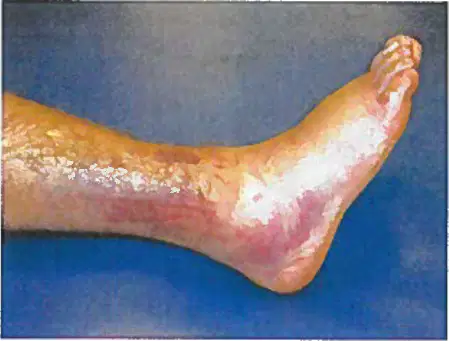
Refer to FIGURE 15-9. The ankle and usually the foot are swollen and discolored following an ________.
ankle sprain
ankle fracture
muscle cramp
shin splint
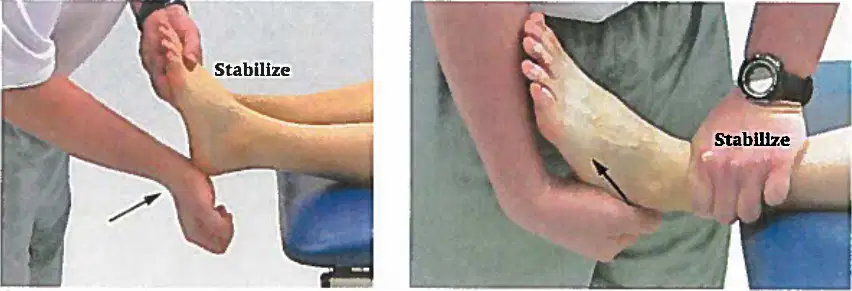
Which special test for ankle injuries is shown in FIGURE 15-8 (A)?
Bump test
Anterior drawer test
Talar tilt test
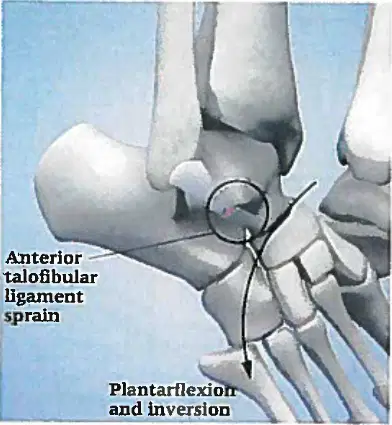
What mechanism of injury can cause a sprain of the anterior talofibular ligament?
Plantarflexion and inversion
Dorsiflexion and eversion
Plantarflexion and eversion
Dorsiflexion and inversion
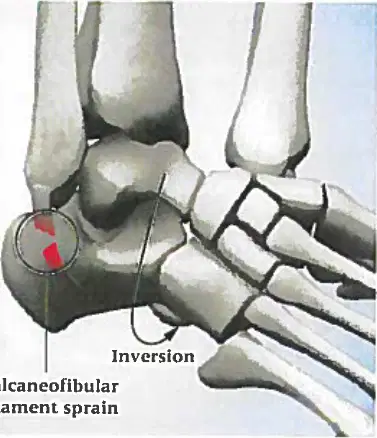
What mechanism of injury can cause a sprain of the calcaneofibular ligament?
Plantarflexion and inversion
Inversion
Eversion
Dorsiflexion and inversion
Eversion ankle sprains are less common than inversion ankle sprains.
True
False
Which ligament may be involved in an avulsion fracture of the tibia before it tears during an eversion sprain?
Deltoid ligament
Anterior cruciate ligament
Posterior talofibular ligament
Calcaneofibular ligament
High ankle sprains involve the anterior and posterior tibiofibular ligaments and the distal portion of which membrane?
Interosseous membrane
Synovial membrane
Periosteal membrane
Articular membrane
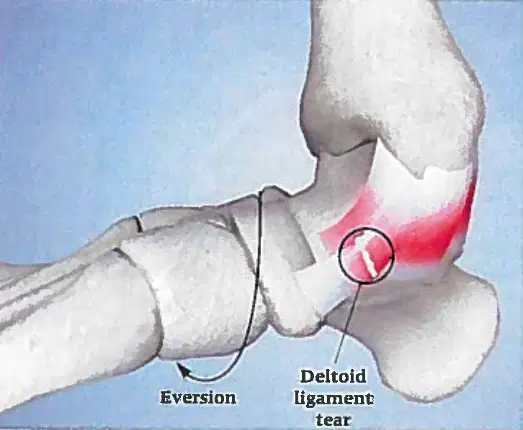
What mechanism of injury can cause a sprain of the deltoid ligament?
Eversion
Inversion
Dorsiflexion
External rotation
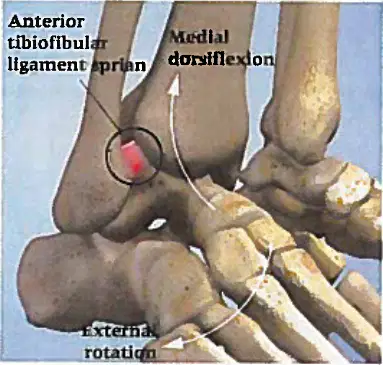
A mechanism of injury that involves hyperdorsiflexion and external rotation of the foot can cause a sprain of which ligament?
Deltoid ligament
Anterior tibiofibular ligament
Calcaneofibular ligament
Posterior talofibular ligament
In a grade 1 sprain, there is some stretching or perhaps tearing of the ligamentous fibers, with little or no joint instability.
True
False
In a grade 2 sprain, what symptoms should be expected? Fill in the blank: Moderate-to-severe pain, swelling, and joint ________ should be expected.
stiffness
redness
numbness
bleeding
Grade 3 sprains involve total rupture of the ligament, manifested primarily by gross instability of the joint.
True
False
What is the most important factor in rehabilitation of an ankle sprain?
Applying heat
Controlling initial swelling with PRICE
Immediate weight bearing
Using a horseshoe pad
List the steps for controlling swelling immediately following injury as described in Focus Box 15-1.
1. Cut out a horseshoe-shaped pad and fit it around the malleolus on the side of injury. 2. Apply a wet compression wrap over the pad. 3. Surround the ankle joint entirely with ice bags and secure them with a dry, elastic wrap. 4. Keep the foot and ankle elevated to a minimum of 45 degrees while icing. 5. Place the athlete on crutches to avoid weight bearing for 24 hours following injury.
1. Apply heat to the injured area immediately. 2. Massage the swelling vigorously. 3. Keep the foot and ankle below heart level. 4. Encourage the athlete to walk on the injury. 5. Remove any compression wraps after 10 minutes.
1. Apply a dry compression wrap only. 2. Use a circular pad instead of a horseshoe-shaped pad. 3. Do not use ice bags. 4. Keep the foot and ankle at ground level. 5. Allow weight bearing as tolerated.
1. Elevate the foot and ankle to 90 degrees. 2. Use a plastic wrap instead of elastic. 3. Apply ice directly to the skin without a barrier. 4. Avoid using any pads. 5. Encourage immediate return to activity.
According to the PRICE technique, what does the 'C' stand for?
Compression
Crutches
Cold
Care
The foot and ankle should be elevated to a minimum of 45 degrees while icing during the initial treatment period.
True
False

What should be applied over the horseshoe pad during the PRICE technique?
Dry compression wrap
Wet compression wrap
Ice bags
Elastic wrap
Fill in the blank: Initial management of an ankle sprain includes ______, protection, rest, ice, compression, and elevation.
PRICE
HEAT
STRETCHING
MASSAGE
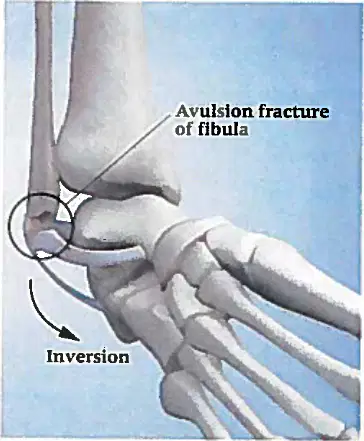
What type of force is applied to the ankle to produce an avulsion fracture of the fibula?
Eversion
Inversion
Compression
Rotation
What is tendinosis?
Tendinosis is the degeneration of the tendons surrounding the ankle joint, commonly due to faulty foot mechanics, inappropriate footwear, or acute trauma.
Tendinosis is an inflammation of the muscles in the lower back caused by overuse.
Tendinosis is a bacterial infection of the skin around the ankle joint.
Tendinosis is a fracture of the bones in the foot due to repetitive stress.
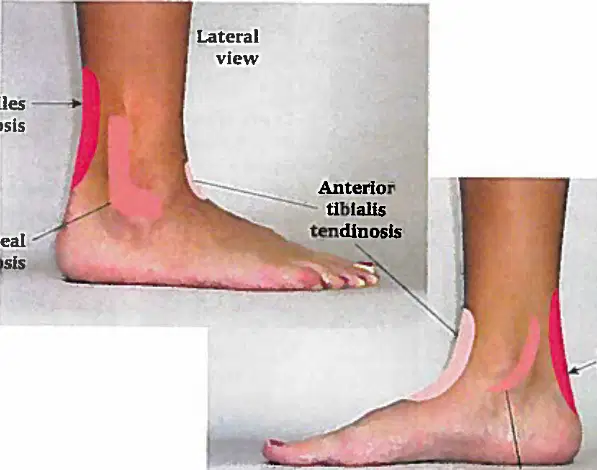
According to the box labeled 'Common sites for tendinitis,' which of the following is NOT a common site for tendinitis?
A) Anterior tibialis
B) Posterior tibialis
C) Peroneals
D) Plantar fascia
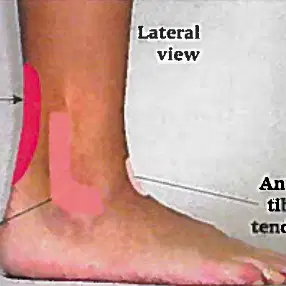
Identify the site labeled as 'Achilles tendinosis.'
The Achilles tendinosis site is located at the back of the heel/ankle in both the lateral and medial views.
The Achilles tendinosis site is located at the top of the foot near the toes.
The Achilles tendinosis site is located on the inner arch of the foot.
The Achilles tendinosis site is located at the front of the ankle joint.
A jogger, after running downhill for an extended period, experiences pain in the anterior medial aspect of the left foot. The condition is diagnosed as anterior tibialis tendinosis. What is the appropriate management for this condition?
Rest, ice, and activity modification
Immediate surgical intervention
Continued running without changes
Application of heat and massage only
History: The duration of pain has been:
A few hours
Several weeks
A year
A decade
History: The pain or discomfort is located at which site?
Chest
Leg
Head
Arm
History: The feeling has changed or there is numbness.
Yes, there is a change or numbness.
No, there is no change or numbness.
There is only pain, no numbness.
There is swelling but no numbness.
History: There is a feeling of warmth.
Yes
No
Sometimes
Rarely
History: There is a sense of muscle weakness or difficulty in walking.
Yes
No
Sometimes
Only after exercise
History: The problem occurred due to which reason?
A specific event or action
A random occurrence
A natural disaster
A technological advancement
Observation: Any postural deviations, such as toeing in, should be noted.
True
False

A positive Thompson test indicates:
A ruptured Achilles tendon
A torn meniscus
A dislocated patella
A fractured tibia
The tibia is more commonly fractured than the fibula.
True
False
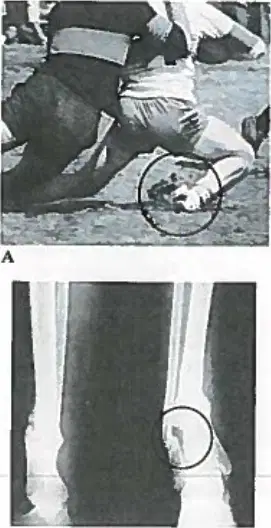
What are the signs of injury for tibial fractures?
Immediate pain, swelling, possible deformity, may be open or closed, and present with pain and point tenderness on palpation and with ambulation.
Gradual onset of pain, no swelling, and no deformity, with normal ambulation.
No pain, only mild bruising, and no tenderness on palpation or with ambulation.
Sudden loss of consciousness, chest pain, and difficulty breathing.
What is the most likely period of immobilization and restricted weight bearing for tibial fractures?
Several weeks to possibly months, depending on the severity and involvement of the injury.
A few hours, regardless of the injury.
No immobilization is required for tibial fractures.
Only one day, irrespective of the fracture type.
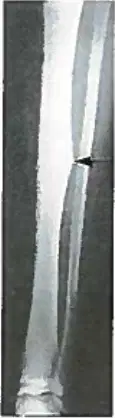
Stress fractures of the tibia and fibula are most commonly caused by:
Direct trauma
Repetitive loading during training and conditioning
Infection
Poor nutrition
Tibial stress fractures usually occur in the middle of the shaft, whereas fibular stress fractures are more likely to occur in the distal part of the bone.
True
False
What is the main symptom of shin splints (medial tibial stress syndrome)?
Pain in the anterior aspect of the lower leg.
Swelling of the ankle joint.
Numbness in the toes.
Redness and warmth over the knee.
Medial tibial stress syndrome is more correctly called a condition that involves increasing pain specifically at the distal two-thirds of the _______ aspect of the tibia.
posterior medial
anterior lateral
superior medial
inferior lateral
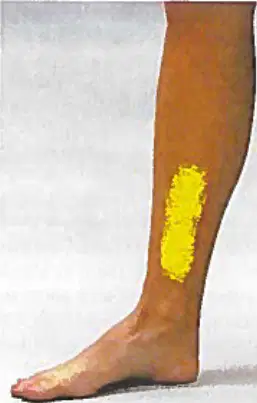
In medial tibial stress syndrome, the pain is usually located on the medial aspect of the lower leg just posterior to the tibia. Pain is most often associated with which muscle?
posterior tibialis muscle
gastrocnemius muscle
soleus muscle
peroneus longus muscle
What is a common sign of medial tibial stress syndrome?
Pain is usually diffuse about the distal medial tibia and the surrounding soft tissues.
Numbness in the toes only.
Swelling of the entire leg.
Sharp pain in the lateral thigh.
Which of the following is a recommended care for medial tibial stress syndrome?
Immediate surgery
Correction of abnormal foot mechanics
Avoiding all physical activity
Ignoring the pain
Shin contusions occur most frequently in which sport?
soccer
basketball
swimming
tennis
Severe blows to an unprotected shin can lead to chronic inflammation.
True
False
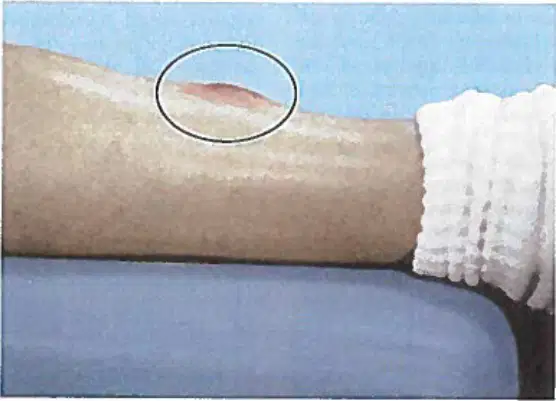
A serious shin contusion can cause what syndrome?
compartment syndrome
shin splints
patellar tendonitis
stress fracture
A soccer player who is not wearing shin guards is kicked on the outside shin of his right leg. After several minutes he again feels some tingling and numbness in his foot. What is the primary concern with this injury, and what steps should be taken to manage this situation?
The primary concern is nerve injury, and the player should be evaluated for possible nerve damage and monitored for worsening symptoms.
The primary concern is dehydration, and the player should drink fluids and rest.
The primary concern is a muscle cramp, and the player should stretch and massage the area.
The primary concern is a broken toe, and the player should tape the toe and continue playing.
A 35-year-old racquetball player feels a pop and severe immediate pain in the back of his left lower leg. He actually felt like someone kicked him, but when he turned around, no one was there. Then he realized he could not push off on his foot. What injury does he most likely have, and how should it be managed?
Achilles tendon rupture; managed with immobilization and referral to orthopedics
Medial meniscus tear; managed with rest and NSAIDs
Plantar fasciitis; managed with stretching and orthotics
Ankle sprain; managed with RICE (rest, ice, compression, elevation)
Compartment syndrome classifications: Which of the following is NOT a type of compartment syndrome?
Acute compartment syndrome
Acute exertional compartment syndrome
Chronic compartment syndrome
Acute tendon syndrome
What is the usual cause of Achilles tendon rupture?
A sudden, forceful plantarflexion of the ankle.
Gradual stretching of the tendon over years.
Direct trauma to the shin bone.
Chronic inflammation of the knee joint.
Achilles tendinitis generally takes a long time to resolve.
True
False
A ruptured Achilles tendon can occur following chronic inflammation.
True
False
What are the movements that take place at the talocrural joint?
Plantarflexion and dorsiflexion.
Abduction and adduction.
Inversion and eversion.
Flexion and extension.
Inversion and eversion occur at the ______ joint.
subtalar
knee
elbow
hip
Which of the following is NOT a recommended treatment for Achilles tendinitis?
Limiting activity
Aggressive stretching
Using anti-inflammatory medication
Ignoring the inflammation

Figure 15-22 shows an Achilles tendon rupture. What does this injury involve?
Tearing and separation of fibers.
Swelling of the ankle joint.
Dislocation of the knee cap.
Fracture of the tibia.

