
 Worksheets
NCM2 Quiz Question Bank
Total questions: 255
Worksheet time: 19hrs 4mins

Which two angles are supplementary
∠1 and ∠3
∠2 and ∠6
∠4 and ∠6
∠7 and ∠8

Which two angles are alternate exterior?
1 & 3
2 & 6
4 & 7
7 & 1

Which of the following two angles are congruent?
1 & 4
4 & 5
1 & 5
7 & 8

Which two angles are corresponding?
4 and 8
4 and 6
1 and 2
2 and 8

If angle 2 is 70 degrees, what is the measure of angle 1?
70 degrees
20 degrees
110 degrees
180 degrees

If angle 2 is 70 degrees, what is the measure of angle 4?
70
110
20
180

Solve for x.
23
-20
32
20
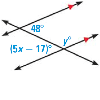

Find the measure of x
35
60
85
120
Which sets of measurements could be the interior angles of a triangle? Select EACH correct answer.
15°, 15°, 150°
10°, 90°, 100°
30°, 30°, 115°
10°, 80°, 90°
60°, 60°, 60°


Hint: x + x + x = 180

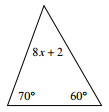

What is the measure of a third angle in a triangle when the first two angles measure
34° and 101° ?32°
45°
54°
39°

Solve for x.
21
17
11
10

The Exterior Angle Theorem states that...
< 4
90
< 3
180
Remote interior angles of a triangle are...
inside a triangle and are not adjacent to the exterior angle
inside a triangle and are adjacent to the exterior angle
outside a triangle and are not adjacent to the exterior angle
outside a triangle and are adjacent to the exterior angle

What is the value of x?
(a)

Find the measure of each angle indicated.
(a)

Solve for x
49
58
70
94

Solve for x
70
23
120
130

Solve for x
85
78
95
110

What is the name of this kind of triangle?
Select all that apply.
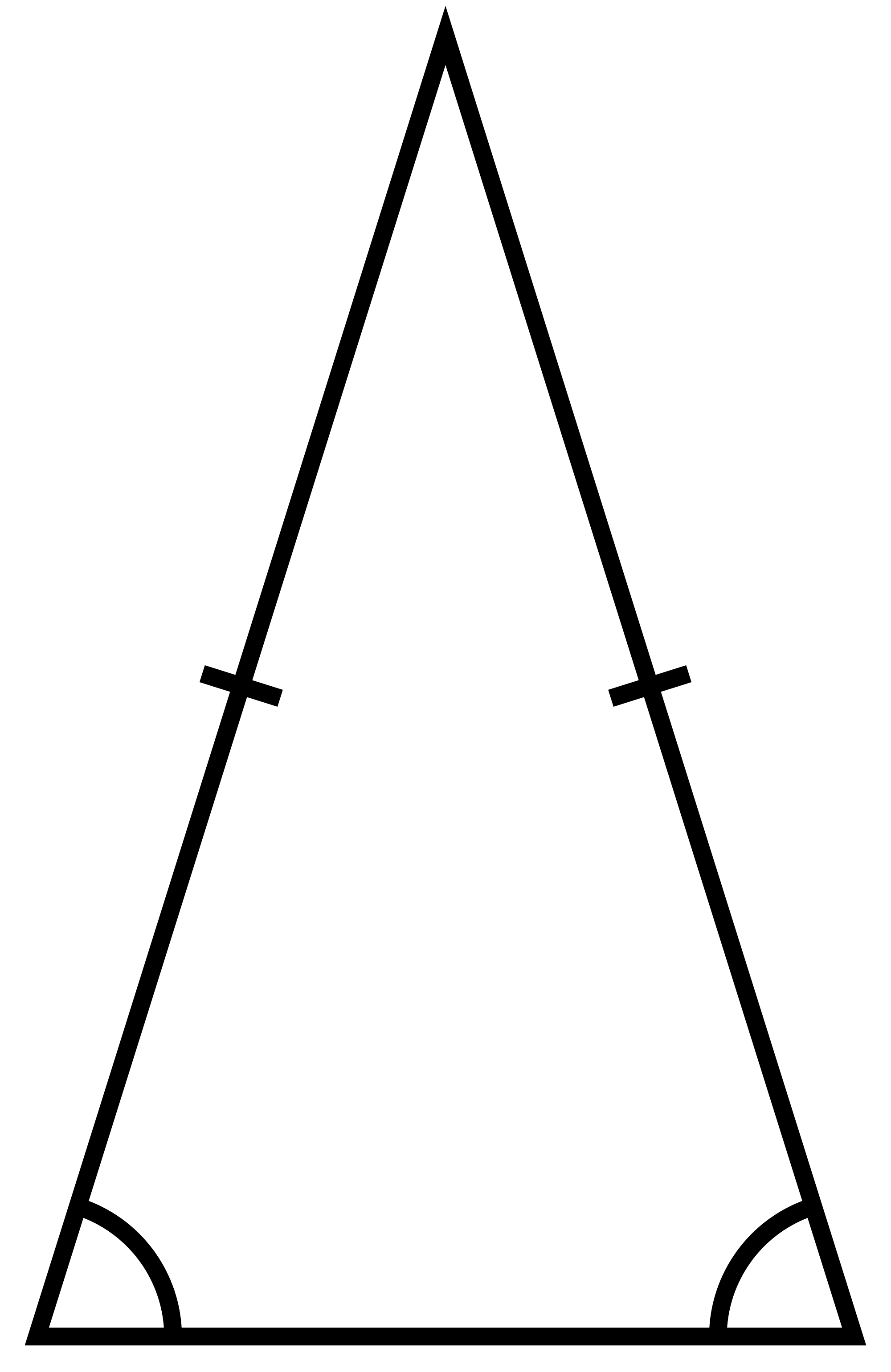
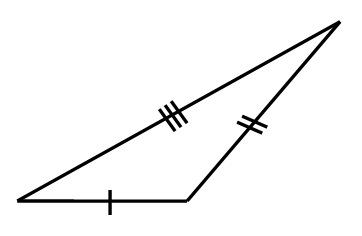
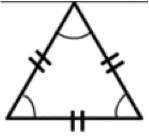
Look at the sides and angles of this triangle. Which type of triangle is pictured?
Select all that apply
Acute Triangle
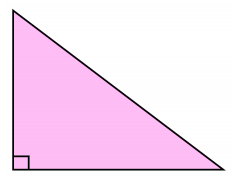
What type of triangle is shown?
Isosceles
Right
Equilateral
Scalene
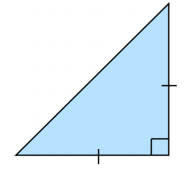
What type of triangle is shown?
Select all that apply
Isosceles
Right
Equilateral
Scalene
Daniel has drawn a triangle with sides of length 5cm, 5cm and 8cm.
What type of triangle has he drawn?
Isosceles
Perfect
Equilateral
Scalene
Charlotte has drawn a triangle with angles of 60°, 60° and 60°.
What type of triangle has she drawn?
Obtuse
Right-angled
Scalene
Acute
Match the following triangles to the type. Each triangle can only have 1 name...choose the best name for each!

Scalene

Isosceles

Equilateral
Which of the following are considered special right triangles?
30-60-90
45-45-90
20-70-90
40-50-90
The (a) of a right triangle create the (b) and the (c) is always the (d) side.

What is the value of y?
52
10
5
56
None of these
What is the value of x?
52
10
5
56
None of these

What is the value of x?
7
143
14
273 .
None of these
What is the value of y?
7
143
14
273 .
None of these

What is the value of y? Value only, no y =
What is the value of x? Value only, no x =

What is the value of x? Value only, no x =
What is the value of y? Value only, no y =

What is the value of a? Value only, no a =

What is the value of m? Value only, no m =
Match the following for finding sides in a 30-60-90 right triangle.
Short Leg
Half of the hypotenuse
Hypotenuse
Double the short leg
Long Leg
Short leg times square root of 3
In a 45-45-90 right triangle, to find the measure of a leg, you take the (a) and (b) by (c) .
2
In a 30-60-90 right triangle, to find the measure of the long leg, you take the (a) and (b) by (c) .
2
Match the following for a 30-60-90 right triangle
Short Leg
Opposite the 30° angle.
Long Leg
Opposite the 60° angle.
Hypotenuse
Opposite the right angle.
In a 45-45-90 right triangle, how many sides are the same size?
None
Two
All 3
Depends on the triangle
If you know the value of the hypotenuse in a 45-45-90 right triangle, how would you find the measure of a leg?
Divide by the square root of 2
Divide by the square root of 3
Multiply by 2
Divide by 2
None of these
If you knew the value of the hypotenuse of a 30-60-90 right triangle, how would you find the measure of the long leg?
Divide by the square root of 3
Multiply by the square root of 3
Divide by 2
Multiply by 2
None of these
Label each of the following.
Short Leg
Long Leg
Hypotenuse

90° Clockwise
270° Clockwise
270° Counterclockwise


When a coordinate yields (-x, -y), it is a

A(3,3) B(6,6) C(9,3)
A dilation produces a congruent figure
True
False
(x, y) → (1/3x, 1/3y)
(x, y) → (-3x, -3y)
(x, y) → (x + 3, y + 3)
(x, y) → (3x, 3y)


Find missing side. If the scale factor is 1:3
5
7
3
11

What is the scale factor from the Small triangle to the Large triangle?
1
3
1/3
8

Find the missing side.
If the scale factor is
1:2
x = 10
x = 4
x = 2
x = 5
If the scale factor is equal to 1, the copy is ________ the original.
the same as
smaller than
bigger than
Two objects that are the same shape but not the same size are:
Congruent
Similar
Complementary
Vertical
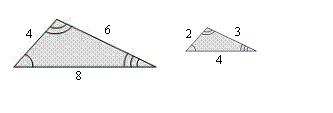
Tell whether the two figures are similar. Explain your reasoning.
Yes, similar because they are the same shape and side lengths are proportional.
No, not similar because they are the same shape, but side lengths are not proportional.
Yes, same shape
No, different sizes
Translations, reflections and rotations are all known as ________________________.
Geometry
Rigid Transformations
Congruent Transformatives
Specialty Transformations
Congruent means...
The same angles only.
The same size, shape and angles.
The same shape but different size.
The same transformation.

What is the sequence of transformations for the image given? (Remember: The new Image has the prime symbols.)
Reflect over the x-axis, translate (x+8,y)
Reflect over the x-axis then translate (x+6, y)
Reflect over the y-axis then (x+1, y+1)
Translate down 4 (y-4) and to the right 5 (x+5)

Which of the following describes the sequence of transformations shown? (From A to A' to A")
Reflect across the x-axis and then rotate 90 degrees clockwise around the origin
Rotate 90 degrees clockwise around the origin and then translate down.
Reflect across the x-axis and then reflect across the y-axis.
Translate up and then rotate 90 degrees counterclockwise about the origin.

Which figure can be transformed into figure L by a 90° rotation clockwise about the origin followed by a translation 2 units down?
Figure J
Figure M
Figure N
Figure P

. Triangle FGH and triangle F'G'H' are shown on the coordinate grid above.
Which sequence of transformations could be applied to triangle FGH to create triangle F'G'H'?
a translation 3 units left followed by a translation 1 unit up
a reflection across the x-axis followed by a rotation 180° clockwise about the origin
a rotation 180° clockwise about the origin followed by a translation 3 units up and then a translation 1 unit right
a reflection across the y-axis followed by a rotation 90° counterclockwise about the origin and then a reflection across the x-axis

Match the following angles with the correct relationship.
∠ADC and ∠BED
Corresponding angles
∠CDG and ∠BEF
Alternate Exterior Angles
∠GDE and ∠DEH
Same side Interior Angles
∠ADE and ∠CDG
Vertical Angles
What is the value of ∠GDE ?
(a)
What is the value of ∠BEF ?
(a)
What is the value of ∠CDG ?
(a)

∠WVY and ∠VWT are (a) angles.
When two parallel lines are cut by a transversal, the (b) angles are supplementary.

The m∠SVW is (a)
The m∠VWT is (b)

Match all of the corresponding angles to one another.
1
5
3
7
2
6
4
8
Which angles are exterior angles? (a) (b) (c) (d)
The relationship between angles 3 and 6 is (a)
The relationship between angles 4 and 6 is (b)

The Cross Country Bike Trail follows a straight line where it crosses 350th and 360th Streets. The two streets are parallel to each other. What is the measure of the larger angle formed at the intersection of the bike trail and 360th Street?
112
122
132
142
How many angles are created when a transversal crosses three parallel lines?
8
10
12
14

Which equation would be used to solve for x?
3x + 2x + 50 = 180
3x = 2x + 50
Corresponding Angles
Angles of the same side of the transversal and in the same position
Alternate Interior Angles
Interior angles, non-adjacent, and on opposite sides of the transversal
Alternate Exterior Angles
Exterior angles, non-adjacent, and on opposite sides of the transversal
Same Side Interior Angles
Interior angles that are on the same side of the transversal
Same Side Exterior Angles
Exterior angles that are on the same side of the transversal

Which equation should be used to find the value of x?
74 = 9x + 11
9x + 11 + 74 = 180
If angle 2 is 70 degrees, what is the measure of angle 1?
70 degrees
20 degrees
110 degrees
180 degrees

Match the following:

Same-side Interior Angles

Alternate Exterior Angles

Alternate Interior Angles

Corresponding Angles

A taxi way is being constructed that intersects two parallel runways at an airport. The m∠1 = 79° .
What is the m∠2 ?
97°
79°
101°
11°

What value of x would make m∥n ? Write the NUMBER ONLY.
(a)

Find the measure of x? Write the NUMBER ONLY.
(a)
Dilation
A flip is also called ___________.
Translation
Reflection
Rotation
Dilation

Identify this transformation.
Dilation
Rotation
Translation
Reflection

(x+2, x+9)
(x-2, y+9)

Determine where X' would be if you translated the figure 3 units to the left and 9 units down.


T2,−9
T2,9
T−2,−9
T−2,9
The result of a transformation (the "after").
The original figure prior to a transformation (the "before").
(x, y) ----> (x + 2, y - 3)
What does this transformation say to do?
T0,4

(3, 2)
(-2, 3)
(3, 0)


Which equation produces a vertical (straight up and down) line?
x = k
y = k
Which equation produces a horizontal (straight left to right) line?
x = k
y = k

Reflection across y = -x
Reflection across y = x

Find C' if the figure is reflected across the x-axis
(1, 3)
(-1, -3)
(-3, -1)
(-1, -3)

Reflections over the x-axis change the _____________.

Find the midpoint:
(−1,3)
(3,4)
(4,3)

Simplify 81 . Write the NUMBER ONLY.

What is the distance from the hospital to the gas station? HINT - Use the Pythagorean Theorem.
Simplify the following radical: √32

*Hint: Domain is the set of all x-values included in the function.
x ≥ 3
x ≤ 3
All Real Numbers
-1 ≤ x ≤ 5
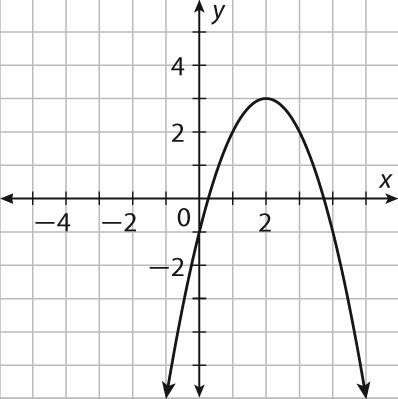
What is the range of the function?
*Hint: Range is all of the y-values included in the function.
(−∞, 3]
[−3, ∞)
All Real Numbers
[−6, 3]

Identify the domain and range of the function.
Domain: All Real Numbers
Range: Range: ( −∞ , -3)
Domain: All Real Numbers
Range: ( −∞ , -3]
Domain: All Real Numbers
Range: (-3, ∞ )
Domain: All real Numbers
Range: [-3, ∞ )

A quadratic function is graphed on the grid.
Which answer choice best represents the domain and range of the function?
Domain: x≥−3
Range: y≥5
Domain: All Real Numbers
Range: y≥5
Domain: x≥−3
Range: All Real Numbers
Domain: y≥5
Range: x≥−3

The graph of the quadratic function f is shown on the grid.
Which of these best represents the domain of f?
−3≤x≤2
All Real Numbers
y≥5.5
All Real Numbers Less Than -3 or Greater Than 2
What is the domain of f(x)=9−x2 ?
f(x)≥9
All Real Numbers
−3≤x≤3
x≤9
Which graph best represents a function with a range of all real numbers greater than or equal to -6?


Which graph best represents a function with a range of all real numbers less than or equal to -6?


What are the domain and range of the graph?
Domain: all real numbers
Range: y≤−4
Domain: −6<x<−1 Range: y≥−4
Domain: all real numbers
Range: y≥−4
Domain: −6≤x<−1 Range: y≥−4

Name the vertex.
(3, -4)
(1, 0)
(5, 0)

Identify the x-intercepts. Select ALL that apply.
-4
0
-2

Identify the y-intercept. Select ALL that apply.
1
-1
3

Does the vertex of this parabola represent maximum or minimum?
Maximum
Minimum
What is another word for x-intercept? Select ALL that apply.
solution
root
zero
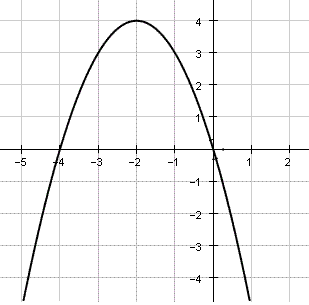
Does the vertex of this graph represent maximum or minimum?
Maximum
Minimum
Which of the following are x-intercepts of this graph? Select all that apply.
(-2,4)
(-4,0)
(0,-4)
(0,0)

y = 2
x = 2
x = 1
y = 1


What is the significance of the ordered pair (0, -2) to the graph?
It is the vertex
It is an x-intercept
It is the y-intercept
It is the axis of symmetry
What is the significance of the ordered pair (2, -4) to the graph?
It is the vertex
It is an x-intercept
It is the y-intercept
It is the axis of symmetry

Which point is the vertex?
(-8, 0)
(-5, -9)
(-2, 0)
(-9, -5)

rate of change
vertex
x-intercepts
Define X-intercept
The highest or lowest point on the graph.
Where the parabola touches or intersects the x-axis.
Where the parabola touches or intersects the y-axis.
A line that divides the graph into two equal parts. i.e. cuts the graph in half.
Define Y-intercept
Where the parabola touches or intersects the x-axis, also called the x-intercept
The lowest y-value on the graph
The highest y-value on the graph
Where the parabola touches or intersects the y-axis
Define Vertex
Where the parabola touches or intersects the x-axis
The highest or lowest point on the graph
Where parabola line touches or intersects the x- axis, also called the x-intercept
A line that divides the graph into two equal parts. i.e. cuts the graph in half
Define Axis Of Symmetry
A line that divides the graph into two equal parts. i.e. cuts the graph in half
Where the parabola touches or intersects the x-axis, also called the x-intercept
The highest y-value on the graph
The highest or lowest point on the graph

Identify the y-intercept
(0, -3)
(3, 0)
(0, 3)
(2, 1)


What is the axis of symmetry for this parabola?
x=2
x=3
x=4
x=5

Is the vertex of this parabola a maximum or minimum?
Maximum
Minimum

Does this graph have a maximum or minimum value?
maximum
minimum
Identify A, B, and C if y = 3x2 - 8 + 5x
A=3
B=5
C=-8
A=3
B=-8
C=5
A=3x2
B=5x
C=-8
A=3
B=8
C=5
The parabola y = - 2x2 - 4x + 1 will have an axis of symmetry of
x = - 1
x = 1
x = 4
x = - 4
What is the equation for the AXIS OF SYMMETRY from the standard form of a quadratic? (also the x-value of the vertex)
x=2a−b
x=−2ab
x=2b−a
x=ab−2
Which of the following ordered pairs is the vertex of the equation y= −x2 + 2x + 1?
(1, 2)
(2, 1)
(0, 1)
(1, 0)
In order to graph a quadratic equation in standard form, the first two steps are to use the equation (a) to find the axis of symmetry (which is the (b) of the (c) ), and then you can plug that value back into the equation to find the (d) .
(x−h)2 , y-intercept
y coordinate
−2ab
The parabola y = x2 - 2x + 4 will
open up
open down
The parabola y = -3x2 - x + 4 will
open up
open down
Which graph represents the following equation: y=x2−2x−3


What is the quadratic equation in standard form if a = 2, b = -3, and c =-6?
x2−3x−6=0
2x2+3x+6=0
3x2+2x+6x=0
2x2−3x−6=0
What does it mean to write a quadratic equation in standard form?
Move all of the terms to one side and set the equation equal to 0
Find the x-intercept(s)
Find the y-intercept
Find the vertex
How do you write the equation below in standard form and determine a, b, and c?
16x2−9=2x


Identify the b value for the following Quadratic:
-8x2 - x + 7 = 0
1
0
-1
Identify a, b, and c for the following Quadratic:
x2 + 2x = 4
a = 1
b = - 4
c = 2
a = 1
b = 2
c = 4
a = 1
b = 2
c = 0
a = 1
b = 2
c = - 4
Identify the c value of the following Quadratic:
y = x2 + 4x
What should you do first in solving this equation?
x2 + 6x - 13 = 3
Factor.
Subtract 3 from both sides.
Add 3 to both sides.
Add 13 to both sides.
2m2=−2m+12
Solve using the quadratic formula.
x=2,−3
x=3,−2
x=1±13
No Solution
Simplify the following radical: 32
32
48
162
42
4x7y5z9 Simplify
2x3y2z3xy
2z3x7y5
2xyzx6y5z8
2x3y2z4xyz
(n+2)(n2+5n−3)
n3+7n2+13n−6
n3+7n2+−7n+6
n3+7n2+7n−6

Choose the correct ratio.
cos(33o)= 14x
sin(33o)= 14x
cos(33o)= x14
sin(33o)= x14

419
4140
409
103

tan(R)=
Simplify all ratios!
5328
5345
2845
4528
a−b
2ab
2a−b
Where is the axis of symmetry?

Y = -3x2 +7x - 2
y=x2+8x+15
y=x2+8x+15
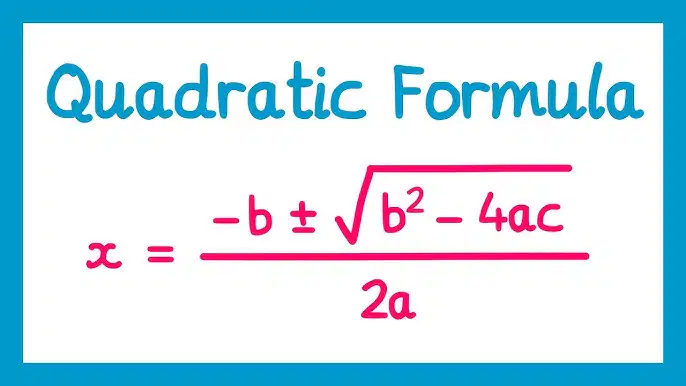
2m2=−2m+12
Solve using the quadratic formula.
x=2,−3
x=3,−2
x=1±13
No Solution
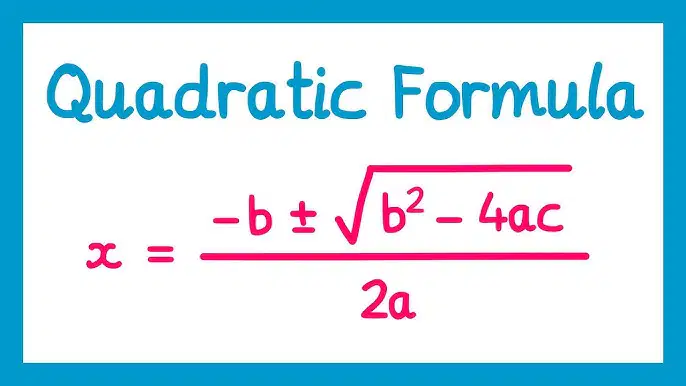
Use the quadratic formula to find the solutions for
y = -x2 - 5x + 12
Hint: Use the Quadratic Formula.
No Real Solution


What is the math notation for "each point translates to the right 4 and down 3"
(x,y)→(x+4,y+3)
(x,y)→(x−4,y−3)
(x,y)→(x+4,y−3)
(x,y)→(x−3, y+4)
Translate the math notation into words.
(x,y)→(x, y−9)
Each point translates right 9
Each point translates left 9
Each point translates up 9
Each point translates down 9
Translate the math notation into words.
(x,y)→(x+3, y)
Each point translates right 3
Each point translates left 3
Each point translates up 3
Each point translates down 3

Describe the reflection that occurred between AGRW and A'G'R'W' using coordinate notation.
( x , y ) → ( x , -y )
( x , y ) → ( y , -x )
( x , y ) → ( y , x )
( x , y ) → ( -x , y )

Describe the dilation that occurred between DEFG and D'E'F'G' using coordinate notation.
( x , y ) → ( 2x , 2y )
( x , y ) → ( x + 2 , y + 2 )
( x , y ) → ( 21 x , 21 y )
( x , y ) → ( 2y , 2x )
Describe the rotation that occurred between A ( 2 , 3 ) and A' ( 3 , -2 ) using coordinate notation.
( x , y ) → ( y , -x )
( x , y ) → ( -y , x )
( x , y ) → ( -y , -x )
( x , y ) → ( -x , -y )
Find the point A' if A ( 7 , 9 ) was transformed by ( x , y ) → ( 2x , 2y ).
( 14 , 18 )
( 9 , 11 )
( 3.5 , 4.5 )
( 5 , 7 )
What is the vertex?
y= ( x - 7 ) 2 - 5
( 7,-5)
(-7 ,-5)
( 7, 5 )
9 -7,5)
Where is the axis of symmetry?

(5, 2)
opens up
(-5, 2)
(-5, 2) opens down
Given the equation y = -(x-4)2-3,
does this parabola have a maximum or minimum value?
Which equation(s) is/are in Vertex Form?
y = 3x2−x+10
y=(x+2)2−4
y = (x−1)(x+2)
y=41(x−3)2+15
y=12 +6x2
Which graph could match the equation below?
y=2(x+3)2+3


Which of the following describes the sequence of transformations shown?
Reflection, then a rotation.
Rotation, then a translation.
Reflection across the x-axis, then a reflection across the y-axis.
Translation, then a rotation.

Which sequence of transformations will map PQRT to its image P'Q'R'T'?
A translation, then a reflection over the y-axis.
A reflection over the x-axis, then a translation.
A rotation 90o clockwise, then a reflection over the x-axis.
A rotation 180o clockwise, then a reflection over the y-axis.

If two figures are similar, the corresponding angles are ____.
Congruent
Supplementary
Proportional
Different

The two triangles are similar. Solve for X.

Tell whether the two figures are congruent or similar.
Congruent, because their corresponding sides are the same.
Congruent, because their corresponding sides are proportional.
Similar, because their corresponding sides are the same.
Similar, because their corresponding sides are proportional.
They are not congruent or similar.

Tell whether the two figures are congruent or similar.
Congruent, because their corresponding sides are the same.
Congruent, because their corresponding sides are proportional.
Similar, because their corresponding sides are the same.
Similar, because their corresponding sides are proportional.
They are neither congruent or similar.
∠K ≅ ____
If ΔCDE≅ΔPQR then, EC≅
PQ
QR
RP
CE
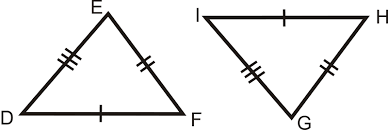
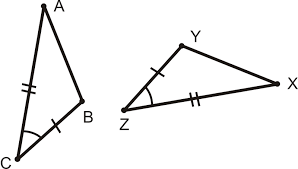
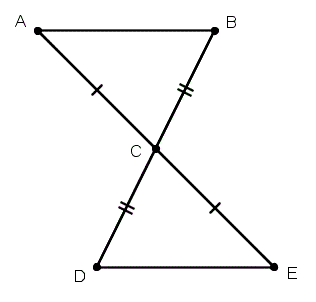
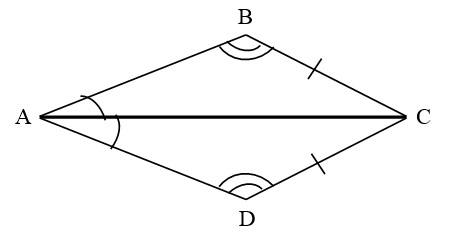
Name the postulate that makes the triangles congruent.
SAS
ASA
AAS
SSS
The image (x,y) after a rotation of 270°
(a)
The image ( 2,3) after T2,1
(a)
The image ( -1,5) after T-3,-2
(a)
A translation moves point A (4,-2) onto A' ( 0,2) what is the rule?
(a)

Which is a rule for a reflection over the x-axis?
f(x,y)=(x,−y)
f(x,y)=(−x,y)
f(x, y)= (−y, x)
f(x, y)= (y,− x)

What does the rule f(x,y)=(x−6,y+4) tell you to do?
Translate right 6 & up 4
Translate left 6 & up 4
Translate right 6 & down 4
Translate left 6 & down 4

What is the rule for the following reflection?
Reflection across y = 3
Reflection across x = −3
Reflection across x = 3
Reflection across y = −3

State the line of reflection
x = 2
y = - 1
y = 2
x = - 2

What is the rule for the following reflection?
Reflection across y = −1
Reflection across y = 1
Reflection across x = −1
Reflection across x = 1

The point ( -2,5) is reflected over the line x = 1. Find its image.
( 4, 5)
( -2 , -5)
( 2 , 5)
(2 , -5)

Graph the image of the figure using the transformation given.
a
b
c
d
(x, y) ---> ___________
(x, y) ---> ___________
(x, y) ---> ___________
(x, y) ---> ___________
(x, y) ----- (-x, -y)
Rotate K (7, 8) around the origin 90° counterclockwise. State the image of K'.
K' (-7, -8)
K' (8, -7)
K' (-8, 7)
K' (8, 7)
What is the image of S (2, -5) after a rotation of 90° clockwise about the origin?
S' (-5, -2)
S' (5, -2)
S' (-2, 5)
S' (5, 2)
What is the image of M (4, -8) after a rotation 270° clockwise?
M' (-8, 4)
M' (8, 4)
M' (-4, -8)
M' (-8, -4)
What is the image of M (3,2) after a rotation 270° counterclockwise?
M' (-2, -3)
M' (-2, 3)
M' (2, -3)
M' (-3, -2)
Rotate the point (5,5) around the origin 180 degrees. State the image of the point.
(5,-5)
(5,5)
(-5,5)
(-5,-5)



