
 Worksheets
U.S. History Final Exam Prep (Semester 1)
Total questions: 62
Worksheet time: 38mins
(Multi Select) Regarding the Industrial Revolution, select all that were problems faced by cities in the 1800s.
Overcrowding
Sanitation
Traffic jams
Clean water
Many poor people in the late 1800s lived crowded together in cheap and unhealthy...
Emergency shelters
Detention centers
Tenements
Settlement houses
During the Industrialization period, who was the government most sympathetic to?
Factory owners
Anarchists
Union leaders
Workers
Machine production, large facilities, effective management, and hiring many workers for a textile mill would increase what?
Public education
Homesteading
Industrialization
Subsistence farming
The Progressive Era in the late 1800s wanted the government to show more concern for which group?
Upper class women
Workers
Factory owners
Business leaders
(Multi-select) Select all the ways in which women pushed for the right to vote.
Parades
Picketing the White House
Destruction of public property
Lobbying the president and Congress
Select all the goals of Progressivism.
Moral improvement
Economic reform
Social welfare
Establish political machines
How are these three things alike? (Jane Addams opens Hull House, Jacob Riis photographs tenements, and Ida Tarbell exposes corruption in the Standard Oil Company)
They support business monopolies
They improve rural areas
They solve problems of American farmers
They correct abuses of the Industrial Revolution
The Women's Christian Temperance Union fought for what cause by entering saloons, singing, praying, and harassing customers to stop drinking?
(a)
In The Jungle, what did Upton Sinclair expose in his writing?
Unsanitary conditions in the meatpacking industry
Dangers faced by garment industry workers
Corrupt business practices of the Standard Oil Company
Dangers faced by coal miners
What name was given to Progressive Era writers who exposed problems in government and industry?
Know-nothings
Mugwumps
Muckrakers
Cosmopolitans
(Select all that apply) Due to the Triangle Shirtwaist Company Fire tragedy, where 154 people leaped to their deaths, what improvements occurred?
Requirement for updated public safety equipment
Increased workplace safety regulations
Stricter building codes
Decrease in workers' wages to pay for repairs
What is the term for extending a nation's power by controlling other countries militarily, politically, or economically?
Nationalism
Isolationism
Dollar Diplomacy
Imperialism
In the late 1800s, what was one reason in favor of American imperialism?
New markets for American goods
More factories
Trade with Great Britain
Colonies in Africa
In the late 1800s, what was a reason against American imperialism?
America spent too much money on factories.
Americans felt it was hypocritical due to their colonial past.
Americans believed in spreading their wealth to other countries.
Americans disapproved of capitalism.
When newspapers and magazines use sensationalism to attract readers, what is this called?
Attraction
Yellow Journalism
Graphing
Jumplining
Select all of the following that were factors leading to the Spanish-American War of 1898.
Yellow journalism
Brutal treatment of Cuban rebels by the Spanish
Explosion of the USS Maine
Admiral Dewey's victory in the Philippines
Areas of China in which certain European nations claimed exclusive trading rights were called this. Spheres of I (a) .
What did the Open Door Policy initiated by the U.S. in 1899-1900 intend to do?
Protect American trading rights in China
Allow Japanese workers to settle in the U.S.
Allow Chinese workers to settle in the U.S.
Prevent the U.S. from trading with China
Select the item below that was a cause of WWI along with nationalism and imperialism.
Communism
Democracy
Militarism
Socialism
"Nothing to see but bare mud walls, nowhere to sit but on a wet, muddy ledge; no shelter of any kind against the weather except the clothes you are wearing; no exercise you can take in order to warm yourself." What is this quote about?
Life for a Russian peasant
Troops spent their lifetime in the training barracks
There were a lot of prisoners of war
Soldier's life in the trenches
What was the United States' position at the start of WWI?
It joined the allies
It joined the Central Powers
It declared neutrality
It refused to trade with either side
Select all the reasons for the United States' entry into WWI.
Zimmerman Telegram
Protect American lives and shipping
Protect American investments with the Allies
Gain territory in Europe
How did the U.S. raise an army for World War I?
Hired mercenaries (soldiers for hire)
Draft and volunteers
Through the Committee on Public Service
Used people from their islands in the Pacific
Which government agency was responsible for creating posters for the WWI effort?
War Industries Board
U.S. Food Administration
U.S. Congress
Committee on Public Information
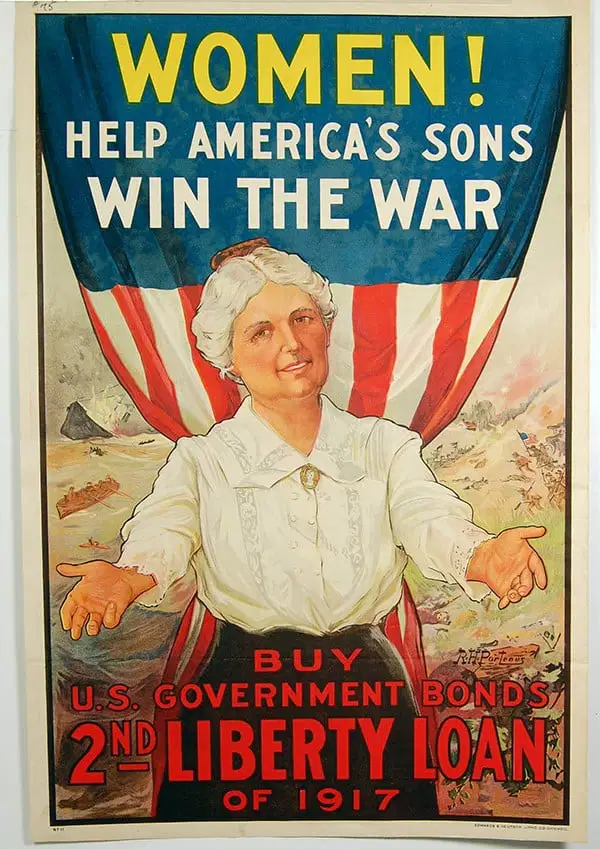
Select all the messages this WWI propaganda poster conveys.
Americans should enlist in the military.
Women should play their part in the American war effort.
Civilians are an important part of the American war effort.
Support the war effort by financially helping the government.
The 1919 Supreme Court decision in Schenck v. U.S. established the "clear and present danger" test as a method of?
Determining the limits of freedom of expression (speech)
Controlling the activities of organized crime
Limiting the powers of the president during wartime
Establishing qualifications for United States participation in the League of Nations
"We entered this war because violations of rights had occurred which touched us to the quick and made the life of our own people impossible unless they were corrected and the world secured once and for all against their recurrence. What we demand in this war, therefore, is nothing peculiar to ourselves. It is that the world be made fit and safe to live in; and particularly that it be made safe for every peace-loving nation which, like our own, wishes to live its own life, determine its own institutions, and be assured of justice and fair dealing by the other peoples of the world as against force and selfish aggression."
(Pres. Wilson Jan. 8, 1918)
From which document is this passage taken?
The UN Charter
The 14 Points
Zimmerman Telegram
A Committee of Public Information pamphlet
"We entered this war because violations of rights had occurred which touched us to the quick and made the life of our own people impossible unless they were corrected and the world secured once and for all against their recurrence. What we demand in this war, therefore, is nothing peculiar to ourselves. It is that the world be made fit and safe to live in; and particularly that it be made safe for every peace-loving nation which, like our own, wishes to live its own life, determine its own institutions, and be assured of justice and fair dealing by the other peoples of the world as against force and selfish aggression."
(Pres. Wilson Jan. 8, 1918)
Which statement best represents the main idea of the passage?
The right to self-determination
Free economic trade
League of Nations
Freedom of the Seas
"We entered this war because violations of rights had occurred which touched us to the quick and made the life of our own people impossible unless they were corrected and the world secured once and for all against their recurrence. What we demand in this war, therefore, is nothing peculiar to ourselves. It is that the world be made fit and safe to live in; and particularly that it be made safe for every peace-loving nation which, like our own, wishes to live its own life, determine its own institutions, and be assured of justice and fair dealing by the other peoples of the world as against force and selfish aggression."
(Pres. Wilson Jan. 8, 1918)
Which of the following groups in the U.S. rejected the principles in this quote?
Interventionists
Democrats
Isolationists
Socialists
What was the main reason many Black Americans migrated to the North during and after WWI?
Few opportunities to gain political office were available in the South
Racism and discrimination had been completely eliminated in the North
Southern cities were overcrowded
More jobs in the North
What was the major result of Prohibition in the U.S. during the 1920s?
Restriction of immigration
Growth of communism
Increase in organized crime
Destruction of family values
Which amendment banned the manufacture and sale of alcoholic beverages?
17th Amendment
18th Amendment
19th Amendment
20th Amendment
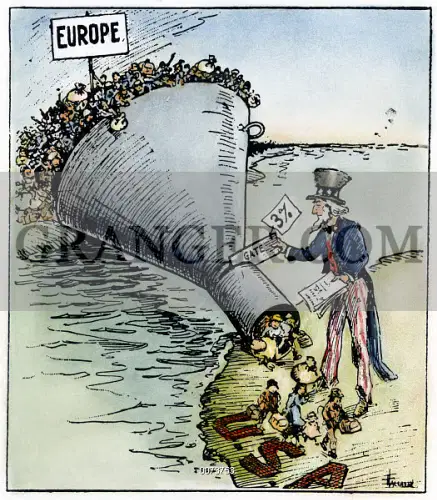
Which of the following best describes the immigration cartoon?
There should be no limits on European immigration into the U.S.
Very few Europeans are trying to enter the U.S.
Immigration of Europeans into the U.S. must be limited.
The United States does not have a problem with immigration.
Select all of the following that showed an increase in intolerance and fear of different ethnic groups in the 1920s.
Rise of the KKK (Ku Klux Klan)
New immigration quota laws
Sacco-Vanzetti Trial
National Prohibition
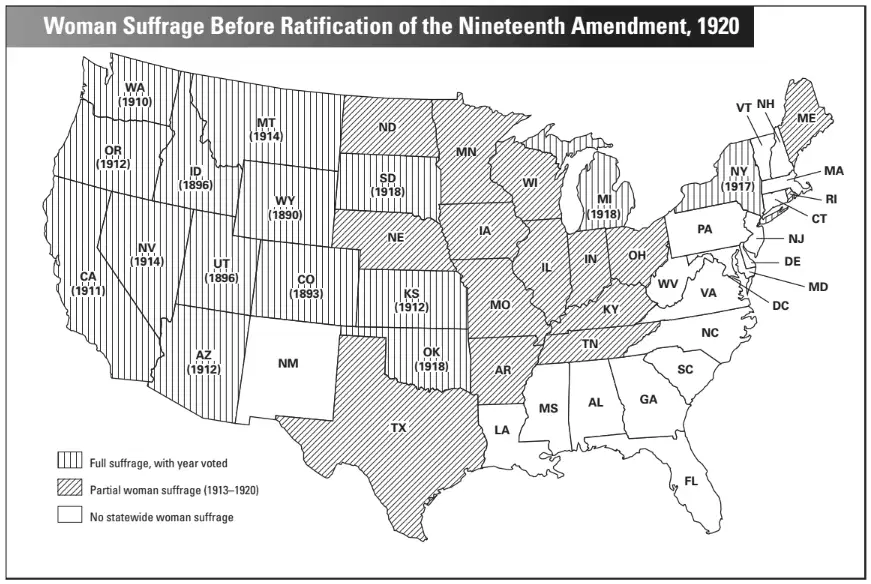
In which region of the U.S. did women receive the most support for equal suffrage before the passage of the 19th Amendment?
East
South
North
West
The Red Scare of the 1920s reflected a fear of government takeover by?
The military
German invading forces
Communists & Anarchists
Industrial leaders and stockholders
Which trial in 1925 represented a conflict between science and religion?
Sacco & Vanzetti trial
Scopes trial
Sterns trial
Schenck vs. U.S.

In the political cartoon, which statement best represents the cartoonist's point of view?
Men are the best babysitters.
Two kids are better than one.
If women vote, men will have more responsibility at home.
Birth control should be made.

What is this political cartoon referring to?
Fear of communism spreading
An unwillingness to lose American lives fighting in foreign wars
An effort to conquer foreign lands in order to build an empire
The "white man's burden"
The factories depicted behind Uncle Sam would be in reference to what?
Industrial production
Progressive reforms
Building military bases
Fear of immigrants
What weakened the economy during the 1920s?
Too much foreign trade with European and Asian countries
Overproduction in agriculture and industry leading to a decline in prices
An unwillingness to buy on credit
Sharp increases in national debt
In the 1920s, this caused a slowdown in international trade.
Low tariffs
High tariffs
High stock prices
Low stock prices
The (a) market crash of 1929 was seen as the start of the Great Depression.
President Hoover believed that citizens should save themselves by working hard. What was this called?
Socialism
Dependency
Rugged individualism
Helplessness
Which president believed the economy would recover on its own during the Great Depression?
Pres. Ford
Pres. Hoover
Pres. Franklin Roosevelt
Pres. Taft
When Franklin D. Roosevelt was elected in 1932, this reflected the desire of many Americans to...
Have the government take an active role in solving economic problems
Have the government take a hands-off approach to solving economic problems
Return to the policy of laissez-faire
Abandon capitalism in favor of socialism
What technology assisted President Roosevelt in conveying messages that restored citizens' confidence in the U.S. economy?
(a)
Starting programs that would provide immediate economic relief was which step in Franklin Roosevelt's goal to counteract the Great Depression?
Initial (first) goal
Second goal
Last goal
This wasn't part of his plan
I want to talk for a few minutes with the people of the United States about banking—with the comparatively few who understand the mechanics of banking, but more particularly with the overwhelming majority who use banks for making deposits and drawing checks. I want to tell you what has been done in the last few days, why it was done, and what the next steps are going to be. I recognize that the many proclamations from State Capitols and from Washington, the legislation, the Treasury regulations, etc., couched for the most part in banking and legal terms, should be explained for the benefit of the average citizen. I owe this in particular because of the fortitude and good temper with which everybody has accepted the inconvenience and hardships of the banking holiday. I know that when you understand what we in Washington have been doing, I shall continue to have your cooperation as fully as I have had your sympathy and help during the past week. (Franklin Roosevelt, March 12, 1933)
What was the purpose of the president's fireside chats?
Talk directly to the American people
Gather ideas from the American people
To make an argument for his re-election
To criticize Herbert Hoover
I want to talk for a few minutes with the people of the United States about banking—with the comparatively few who understand the mechanics of banking, but more particularly with the overwhelming majority who use banks for making deposits and drawing checks. I want to tell you what has been done in the last few days, why it was done, and what the next steps are going to be. I recognize that the many proclamations from State Capitols and from Washington, the legislation, the Treasury regulations, etc., couched for the most part in banking and legal terms, should be explained for the benefit of the average citizen. I owe this in particular because of the fortitude and good temper with which everybody has accepted the inconvenience and hardships of the banking holiday. I know that when you understand what we in Washington have been doing, I shall continue to have your cooperation as fully as I have had your sympathy and help during the past week. (Franklin Roosevelt, March 12, 1933)
In this quote, the president discusses banking. What is he referring to?
The strength of U.S. banks in America during the Great Depression
The lack of banks in Germany causing Mussolini's rise to power
The weaknesses of banks in America during the Great Depression
The role the banks played in costing him re-election as President to Herbert Hoover
What did the Social Security Act of 1935 protect?
Labor unions
Disabled and retirement-age people
Struggling farmers
Banks that failed during the Great Depression

Who is the man in this cartoon?
Warren Harding
Alvin York
Franklin Roosevelt
William Howard Taft
What do the letters on the shirts of the children represent?
New Deal programs designed to fix the economy
WWI weapon systems
Abbreviations for territories taken by the U.S. during the Age of Imperialism
Acronyms for groups that were active during the Progressive Era
Between WWI and WWII, most Americans felt the U.S. should follow which foreign policy?
Spreading of communism
Collective security and defensive alliances
Internationalism and free trade with China only
Neutrality & isolation
Before WWII, economic crises and people willing to listen to those who claimed they could fix them led to...
Socialism in the U.S.
A second Great Depression in the U.S.
Rise of dictators in Europe
Rise of a dictator in the U.S.
Who believes that extreme loyalty to the country comes first, even if it tramples on a minority group?
Buddhist
Anarchist
Democrat
Fascist
What was the agreement before WWII in which the Allies appeased Hitler?
Warsaw Pact
Munich Agreement
Treaty of Versailles
NATO
What was the role of the U.S. in the early stages of WWII?
Supplied Allies with weapons and food
Completely avoided involvement and closed all ports of trade with others
Asked Japan to intervene in China to prevent them from becoming Communist
Built up our army so it would be fully trained and ready for war
When Japan bombed Pearl Harbor and Hitler declared war on the U.S., what was this event in U.S. history?
Entry into WWI
Entry into WWII
Entry into the Cold War
Start of the Great Depression
Let me give you an illustration: Suppose my neighbor's home catches fire, and I have a length of garden hose four or five hundred feet away. If he can take my garden hose and connect it to his hydrant, I may help him put out his fire.
In other words, if you lend certain munitions and get the munitions back at the end of the war, if they are intact, haven't been hurt – you are all right; if they have been damaged, deteriorated, or lost completely, it seems to me you come out pretty well if they are replaced by the person to whom you lent them. (Pres. Franklin D. Roosevelt, Dec. 17, 1940)
What does this passage refer to?
Expression of American Isolationism
Return to normalcy following WWI
Selective Service Act
Lend-Lease Act
Well, let me give you an illustration: Suppose my neighbor's home catches fire, and I have a length of garden hose four or five hundred feet away. If he can take my garden hose and connect it to his hydrant, I may help him put out his fire...
In other words, if you lend certain munitions and get the munitions back at the end of the war, if they are intact, haven't been hurt – you are all right; if they have been damaged or have deteriorated or have been lost completely, it seems to me you come out pretty well if you have them replaced by the fellow to whom you lent them. (Pres. Franklin D. Roosevelt, Dec. 17, 1940)
What was the main goal of the program mentioned in the passage?
To keep the U.S. from getting involved in WWI
Provide weapons and aid to Allied countries fighting against Germany in WWII
To help the American economy recover after WWI
Draft men into the U.S. Military to help the country prepare for WWII

