
 Worksheets
Geography and Earth Science Quiz
Total questions: 82
Worksheet time: 41mins
Where does internal force originate from?
Inside the Earth.
Outside the Earth.
Solar radiation.
Earth's gravity.
What is the source of external force?
Inside the Earth.
Earth's gravity.
Solar radiation.
Earth's core.
Where is the average temperature highest?
Western hemisphere.
Ocean.
Land.
Eastern hemisphere.
Where is the average temperature lowest?
Eastern hemisphere.
Land.
Ocean.
Western hemisphere.
What is air pressure?
Air not pressing down on the Earth.
Air pressing down on the Earth.
Air not pressing down on the ocean.
Air pressing down on water.
Which belt is a low-pressure area?
Equator, tropics.
Tropics, temperate.
Temperate, equator.
Poles, tropics.
What causes wind?
High and low pressure.
Convection and condensation.
Land and ocean.
Mountain slopes.
Where do westerlies blow from?
Tropics to temperate.
Poles to temperate.
Equator to temperate.
Equator to tropics.
Where do trade winds blow from?
Tropics to temperate.
Poles to temperate.
Equator to tropics.
Equator to temperate.
What is the characteristic of trade winds?
Hot and humid.
Dry.
Cold and dry.
Humid.
What is the characteristic of westerlies?
Hot and humid.
Cold and dry.
Dry.
Humid.
What is a feature of monsoon winds?
Wind direction changes with seasons.
Air composition does not change.
Wind direction does not change.
Air composition changes with seasons.
Low pressure areas have a lot of rain because
There is always wind blowing out from the center.
There is always wind blowing out from the edge.
Moist air is pushed up high.
Moist air is not lifted.
Where is there little rain?
Between hot and cold air masses.
Between high pressure and low pressure areas.
Areas with many strong air disturbances.
Areas that frequently have strong winds blowing away.
Where is there little rain?
Where a cold ocean current passes.
Where a warm ocean current passes.
Where there is a lot of dragon activity.
Where there is a tropical convergence.
In a mountain range, there is usually a lot of rain on
the leeward side.
the high side of the mountain.
the peak of the mountain.
the windward side.
Which statement is correct regarding the distribution of rainfall on Earth?
There is a lot of dry rain in the equatorial region.
There is relatively little rain in the tropics.
There is not much rain in the two temperate regions.
There is relatively much rain in the two polar regions.
Factors that cause the equatorial region to have a lot of rain are
low pressure, tropical convergence, warm ocean current.
low pressure, tropical convergence, cold ocean current.
tropical convergence, warm front, trade winds.
tropical convergence, high mountains, trade winds.
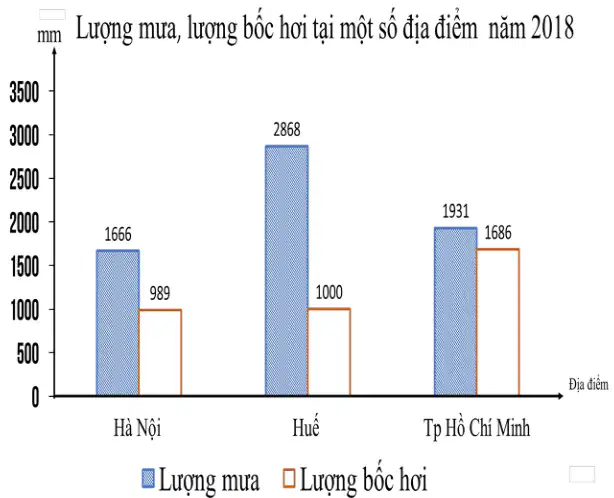
Given the chart below
Hue has the highest rainfall among the three cities.
Hanoi has the highest evaporation among the three cities.
Ho Chi Minh City has the lowest rainfall among the three cities.
Hue has the lowest evaporation among the three cities.
Thủy quyền là lớp nước trên Trái Đất bao gồm nước ở đâu?
sea, ocean; groundwater; ice; river, stream, lake.
sea, ocean; water on land; water vapor in the atmosphere.
river, stream, lake; groundwater; water in seas and oceans.
river, stream, lake; ice; water in oceans, water vapor.
Độ muối trung bình của nước biển là bao nhiêu?
33 %
34 %
35 %
36 %
Độ muối nước biển lớn nhất ở vùng nào?
equator
tropical
polar
temperate
Nhiệt độ trung bình của đại dương thế giới là bao nhiêu?
15.5°C
16.5°C
17.5°C
18.5°C
Càng xuống sâu, nhiệt độ nước biển sẽ như thế nào?
low
high
increase
unchanged
Nước trên lục địa gồm nước ở đâu?
on the surface, groundwater
on the surface, water vapor
groundwater, water vapor
ice, river, lake
Nước băng tuyết ở thể nào sau đây?
Solid
Liquid
Vapor
Gas
Băng hạ có tác dụng chính trong việc gì?
storing freshwater
regulating climate
lowering sea level
raising terrain elevation
Nước ngầm được gọi là gì?
saline water reservoir of the Earth
foundation supporting terrain
source of rivers and streams
freshwater reservoir of the Earth
Giải pháp nào sau đây được xem là quan trọng hàng đầu trong bảo vệ nguồn nước ngọt trên Trái Đất?
Raising awareness
using water efficiently
Keeping water clean
punishing, rewarding
Ở những vùng đất, đá thấm nước nhiều, nhân tố nào sau đây có vai trò đáng kể trong việc điều hoà chế độ nước của sông?
Groundwater
Ice
Terrain
Vegetation
Ý nghĩa của hồ đầm đối với sông là gì?
regulating river water regime
reducing river water flow
many valleys
steep terrain
Ở miền núi, nước sông chảy nhanh hơn đồng bằng là do có yếu tố nào?
complex terrain
many valleys
many high peaks
steep terrain
Yếu tố nào sau đây góp phần chủ yếu làm cho chế độ nước sông điều hoà?
Rainwater flowing on the surface
Groundwater springs
Steep hilly terrain
Wide flat land surface
Sông nằm trong khu vực xích đạo thường có nhiều nước vào thời gian nào?
in summer
in spring
all year round
seasonally
Nguồn cung cấp nước cho sông ở hoang mạc chủ yếu là gì?
surface water
groundwater
ice
rainwater
Hình thức dao động của sóng biển là theo chiều nào?
vertical
circular
What is the main cause of ocean waves?
Rain.
Volcanoes.
Earthquakes.
Wind.
What is the main cause of tsunamis?
Wind.
Storms.
Earthquakes.
Volcanoes.
What causes tides?
The gravitational pull of the Moon and the Sun.
The strength of ocean currents.
Large-scale volcanic activity.
Earthquake activity.
Which climate is typical for tropical continental regions?
Warm, rainy.
Dry, little rain.
Cold, rainy.
Hot, rainy.
What is a characteristic of soil (usually)?
Porosity.
Fertility.
Hardness.
Loose material.
What is soil (usually) made of?
Porous surface of the Earth.
Surface of the Earth.
Soft surface of the continent.
Loose surface of the Earth.
Which of the following is a direct factor affecting the formation of soil's organic component?
Climate.
Living organisms.
Parent rock.
Topography.
What is an important role of living organisms in soil formation?
Contribute organic matter.
Help destroy soil.
Prevent erosion.
Decompose and form humus.
Which factor directly affects the formation of the inorganic component of soil?
Climate.
Living organisms.
Parent rock.
Topography.
Which combination of factors most directly influences soil formation?
Temperature and humidity.
Water and air.
Heat and humidity.
Heat and water.
What is the correct order of soil layers from top to bottom?
Weathered layer, humus layer, parent rock.
Humus layer, weathered layer, parent rock.
Parent rock, weathered layer, humus layer.
Weathered layer, parent rock, humus layer.
What is one of the roles of geography in the formation of soil?
Creating organic matter
Providing organic matter
Creating soil rings
Destroying rock roots
Which statement is correct about the relationship between the activities of soil-forming factors?
No interaction
Acting in a certain order
Related to each other
No effect on each other
Which factor most affects the development and distribution of organisms due to soil formation?
Plants in tropical areas with high temperature
Animals in deserts with few species
Shade-tolerant species in dense forests
Tall trees in tropical rainforests
Which factor most affects the appearance and end of vegetation rings?
Slope
Slope direction
Slope aspect
Slope steepness
Which factor affects the distribution of vegetation rings in temperate zones?
Temperature and humidity
Humidity and rainfall
Rainfall and wind
Temperature and air pressure
Which biological factor determines the distribution of animal rings?
Temperature
Humidity
Food
Habitat
According to the rainfall data for Da Nang in 2021, which month had the highest rainfall?
May
September
November
December
What is the average annual rainfall in Da Nang in 2021?
485.8 mm
2492.1 mm
782.8 mm
93.5 mm
Why do rainfall levels increase mainly due to wind activity and tropical monsoon?
Because of high temperature
Because of wind and monsoon activity
Because of low humidity
Because of low pressure
What is one of the economic values of the sea?
The sea is a source of oil and gas
The sea is a source of fresh water
The sea is a source of minerals
The sea is a source of wood
How do the sea and oceans contribute to the development of the fishing industry?
By providing oil and gas
By allowing the development of fishing and aquaculture
By providing minerals
By providing fresh water
Why do animals often hide in caves, burrows, or climb high places?
To avoid heat and sunlight.
To find food easily.
To avoid predators.
To avoid cold and maintain body temperature.
How does climate affect the living organisms?
By providing water only.
By affecting temperature and sunlight.
By changing soil composition.
By increasing food supply.
Which of the following is NOT a main component of soil?
Minerals
Organic matter
Water
Plastic
Based on the data, what is the average temperature in Lang Son in January 2021?
13.7°C
18.7°C
22.1°C
24.5°C
If the average temperature at the base of Hoang Lien Son mountain (0m) is 15°C, what is the temperature at 1000m altitude?
10°C
12°C
15°C
18°C
What is the temperature difference between January and July in Hanoi according to the table?
10.0°C
12.5°C
16.4°C
28.9°C

Based on the table, which month has the highest average temperature in Lang Son?
January
May
June
July

What is the total rainfall in Da Nang in 2021 according to the provided data table? (Round your answer to the nearest whole number in mm)
2,500 mm
2,900 mm
3,000 mm
3,500 mm

Which month had the highest rainfall in Hue in 2021?
September
October
November
December

Based on the data, what is the total rainfall in Hanoi in 2022? (Round your answer to the nearest whole number in mm)
1,900 mm
2,200 mm
2,500 mm
2,800 mm

If the rainfall in Cà Mau in July 2022 was 565.0 mm, which of the following months had the lowest rainfall?
January
February
December
March

Using the rainfall data for Da Nang in 2021, which month had the least rainfall?
January
April
July
August

Based on the rainfall data for Hanoi in 2022, which month had the highest rainfall?
July
August
September
October

What is the total rainfall in Cà Mau in 2022 according to the provided data table? (Round your answer to the nearest whole number in mm)
3,000 mm
3,500 mm
4,000 mm
4,500 mm
Based on the given data table, what is the sum of all the flow rates (Lưu lượng) listed?
8186
7000
9000
7500
What is the average annual flow rate at Yên Thượng station on the Cà river, rounded to the nearest whole number (m³/s)?
682
700
750
800
If you were to calculate the average flow rate from the given data, which mathematical operation would you use?
Addition and division
Multiplication and subtraction
Subtraction and division
Multiplication and addition
Which of the following is a reason why we should protect freshwater sources?
Freshwater is unlimited and does not need protection.
Freshwater is essential for drinking, agriculture, and daily life.
Freshwater is only used for industrial purposes.
Freshwater is not affected by pollution.
Which of the following is a solution to protect freshwater sources?
Dumping waste into rivers and lakes.
Using water carelessly and excessively.
Treating wastewater before releasing it into the environment.
Ignoring water pollution problems.
What is one way local communities can help protect water sources?
Organizing clean-up campaigns for rivers and lakes.
Increasing the use of chemical fertilizers near water sources.
Building more factories near rivers.
Allowing unrestricted fishing in all water bodies.
Why is it important for local governments to implement measures to protect water sources?
To ensure water is available for future generations.
To increase pollution in the area.
To reduce the cost of water treatment.
To make water sources private property.
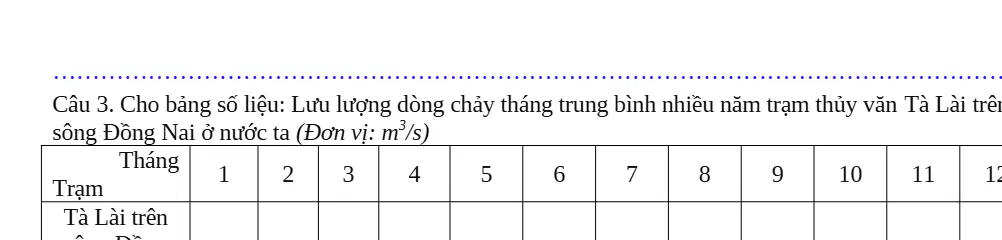
Given the table of average monthly water flow at the Tà Lài station on the Đồng Nai River, which month has the highest water flow?
August
September
October
July
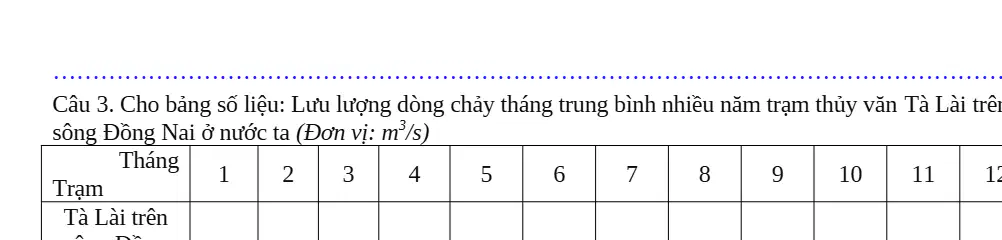
According to the data, what is the water flow (in m³/s) at Tà Lài station on the Đồng Nai River in January?
96
59
48
71
Which of the following best describes the impact of humans on the development and distribution of plants and animals in a local area?
Human activities can change habitats and affect the growth and spread of plants and animals.
Human activities have no effect on plants and animals.
Only animals are affected by human activities, not plants.
Plants and animals always thrive better in areas with more human activity.

