
NEW
Font size
 Worksheets
Periodic Table and Element Properties Quiz
Total questions: 50
Worksheet time: 46mins
Who created an early periodic table that arranged elements by increasing atomic mass and recurring chemical properties?
Dmitri Mendeleev
Albert Einstein
Marie Curie
Isaac Newton
What did Mendeleev successfully predict using his periodic table?
The existence and properties of undiscovered elements
The speed of light
The structure of DNA
The laws of motion
What does the periodic law state about elements arranged in order of increasing atomic number?
Their physical and chemical properties repeat in a regular, predictable pattern
Their mass increases exponentially
Their color changes
Their melting points decrease
How are elements arranged in the modern periodic table?
By increasing atomic number
By decreasing atomic mass
By alphabetical order
By color
Which property is NOT typical of metals?
Brittle
Shiny
Malleable
Good conductors of heat
Why do metals lose electrons more easily down a group?
Because of low ionization energy, large atomic size, and electron shielding
Because of high melting points
Because of small atomic radius
Because of strong nuclear attraction
What type of ions do nonmetals tend to form?
Negative ions
Positive ions
Neutral ions
Metallic ions
What is a property of metalloids?
Partial conductivity and variable reactivity
High malleability
Strong magnetism
High ductility
What determines the block identity in the periodic table?
Type of atomic orbital (s, p, d, or f) being filled by valence electrons
Atomic mass
Color of the element
Melting point
What can hydrogen do with its electron?
Lose, gain, or share it covalently
Only lose it
Only gain it
Only share it
How do alkaline earth metals react with water and oxygen compared to alkali metals?
Less violently
More violently
Not at all
Equally violently
What type of ions do alkaline earth metals form?
+2 ions
+1 ions
-1 ions
-2 ions
Which element group is described as shiny, malleable, ductile, and good conductors of heat and electricity?
Metals
Nonmetals
Metalloids
Noble gases
What is the role of valence electrons in determining chemical behavior?
They govern chemical reactivity and bonding patterns
They determine color
They affect melting point
They control magnetism
What is the main factor that helps predict block identity in the periodic table?
Type of atomic orbital being filled
Atomic mass
Color
Melting point
Why do metals generally have high reactivity?
Because electron loss becomes easier down a group
Because they have high melting points
Because they are brittle
Because they have strong nuclear attraction
Which group of elements has full valence shells, making them chemically inert?
Halogens
Transition Metals
Noble Gases
Lanthanides
What drives the reactivity of halogens with metals?
Low electronegativity
High electronegativity
Maximum electron pairing
Large atomic radius
What happens to the reactivity of halogens as you move down the group?
It increases
It remains constant
It decreases
It fluctuates
What enables transition metals to have colored compounds?
Electron shielding
d–d electron transitions
Maximum electron pairing
High electronegativity
What property do transition metals have due to their valence electrons being more tightly held than in s-block metals?
High reactivity
Moderate reactivity
No reactivity
Maximum electron pairing
Which block elements have similar chemical behavior because their valence electrons occupy the 4f or 5f orbitals?
s-block elements
p-block elements
f-block elements
d-block elements
Ion formation depends on which of the following?
Electron shielding only
Atomic size only
Valence electron configuration, atomic size, and electron shielding
Maximum electron pairing only
What is electron shielding?
The attraction between protons and neutrons
The reduction in the attractive force felt by valence electrons due to repulsion from inner electrons
The increase in atomic radius
The removal of valence electrons
Ionization energy is the energy required to:
Add a valence electron to a neutral atom
Remove a valence electron from a neutral atom
Pair electrons in an orbital
Increase atomic radius
Which elements have multiple oxidation states due to partially filled d orbitals?
Halogens
Noble gases
Transition metals
Lanthanides
Which property allows transition metals to enable catalytic activity?
Maximum electron pairing
Moderate reactivity
High electronegativity
Large atomic radius
What is electronegativity a measure of?
An atom’s ability to attract electrons in a chemical bond
An atom’s ability to lose electrons
An atom’s ability to gain protons
An atom’s ability to form positive ions
How does metallic character change across a period?
It decreases
It increases
It stays the same
It becomes zero
What is the main reason for the increase in nonmetallic character across a period?
Increasing atomic number enhances nuclear attraction
Decreasing atomic number weakens nuclear attraction
Electrons are less shielded
Protons are lost
Shielding increases with ...
a decreasing number of energy levels
an increasing number of energy levels
an increasing number of valence electrons
a decreasing number of valence electrons
Which of the following is MOST reactive?
Lithium
Lead
Tin
Copper

What are valence electrons?
The total number of electrons in an atom
The number of electrons in the outermost shell
The number of electrons in the second shell
The number of protons in the outermost shell
Which elements have the most similar chemical properties?
boron and carbon
oxygen and sulfur
aluminum and bromine
argon and silicon
What element contains 7 protons and 5 valence electrons?
Boron
Vanadium
Nitrogen
Lithium
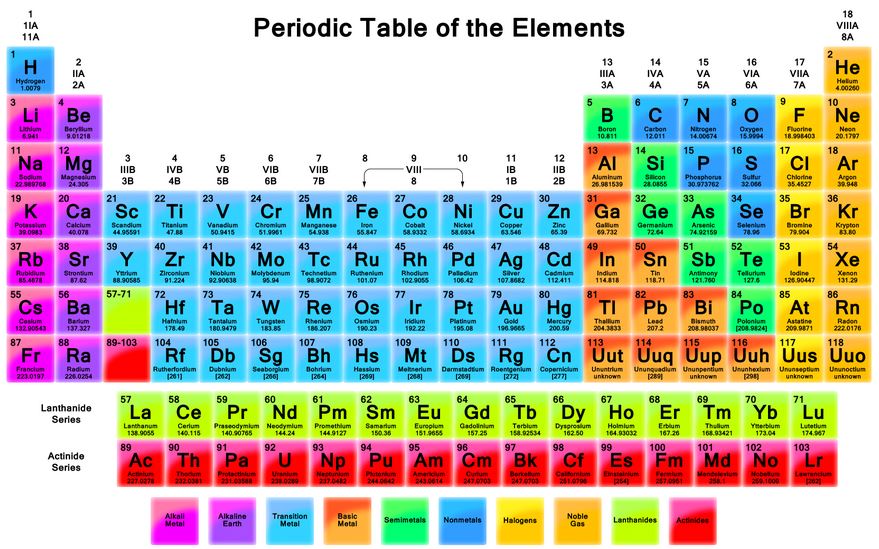
Why are metals malleable?
They are shiny
The electrons are held tightly within the lattice structure making it strong
The electrons are delocalized and able to move between the atoms
The electrons are shared between two metal ions and this holds the atoms together
Place the following in order of decreasing metallic character; P, As and K.
K > As > P
As > P > K
P > As > K
As > K > P
What is the trend in ionization energy as you move from left to right across a period?
It decreases
It fluctuates
It remains constant
It increases
Which group of elements typically forms negative ions by gaining electrons?
Noble gases
Transition metals
Halogens
Alkali metals

Elements in the same group or column have the same ...
# of valence electrons
# of shells
# of protons
Mass Number

How many Valence electrons does Ba-Barium have?
3
2
6
56

Which element is more reactive?
Cs - Cesium
Ca - Calcium
C - Carbon
He - Helium

Using the Blank Periodic Table:
Which elements would have similar chemical properties as element A?
A
B
F
G
H

How many valence electrons does this atom have?
4
2
6

