
 Worksheets
MOD 9 Exodus review
Total questions: 84
Worksheet time: 42mins
_____ Antenna that offers conveying of signals to-and-from the dish, often attached to waveguides.
Coaxial Cable
Reflector
Feed Horn
Whip Antenna
What does MODEM stand for?
Multiplexing-Demultiplexing
Multiplex-Demultiplex
Modulate-Demultiplex
Modulate-Demodulate
Does a Modem use a transponder?
YES
NO
Circular polarization allows adjustments to which two forms?
Left-hand and right-hand
Narrowband and wideband
Horizontal and diagonal
Co-polarized and cross polarized
When receiving a signal from a satellite, what happens first?
Modem demodulates signal
Amplifier increases downlink power
Signal reflects off the parabolic dish into feed horn
Block up converter increases frequency
The FEC “rate” 1/2, 2/3 ,3/4 indicates what?
The frequency deviation of the modem
How many copies of the message are transmitted
The number of feed horns required
Which encryption key is in use
capable of adjusting for different types of polarization.
Reflector
ICBM with a B83 Warhead
Feed Horn
North and South
MODEMs can house different connections such as RS-232, RS-422, HSSI, and Ethernet
True
False
What is the primary purpose of coaxial cables in satellite communication terminals?
To store power for the antenna
To align the satellite dish
To cool the RF equipment
To pass signals throughout the terminal
What is the inner conductor of a coaxial cable also known as?
Center conductor
Dielectric core
Braided shield
Outer jacket
What is one modern alternative to coaxial cables for sending RF signals?
Fiber
HDMI cables
Ethernet
Twisted pair copper
Older modems typically used how many access methods?
3
2
4
1
How many transit cases for the GMT fit on one 463L pallet?
29
19
25
24
TRUE or false, Hub 1 and 2 are identical and interchangeable?
False
True
Multiband Satellite Terminals have the capability to operate on _______.
C, X, K and Ka-bands
C, X, and all three K-bands
C, X, Ku and Ka-bands
X, Ku, K and Ka-bands
What is the defining feature of GMT Hub1 and Hub 2
Hub 1 and Hub 2 are identical and interchangeable
Hub 2 has twice the bandwidth capacity of Hub 1
Hub 1 can handle commercial satellites, Hub 2 only handles military satellites
Hub 2 is receive only while hub 1 is transmit only
The GMT is capable of how many uplinks and downlinks per hub?
1 uplink, 3 downlinks
1 uplink, 6 downlinks
2 uplinks, 12 downlinks
4 uplinks, 8 downlinks
The Remote PDP can be how many feet away from the generator?
250 Feet
300 Feet
350 Feet
50 Feet
PDPs used with the GMT require what type of input cable?
80 amp six wire braided cable
120- amp dual-phase cable
60 amp five-wire power cable
30 amp three wire copper cable
Including both hubs, The GMT’s total capacity is__
1 uplink, 6 downlinks
2 uplinks, 6 downlinks
2 uplinks, 12 downlinks
4 uplinks, 8 downlinks
How many total GMT transit cases are required for deployment?
14
22
25
29
How many antenna cases does the GMT use?
19
29
25
18
The NSM is best described as what type of multiplexer ?
Synchronous time division digital multiplexer
Packet- switched router
Analog signal multiplexer
Asynchronous frequency division multiplexer
What is the primary function of a Block Down Converter (BDC)?
Convert IF to RF
Convert downlink frequency to IF
Extract data from the signal
Amplify the uplink signal
After conversion by the BDC, where is the signal sent?
Antenna
Satellite
Power amplifier
Modem
What capability does the NSM provide when interfacing modems with terminal radio equipment?
Half-duplex only
Full- duplex communication
Simplex communication
One-way transmission
What is the maximum data rate the NSM can operate at ?
26Mbps
100 Mbps
52Mbps
32Mbps
After receiving data from the DTE, the modem modulates the information into what?
Infra-red (IF)
Intermediate Frequency (IF)
Interdimensional Frequency (IF)
Intertwined Frequency (IF)
What does the port router in the NSM provide?
Interconnectivity of data flow
Frequency conversion
Error correction
RF amplification
Monitor and control of the NSM is accomplished through which connection?
USB
RS-422
RS-232
Ethernet
TRUE or FALSE The block up converter’s primary responsibility is to translate the IF?
False
True
From the modem, the IF is passed to what?
Block Up Converter
Feed Horn
Block Down Converter
NSM
In the GMT, NSM monitoring and control is handled through which interface?
Command line Interface (GUI)
SNMP Manager
Local Terminal Display
Control, Monitor, and Alarm (CMA) GUI
Amplification in transmission uses an HPA
True
False
Used in communications terminals to amplify the radio frequency to a level suitable to reach the satellite.
receiver
Amplifier
Antenna
Modem
Most commonly used Amplifier in satellite comms?
Stationary Wave Tube Amplifier
Mobile Wave Tube Amplifier
Traveling Wave Tube Amplifier
Moving Wave Tube Amplifier
What happens to the signal strength as the Vacuum tube heats up?
Amplifies
Modulates
Moderates
Weakens
the block up converter conveys the _____ to the amplifier though a coax cable
X-Band
Demodulated Signal
Receive signal
Transmit signal
The up Converter also provides a variable amount of attenuation to control
The Sideband's
Total Power
The Down Converter
The Carrier wave
The NSM is a ____________ time division digital multiplexer
Synchronous
Asynchronous
Wireless
High power

What is this?
HPA
LRO
NSM
BDC
What is the correct receive signal path?
Modem- HPA-BUC-LNA
Feed Horn-BUC-BDC-Modem
Feed Horn-TWTA-BDC-Modem
Feed Horn-LNA-BDC-Modem
What is the purpose of the block down converter?
Translate IF to RF
Convert RF to IF
Modulate Data
Amplify weak signals
Ground terminals often receive a weak downlink signal from the satellite because?
physical distance
Intellectual distance
Psychological distance
Humidity
What is the typical strength of a satellite downlink before LNA amplification?
-20 to 0 dBm
-140 to -70 dBm
-10 to +10 dBM
+10 to +30 dBm
Why is a low noise amplifier (LNA) used in the receive chain?
To amplify without degrading Signal-to-noise ratio
To increase frequency
To convert radio frequency to intermediate frequency
To demodulate the signal
In order to bring the signal to a usable level, it is passed through a
Speaker
High Noise Amp
Low Noise Amp
Coaxial Cable interface
What is day is 167 on a Julian calendar?
September 21
JUN 16
March 03
August 08
What frequency does the rubidium oscillator distribute to GMT equipment?
1MHz
5 MHz
6 GHz
9 GHz
What component supplies the GMT with a highly stable timing source?
Cesium Oscillator
Data modem
Stratum -10 timing source with cesium oscillator
Stratum-1 timing source with rubidium oscillator
What is stored by the internal battery inside the TRAK 9000 expansion card?
User frequency presets
GPS Almanac Data
Satellite beacon strength logs
Modem configuration files
What is day is 232 on a Julian calendar?
May 04
November 15
August 20
July 11
What information is shown on the Time of Year (TOY) display?
Modem Configuration
Only Local Time
Only GPS satellite count
Day of the Year and UTC/local Time
What information does the Time of Year (TOY) display provide that is critical for timing verification?
Julian date and ITC/local time
Satellite data
Antenna azimuth and elevation
Fault status indicators
What is the purpose of the ENT key?
Scroll through modules
Clear all data
Enter selected Data
Reset the timing unit
Which sequence correctly allows an operator to view the setup screen without modifying system parameters?
MENU -> ENT -> NEXT
SEL -> NEXT -> ENT
NEXT -> PREV -> ENT
STAT -> NEXT repeatedly
What is the function of the SEL key in multi-option setup screens?
Scrolls through available choices
Saves configuration data
Navigates between screens
Resets cursor position
Which rear panel port supports remote monitoring and asynchronous ASCII command communication?
EXT STD
RS-232A
STATUS
RS-232B
Each hub in the GMT has a non-dedicated timing unit allowing both hubs to operate in tandem
True
False
What is the diameter of the Small Aperture Antenna (SAA)
1.2m
2.4m
4.9m
6.1 m
What is the diameter of the Q-LAA antenna?
4.9 m
2.4m
3.9m
5.2 m
The Quad- Band Large Aperture antenna (Q-LAA) is best described as
A fixed-site antenna requiring external control systems
A trailer-mounted antenna with Ka-Band only capability
A self-contained transportable antenna subsystem
An offset-fed antenna requiring an external GMT kit
What is the Diameter of LAMDA
4.9m (16ft)
2.4 (8ft)
3.9 (13ft)
6.1 (20ft)
What is the diameter of the Q-LAA antenna?
4.9m
6.1m
3.9m
2.4m
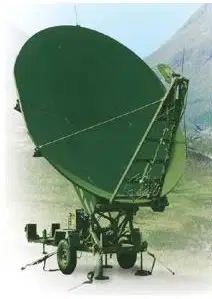
What type of antenna is this?
SAA
QLAA
LAMDA
QRSA
Optrack is the Secondary tracking mode used in the ACU
True
False
What antenna is commonly referred to as the Trailer Mounted Antenna (TMA)
LAMDA
LHGXA
OE-36 QRSA
Q-LAA
What is the primary tracking mode used in the ACU?
Step Track
Memory Track
Geo Track
OpTrack
During Step Track, what happens if no signal meets the threshold?
A box scan is performed
Tracking Steps
The HPA is disabled
Antenna shuts down
Position Track requires the operator to enter:
Latitude and Longitude
Initial azimuth, elevation, and polarization
Orbital slot and footprint
Tracking gain levels
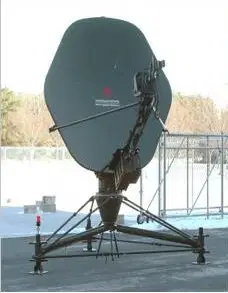
What antenna is this?
SAA
QLAA
LAMDA
QRSA
Geo Track requires operator entry of
Azimuth and Polarization
Antenna size and GPS time
Satellite latitude and longitude
Wavelength and Frequency
Optrack works by storing ________.
Azimuth, Elevation, and Polarization
Timing, Latitude, and Longitude
Azimuth, Elevation and Synchronization
Geolocation
Step track works by searching for any signal that breaches the established signal threshold.
True
False
Which antenna requires the largest crew and longest setup time?
LHGXA
Q-LAA
OE-36 QRSA
LAMDA
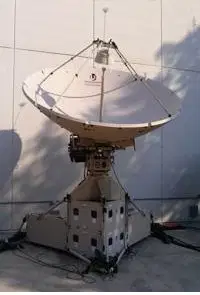
What type of antenna is this?
SAA
QLAA
LAMDA
QRSA
Why does memory track work effectively with geosynchronous satellites?
They do not require active tracking
They operate in multiple frequency bands
They transmit higher power signals
They maintain consistent daily rotation
Which antenna is capable of worldwide operations with DSCS, NATO IV, and Skynet
Q-LAA
LHGXA
LAMDA
OE-36 QRSA
Position Track, Geo Track, Position Track are all enhanced versions of OpTrack
False
True
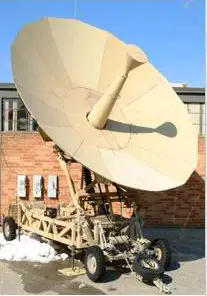
What antenna is this?
SAA
QLAA
LAMDA
QRSA
If the step track finds no signal after a box scan, what message appears?
NO SIGNAL FOUND
TRACKING FAILED
BEACON LOST
SAT NOT AVAILABLE
Memory track improves performance by
Replacing OpTrack
Storing satellite positions over time
Removing LNA noise
Reducing antenna size requirements
Memory track works because geosynchronous satellites do what?
Drift rapidly
Change orbits daily
Have predictable daily movement
Require constant recalibration
Which Antenna System requires up to 1 to 2 hours to set up and requires 6-8 people?
SAA
QLAA
LHGXA
QRSA

