
NEW
Font size
 Worksheets
NASH-JAS- Reviewer 2025
Total questions: 50
Worksheet time: 32mins
Face-to-face (F2F) learning refers to a learning delivery modality (LDM) where the teacher and learner/s are physically in one venue. What makes it distinct from other learning modalities?
1. There are opportunities for active engagement, immediate feedback and socioemotional development of learners.
2. It may be conducted in any available physical learning space.
Statement 1 alone is sufficient but statement 2 alone is not sufficient to answer the question.
Statement 2 alone is sufficient but statement 1 alone is not sufficient to answer the question.
Both statements 1 and 2 are sufficient to answer the question.
Each statement alone is sufficient to answer the question.
Michael was given materials or access to resources and he undertakes self-directed study at home or in another venue. What kind of learning delivery modality was given to him?
Face-to-face
Homeschooling
Distance learning
Blended learning
Which is NOT an example of blended learning?
F2F and homeschooling
F2F and modular distance learning
F2F and online distance learning
F2F and TV-based instruction/Radio-based instruction
Neshelle was enrolled in an alternative learning delivery mode (ADM) that provides her with access to formal education while staying in an out-of-school environment, with her parents as authorized facilitators instead of classroom teachers. What type of ADM was used?
Face-to-face
Homeschooling
Distance learning
Blended learning
Which of the LDMs do not have a face-to-face learning component?
1.Distance learning
2.Home schooling if done via distance learning
Statement 1 alone is sufficient but statement 2 alone is not sufficient to answer the question.
Statement 2 alone is sufficient but statement 1 alone is not sufficient to answer the question.
Both statements 1 and 2 are sufficient to answer the question.
Each statement alone is sufficient to answer the question.
The Schools Division Office chose a learning delivery that is in the form of individualized instruction where learners use self-learning modules (SLMs) in print or digital format, whichever is applicable in the context of the learner, with the guidance of any member of the family or other stakeholder in the community trained to serve as learning facilitators. What was used by the SDO as a learning delivery?
Homeschooling
Modular distance learning
Online distance learning
TV-based instruction/Radio-based instruction
Teacher Oscar facilitates learning and engages learners' active participation using various technologies connected to the internet while they are geographically remote from each other. What type of LDM was used by the teacher?
Homeschooling
Modular distance learning
Online distance learning
TV-based instruction/Radio-based instruction
Schools may adopt a combination of both synchronous and asynchronous online teaching in consideration of the Screen Time Guidelines by Age as recommended by the American Academy of Pediatrics (AAP) and World Health Organization (WHO). Which is INCORRECT with regards to screen time of pupils/students?
Key Stage 1 (K to 3): At most, one hour daily for Kindergarten and one hour to 1.5 hours for Grades 1 to 3
Key Stage 2 (Grades 4 to 6): Up to two hours in the morning and two hours in the afternoon
Key Stage 3 (Grade 7 – 10): Up to two hours for Grades 7-8 and up to four hours for Grades 9-10 (two hours in the morning and the other two hours in the afternoon)
Key Stage 4 (Grades 11 to 12): At most four hours (two hours in the morning and the other two hours in the afternoon)
It is conducted using live webinars, video conferencing, live chat or instant messaging.
1. Synchronous learning
2. Asynchronous learning
Statement 1 alone is sufficient but statement 2 alone is not sufficient to answer the question.
Statement 2 alone is sufficient but statement 1 alone is not sufficient to answer the question.
Both statements 1 and 2 are sufficient to answer the question.
Each statement is not sufficient and additional data is needed to answer the question.
Under this platform, LMS shall be utilized for self-paced learning. This avoids the assumption that technology is readily available for learners when the teacher deems it as necessary or that learners are in an environment that is free of distraction at the allotted class meeting time.
1. Synchronous learning
2. Asynchronous learning
Statement 1 alone is sufficient but statement 2 alone is not sufficient to answer the question.
Statement 2 alone is sufficient but statement 1 alone is not sufficient to answer the question.
Both statements 1 and 2 are sufficient to answer the question.
Each statement is not sufficient and additional data is needed to answer the question.
Teacher Pacita uses the programs Sineskwela at Math-Tinik which are dedicated to providing learning content to learners in Science and Mathematics, respectively as a form of distance education. These are examples of what type of LDM?
Homeschooling
Modular distance learning
Online distance learning
TV-based instruction/Radio-based instruction
For a lesson on figures of speech, learners read about “Figurative Language” and perform exercises through the use of a printed self-learning module in their respective homes. The following day, they attend a face-to-face class where Teacher Queenie checks on their answers to the exercises and attends to the difficulties and misconceptions of the learners related to the lesson. What type of Blended Learning was used?
Blended face-to-face and Online Distance Learning (ODL)
Blended face-to-face and Modular Distance Learning (MDL)
Blended face-to-face and Television/Radio-Based Instruction (TVI/RBI)
Blended face-to-face and Television/Radio-Based Instruction (TVI/RBI) and Online Distance Learning (ODL)
Teacher Raul discusses key concepts on matter during the face-to-face class. The learners are then given two activity sheets to take home. Activity Sheet 1 requires each learner to watch the TV episode on States of Matter that will be broadcasted via IBC 13 network at 5:44-6:09 p.m. and then answer the guide questions provided. The next day, the learners remain in their respective homes and accomplish Activity Sheet 2. Activity Sheet 2 instructs them to perform an experiment on describing changes in materials based on the effect of temperature using an interactive simulations site. They then share and compare the results they gathered from the activity with their group mates via Facebook Messenger and discuss answers to the activity questions. The learners submit their accomplished activity sheets to the teacher at the following face-to-face session, where all the home-based activities will also be discussed. What type of Blended Learning was used?
Blended face-to-face and Online Distance Learning (ODL)
Blended face-to-face and Modular Distance Learning (MDL)
Blended face-to-face and Television/Radio-Based Instruction (TVI/RBI)
Blended face-to-face and Television/Radio-Based Instruction (TVI/RBI) and Online Distance Learning (ODL)
For a lesson on the Philippine Revolution in Araling Panlipunan class, the learners watch the movie Bonifacio: Ang Unang Pangulo in their face-to-face session. For the next two meetings, the learners do home-based activity, where they are asked to write a 3-paragraph review about the movie they watched in class and to post their movie reviews on their Google Classroom’s discussion forum. They also comment on the movie reviews posted by their classmates. What type of Blended Learning (BL) modality was used?
Blended face-to-face and Online Distance Learning (ODL)
Blended face-to-face and Modular Distance Learning (MDL)
Blended face-to-face and Television/Radio-Based Instruction (TVI/RBI)
Blended face-to-face and Television/Radio-Based Instruction (TVI/RBI) and Online Distance Learning (ODL)
During the face-to-face class in grade 6 Edukasyon sa Pagpapakatao, Teacher Siony discusses concepts related to pagmamalasakit sa kapwa. The following day, the learners, in their respective homes, refer to an activity sheet in the learning module provided which instructs them to watch the accompanying Hiraya Manawari video lesson on the applications of this Filipino value. The activity sheet also asks the learners to answer exercises where they apply what they have learned from the video lesson. The activity sheet is submitted at the following face- to-face meeting. What type of Blended Learning (BL) modality was used?
Blended face-to-face and Online Distance Learning (ODL)
Blended face-to-face and Modular Distance Learning (MDL)
Blended face-to-face and Television/Radio-Based Instruction (TVI/RBI)
Blended face-to-face and Television/Radio-Based Instruction (TVI/RBI) and Online Distance Learning (ODL)
Students are assigned the “homework” of watching video lectures and reading any materials relevant to the next day’s class. During class time, students practice what they’ve learned through traditional schoolwork, with their teachers freed up for additional one-on-one time. What type of unique flipped classroom model was used?
Faux-Flipped Classroom
Standard Inverted Classroom
Discussion-Oriented Flipped Classroom
Demonstration-Focused Flipped Classroom
Teacher Teddy assigned lecture videos, as well as any other video or reading related to the day’s subject like TED Talks, YouTube videos, and other resources. The class time is then devoted to discussion and exploration of the subject. This can be an especially useful approach in subjects where context is everything such as history, art, or English. What type of unique flipped classroom model was used?
Faux-Flipped Classroom
Standard Inverted Classroom
Discussion-Oriented Flipped Classroom
Demonstration-Focused Flipped Classroom
This model adds a new element to help students learn — each other. The class starts the same way others do, with lecture videos and other resources shared before class. The shift happens when students come to class, teaming up to work together on that day’s assignment. This format encourages students to learn from one another and helps students to not only learn the what the right answers are but also how to actually explain to a peer why those answers are right.
Flipping the Teacher
Faux-Flipped Classroom
Virtual Flipped Classroom
Group-Based Flipped Classroom
For older students and in some courses, the flipped classroom can eliminate the need for classroom time at all. Some college and university professors now share lecture videos for student viewing, assign and collect work via online learning management systems, and simply require students to attend office hours or other regularly scheduled time for brief one-on-one instruction based on that individual student’s needs.
Flipping the Teacher
Faux-Flipped Classroom
Virtual Flipped Classroom
Group-Based Flipped Classroom
It is the process of determining what learning opportunities students in school will have by planning “the content of instruction, selecting teaching materials, designing the learning activities and grouping methods, and deciding on the pacing and allocation of instructional time.”
Lesson Planning
Curriculum Designing
Assessment of Learning
Alternative Delivery Mode
Lesson planning is important because it helps ensure that ___________________________.
i. teachers carry out a lesson successfully
ii. teachers set learning targets for learners
iii. lessons are responsive to learner’s needs
iv. teachers master their learning area content
v. time is maximized for instruction and learning
vi. learners successfully reach the set learning goals
vii. teachers become more reflective about their teaching
i, ii, iv, and vii
i, ii, iii, v, and vi
i, ii, iii, v, vi and vii
i, ii, iii, iv, v, vi and vii
What are the elements or components of well-designed lessons?
1. Clearly articulated lesson objectives
2. Well-selected and logically sequenced presentation of learning resources and activities
Statement 1 alone is sufficient but statement 2 alone is not sufficient to answer the question.
Statement 2 alone is sufficient but statement 1 alone is not sufficient to answer the question.
Both statements 1 and 2 are sufficient to answer the question.
Each statement alone is sufficient to answer the question.
According to DepEd Order No. 42, s. 2016, this part of DLL and DLP should be filled up after the lesson is delivered. What is this part?
Content
Remarks
Reflection
Procedures
Under this ADM, the class is divided into two groups. From Monday to Thursday one group starts with in-school activities, making use of a textbook and handled by the learning area teacher while the other group starts with the off-school activities in the self-instructional materials (SIMs) and guided by the teacher-facilitator. Both groups then meet on Friday with the learning area teacher. What kind of ADM is described?
Alternative Learning System (ALS)
Open High School Program (OHSP)
Modified In-School Off-School Approach (MISOSA)
Enhanced Instructional Management by Parents, Community and Teachers (E-IMPACT)
Why do teachers need to ask a large number of questions and check the responses of all students?
Students need cognitive support to help them learn to solve problems.
They help students strengthen the connections among the material they have learned.
They help students practice new information and connect new material to their prior learning.
It is not enough simply to present students with new material, because the material will be forgotten unless there is sufficient rehearsal.
There is a need to provide students with models and worked examples which can help them learn to solve problems faster. Why is it important to do so?
Students need cognitive support to help them learn to solve problems.
They help students strengthen the connections among the material they have learned.
They help students practice new information and connect new material to their prior learning.
It is not enough simply to present students with new material, because the material will be forgotten unless there is sufficient rehearsal.
Teachers must check for student understanding. Checking for student understanding at each point can help students learn the material with fewer errors. Why is this important?
Students need cognitive support to help them learn to solve problems.
These will let teachers know if students were developing misconceptions.
They help students strengthen the connections among the material they have learned.
They help students practice new information and connect new material to their prior learning.
Students need to obtain a high success rate. It is important for students to achieve a high success rate during classroom instruction. How can this be achieved?
Teacher needs to give cognitive support to students them learn to solve problems.
Teacher needs to help students strengthen the connections among the material students have learned.
Teacher needs to help students practice new information and connect new material to students’ prior learning.
Teacher needs to provide guided practice which leads to a higher success rate when students are working on problems on their own.
Teacher provides students with temporary scaffolds to assist them when they learn difficult tasks. Why is this important?
These will let teachers know if students were developing misconceptions.
These give or instructional support to students to help them learn difficult tasks.
They help students strengthen the connections among the material they have learned.
They help students practice new information and connect new material to their prior learning.
Formative assessment may be given before the lesson. Which is an example of this kind of assessment method under this part of the lesson?
Observations
Recitations
Agree/disagree activities
Multimedia presentations
Formative assessment may be given before the lesson. What is the purpose of giving this kind of assessment for the learners on this part of the lesson?
Monitor his/her own progress
Identify factors that help him/her learns
Know what s/he knows and does not know
Identify ideas or concepts s/he misunderstands
Formative assessment may be given during the lesson proper. What is the purpose of giving this kind of assessment for the teacher on this part of the lesson?
Identify learning gaps
Remediate and/or enrich with appropriate strategies as needed
Evaluate whether learning intentions and success criteria have been met
Assess whether learning objectives have been met for a specified duration
Formative assessment may be given during the lesson proper. Which is an example of this kind of assessment method under this part of the lesson?
Checklist
Discussion
Written work
Simulation activities
Formative assessment may be given after the lesson. Which is an example of this kind of assessment method under this part of the lesson?
Open-ended questions
Performance tasks that emanate from the lesson objectives
KWL activities (what I know, what I want to know, what I learned)
Inventories/checklists of skills (relevant to the topic in a learning area)

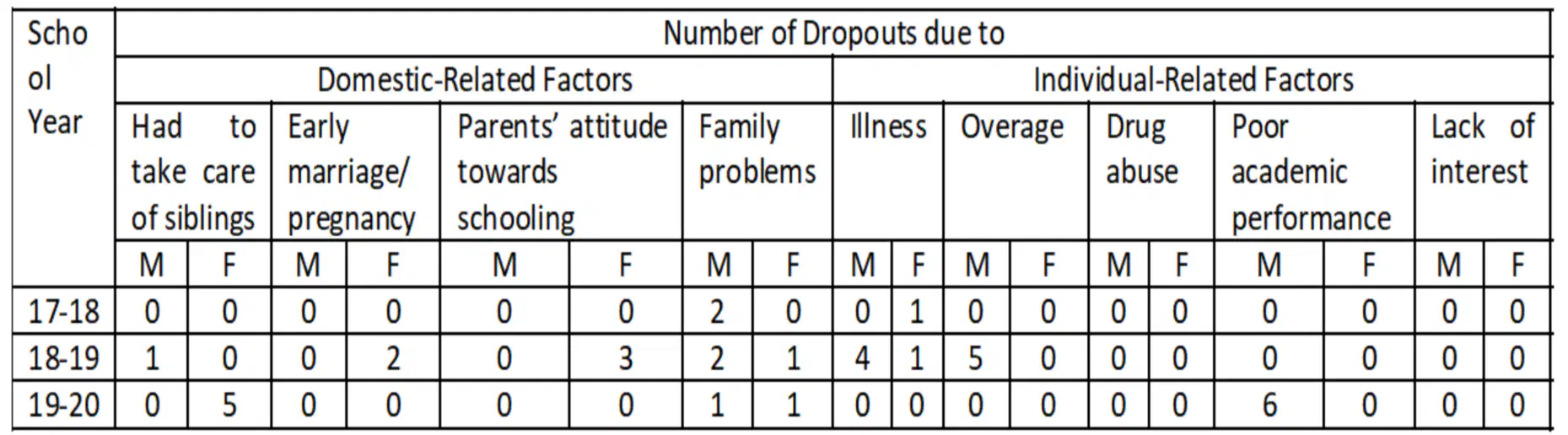
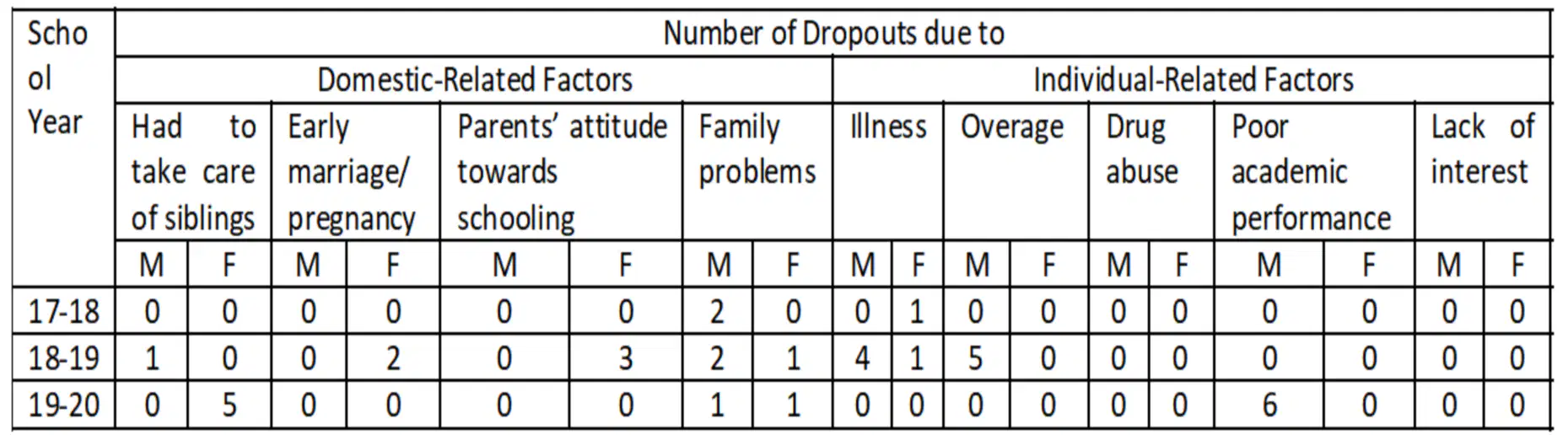
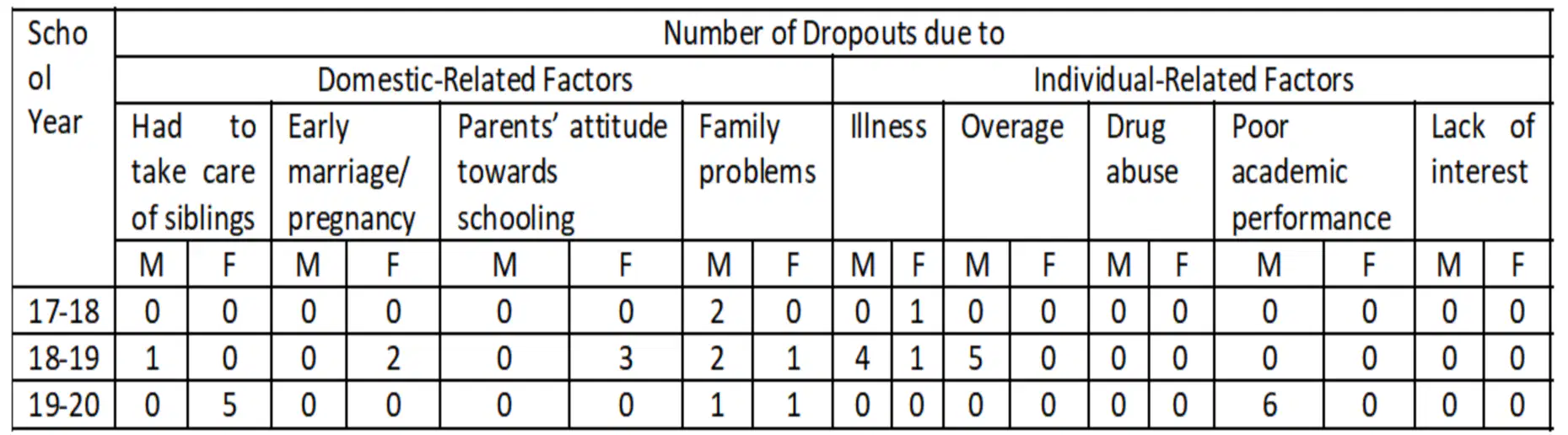
Which were the reasons of female students for dropping out of school?
i. Illness v. Had to take care of siblings
ii. Overage vi. Poor academic performance
iii. Family problems vii. Parents’ attitudes toward schooling
iv. Early marriage/pregnancy
i, ii and iv
iii, iv and vi
iv, v and vii
v, vi and vii

Which is correct on dropout rate for SY 2017-2018?
1. The school had dropout rate of three percent (3%)
2. Male students had higher dropout rate compared to female.
Statement 1 alone is sufficient but statement 2 alone is not sufficient to answer the question.
Statement 2 alone is sufficient but statement 1 alone is not sufficient to answer the question.
Both statements 1 and 2 are sufficient to answer the question
Each statement is not sufficient and additional data is needed to answer the question.
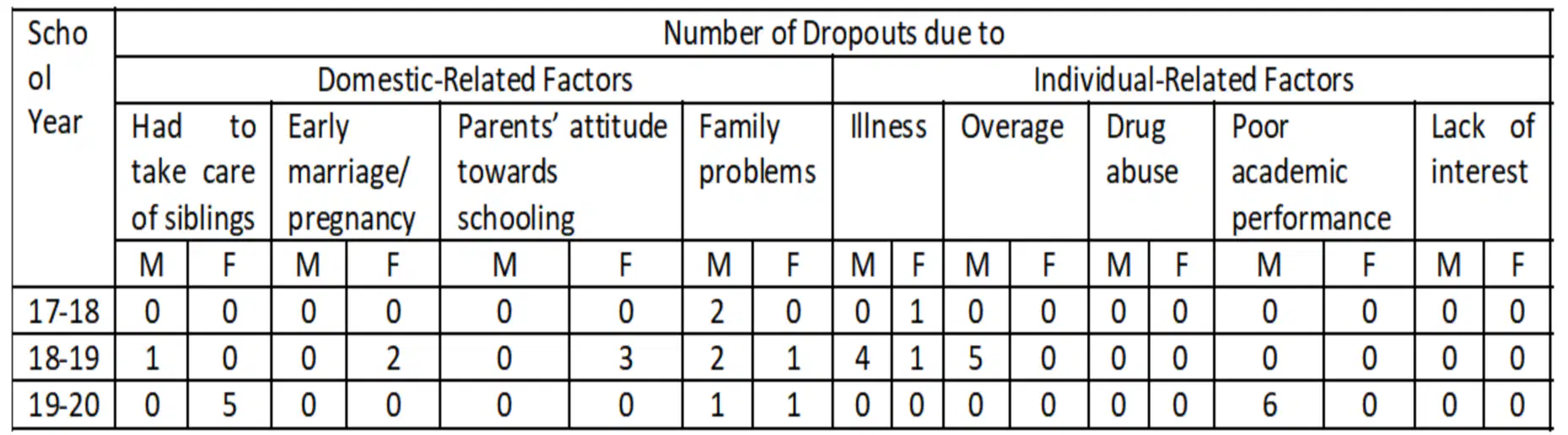
Which is correct on dropout for SY 2018-2019?
1. Parents’ attitude towards schooling was the main reason for dropout among female students with more than 42% of all the total cases involving this gender.
2. Individual-related factors out-weighted domestic-related factors with a ratio of 9:10
Statement 1 alone is sufficient but statement 2 alone is not sufficient to answer the question.
Statement 2 alone is sufficient but statement 1 alone is not sufficient to answer the question.
Both statements 1 and 2 are sufficient to answer the question
Each statement is not sufficient and additional data is needed to answer the question.

Which is correct on dropout for SY 2019-2020?
1. Poor academic performance was the main reason for dropout with more than 46%
2. Male out-weighted female students in terms of number of dropouts with more than 53%
Statement 1 alone is sufficient but statement 2 alone is not sufficient to answer the question.
Statement 2 alone is sufficient but statement 1 alone is not sufficient to answer the question.
Both statements 1 and 2 are sufficient to answer the question.
Each statement alone is sufficient to answer the question.
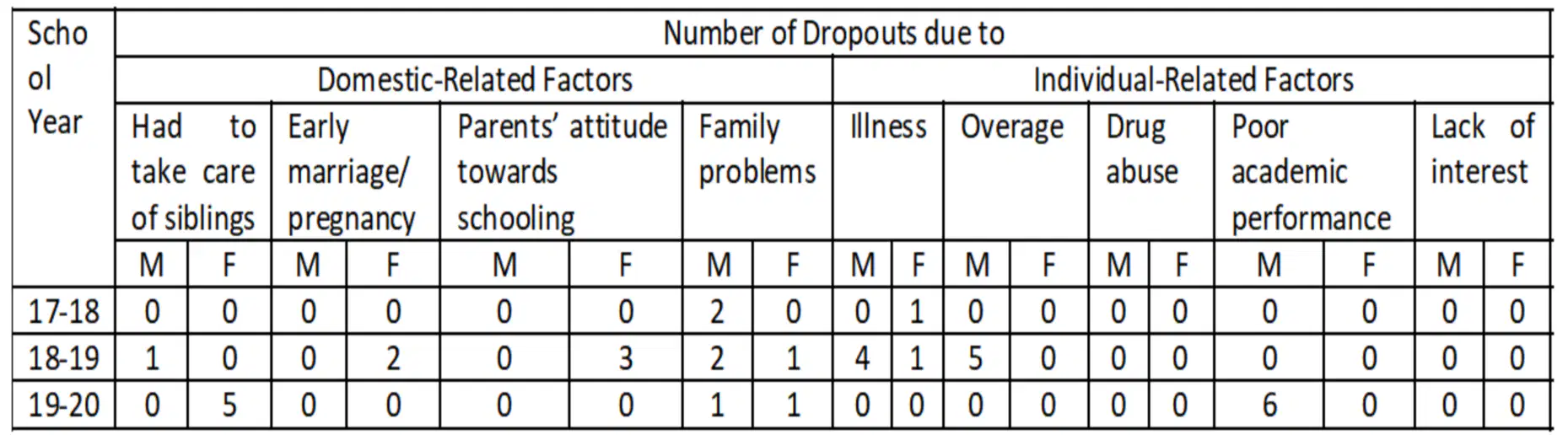
Which reason for dropping out had an increase of 50% from SY 2017-2018 to 2018-2019?
Illness
Overage
Family problems
Early marriage/pregnancy

What was the percentage of increase in “illness” as reason for dropout from SY 2017-2018 to 2018-2019?
400%
125%
80%
50%

What reason/s for dropping out had a decrease of 100% SY 2018-2019 to 2019-2020?
1. Poor academic performance
2. Parents’ attitude towards schooling
Statement 1 alone is sufficient but statement 2 alone is not sufficient to answer the question.
Statement 2 alone is sufficient but statement 1 alone is not sufficient to answer the question.
Both statements 1 and 2 are sufficient to answer the question.
Each statement alone is sufficient to answer the question.

What was the highest percentage of increase among the reasons for dropping out from SY 2018-2019 to 2019-2020?
600%
500%
400%
300%

What was the percentage of increase in “early marriage/pregnancy” as the reason for dropping out from SY 2018-2019 to 2019-2020?
1. -100%
2. 200%
Statement 1 alone is sufficient but statement 2 alone is not sufficient to answer the question.
Statement 2 alone is sufficient but statement 1 alone is not sufficient to answer the question.
Both statements 1 and 2 are sufficient to answer the question.
Each statement is not sufficient and additional data is needed to answer the question.
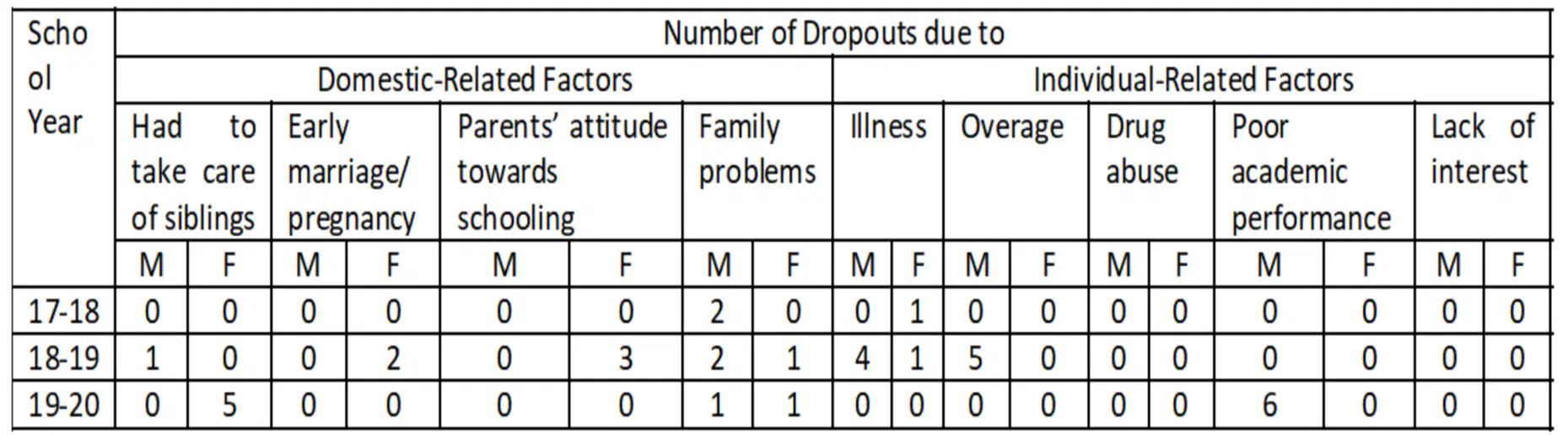
Reason for dropping out which had a decrease of 33%
1. Family problems
2. From SY 2018-2019 to 2019-2020
Statement 1 alone is sufficient but statement 2 alone is not sufficient to answer the question.
Statement 2 alone is sufficient but statement 1 alone is not sufficient to answer the question.
Both statements 1 and 2 are sufficient to answer the question.
Each statement alone is sufficient to answer the question
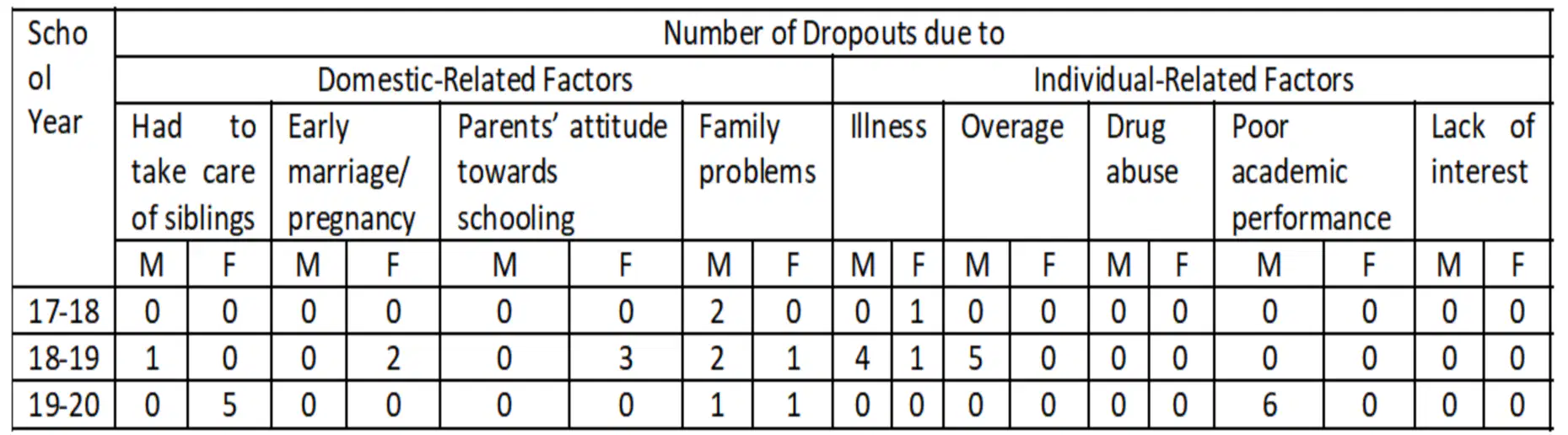
How many was the increase of percentage in “poor academic performance” as the reason for dropping out from SY 2018-2019 to 2019-2020?
1. -600%
2. 600%
Statement 1 alone is sufficient but statement 2 alone is not sufficient to answer the question.
Statement 2 alone is sufficient but statement 1 alone is not sufficient to answer the question.
Both statements 1 and 2 are sufficient to answer the question.
Each statement is not sufficient and additional data is needed to answer the question.

SY 2017-2018: M- 1,000; F-1,000
SY 2018-2019: M- 1,200; F-1,400
SY 2019-2020: M- 1,400; F-1,500
What was the dropout rate for SY 2017-2018?
M: 0.002% F: 0.001%
M: 0.02% F: 0.01%
M: 0.2% F: 0.1%
M: 2.0% F: 1.0%
SY 2017-2018: M- 1,000; F-1,000
SY 2018-2019: M- 1,200; F-1,400
SY 2019-2020: M- 1,400; F-1,500
What was the dropout rate for SY 2018-2019?
M: 1.0% F: 5.0%
M: 1.0% F: 0.5%
M: 0.1% F: 0.05%
M: 0.01% F: 0.005%
SY 2017-2018: M- 1,000; F-1,000
SY 2018-2019: M- 1,200; F-1,400
SY 2019-2020: M- 1,400; F-1,500
What was the dropout rate for SY 2019-2020?
M: 0.005% F: 0.004%
M: 0.05% F: 0.04%
M: 0.5% F: 0.04%
M: 0.5% F: 0.4%
SY 2017-2018: M- 1,000; F-1,000
SY 2018-2019: M- 1,200; F-1,400
SY 2019-2020: M- 1,400; F-1,500
What was the average dropout rate for the last three (3) school years?
M: 0.57% F: 0.33%
M: 0.27% F: 0.33%
M: 0.06% F: 0.03%
M: 0.006 F: 0.003%
Teacher needs to require and monitor independent practice. Students need extensive, successful, independent practice in order for skills and knowledge to become automatic. Why is this important?
These will let teachers know if students were developing misconceptions.
These give or instructional support to students to help them learn difficult tasks.
They help students strengthen the connections among the material they have learned.
This is necessary because a good deal of practice (overlearning) is needed in order to become fluent and automatic in a skill.

