
 Worksheets
physics
Total questions: 173
Worksheet time: 3hrs 22mins
____ is one of the best reflectors of light.
Gold
Silver
Brass
Aluminium
Reflection of light have___laws.
1
2
3
4
When light is available which image is formed.
Real
Virtual
Erect
If an object is placed at a distance of 10 cm in front of a plane mirror how far would it be from its image.
10cm
20cm
30cm
40cm
Which mirror has a wider field of view?
Convex
Concave
Plane
Which equation related to ohm's law?
V=IR
R=V/I
I=V/R
All of the above
When an obj is placed at focus then which type of image is formed?
Real
Virtual
Inverted
Both (1)and (3)
A ray of light is incident on a plane mirror at an angle of 30°.what is the angle of refrection?
10°
20°
30°
40°
Which type of image formed by plane mirror?
Same size
Erect
Virtual
All of the above
Real image is always
Erect
Real
Inverted
Virtual

What is nature of the image
(a)
Which factor does not affect resistivity?
Length
Mass
Cross-sectional area
Temperature
The unit of resistivity is
Ω/m
Ω/m2
Ω.m
Ω.m2
The nichrome wire has a cross-sectional area of 1.3 × 10⁻⁷ m2 . Resistivity of nichrome = 1.1 × 10⁻⁶Ωm and a resistance of 53Ω. The length of the wire is
0.63m
63m
0.0063m
6.3m
Resistance of a material would be equal to resistivity when
l = T
A = l
A = T
l = R
A wire of uniform diameter 0.28mm and a length of 1.50m has a resistance of 45Ω. It's resistivity is
2.2 x 10⁻⁸Ωm
36 Ωm
1.8 x 10⁻⁶Ωm
3.4 x 10⁻⁷Ωm


Two resistors R1 and R2 are made of wires of the same material. The wire used for R1 has half the diameter and is twice as long as the wire used for R2.
What is the value of the ratio resistance of R1 / resistance of R2?
8
4
1
0.5
What is the SI unit of resistivity?
ohm
ohm meter
metre
none of these
What will be the resistivity of a metal wire of 2 m length and 0.6 mm in diameter, if the resistance of the wire is 50 Ω.
4.045 ×10⁻⁸Ωm
7.065 ×10⁻⁸Ωm
7.065 ×10⁻⁶Ωm
4.045 ×10⁻⁶Ωm
The resistance of an electric wire of an alloy is 10 Ω. If the thickness of wire is 0.001 meter, and length is 1 m, find its resistivity.
10−6Ωm
10Ωm
7.85 x 10⁻⁴Ωm
None of these
The resistivity of a metal wire is 10 x 10−8 Ω m at 20°C. Find the resistance of the same wire of 2 meter length and 0.3 mm thickness.
3.825 Ω
0.26 Ω
0.66 Ω
What are the factors affecting resistance of the wire?
Area of cross section
Length of wire
Nature of wire
All of above
A wire with least resistivity is a ...................
Bad conductor
Good conductor
Information is not sufficient
None of these
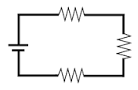
In a series circuit what happens when you add another bulb?
The bulbs gets brighter
The bulbs gets dimmer
Nothing changes


If the light bulb in the middle burned out, what would happen to the other two?
The light bulb to the left would stay lit, but the one to the right would turn off.
They would both stay lit.
The light bulb to the right would stay lit, but the one to the left would turn off.
They would both turn off.
1 coulomb charge is equivalent to_____
2.6 x 10¹⁹ electron
6.2 x 10¹⁹ electron
2.65 x 10¹⁹ electron
6.25 x 10¹⁸ electron
Electrical resistivity of a given metallic wire depends upon
length
thickness
shape
nature of material
A current of 1 A is drawn by a filament of an electric bulb. Number of electrons passing through a cross section of the filament in 16 seconds would be roughly
1020
1016
1018
1023
What is the maximum resistance which can be made using five resistors each of 1/5 Ω?
1/5 Ω
10 Ω
5 Ω
1 Ω
A cylindrical conductor of length 'l' and uniform area of cross section A has resistance 'R'. Another conductor of length '2l' and resistance 'R' of the same material has area of cross section ?
A/2
3A/2
2A
3A

A student carries out an experiment and plots
the V-I graph of three samples of nichrome wire
with resistances R1, R2 and R3 respectively. Which of the following is true?
R1 = R2 = R3
R1 > R2 > R3
R3 > R2 > R1
R2 > R3 > R
The resistivity does not change if
the material is changed
the temperature is changed
the shape of the resistor is changed
both material and temperature are changed
In an electrical circuit three incandescent bulbs A, B and C of rating 40 W, 60 W and 100 W respectively are connected in parallel to an electric source. Which of the following is likely to happen regarding their brightness?
Brightness of all the bulbs will be the same
Brightness of bulb A will be the maximum
Brightness of bulb B will be more than that of A
Brightness of bulb C will be less than that of B
In an electrical circuit two resistors of 2 Ω and 4 Ω respectively are connected in series to a 6 V battery. The heat dissipated by the 4 Ω resistor in 5 s will be
5 J
10 J
20 J
30 J
An electric kettle consumes 1 kW of electric power when operated at 220 V. A fuse wire of what rating must be used for it?
1 A
2 A
4 A
5 A
Two resistors of resistance 2 Ω and 4 Ω when connected to a battery will have
same current flowing through them when connected in parallel
same current flowing through them when connected in series
same potential difference across them when connected in
series
different potential difference across them when connected in
parallel
Unit of electric power may also be expressed as
volt ampere
kilowatt hour
watt second
joule second
the substance which has infinitely high resistance is called
conductor
resistor
semiconductor
insulator
relation between resistivity and area of cross section
directly proportional
indirectly proportional
both are equal
resistivity does not depend on area of cross section

- The resistance whose V-I graph is given below is
5/3 Ohm
3 /5 Ohm
5 / 2 Ohm
2 / 5 Ohm
2.To get 2 Ω resistance using only 6 Ω resistors, the number of them required is
2
3
4
6
If R1 and R2 be the resistance of the filament of 40 W and 60 W respectively operating 220 V, then
R1 < R2
R2 < R1
R1 = R2
R1 ≥ R2

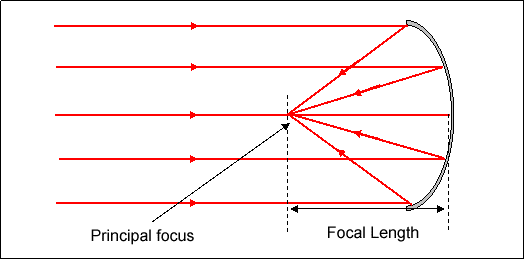
what is A on the diagram?
center of curviture
focal length
reflected ray
focal point


Which device uses refraction to converge light?


Which device uses reflection to diverge light?


People who are into the mystic arts say to never leave a crystal ball uncovered while you aren't home to prevent evil spirits. Actually, you should always keep a crystal ball covered to prevent house fires! Why?
Because a crystal ball acts like a diverging lens.
Because a crystal ball acts like a converging lens.
Because a crystal ball acts like a diverging mirror.
Because a crystal ball acts like a converging mirror.
How could a convex lens cause house fires?
Because it creates an upright image of the sun.
Because it could cause all the sunlight to diverge away from a single spot.
Because it could project a virtual image of the sun.
Because it could cause all the sunlight to converge on a single point.
Which ray diagram shows a real image?


None of the above
Four ray diagrams show the images formed in mirrors and lenses. Which shows a virtual image?


All of the above.

This gif best shows
that images are always largest when an object is near the focal point
that images are always virtual for converging mirrors
that images are always larger for converging mirrors
that images are smallest when the object is on the focal point

Based on this picture, what is known about the focal length of this device?
f is positive
f is negative
there is no focal length of this device
there is not enough information to determine



Type of mirror used as a side mirror on a vehicle to provide a wide angle view...
Plane
Convex
Concave

Type of mirror used by a dentist to get magnified view of a patient's teeth...
Plane
Convex
Concave
An image behind the mirror is...
virtual
real
inverted
upright
If the object is beyond C (2F)...
image is real, smaller and inverted
image is real, smaller and upright
image is virtual, smaller and inverted
image is real, bigger and upright
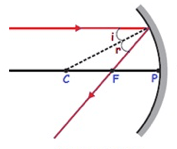
This ray diagram is for which mirror?
concave
convex
plane
window
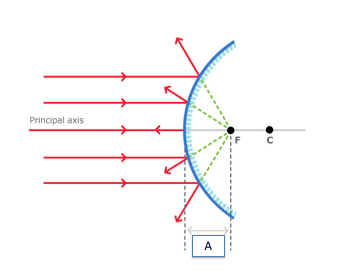
In the image, all the rays meet at F, What is F
focal length
focal point
center of curvature
reflection
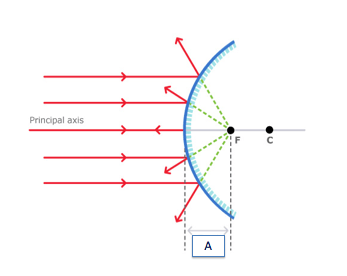
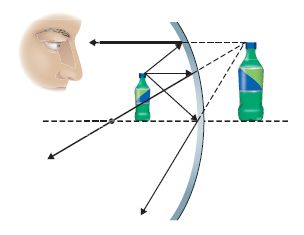
This image is showing a convex mirror because the image is (choose 2 answers)
real light rays meet behind the mirror
real light rays don't meet
the focal point is in front of the mirror
the focal point is behind the mirror
This type of mirror is used in supermarkets to see around bends
concave
convex
plane
window
A dentist uses a small dental mirror to help magnify teeth in your mouth. What type of mirror is this?
a convex mirror
a concave mirror
a convex lens
a concave lens
An object is at a distance of 36cm from a concave mirror of focal length 12 cm. Find the image distance
18cm
-18cm
12 cm
-12 cm
22. An object is placed at the centre of curvature of a concave mirror. The distance between its image and the pole is
(a) equal to f
(b) between f and 2f
(c) equal to 2f
greater than 2f

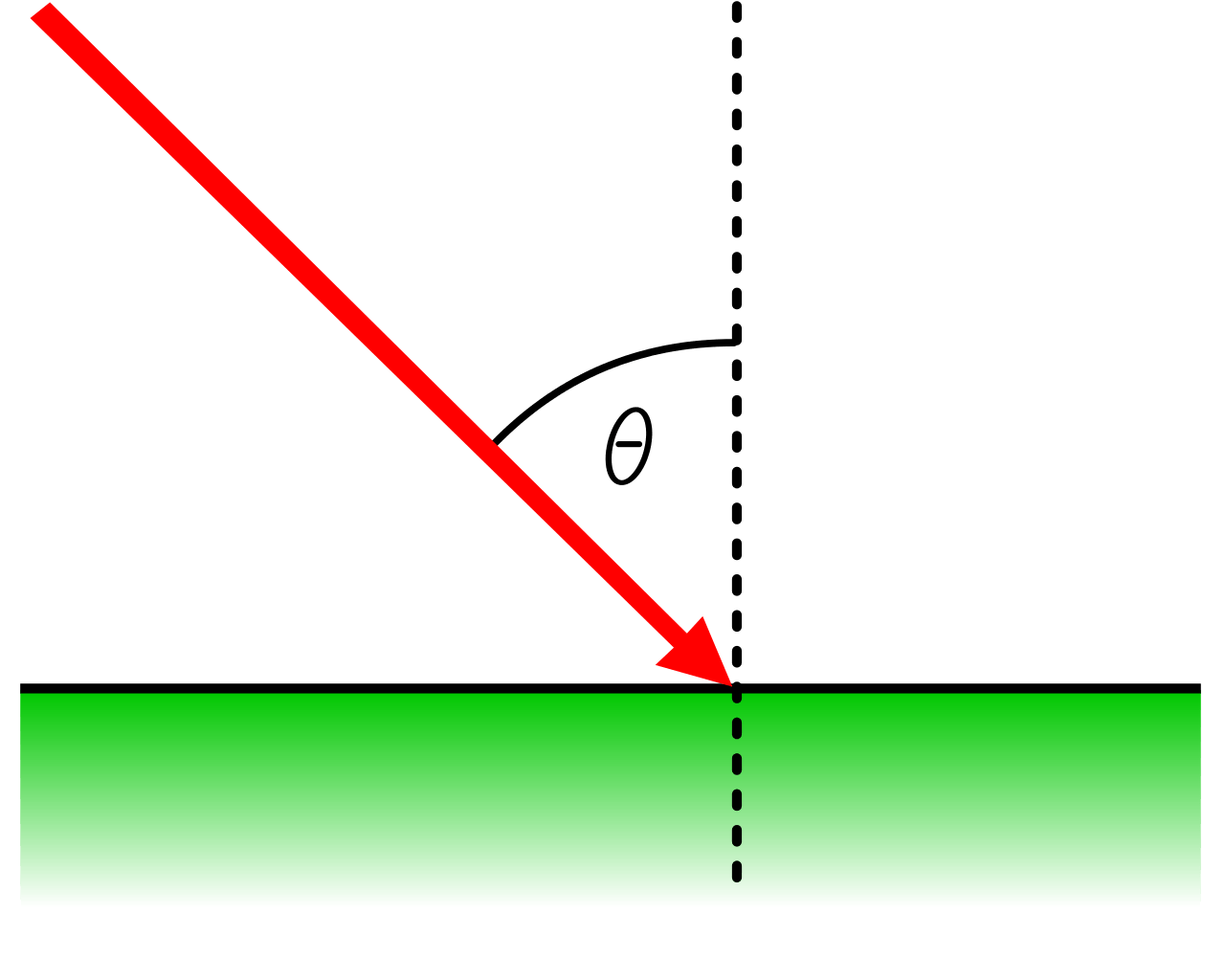
Which is the angle of Incidence?
A
B
C
D
Can reflected ray and incident ray be on the same side of the normal?
Yes
No
I'm not sure
Can reflected ray and incident ray be on the normal?
Yes
No
I'm not sure
An image ...
Can be touched
Can't be touched
I'm not sure
The normal is ____ to the mirror
Perpendicular
Parallel
Perpendicular and Parallel
None of the above
What is reflection?
Light bouncing off a smooth surface
Light absorbing into a smooth surface
Light bending off a smooth surface
Light scattering off a smooth surface
How do light waves travel in air?
Slowly
It curves
In straight lines
Different colours have different speeds
What uses reflection


Which is right ?


I'm not sure
Which is not a light source?


An image behind the mirror is...
virtual
real
inverted
upright
An image that points below the principal axis is (choose 2)...
virtual
real
upright
inverted
If the object is beyond C (2F)...
image is real, smaller and inverted
image is real, smaller and upright
image is virtual, smaller and inverted
image is real, bigger and upright
This ray diagram is for which mirror?
concave
convex
plane
window
In the image, all the rays meet at F, What is F
focal length
focal point
center of curvature
reflection
This image is showing a convex mirror because the image is (choose 2 answers)
real light rays meet behind the mirror
real light rays don't meet
the focal point is in front of the mirror
the focal point is behind the mirror
This type of mirror is used in supermarkets to see around bends
concave
convex
plane
window
Real images are :
Always inverted
can be larger or smaller than the object
can be obtained on screen
all the above
A dentist uses a small dental mirror to help magnify teeth in your mouth. What type of mirror is this?
a convex mirror
a concave mirror
a convex lens
a concave lens
The side view mirrors on your car help shrink the image on both sides of the car, allowing you to see a larger field of view. What type of mirror is this?
a convex mirror
a concave mirror
a convex lens
a concave lens
An image that forms when light rays actually meet
virtual image
real image
diffuse reflection
regular reflection
Virtual images are
always upright
can be obtained on screen
always smaller
If the object is between C and f, the image is ...
image is real, smaller, and inverted
image is real, smaller, and upright
image is virtual, smaller, and inverted
image is real, bigger, and inverted
If the object is between f and the mirror, the image is ...
image is real, smaller, and inverted
image is virtual, larger, and upright
image is virtual, smaller, and inverted
image is real, bigger, and inverted

Images in a plane mirror are
real
larger
same size
smaller


The ray of light that strikes a mirror
Reflected Ray
Incidence Ray
Angle of Incidence
Angle of Reflection

The ray that bounces off the mirror.
Angle of Reflection
Incidience Ray
Reflected Ray
Angle of Reflection

The angle between the incident ray and the normal. (X on the diagram)
Angle of X-Ray
Angle of Reflection
Angle of Incidence
Angle of Normal

Given that the angle of incidence = 30 degrees
Which is the correct diagam?
A
B
C
D
image above the principal axis (PA) is
virtual
real
upright
upside down
This ray diagram is for which mirror?
concave
convex
plane
window
In the image, all the rays meet at F, What is F
focal length
focal point
center of curvature
reflection

The angle of incidence is equal to the angle of reflection
Law of Reflection
Law of Light
Incidence Ray
The Normal
A shopkeeper wants to keep an eye on his store in order to prevent shoplifting. What could the shopkeeper hang on the wall in order to see a wider image of his store and his customers?
a convex mirror
a concave mirror
a convex lens
a concave lens
A dentist uses a small dental mirror to help magnify teeth in your mouth. What type of mirror is this?
a convex mirror
a concave mirror
a convex lens
a concave lens
The side view mirrors on your car help shrink the image on both sides of the car, allowing you to see a larger field of view. What type of mirror is this?
a convex mirror
a concave mirror
a convex lens
a concave lens
The angle between the reflected ray and the normal. (X on the diagram)
Angle of X-Ray
Angle of Reflection
Angle of Incidence
Angle of Normal
Which mirror type can produce real and virtual images?
plane
concave
convex
Which is the angle of Incidence?
A
B
C
D
Can reflected ray and incident ray be on the same side of the normal?
Yes
No
I'm not sure
Can reflected ray and incident ray be on the normal?
Yes
No
I'm not sure
An image ...
Can be touched
Can't be touched
I'm not sure
The normal is ____ to the mirror
Perpendicular
Parallel
Perpendicular and Parallel
None of the above
What is reflection?
Light bouncing off a smooth surface
Light absorbing into a smooth surface
Light bending off a smooth surface
Light scattering off a smooth surface
How do light waves travel in air?
Slowly
It curves
In straight lines
Different colours have different speeds
What uses reflection
Which is right ?
I'm not sure
Which is not a light source?
Bouncing of a light ray when it strikes a reflecting surface is called.........
Refraction
Dispersion
Reflection
Diffraction
which of the following is not a property of the image formed by a [lane mirror?
virtual and erect
Object size = image size
object distance = image distance
Real and inverted
Which of the following is a concave mirror?


Four students A, B, C and D performed the experiment to determine the focal length of a concave mirror by obtaining the image of a distant tree on a screen. They measured the distances between the screen and the mirror as shown in the above figure.
The correct way of measuring accurate focal length of the mirror is
A
B
C
D

which of the following ray diagrams is correct for the ray of light incident on a concave mirror as shown in the figure 10.6?
A
B
C
D
Convex mirror is also called as
converging mirror
diverging mirror
plane mirror
silver mirror
The relation between focal length and radius of curvature is
R = 2f
1/f = 2R
f = R/2
R = 2/f
The point on the spherical mirror at the middle of the surface is called
focus
centre of curvature
pole
radius of curvature
The focal length of a plane mirror is ........
infinite
zero
1m
100m
A convex mirror has a focal length 12 cm. Then its radius of curvature is ........ cm
24
12
6
1.2
When the object is in between the centre of curvature (C) and focus (F) of a concave mirror, then the position of the image is ...........
At focus
At the centre of curvature
at infinity
beyond the centre of curvature
Which of the following characteristic of an image formed for a convex mirror?
Enlarged size
virtual image
Real image
inverted image

Which mirror is shown in the figure?
convex mirror
concave mirror
plane mirror
silver mirror

Mirror formula is defined as ........
A
B
C
D
When the object is at infinity, a point sized image is formed at ................ by the convex mirror
focus behind the mirror
focus in front of the mirror
radius of curvature
principal axis
The image formed by a concave mirror when the object is placed between the pole and the focus is ......
virtual, erect and magnified
virtual, erect and diminished
real, inverted and magnified
real, inverted and diminished
The angle of incidence of a ray of light passing through the centre of curvature of a concave mirror is ........... degree
105
180
90
0
According to laws of reflection,
angle of incidence > angle of reflection
angle of incidence < angle of reflection
angle of incidence = angle of reflection
both 1 and 2
Where will be the images of the Sun or the moon are formed by a concave mirror?
Focus
Pole
centre of curvature
beyond centre of curvature
What is the size of the image formed when an object is kept at the focus in front of concave mirror?
enlarged
diminished
highly enlarged
highly diminished

