
NEW
Font size
 Worksheets
Introduction to Immunohistochemistry
Total questions: 28
Worksheet time: 14mins
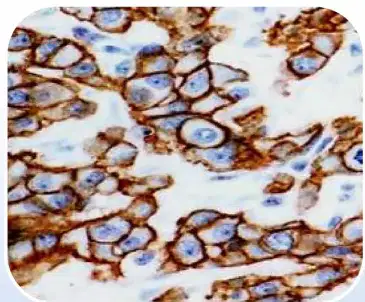
Which statement best defines immunohistochemistry (IHC)?
Quantifying cytokines released during inflammation
Culturing immune cells from patient blood samples
Measurement of serum antibodies by enzyme assays
Detection of tissue antigens using labeled antibodies
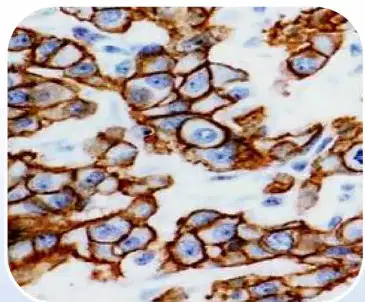
A lab wants to localize a specific protein within a tissue section. Which approach aligns with the IHC mechanism?
Apply antibodies that bind the target antigen in situ
Extract proteins and separate them by gel electrophoresis
Stain lipids using nonspecific chemical dyes
Measure antigen concentration with radioimmunoassay
Which step logically occurs immediately before applying the primary antibody in an immunohistochemistry workflow?
Mounting coverslip with permanent medium
Blocking endogenous enzymes to reduce background
Chromogen substrate development for color signal
Counterstaining nuclei with hematoxylin
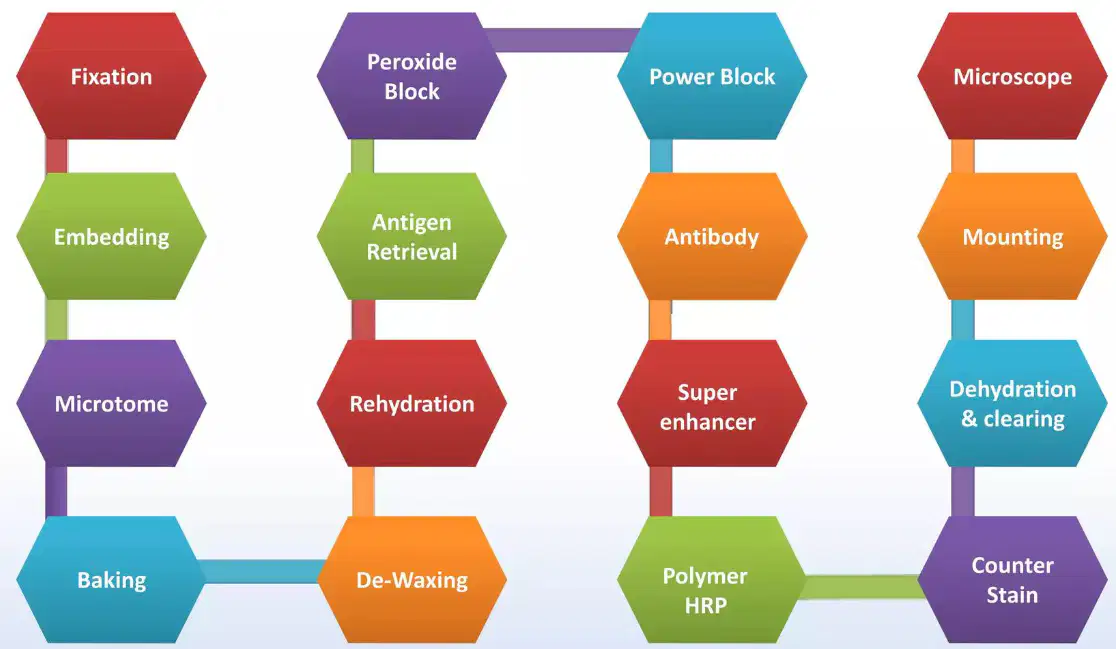
A lab reports weak signal and high background after chromogen development. Based on the protocol diagram, which adjustment is MOST appropriate to try first?
Shorten dehydration and clearing sequence
Apply mounting medium before counterstain
Skip antigen retrieval to preserve epitopes
Increase blocking of endogenous enzymes duration
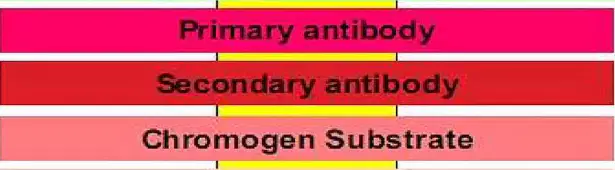
Place these IHC actions in the correct order starting from prepared slides: 1) Secondary antibody, 2) Counterstain, 3) Chromogen substrate, 4) Primary antibody.
4 → 1 → 3 → 2
1 → 4 → 3 → 2
3 → 4 → 1 → 2
4 → 3 → 1 → 2
Which statement best explains why formaldehyde is the preferred fixative in immunohistochemistry?
It prevents elution and degradation of antigens
It rapidly freezes tissues for cryosectioning
It stains nuclei with high affinity for DNA
It dissolves lipids to clear tissue spaces
A lab aims for optimal adhesion and morphology. Which combination aligns with standard slide preparation?
Sections 2–4 millimeters, charged slides, baking at 30°C
Sections 1 micron, uncoated slides, no baking
Sections 2–4 microns, charged slides, baking at 60°C
Sections 8–10 microns, plain slides, air-dry overnight
During deparaffinization, which procedural sequence is most appropriate to remove paraffin from tissue sections?
Xylene baths followed by graded alcohol series
Distilled water followed by acetone rinse
Direct ethanol immersion without xylene
Heated saline followed by buffered formalin
Which statement best describes the purpose of antigen retrieval in immunohistochemistry?
Enhance chromogen precipitation without antibodies
Block non-specific antibody binding globally
Fix tissues by increasing cross-link density
Reverse formaldehyde conformational changes of antigens
A lab must choose between Heat-Induced Epitope Retrieval (HIER) and Protease-Induced Epitope Retrieval (PIER). Which pairing correctly matches the mechanism with the method?
HIER uses heat to allow protein refolding; PIER uses enzymes to cleave proteins
HIER uses proteases to digest epitopes; PIER uses microwaves to denature antigens
HIER depends on rapid cooling to freeze epitopes; PIER fixes tissues with aldehydes
HIER breaks peptide bonds enzymatically; PIER stabilizes antigens by steaming
You need to plan a HIER protocol for a formalin-fixed section. Which setup and post-treatment will most likely maximize antigen accessibility while preserving morphology?
Heat sections near 100°C in a pressure cooker, then cool slowly to allow protein refolding
Briefly heat sections to 60°C on a hotplate, then snap-chill on ice immediately
Expose sections to proteolytic enzyme at 37°C, then wash extensively
Incubate sections at room temperature in buffer, then air-dry rapidly
Which pre-treatment step in immunohistochemistry is used to neutralize endogenous peroxidase activity that could cause false signal?
Heat-induced epitope retrieval with citrate buffer
Peroxide block using three percent hydrogen peroxide
Rinsing with buffered saline for five minutes
Protein block with normal serum at ten percent
What is the primary purpose of applying a protein block before adding the primary antibody to a tissue section?
To block nonspecific binding sites and reduce background
To denature the target antigen for stronger binding
To fix the tissue proteins permanently in place
To increase endogenous peroxidase activity intentionally
Which statement correctly contrasts polyclonal and monoclonal primary antibodies?
Polyclonals bind weaker to damaged antigens; monoclonals tolerate heterogeneity
Polyclonals are serum from immunized animals; monoclonals are from hybridomas
Polyclonals recognize one epitope; monoclonals recognize many epitopes
Polyclonals come from hybridomas; monoclonals come from animal serum
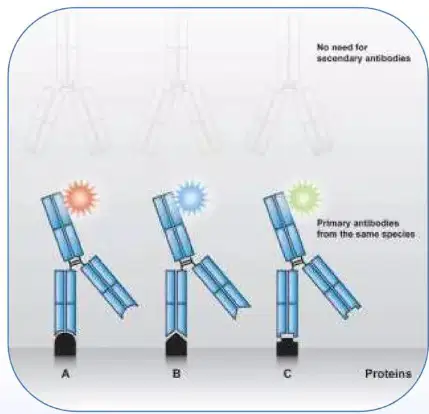
Which feature best distinguishes the direct immunohistochemistry method from the indirect method?
Single step using labeled primary antibody
Two steps using labeled primary antibody
Two steps using unlabeled secondary antibody
Single step using labeled secondary antibody
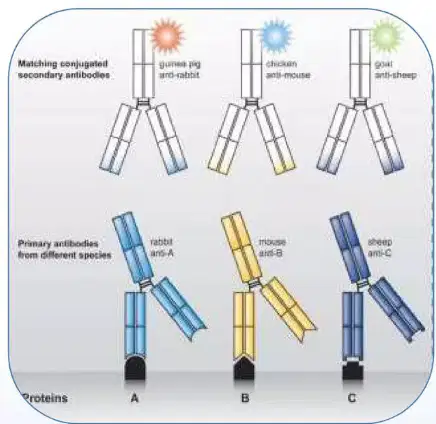
Why is the indirect immunohistochemistry method generally more sensitive than the direct method?
Antigen concentration is increased during fixation
Shorter incubation reduces background noise
Signal amplification via multiple secondary antibodies
Primary antibody is chemically brighter by design
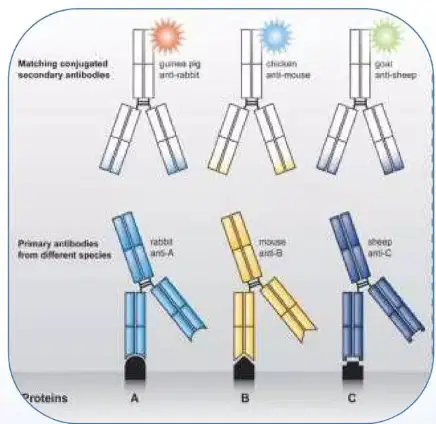
A lab wants to minimize reagent costs when staining many targets raised in rabbit. Which approach is most economical?
Order custom conjugates for each primary antibody
Buy a labeled primary for every target antigen
Use one anti-rabbit secondary for various primaries
Use species-matched primaries without secondaries
Which statement best describes the composition of the peroxidase–antiperoxidase (PAP) complex in immunohistochemistry?
Two antibody molecules and one horseradish peroxidase molecule
Three antibody molecules and two horseradish peroxidase molecules
One antibody molecule and two horseradish peroxidase molecules
Two antibody molecules and three horseradish peroxidase molecules
Why does the PAP method exhibit markedly increased sensitivity compared with direct enzyme conjugation strategies?
Peroxidase is immunologically bound and retains full enzymatic activity
Peroxidase is chemically conjugated and increases turnover number
Antibody valency is reduced to prevent background staining
IgG is denatured, exposing more antigenic epitopes
In the biotin–avidin procedure, which sequence correctly localizes the enzyme to the antigen site?
Biotinylated primary antibody binds antigen, avidin–peroxidase binds biotin
Biotinylated antigen binds avidin, free antibody binds peroxidase
Avidin binds antigen directly, biotinylated peroxidase binds avidin
Peroxidase binds antigen first, avidin links to biotin later
A lab must choose between PAP and a biotin–avidin system to detect a low-abundance antigen with limited primary antibody available. Which approach offers a practical advantage and why?
Direct HRP conjugate, because it avoids any intermediate layers
Biotin–avidin, because avidin blocks all endogenous peroxidase
Indirect IgG only, because fewer steps ensures higher specificity
PAP, because high sensitivity allows higher primary antibody dilution
Which enzyme label commonly used in immunohistochemistry forms a dark brown precipitate when DAB is applied?
Alkaline phosphatase with NBT
Peroxidase linked to DAB
Hematoxylin with peroxide
Eosin interacting with DAB
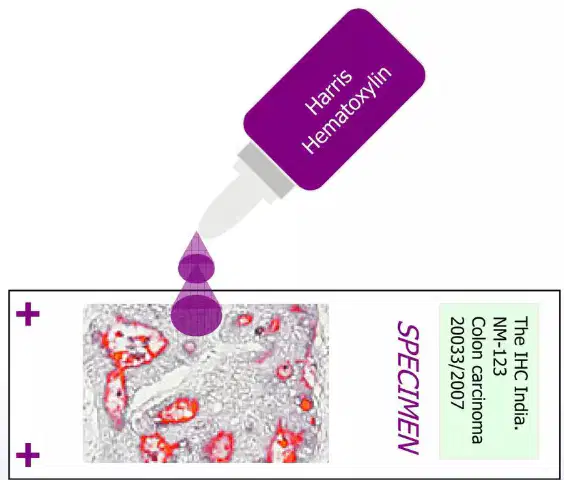
In the diagram, what is the primary purpose of applying a counterstain such as Hematoxylin and Eosin after enzyme labeling?
Enhance contrast to primary stain
Increase antigen retrieval efficiency
Block endogenous peroxidase activity
Fix tissues to glass slides
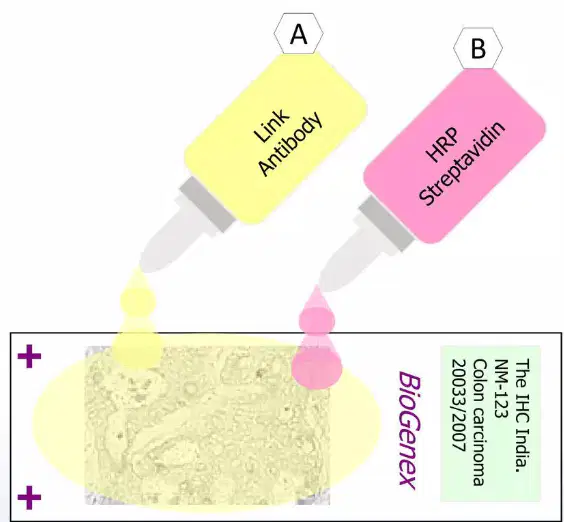
A lab wants a colored precipitate visible without fluorescence. Which strategy best achieves this using antigen–antibody complexes?
Mount in aqueous medium only
Use HRP enzyme with chromogen
Apply eosin without enzymes
Rinse only with buffer saline
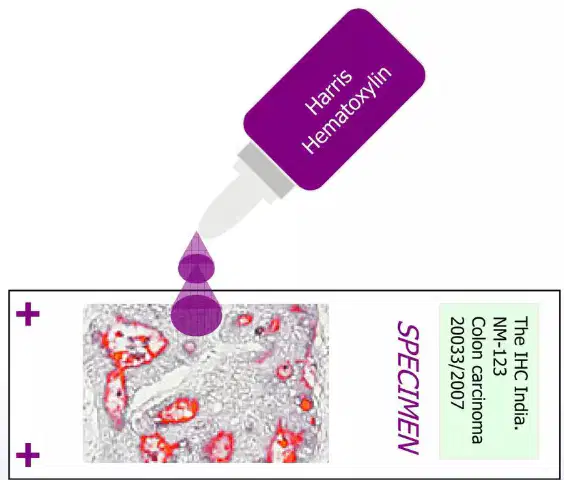
Which pairing correctly matches stain with its typical color outcome on tissue?
DAB: nuclei blue
Eosin: nuclei blue
Hematoxylin: nuclei blue
Alkaline phosphatase: dark brown
Which buffer is commonly used to rinse slides during immunohistochemistry workflows?
Tris‑buffered saline (TBS) solution
Methanol-acetone mixture
Formalin fixative solution
Ammonium sulfate solution
Which reagent is a chromogen that yields a brown precipitate when detecting peroxidase activity?
DAB (3,3′‑diaminobenzidine) reagent
Tris-glycine running buffer
FITC fluorochrome dye
Proteinase K enzyme solution
A lab plans fluorescence detection instead of brightfield peroxidase staining. Which reagent should be selected to visualize targets?
DAB for peroxidase chromogenic staining
Trypsin for antigen retrieval digestion
PBS for general washing steps
Fluorochromes for fluorescence microscopy

