
Font size
 Worksheets
Atomic Theory and Periodic Table (MCQs 1-9)
Total questions: 83
Worksheet time: 42mins
Which of these explain what was missing from Dalton’s atomic theory?
Atoms are made up of smaller particles.
All atoms of the same element are identical.
Compounds form when atoms of different elements combine in a specific ratio.
Atoms of different elements have different masses.
What is the main difference between the cloud model of the atom and the modern model?
Electrons move in specific orbits in the modern model.
Electrons exist in a cloud around the nucleus in the cloud model.
Only the modern model includes protons.
The cloud model does not include neutrons.
Use the information below to answer question: How many neutrons are in an atom of Carbon-14?
14
8
6
2
Which of these explain what was missing from Dalton’s atomic theory?
All atoms of the same element are identical.
Atoms of different elements have different masses.
Compounds form when atoms of different elements combine in a specific ratio.
Atoms are made up of smaller particles.
Which statement best explains why the table of elements is periodic?
It has many different parts, each of which is different from other parts
All elements are included in the table.
It has rows and columns, as a calendar does.
Properties of the elements repeat in a cycle or repeating pattern.

From the information in this cell, what is the most likely number of neutrons in an atom of titanium?
48
25.90
26
47.90
Sodium chloride (NaCl) is the chemical name for table salt and potassium chloride (KCl) is a common salt substitute. Using the periodic table, choose the correct statement about how these compounds form.
Chlorine gains electrons from potassium and loses electrons to sodium.
Chlorine gains more electrons from potassium than it does from sodium.
Sodium and potassium lose electrons and chlorine gains them.
Both sodium and potassium atoms gain electrons to form ions.
Which statement provides one explanation why helium and neon have similar chemical properties?
They are both non-metals.
They both have few protons.
The outermost energy level of both elements is filled.
They each have only one valence electron.
Which is most likely to be damaged by an acid?
A plastic bottle
An aluminum can
A glass jar
A gold bracelet
What is the main difference between these two kinds of mixtures?
In a homogeneous mixture, the components are easy to see and are well mixed so the components show up in different parts of the mixture.
In a homogeneous mixture, the components are not evenly spread throughout the mixture. In a heterogeneous mixture, the components are evenly spread throughout the mixture.
In a heterogeneous mixture, the components are difficult to see and are spread out uniformly throughout the mixture.
In a heterogeneous mixture, the components are not evenly spread throughout the mixture. In a homogeneous mixture, the components are evenly spread throughout the mixture.
A student heats a white powder in a test tube. After heating, a new black solid form and a gas is released. What type of change has occurred?
Physical change, because the powder only changed color
Physical change, because the powder is still solid
Chemical change, because it melted
Chemical change, because a new substance was formed
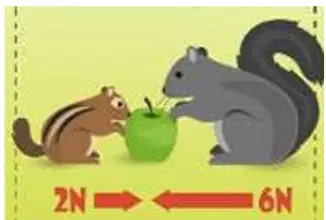
The net force exerted on the apple equals:
4 N, to the right
6 N, to the right
6 N, to the left
4 N, to the left
Which of these situations produces the most friction between the shoes and the floor?
a girl with less mass wearing shoes with more tread
a girl with less mass wearing shoes with less tread
a girl with greater mass wearing shoes with less tread
a girl with greater mass wearing shoes with more tread
A swimmer pushes the water backward with their hands, and as a result, the swimmer moves forward. This action-reaction pair is an example of:
Newton's first law
Newton's second law
None of the above
Newton's third law
When a car accelerates forward, the force of the tires on the road causes the car to move forward. According to Newton's third law, the reaction to this force is:
The force of the road on the tires
The force of the air resistance
The force of gravity on the car
The force of the car on the road
What term refers to an object's resistance to change in its state of motion?
Velocity
Force
Acceleration
Inertia
Suppose a bulldozer is being hauled on the back of a flatbed truck at 50 km/h to a construction site. From which reference point would the bulldozer not appear to be moving?
a traffic light
the road
the truck driver
a roadside tree
If an object's initial velocity is 10 m/s and its final velocity is 30 m/s, and the time taken is 5 seconds, what is the acceleration?
6 m/s²
8 m/s²
4 m/s²
2 m/s²
What type of force is responsible for holding objects on the ground?
Magnetic force
Tension force
Gravitational force
Frictional force
Which of the following best defines balanced forces?
Forces that only act on stationary objects
Forces that result in no change in an object's motion
Forces that cause an object to slow down
Forces that cause an object to accelerate
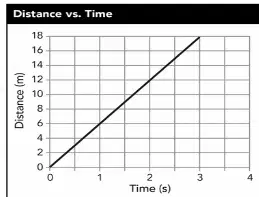
How far down the lane was the ball after two seconds?
6 m
18 m
9 m
12 m
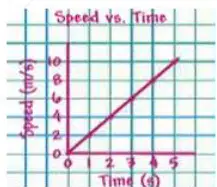
Which scientific term this graph describes?
Average speed
Acceleration
Speed
Velocity
The complementary strand of DNA of (A-C-C-T-G) will be ............
C-A-A-G-U
U-G-G-G-A-C
C-A-A-A-G-T
T-G-G-A-C
Snowshoe hares have large hind feet that prevent them from sinking into soft snow. Their brown coats turn white in the winter to blend in with the snow. These hares have adapted in order to survive and reproduce in their snowy environment. What is this an example of?
competition
variation
overproduction
fitness
Ibrahim learns that the fossil record helps people understand life on Earth millions of years ago. Which statement is true about the fossil record?
The fossil record shows only evidence of traces of animals in rock.
The fossil record shows no evidence of how organisms evolved.
The fossil record shows only plant life that has become extinct.
The fossil record shows patterns that are like data that can be analyzed
What technique is used to increase desirable traits in domesticated animals through breeding?
Artificial selection
Cloning selection
Genome selection
Natural selection
The expected number of chromosomes in human body cells is 46. Fruit flies have only 8 chromosomes, mulberry trees have 308, and protests can have thousands. Dogs are in the middle of the range, with 78 chromosomes. How many chromosomes are in the sex cells of each of these organisms?
always 23
always twice as many as in the body cells
always half as many as in the body cells
always as many as in the body cells
Mohamed goes to the Museum of Natural History and sees a display of bones from a dolphin's flipper and a cat's leg. They are very different, but the display shows that their bones have homologous structures in their limbs. What can you infer about these two organisms from their homologous structures?
They evolved rapidly.
They evolved at the same time.
They live in similar environmental conditions. edges in front so they can climb and live on steep cliffs.
They related and share a common ancestor.
What forms when a sperm cell and an egg cell fuse?
Embryo
Gamete
Zygote
Chromatid
What is a variation?
A harmful mistake in DNA
A trait shared by all members of a species
A difference between individuals of the same species
A change caused only by the environment
What is a karyotype?
A map of all genes in the body
A test that measures protein levels
A picture of all chromosomes arranged by size and pattern
A diagram of a DNA molecule
One advantage of using bacteria in genetic engineering is that they:
Reproduce extremely fast
Are too slow to use for production
Cannot survive outside the body
Need very expensive equipment to grow
What causes genetic diseases?
Mutations in DNA
Excess oxygen
High blood pressure
Bacterial infection
In cloning, what replaces the nucleus of the unfertilized egg?
A bacterial chromosome
A plant cell
A nerve cell nucleus
A body-cell nucleus
Which of these is an example of coevolution?
Ticks draw blood from a deer and can travel from host to host.
Mountain goats evolved hooves that spread apart and have pointed edges in front so they can climb and live on steep cliffs.
Female seahorses lay eggs and the male seahorses carry the eggs.
Bumblebees eat the nectar from flowers and then spread the pollen.
How would plant life most likely react to this stress?
All plants would evolve into new species and survive the climate change.
The plants would gradually change over time and produce new species.
All plant life would become extinct, and the new plants would evolve very slowly.
Plants that adapted to the cooler conditions would survive and rapidly evolve into a new species.
Which tiny part in an atom has a positive charge?
Proton
Electron
Neutron
Nucleus
Which tiny part in an atom has no charge?
Electron
Proton
Neutron
Isotope
What do protons and neutrons together make in the center of an atom?
Core
Nucleus
Cloud
Shell
Which part moves around the atom’s center?
Protons
Neutrons
Electrons
Isotopes
Cutting paper is an example of which kind of change?
Chemical change
Physical change
Magnetic change
Nuclear change
A plant makes pollen cells with half the chromosomes. Which type of cell division is this?
Mitosis
Meiosis
Binary fission
Budding
A bacterium splits into two identical cells. Which type of cell division is this?
Fertilization
Mitosis
Meiosis
Fusion
A cell copies once and divides twice to make four cells. Which type is this?
Budding
Fusion
Meiosis
Mitosis
An aircraft in steady flight shows which kind of forces?
Friction forces
Magnetic forces
Unbalanced forces
Balanced forces
Wind blows dandelion seeds away. What kind of forces act here?
Balanced forces
Unbalanced forces
No forces
Equal forces
In a lithium atom model, students with a “+” sign represent which particles?
Electrons
Protons
Neutrons
Isotopes
In the atom model, students with “0” signs represent which particles?
Electrons
Neutrons
Isotopes
Protons
In the atom model, students with a “–” sign represent which particles?
Protons
Electrons
Isotopes
Neutrons
Barium chloride is best described as which kind of substance?
Ionic compound
Covalent molecule
Made from metals
Made from nonmetals
When barium reacts with chlorine, barium becomes which kind of ion?
Polyatomic ion
Positive ion
Neutral ion
Negative ion
Which law explains the action and reaction forces between a ball and a mallet?
All Newton’s laws
Newton’s third law
Newton’s second law
Newton’s first law
Which law explains that a moving ball keeps going because of inertia?
Newton’s first law
Newton’s second law
Newton’s third law
All Newton’s laws
How many valence electrons does chlorine usually have?
Five valence electrons
Two valence electrons
Eight valence electrons
Seven valence electrons
How many valence electrons does neon usually have?
Eight valence electrons
Ten valence electrons
Zero valence electrons
Two valence electrons
Which bonding happens when atoms transfer electrons and make ions?
Covalent bonding
Metallic bonding
Hydrogen bonding
Ionic bonding
Which bonding happens when atoms share electrons to make molecules?
Covalent bonding
Ionic bonding
Hydrogen bonding
Metallic bonding
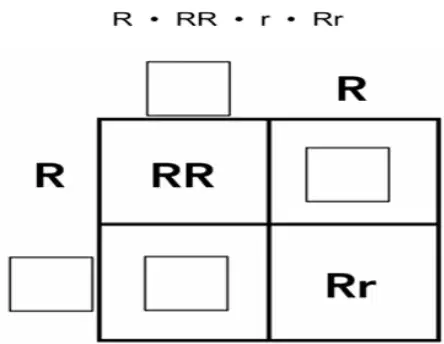
Look at the Punnett square with parents R and r. Which child box shows two capital letters?
Bottom right square
Bottom left square
Top left square
Top right square
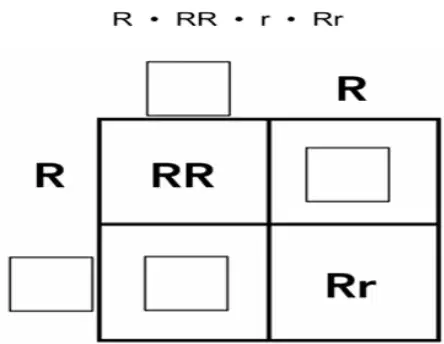
In the Punnett square, what does Rr mean?
No letters shown
Two lowercase letters
One capital one lowercase
Two same letters
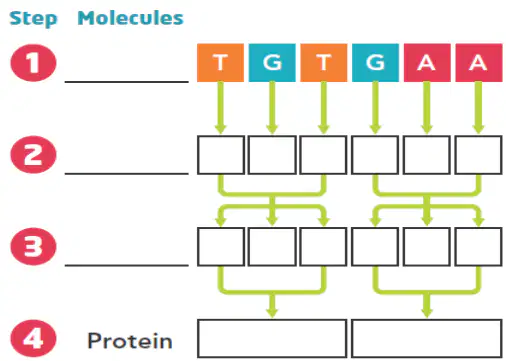
Using the codon chart, groups of three letters help make proteins. What do these three-letter groups make?
Fossil shells
Amino acids
Weather clouds
Plant roots
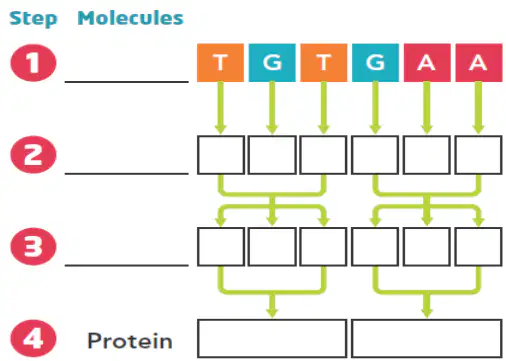
Which picture section asks you to complete steps to build a protein?
Protein coding flowchart
Fossil organizer table
Punnett square grid
Mass and weight table
Which is a trace fossil from the word bank?
Fossilized egg
Teeth marks on trees
Dinosaur bones
Hard shells
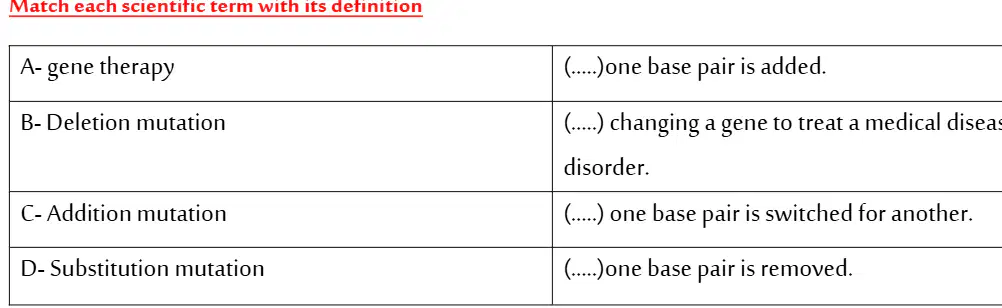
Match idea: Addition mutation means what happens to bases?
Two bases swapped
Bases stay same
One base added
One base removed
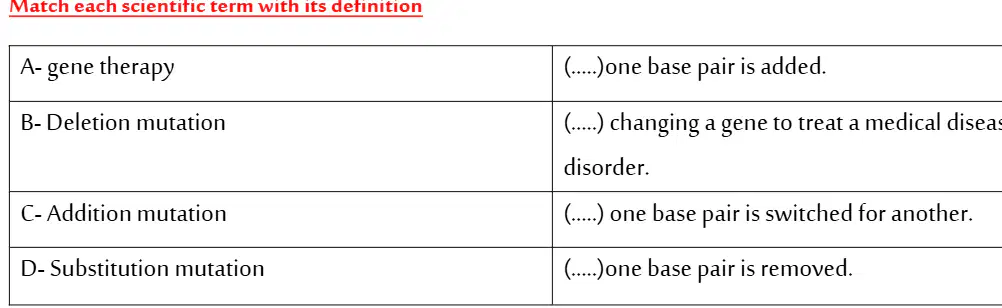
Substitution mutation means what?
One base added
Many bases erased
One base switched
One base removed
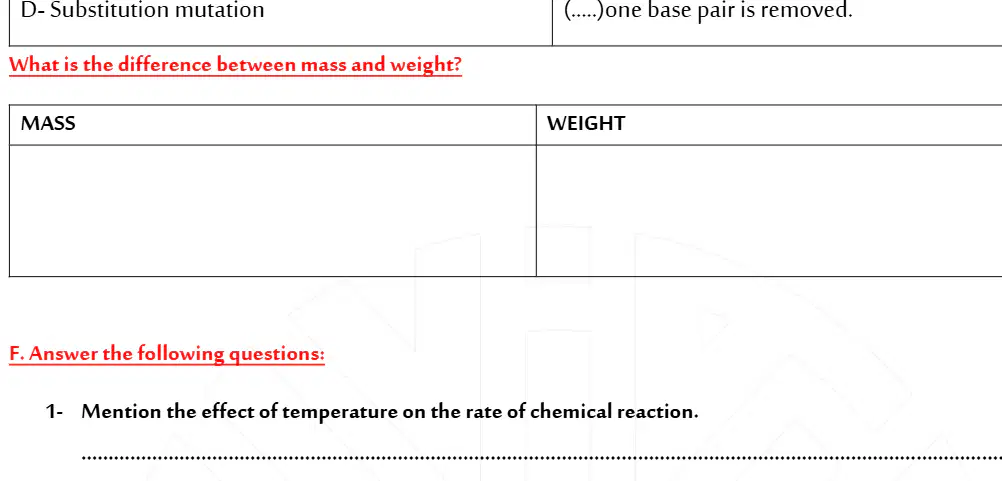
Which table helps compare mass and weight?
Codon chart
Fossil organizer
Punnett grid
Mass and weight boxes
Which force needs touching to push or pull an object?
Contact force like a hand push
Non-contact force like magnet pull
Force that works only at night
Force that needs many batteries
What helps an object resist changes in motion?
Taste of the object
Sound the object makes
Color of the object
Inertia from its mass
Which shows average speed for a trip?
Total distance divided by total time
Fastest speed only for one minute
How long the car rested at lunch
Number of people in the bus
A car goes 200 meters in 10 seconds. What is its average speed?
20 meters per second
10 meters per second
5 meters per second
50 meters per second
A runner changes from 3 m/s to 7 m/s in 4 seconds. What is the acceleration?
0 m/s²
4 m/s²
2 m/s²
1 m/s²
A cyclist changes from 15 m/s to 25 m/s in 5 seconds. What is the acceleration?
1 m/s²
2 m/s²
5 m/s²
10 m/s²
A bus travels 60 km in 1 hour, 80 km in 2 hours, and 40 km in 0.5 hours. What is the average speed for the whole trip?
100 km/h
80 km/h
60 km/h
40 km/h
Which word means how much stuff is in a solution?
Concentration of solute
Temperature of room
Size of the beaker
Shape of the spoon
Which statement about Newton’s laws is true for sitting in a chair?
Chair pushes back equally
Only gravity works there
Chair pulls only sometimes
No forces act at all
Which is the best example of a balanced force?
Rocket blasting upward
Car turning quickly
Ball speeding up fast
Book rests on a table
Which is a body fossil?
Footprints only
A paper drawing
A shadow mark
Bones and teeth
Which group has very reactive elements called halogens?
Group 1 on the table
Group 17 on the table
Middle metals group
Top row special gases
Where are electrons found in an atom?
Around the nucleus
Inside the nucleus
Only in neutrons
Only in protons
If the number of protons changes in an atom, what happens?
It becomes another element
It keeps the same element
It turns into a solution
It stops being matter
Which solution has more solute?
Concentrated solution
Diluted solution
Empty beaker water
Pure ice only
Which bond gives electrons to make ions?
Bond with painted glue
Bond made by strings
Ionic bond between atoms
Sharing-only bond
Which item is an ionic compound at home?
Paper napkin piece
Cooking oil bottle
Sugar candy stick
Table salt on food
Which liquid is a homogeneous solution?
Vinegar in a bottle
Paint in a can
Sand mixed with water
Oil and water mix

