
Font size
 Worksheets
Cell Transport Study
Total questions: 46
Worksheet time: 27mins
Samuel is learning about how substances move in and out of cells. He discovers that passive transport across the cell membrane does not require _____.
water
osmosis
energy
equilibrium
Jackson places a drop of food coloring in a glass of water and watches as the color spreads throughout the water without stirring or adding anything. The movement of molecules without the use of energy is called what?
diffusion
homeostasis
transport
exocytosis
Osmosis is a type of passive transport involving the movement of _____.
sugar
water
starch
cells
Kai is learning about how cells take in large molecules. He discovers that when a cell uses energy to bring large molecules INTO the cell membrane, this process is called?
osmosis
exocytosis
endocytosis
passive transport
Charlotte is studying how cells remove waste. She learns that large molecules going OUT of the cell membrane using energy is called?
osmosis
exocytosis
endocytosis
passive transport
Ava is sitting in a room where someone just sprayed perfume. The crowded perfume particles, like oxygen, move from an area of high concentration near the spray to an area of low concentration across the room without using energy. Choose the term that best fits this process.
active transport
diffusion
osmosis
homeostasis
Choose the term that best fits: Energy is used to move particles from a place of lower to higher concentration.
passive transport
active transport
diffusion
osmosis
Michael is learning about how substances move in and out of cells. He observes that some materials move across the cell membrane without the cell using any energy. Choose the term that best fits this process.
passive transport
active transport
cellular respiration
metabolism
Grace places a raisin in a cup of water and observes that water moves into the raisin through its skin. Choose the term that best fits: The movement of water across the membrane.
plasmolysis
osmosis
active transport
homeostasis
Liam places a gummy bear in a cup of water and observes that it absorbs water through its outer membrane. The movement of WATER across a membrane is called _____.
diffusion
osmosis
active transport
filtration
Emma is conducting a science experiment. She places a fresh stalk of celery into a _____ solution and notices that it shrinks. This is because water in the celery is pulled toward the higher percentage of salt solution.
isotonic
hypotonic
hypertonic
tonic
A raw egg has a selectively permeable _____. This means that only select types of materials are able to pass.
membrane
nucleus
cell wall
chloroplast
What are two main types of passive transport? Select all that apply.
diffusion
osmosis
protein pump
endocytosis
Large molecules entering and leaving the cell.
diffusion
endocytosis/exocytosis
diffusion
osmosis
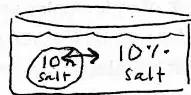
How will the water move for a cell with 10% solute placed in a 10% salt solution?
into the cell
out of the cell
no net movement
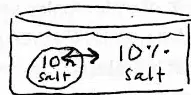
What happens to the cell size in the 10% inside vs. 10% outside scenario?
shrink
stay the same
expand
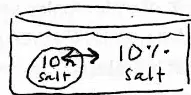
Name the type of solution for a cell with 10% solute placed in a 10% salt solution.
isotonic
hypotonic
hypertonic


Lily places a cell that contains 70% H2O into a solution that contains 30% H2O. What type of solution is this?
Hypotonic
Hypertonic
Isotonic

This animal cell is in a ____________ solution.
hypertonic
hypotonic
isotonic

Zoe is conducting an experiment where she observes how water moves through a thin membrane separating two solutions. What is this movement of water through a cell membrane called?
osmosis
endocytosis
exocytosis
compound

Oliver places a cell with 8 water molecules inside into a solution that has only 2 water molecules outside the cell. What type of solution is the cell in?
hypotonic
isotonic
hypertonic
equilibrium
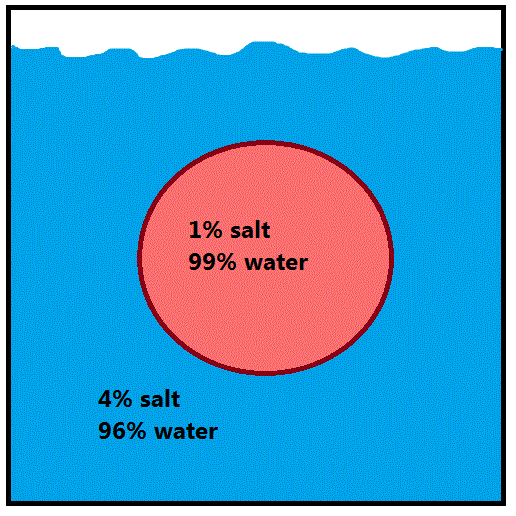
Where will the WATER (look at the water percentages)go?
Into the cell
Out of the cell
Equally in & out - it's isotonic
There is no water
There is a higher concentration of WATER in or out of the cell?
Inside the cell
Higher in the cell
Equally in & out - it's isotonic
There is no water
What is diffusion?
The movement of water molecules across a semipermeable membrane from an area of high concentration to an area of low concentration.
The process by which molecules spread from areas of high concentration, to areas of low concentration.
The active transport of molecules from an area of low concentration to an area of high concentration using energy.
The engulfing of large particles into the cell.
What is passive transport?
The movement of molecules across the cell membrane without the use of energy by the cell.
The movement of molecules across the cell membrane using energy.
The process of taking material into the cell by means of infoldings, or pockets, of the cell membrane.
The release of materials from the cell.
Which organelle is responsible for controlling what moves into or out of cells?
What is the primary function of the cell membrane?
To provide structural support to the cell.
To control what enters and leaves the cell, maintaining homeostasis.
To facilitate the synthesis of proteins.
To store the cell's genetic information.
All cells have a cell membrane.
True
False
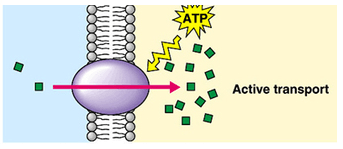

The movement of materials from an area of low concentration to an area of high concentration would require...
glucose
energy (ATP)
fish
chips


Mia places a plant cell in a hypertonic solution during her biology experiment. What happens to the cell?
It swells and bursts
It shrinks and dies
No change occurs
It becomes turgid
Which type of solution has the same concentration of solutes as the cell?
Isotonic
Supersaturated
Hypertonic
Hypotonic
If a red blood cell is placed in a hypotonic solution, what is most likely to happen?
It will swell and possibly burst
It will shrink
It will remain unchanged
It will divide

Which side has the higher concentration of glucose?
cell
blood
Which side has the higher concentration of glucose?
cell
blood

This picture shows what type of transport (leaving the cell)
Facilitated

In active transport, molecules move from _______________ concentration to _____________ concentration.
low; low
high; low
high; high
low; high

Active transport requires ________________ for molecules to move.
energy
sunlight
electricity
gravity

