
 Worksheets
Understanding Parallel Circuits
Total questions: 23
Worksheet time: 12mins
What is a parallel circuit?
A circuit with only one path for current to flow
A circuit with multiple paths for current to flow
A circuit without resistance
A circuit with only one resistor
In a parallel circuit, what happens to the total current when more branches are added?
It decreases
It increases
It remains the same
It becomes zero
Which of the following statements is true about the voltage in each branch of a parallel circuit?
It is different for each branch
It is the same for each branch
It is zero
It depends on the resistance
If a bulb in a parallel circuit burns out, what happens to the other bulbs?
All go out
They remain lit
They become dimmer
They explode
What is the formula for the total resistance Rtotal in a parallel circuit with two resistors R1 and R2 ?
Rtotal=R1+R2
Rtotal=R1+R2R1×R2
Rtotal=R1−R2
Rtotal=2R1+R2
Which device is commonly used to protect parallel circuits from excessive current?
Capacitor
Fuse
Transformer
Diode
If three resistors of 6Ω , 3Ω and 2Ω are connected in parallel, which resistor will have the greatest current?
6Ω
3Ω
2Ω
All have the same current
Which of the following is a real-life example of a parallel circuit?
An old string of Christmas lights
The electrical wiring in a house
A flashlight
A single light bulb
If the voltage source in a parallel circuit is 12V , what is the voltage across each branch?
0V
6V
12V
24V
Which statement best describes the current in a parallel circuit?
The current is the same in all branches
The total current is the sum of the currents in each branch
The current is zero in all branches
The current is divided equally regardless of resistance
Given three resistors R1=4Ω , R2=6Ω and R3=12Ω connected in parallel, calculate the total resistance.
1Ω
2Ω
3Ω
22Ω
A parallel circuit has two branches: one with a resistance of 10Ω and another with a resistance of 20Ω . If the voltage across the circuit is 10V , what is the current passing through the 10Ω resistor?
0.5A
1A
2A
10A
If a parallel circuit has three branches with resistances of 2Ω , 4Ω and 8Ω , and the total supplied current is 7A , what is the current passing through the 2Ω branch?
1A
2A
4A
8A
A parallel circuit contains two resistors, R1=5Ω and R2=15Ω , connected to a 30V battery. What is the total current supplied by the battery?
2A
4A
8A
10A
If a parallel circuit has three identical resistors and one is removed, what happens to the total resistance?
It increases
It decreases
It remains the same
It becomes zero
A student connects three resistors in parallel: R1=2Ω , R2=3Ω , R3=6Ω . If the voltage source is 12V , what is the total current in the circuit?
2A
6A
10A
12A
You are designing a parallel circuit for a lighting system. If you want each light to operate independently, why is a parallel circuit preferable to a series circuit?
Because it uses less wire
Because each light receives the same voltage and can operate independently
Because it is easier to build
Because it reduces the current
A parallel circuit has three branches with resistances R1=2Ω , R2=4Ω and R3=8Ω . If the total current from the source is 7A , calculate the voltage of the source.
7V
8 V
28V
56V
Suppose you need to design a parallel circuit with a total resistance of 2Ω using only 4Ω resistors. What is the minimum number of resistors you need and how should you connect them?
1 resistor in parallel
2 resistors in parallel
3 resistors in parallel
2 resistors in series
A parallel circuit is used to power three devices: a 60W lamp, a 100W fan, and a 40W radio, all connected to a 120V source. If the lamp stops working, what happens to the operation of the fan and the radio?
Both stop working because the circuit is interrupted
Both continue working because each has its own path to the voltage source
Only the fan stops working
Only the radio stops working

This is an example of a _______ circuit.
The explanation will be shown after you answer.
open
series
parallel
square
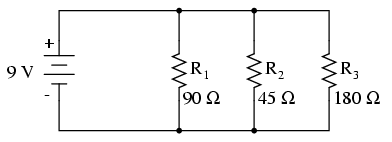
This is an example of a ______ circuit
Series
Parallel
Open
Dihedral
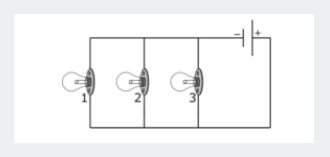
If bulb 1 burns out, what will happen?
bulbs 2 and 3 will go out
bulbs 2 and 3 will receive more voltage
bulbs 2 and 3 will remain lit
nothing will happen

