
Font size
 Worksheets
Governing a New Nation and State Constitutions
Total questions: 113
Worksheet time: 57mins
What is the best definition of a constitution in the context of early state governments?
A speech announcing independence from Britain
A document stating the rules of government
A treaty arranging trade with foreign nations
A list of taxes owed by the colonists
Which states kept using their colonial charters after 1776, with references to the British king removed?
Georgia and South Carolina
Pennsylvania and Delaware
Virginia and New York
Rhode Island and Connecticut
Who is the executive in early state governments?
The legislature that debates and passes laws
The judges who interpret laws during trials
The militia leader who commands state forces
The person who runs government and enforces laws
In many early states, which voting requirement was common?
Being a white male at least twenty‑one
Serving in the Continental Army first
Owning a printing press for the town
Paying a national income tax annually
Which state allowed women to vote during the early state constitution period?
Massachusetts
Maryland
Virginia
New Jersey
Match each term with its description.
Executive
Runs government and carries out laws
Legislature approval
Needed for governors’ key appointments
Colonial charters kept
Used by Rhode Island and Connecticut
Bill of Rights (state)
Protects individual rights of people
Which rights were included in Virginia’s Bill of Rights? Select all that apply.
Freedom of the press
Freedom of religion
Unlimited searches by officials
Trial by jury
No cruel and unusual punishments
Why did many states add bills of rights to their constitutions?
To protect individual rights from government abuse
To weaken juries and strengthen governors
To help Britain enforce colonial trade rules
To raise money through new national taxes
Under the Articles of Confederation, where did most political power remain?
In the courts that controlled taxation
In the office of a single national executive
In the national Congress over the states
In the individual states rather than Congress
Which power did Congress have under the Articles of Confederation?
Make laws and declare war with limits
Collect national taxes from all states
Control trade between all the states
Appoint a national executive leader
Which limitation weakened Congress under the Articles of Confederation?
It could not include delegates from states
It could not talk with foreign nations
It could not write or pass any laws
It could not limit trade or collect taxes
Which weakness of the national government under the Articles of Confederation made it hard to raise money for national needs?
No power to tax citizens directly
Presidents served very long terms
States had to follow one national tariff
Too many federal courts nationwide
What was a goal of the Land Ordinance of 1785?
Create a system for land sales and settlements
Give each state control of the Mississippi
Outlaw slavery across the entire nation
Divide eastern cities into voting districts
Under the Land Ordinance of 1785, how were public lands organized for sale?
Into townships six miles on each side
Into counties three miles each way
Into plantations along major rivers
Into districts based on old colonies
Which policy guaranteed basic rights for settlers and outlawed slavery in the Northwest Territory?
Missouri Compromise
Land Act of 1790
Stamp Act of 1765
Northwest Ordinance of 1787
Which states eventually formed from the Northwest Territory under the 1787 ordinance?
Indiana
Kentucky
Wisconsin
Ohio
Illinois
How did differing state trade policies under the Articles affect the economy?
Prices rose due to one national tax
States stopped all foreign commerce
Trade was limited by state taxes on goods
River shipping became completely free
Why did Spain closing the Mississippi River hurt American farmers in the West?
They received free shipping to Europe
They could sell crops at higher prices
They were given new markets by Spain
They had to move goods by difficult trails
Which best defines an economic depression in the mid-1780s context?
Business slows, prices and wages drop, unemployment rises
Business speeds up, wages climb fast, inflation eases
Exports expand, credit grows, profits rise steadily
Government taxes increase, spending grows, debt falls
What problem did many farmers face during the depression that fueled unrest?
New markets guaranteed steady income
High wages reduced farm labor supply
Growing crop prices increased land values
Falling crop prices made it hard to pay taxes
Who led an uprising of about 1,000 Massachusetts farmers in August 1786?
Daniel Shays, a former Revolutionary captain
Henry Knox, the army’s commander
John Jay, a prominent diplomat
Thomas Paine, a famous pamphleteer
What belief did Shays’ Rebellion strengthen among American leaders?
Foreign armies must occupy Boston
States should abolish all taxes
The Articles worked well as written
A stronger central government was needed
MATCH: Pair each ordinance with its main feature.
Land Ordinance of 1785
Set up land sales in six-mile townships
Northwest Ordinance of 1787
Guaranteed rights and banned slavery in NW
Articles of Confederation
Created weak national government of states
Where and when did the Constitutional Convention begin?
Philadelphia in summer 1787
Richmond in fall 1788
New York in spring 1789
Boston in winter 1786
Which BEST explains why debates at the Convention were kept secret?
To allow honest discussion without pressure
To prevent foreign nations from attacking
To avoid writing down any decisions
To save money on printing official notes
Which state did not send delegates to the Constitutional Convention?
Pennsylvania
Rhode Island
New Jersey
Virginia
Who served as president of the Constitutional Convention?
Alexander Hamilton
Ben Franklin
James Madison
George Washington
Match each delegate with a correct description.
James Madison
Principal author of the Virginia Plan
Alexander Hamilton
Advocated strong national government
George Washington
Presided over the convention
Ben Franklin
Elder statesman and inventor
Who introduced the Virginia Plan on the third day of the Convention?
Edmund Randolph of Virginia
James Madison of New York
Gouverneur Morris of Pennsylvania
George Washington of Virginia
Which statement describes the structure proposed by the Virginia Plan?
Three separate branches of government
One powerful legislative council
A confederation of independent states
A single executive ruling alone
In the proposed three-branch system, which branch interprets laws?
Executive branch
Legislative branch
Military branch
Judicial branch
Why did some delegates prefer a single executive rather than a committee?
It avoided the need for elections
Committees were banned by the Articles
A single executive could act more quickly
It would cost less to pay salaries
What change to Congress did the Virginia Plan suggest?
Creating a two-house legislature
Keeping a single-house congress
Abolishing the national legislature
Letting states appoint no legislators
Which problem did the Great Compromise aim to solve at the Constitutional Convention?
Balancing big and small state representation
Ending foreign trade with all nations
Choosing a national leader by popular vote
Deciding rights for territories in the West
Under the Virginia Plan, how were seats in the legislature to be assigned?
By tax money paid
By land size owned
By equal votes per state
By state population totals
Why did smaller states support the New Jersey Plan?
It based seats only on property
It removed the national legislature
It promised equal seats for each state
It expanded power of large states
What structure of Congress did the Great Compromise create?
One-house legislature with equal seats
Two-house legislature both by population
Two-house legislature with differing rules
Three-house legislature with veto power
Match each chamber of Congress with its representation rule.
House of Representatives
Based on state population
Senate
Equal seats for each state
Both chambers
Members elected and serve set terms
How were terms set in the House of Representatives under Sherman’s plan?
Two-year terms chosen by voters
Two-year terms chosen by governors
Four-year terms chosen by states
Six-year terms chosen by voters
On July 16, 1787, delegates narrowly approved a plan later called the Great Compromise. Who proposed it?
Roger Sherman of Connecticut
James Madison of Virginia
Alexander Hamilton of New York
George Mason of Virginia
What did the Three-Fifths Compromise decide?
Each enslaved person counted as three-fifths
Enslaved people gained full voting rights
Only free people counted for representation
States could not tax imported people
Which statement best explains a northern argument against counting enslaved people fully for representation?
They could not vote, so full counting was unfair
They owned no farms or factories
They paid higher taxes than others
They lived mostly in cities already
If a state held 5,000 enslaved people, how many were counted toward population under the Three-Fifths Compromise?
2,500 people counted
1,000 people counted
5,000 people counted
3,000 people counted
What was the Slave Trade Compromise regarding importing enslaved people?
Imports banned only in northern states
Imports allowed forever without limit
Imports banned immediately in all states
Imports allowed until 1808, then banned
How many states needed to approve the Constitution for it to go into effect?
All thirteen states
Ten of thirteen states
Nine of thirteen states
Seven of thirteen states
Which statement best describes Federalists during the ratification debate?
They opposed enforcing national laws
They supported a strong federal government
They wanted stronger state governments
They rejected any new national taxes
Who were key authors of The Federalist Papers?
James Madison and John Adams
Patrick Henry and Samuel Adams
Thomas Jefferson and George Mason
Alexander Hamilton and John Jay
Which concern was commonly raised by Antifederalists?
The army would be completely disbanded
The president might become like a king
States would gain too much power
New taxes would never be collected
What did some Antifederalists demand be added to protect basic freedoms?
A permanent Congress
A bill of rights
A stronger executive branch
A longer Constitution
Which fear reflected worries about creating a strong central government?
It would abolish all state militias
It would force all states to merge
It would copy England’s powerful monarchy
It would end all local courts forever
Which state was the first to approve the Constitution, on December 7, 1787?
Rhode Island
Pennsylvania
Delaware
Georgia
Which state was the last to ratify the Constitution in May 1790?
Virginia
North Carolina
Rhode Island
New York
What public event took place on July 4, 1788, in Philadelphia?
A protest against taxation laws
A celebration of ratification
A parade for state militias
A vote on presidential powers
After the ninth state ratified the Constitution, what major step did Congress take?
They dissolved the Continental Army
They prepared for a new government
They postponed national elections
They rewrote the Articles of Confederation
Who was elected the first President and Vice President under the new Constitution?
George Washington and Thomas Jefferson
George Washington and John Adams
John Adams and Alexander Hamilton
James Madison and John Jay
Why did many states insist on drafting a Bill of Rights soon after ratification?
To reorganize state borders
To increase presidential power
To protect individual freedoms
To allow states to print money
In what year did three-fourths of the states ratify the first ten amendments?
1791
1793
1789
1787
Match each numbered amendment with its protection.
1st Amendment
Freedoms of religion, speech, press, assembly, petition
2nd Amendment
Right to keep and bear arms for a well-regulated militia
4th Amendment
Freedom from unreasonable searches and seizures
6th Amendment
Rights of accused, including a speedy and public trial
8th Amendment
Freedom from excessive bail and cruel punishments
Which rights are protected by the First Amendment?
Right to petition the government
Freedom of religion and speech
Freedom from self-incrimination
Freedom of the press and assembly
Which amendment protects people from soldiers being housed in their homes without consent?
Tenth Amendment
Seventh Amendment
Third Amendment
Second Amendment
Which amendment guarantees a jury trial in civil cases?
Eighth Amendment
Fifth Amendment
Sixth Amendment
Seventh Amendment
Which amendment reserves powers not given to the federal government to the states or the people?
Tenth Amendment
Fourth Amendment
Ninth Amendment
Second Amendment
Which protections are included in the Fifth Amendment?
Freedom from self-incrimination
Due process of law
Freedom from double jeopardy
Freedom from cruel punishments
Which idea from Ancient Rome most inspired the creators of the U.S. Constitution?
Ruling by a single emperor with absolute authority
Expanding an empire through constant military conquest
Creating a lasting republic with elected representatives
Allowing provinces to act as fully independent nations
What lesson did American leaders draw from the fall of the Roman Empire?
Direct democracy always prevents civil wars
Monarchies protect rights more than republics
Dictatorship can lead to collapse and lost freedoms
Empires remain stable when borders keep growing
Which protection comes from Magna Carta and the English Bill of Rights?
Juries are optional for criminal trials
The head of government must obey the law
Kings can raise taxes without permission
Private property belongs to the monarch
Habeas corpus means that no person may be
held in prison without being charged with a specific crime
forced to vote in every election against their will
tried by a jury of citizens from another country
required to give private property to the government
Which statement best describes private property?
Property owned by an individual
Property shared by all citizens
Property owned by the king
Property held by the army
Montesquieu’s main idea for government was called
separation of powers
divine right of kings
popular mercantilism
imperial centralism
Why was separation of powers designed for a new government?
To give the national government unlimited authority over states
To make elections unnecessary for future leaders
To allow courts to write and enforce all national laws
To keep any one person or group from gaining too much power
MATCH the branch of government to its general role.
Legislative
Makes laws
Executive
Enforces laws
Judicial
Interprets laws

Which goal of the Preamble means states should work together as one nation?
Promote the general welfare
Secure the blessings of liberty
Ensure domestic tranquility
Form a more perfect union

Ensuring domestic tranquility means the government should
increase trade taxes for revenue
build alliances with foreign nations
give every citizen a government job
maintain peace and order at home

Providing for the common defense means the government must
limit voting to times of war
own all private weapons and supplies
ensure equal pay for all workers
protect citizens against foreign attack
Promoting the general welfare means the government should
focus only on the wealthiest citizens
leave health and safety to each state
support the well-being of all citizens
avoid passing any social programs
Securing the blessings of liberty means the government should
centralize all power in a single leader
value and protect the rights of citizens
expand territory to gain more resources
eliminate courts to speed up decisions
Which article of the Constitution establishes powers and limits on Congress?
Article VI outlines state relations only
Article VII outlines amendment procedures
Article IV outlines presidential elections rules
Article I outlines Congress powers and limits
Which article provides a process to amend the Constitution?
Article VII sets the amendment process
Article II sets the amendment process
Article V sets the amendment process
Article IV sets the amendment process
What does Article VI declare about the Constitution?
It is the supreme law of the land
It must be rewritten every decade
It only applies during wartime
It gives states power over treaties
Article VII sets up the procedure for
states to ratify the Constitution
Congress to declare holidays
courts to hear impeachment trials
presidents to veto state laws
Which statement best explains popular sovereignty in the United States?
States give all power to the national leader
People are the source of government authority
The president gains power from foreign allies
Judges grant power to Congress and agencies
The phrase “We the People” in the Preamble mainly shows which constitutional principle?
Executive supremacy over laws
State nullification of acts
Judicial review by courts
Popular sovereignty of the people
Limited government means which of the following?
The president can ignore rules in emergencies
Government powers are restricted by the Constitution
Government may act however leaders decide
Only citizens must follow the laws carefully
Why did the framers include limited government in the Constitution?
They wished to remove all national powers
Colonists feared harsh rule like the British king
They believed monarchs ruled by divine right
They wanted presidents to have total authority
Match each branch with a power shown in the checks and balances diagram.
Legislative branch
Writes laws and can impeach president
Executive branch
Enforces laws and can veto bills
Judicial branch
Interprets laws and can declare unconstitutional
According to the checks and balances diagram, what can the legislative branch do to limit the executive?
Veto bills passed by both chambers
Appoint judges to the Supreme Court
Declare executive orders unconstitutional
Impeach the president or reject appointments
Which actions in the diagram show the judicial branch checking the other branches?
Declare laws unconstitutional
Declare executive orders unconstitutional
Veto bills from Congress
Impeach the president
Federalism is best described as which arrangement of power?
Power granted by states to city governments
Power shared solely among three federal branches
Power held only by the national government
Power divided between national and state governments
Which pair shows each branch being checked by another, as in the diagram?
Courts can declare laws unconstitutional
Congress can impeach the president
The president can veto bills
States can overrule Supreme Court decisions
Which example best shows limited government applying to everyone?
Citizens can ignore laws they dislike
Congress is above the Constitution
Even the president must obey the law
Only governors must follow court rulings
Which statement best describes how representation in the Senate is determined?
Each state has two senators equally
Based entirely on state population
Chosen by the president each term
Rotates among regions every decade
How long is one term for a United States senator?
Six years per term
Two years per term
Eight years per term
Four years per term
Who serves as the President of the Senate and may cast a vote in a tie?
The Vice President of the United States
The Speaker of the House of Representatives
The Chief Justice of the Supreme Court
The Majority Leader of the Senate
Which statement about the Vice President in the Senate is correct?
May vote only to break ties
Leads debates every session
Votes on every bill routinely
Assigns all committee chairs
Representation in the House of Representatives is based on which factor?
State population size
Equal numbers per state
Land area in square miles
County boundaries only
Members of the House of Representatives serve terms of what length?
Two years each term
Six years each term
Four years each term
Three years each term
Who is the leader of the House of Representatives and regulates debates?
The Chief of Staff
The Senate Pro Tempore
The President of the Senate
The Speaker of the House
Match each chamber with its membership rule.
Senate
Two per state
House of Representatives
Population based seats
Both chambers
Must pass bills
What is the minimum age requirement to serve in the Senate?
Thirty years old minimum
Twenty-five years old minimum
Twenty-one years old minimum
Thirty-five years old minimum
What is the minimum citizenship requirement to serve in the Senate?
Nine years as a citizen
Seven years as a citizen
Born a natural citizen
Five years as a citizen
Which requirement applies to both senators and representatives?
Hold a law degree credential
Serve four-year terms length
Live in the state elected
Be born in the United States
What is the minimum age requirement to serve in the House of Representatives?
Twenty-one years old minimum
Thirty years old minimum
Twenty-five years old minimum
Thirty-five years old minimum
Where can a bill be introduced in Congress?
Either the House or the Senate
Only by the President alone
Only in the House chamber
Only in the Senate chamber
If both houses approve a bill, what happens next?
It becomes law immediately
It returns to its sponsor
It goes to the Supreme Court
It is sent to the President
Which branch is responsible for carrying out the laws and running national affairs?
The Executive Branch
The State Governments
The Legislative Branch
The Judicial Branch
Who heads the executive branch of the national government?
The Chief Justice of Court
The Speaker of the House
The Secretary of State
The President of the United States
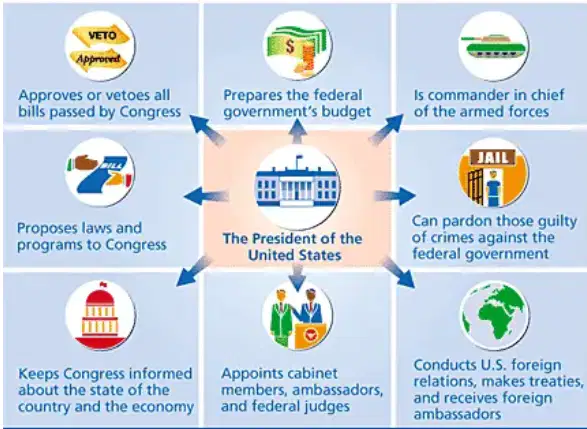
Which are powers of the President? Select all that apply.
Veto or approve bills passed by Congress
Command the armed forces as commander in chief
Conduct foreign relations and make treaties
Make and pass laws without Congress
Appoint cabinet members and federal judges
What limit does the 22nd Amendment place on the presidency?
Unlimited terms with approval
Only one four-year term total
Two terms if nonconsecutive
No more than two full terms
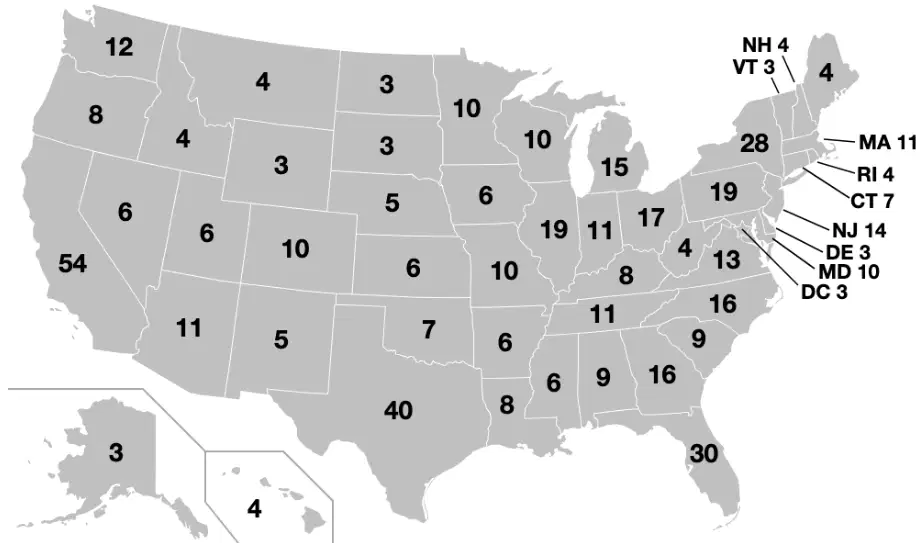
According to the diagram, which region shows states with the largest numbers of electoral votes?
West Coast and large states
Great Plains and Dakotas
New England and Vermont
Mountain states and Wyoming
Match each state to the number of electoral votes shown on the map.
California
54
Texas
40
Florida
30
New York
28
How are electors chosen in most states during a presidential election?
Winner-take-all for state popular vote
Proportional by each county share
Random lottery among voters
Chosen by Congress leaders
Which statement best explains the Electoral College?
Voters choose electors pledged to candidates
Voters directly choose the president nationally
Each state sends equal electors regardless of size
Electors may vote for any candidate they want
Which TWO statements are true about electing the president?
Electors are pledged to state winners
The 22nd Amendment allows three terms
Most states award all votes to winner
Electoral votes go to popular vote runner-up
The president serves four-year terms

