
 Worksheets
5.1 International Flow of Goods and Capital
Total questions: 77
Worksheet time: 39mins
Which statement best defines foreign direct investment (FDI) in an open economy?
Cross-border purchases of finished consumer goods
Investments by a country’s citizens in domestic bonds
Ownership stakes in overseas business operations by investors
Short-term foreign currency deposits held by tourists
In the context of international financial transactions, what primarily moves across borders?
Labor such as migrant workers
Capital such as loans and investments
Manufactured goods like electronics
Natural resources like crude oil
Global supply chains are best described as
Government agencies regulating domestic trade only
Interconnected networks coordinating worldwide production
Single companies exporting to one foreign distributor
Independent firms producing only for local markets
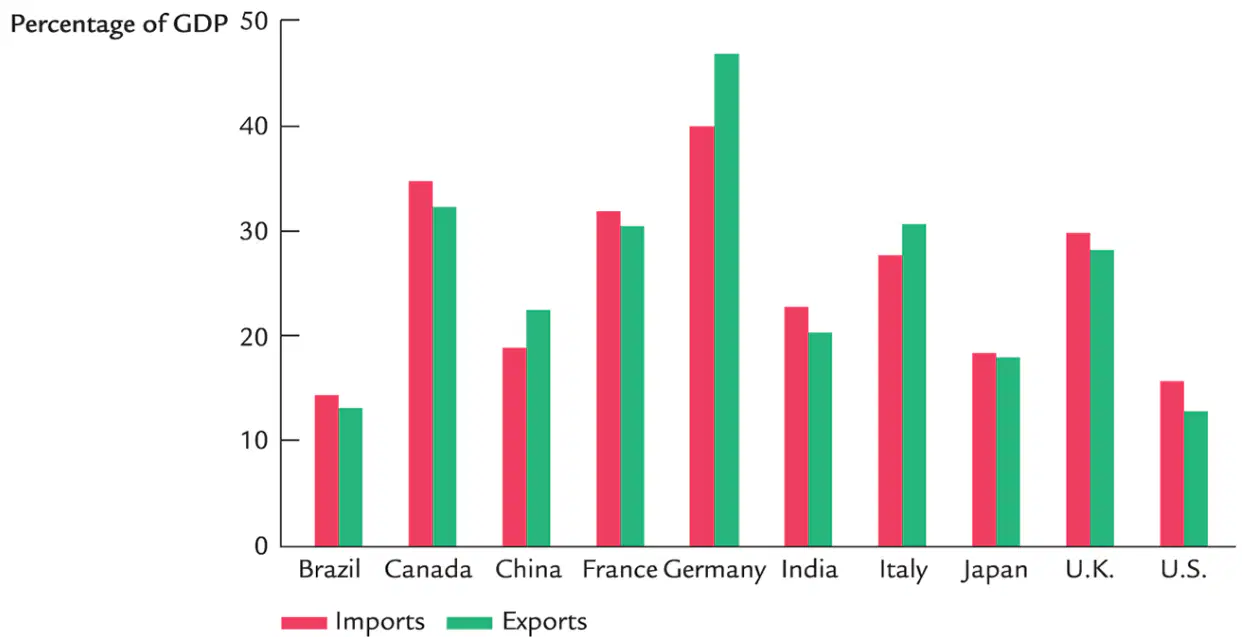
Using the bar chart of imports and exports of selected countries in 2013, which country shows exports noticeably exceeding imports?
U.S. with exports near thirteen percent
U.K. with exports near twenty-seven percent
Canada with exports near thirty-two percent
Germany with exports near forty-five percent
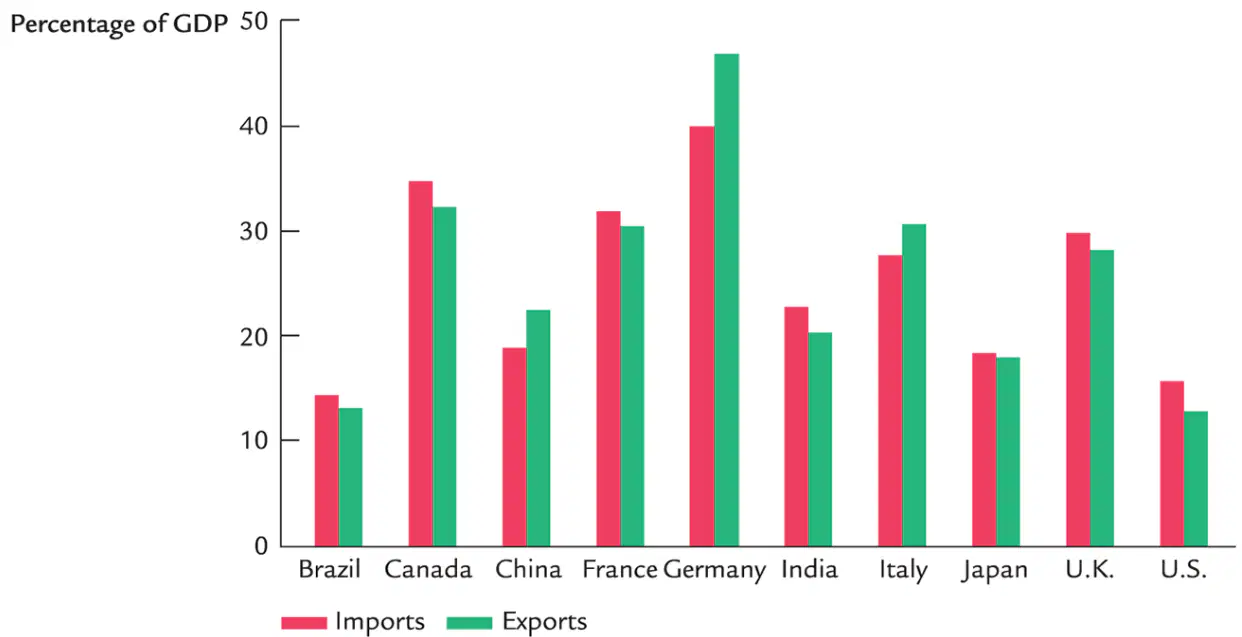
From the same 2013 chart, which economy appears most export‑oriented relative to its GDP among the listed countries?
Germany with exports around forty-five percent
France with exports around thirty percent
Brazil with exports around thirteen percent
Japan with exports around seventeen percent
A country has a trade‑to‑GDP ratio of 150%. What does this most likely indicate about its economy?
It is largely closed with limited trade activity
Its exchange rate is fixed by the central bank
It runs a persistent government budget surplus
Trade flows are large relative to total output
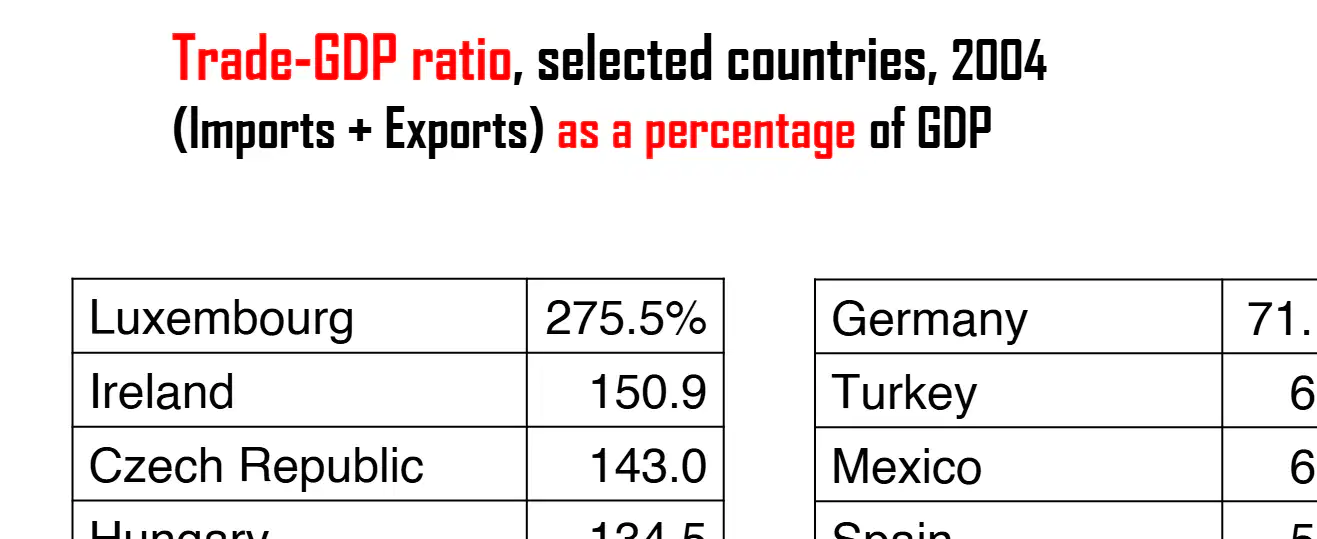
According to the trade‑GDP ratio table for 2004, which pair correctly matches a country with a high ratio?
Germany with about 25 percent
Japan with about 63 percent
United States with about 73 percent
Luxembourg with about 275 percent
Which scenario best illustrates the open‑economy circular flow?
Households buy imports; firms export goods abroad
Labor unions negotiate; wages increase domestically
Government prints money; banks hold excess reserves
Central bank raises rates; inflation expectations fall
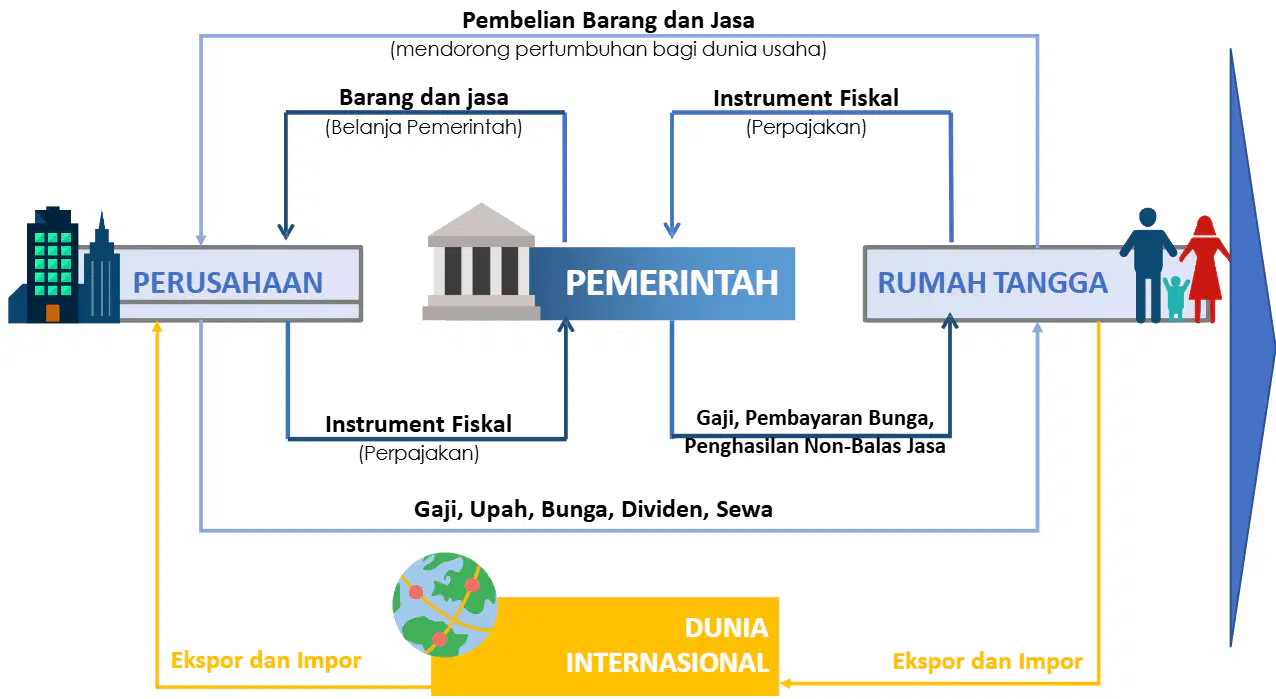
In the open economy diagram, which flow connects domestic firms with the rest of the world through trade?
Interest rate parity adjustments only
Government transfers and tax refunds
Exports and imports of goods and services
Wages and salaries to foreign workers
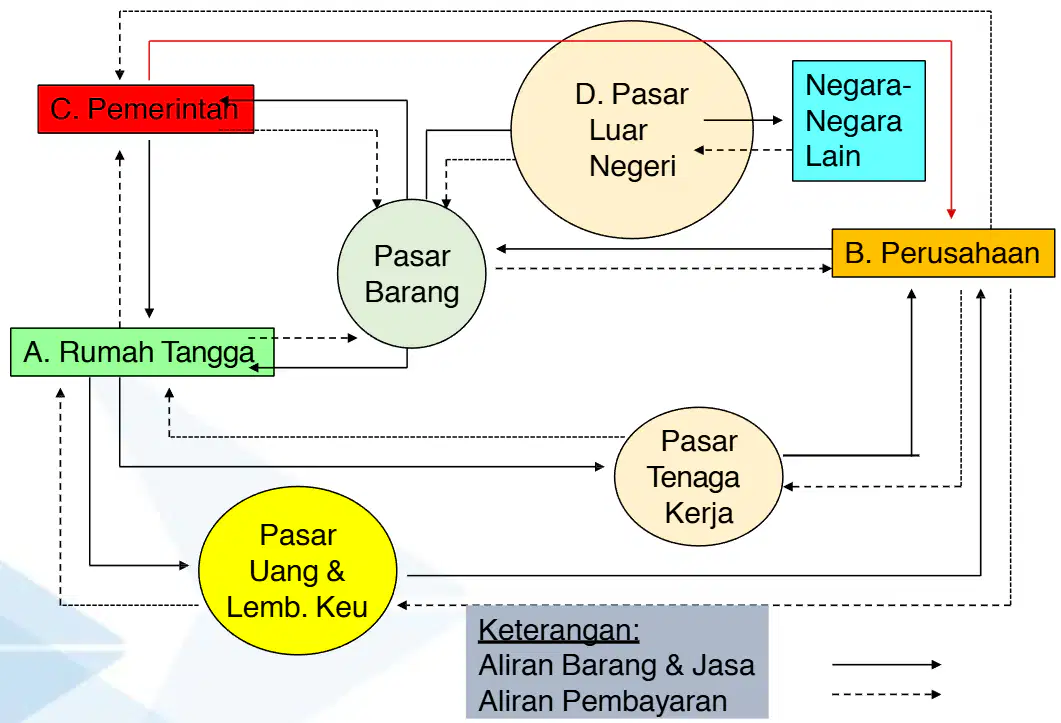
Which market in the diagram primarily determines wages paid from firms to households?
Foreign exchange market intervention
Money market for deposits and loans
Labor market for factor services
Goods market for final consumption
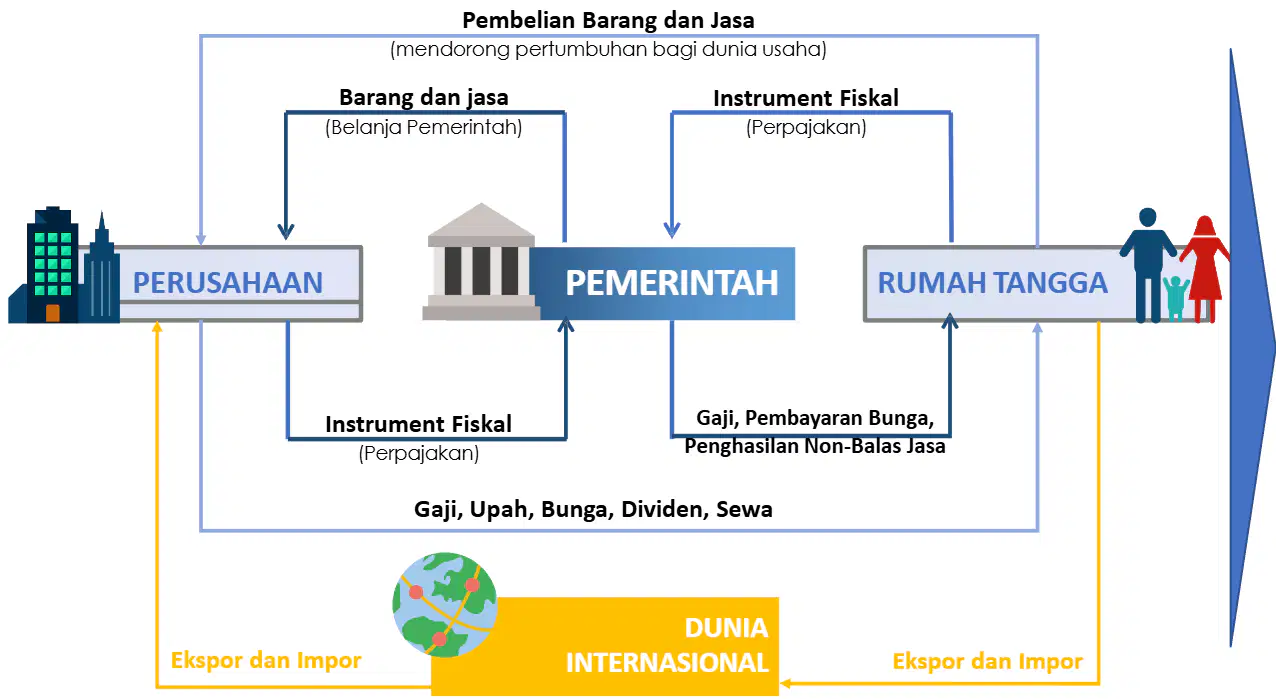
In the visual, what role does the government play in the circular flows between households and firms?
Sets exchange rates mechanically
Borrows solely from foreign markets
Only supplies labor and earns wages
Collects taxes and purchases goods
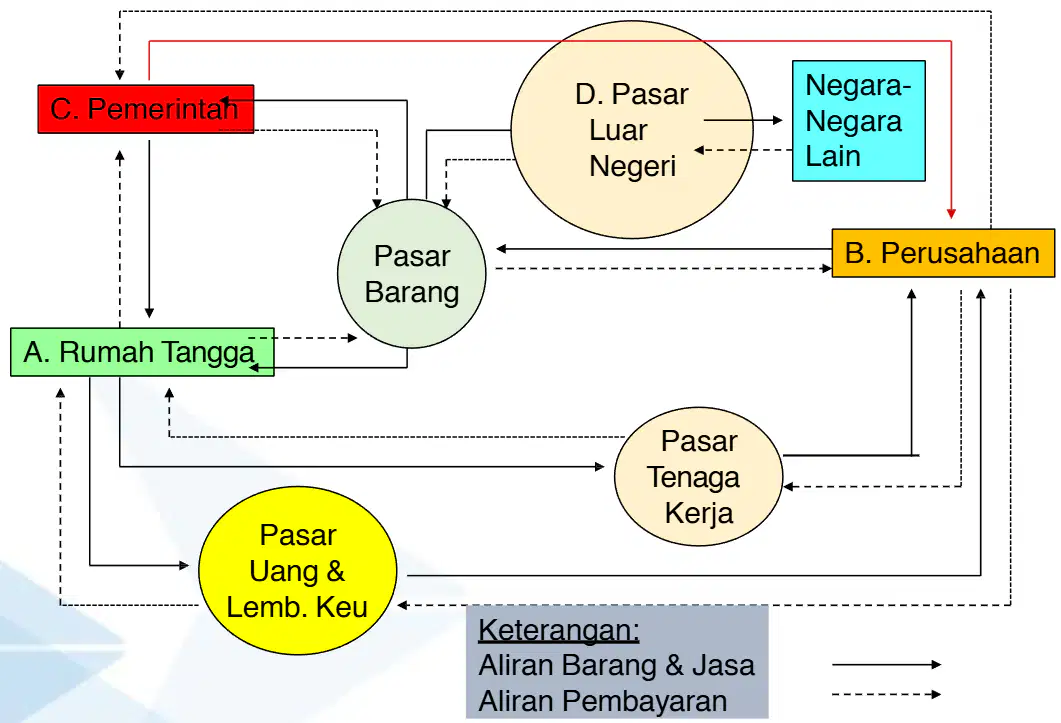
According to the money and labor market figure, which institution intermediates payments between sectors?
Rumah Tangga savings clubs
Pasar Barang for retail trade
Dunia Internasional customs unit
Pasar Uang dan Lembaga Keuangan
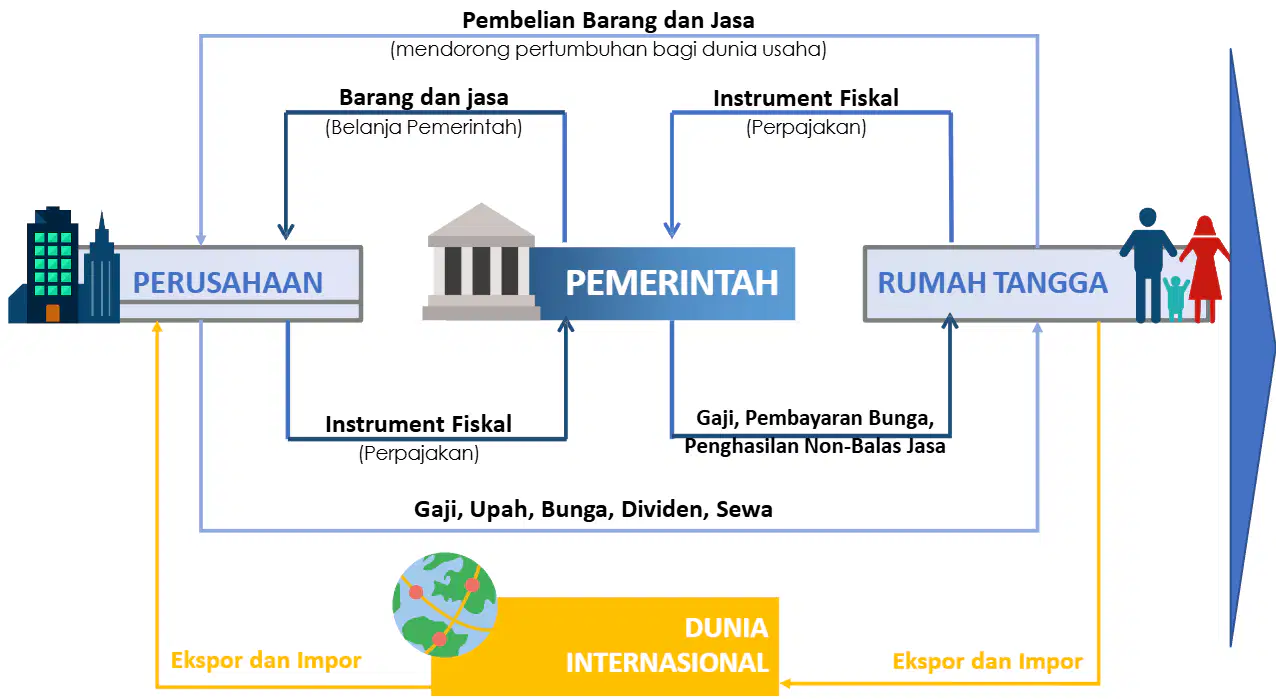
If government purchases increase while taxes are unchanged, which immediate effect is most consistent with the goods market flow in the diagram?
Reduced exports to other nations
Lower supply of household labor
Higher demand for firms’ output
Falling interest rates automatically
In a small open economy, which statement is true about spending and output?
Spending can differ from total output
Spending is unrelated to total output
Spending must equal total output always
Spending always exceeds total output
In a small open economy, which relationship between saving and investment holds?
Saving must equal investment always
Saving is unrelated to investment
Saving can differ from investment
Saving always exceeds investment
What do the superscripts d and f denote when attached to C, I, or G?
Domestic goods and foreign goods
Durable goods and final goods
Demand goods and future goods
Direct goods and fiscal goods
Which expression correctly defines imports (IM) in this framework?
IM equals domestic consumption only
IM equals investment plus government
IM equals C^f + I^f + G^f
IM equals exports minus consumption
Which statement correctly defines net exports (NX)?
NX equals consumption minus investment
NX equals imports minus exports
NX equals exports plus imports
NX equals exports minus imports
Which interpretation of exports (EX) is correct?
Domestic spending on domestic goods
Foreign spending on domestic goods
Government spending on imports
Domestic spending on foreign goods
Which identity represents GDP as expenditure on domestically produced goods and services in an open economy?
Y = EX − IM + NX
Y = C + I + G + NX
Y = C + I + G
Y=Cf+If+Gf
Starting from Y = C^d + I^d + G^d + EX, which step replaces foreign spending components to derive the trade balance?
Subtract (C^d + I^d + G^d) from EX
Add Cf+If+Gf to EX
Subtract (C^f + I^f + G^f) from EX
Replace EX with IM in the identity
If a country’s EX = 400 and IM = 500, which statement is correct?
NX is +100, indicating a trade surplus
NX is 0, indicating balanced trade
NX is −100, indicating a trade deficit
NX is +900, indicating a trade surplus
In an open economy, which identity links output to spending and net exports?
Y = C + G − I − NX
Y = C − I + G − NX
Y = C + I + NX − G
Y = C + I + G + NX
If domestic spending equals C + I + G, then net exports can be written as:
NX = (C + I + G) − Y
NX = Y − (C + I + G)
NX = (Y + C + I + G)
NX = Y + (C − I − G)
Which condition best describes a trade surplus?
Spending exceeds output and imports exceed exports
Output exceeds spending and exports exceed imports
Output equals spending and exports equal imports
Spending equals output and imports equal exports
The size of a trade deficit is measured as:
Negative of net exports, or −NX
Positive net exports, or +NX
Difference of income and taxes, Y − T
Sum of exports and imports, EX + IM
Net capital outflow is defined as:
Y − (C + I + G), the output gap
I − S, the inflow of government funds
S − I, the net outflow of loanable funds
G − T, the fiscal budget balance
When S > I for a country, it is best classified as a:
Balanced trader with zero NX
Net borrower in international markets
Closed economy with no trade
Net lender in international markets
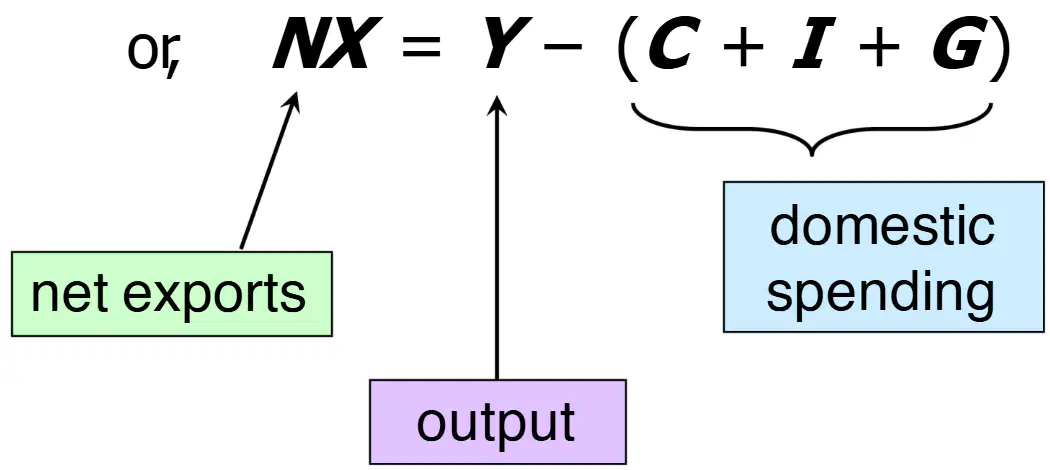
Consider two economies with identical output. Economy A has higher domestic spending than Economy B. Holding output fixed, which statement is most likely true?
Economy A has lower net exports than Economy B
Net exports are unrelated to domestic spending
Economy A has higher net exports than Economy B
Both economies must have equal net exports
A country records large purchases of foreign assets by residents while foreigners buy even larger amounts of its domestic assets. What is the country's status and likely NX sign?
Net borrower with negative net exports
Net lender with positive net exports
Net borrower with positive net exports
Net lender with negative net exports
Which identity links a nation’s trade balance to saving and investment?
NX = G − (Y − C − I)
NX = Y − (C + I + G)
NX = C + I − (Y + G)
NX = (Y + C) − (I + G)
If national saving is less than domestic investment, which outcome follows?
Output must exceed income
Government purchases must fall
Net exports are positive
Net exports are negative
In the identity NX = S − I, what does a negative NX indicate about capital flows?
Net capital inflow occurs
Net capital outflow occurs
No international borrowing occurs
Balanced capital flows occur
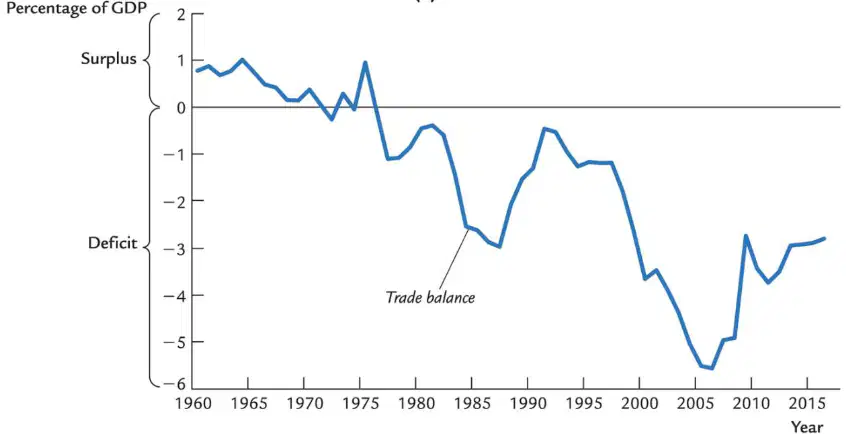
From 1960 to 2014, the U.S. trade balance trend most accurately shows
Movement from small deficits to larger deficits
Persistent surpluses that grew steadily
Stable balance near zero throughout
Deficits turning to large surpluses
Which relationship between saving and investment aligns with a trade surplus?
Saving exceeds investment
Investment equals government revenue
Saving equals government spending
Investment exceeds saving
As of 12/31/2014, which statement best reflects U.S. debtor status?
U.S. residents owned more foreign assets than foreigners owned U.S. assets
Net borrowing from abroad was essentially zero
U.S. net position with rest of world was a surplus
Foreigners owned more U.S. assets than U.S. owned foreign assets
Which equation defines national saving in the small open economy model with exogenous policy variables?
S̄ = Ȳ − C(Ȳ − T̄) − Ḡ
S̄ = C(Ȳ − T̄) + I(r) − Ḡ
S̄ = Ȳ − I(r) − T̄ + Ḡ
S̄ = C(Ȳ) − T̄ − Ḡ
In the small open economy framework, which statement best describes perfect capital mobility?
Interest rate fixed by central bank domestically
Domestic saving equals domestic investment always
No trade in goods across borders allowed
No restrictions on international trade in assets
Under the assumption that domestic and foreign bonds are perfect substitutes, which relationship holds in equilibrium for a small open economy?
Investment is independent of any interest rate
The world interest rate equals domestic saving
The domestic interest rate exceeds the world rate r*
The domestic interest rate equals the world rate r*
Which variables are treated as exogenous policy variables in this model?
Government spending Ḡ and taxes T̄
Output Ȳ and labor L̄
World interest rate r* and capital K̄
Investment I and consumption C
Why does national saving not depend on the real interest rate in this setup?
Because investment is fixed at a constant level
Because consumption depends on disposable income only
Because output varies directly with r
Because taxes adjust to keep saving constant
Given perfect capital mobility and a small economy, what makes r* exogenous to domestic policy?
Capital controls keep the interest rate constant
The economy cannot affect the world interest rate
Bond markets are segmented domestically
Domestic central bank pegs the interest rate
Which function correctly represents investment behavior in the model?
I = I(T) with I decreasing in T
I = I(G) with I increasing in G
I = I(Y) with I increasing in Y
I = I(r) with I decreasing in r
If Ḡ increases while Ȳ and T̄ are unchanged, what happens to national saving S̄, holding r* fixed?
S̄ rises and then returns to initial level
S̄ is unchanged because r* determines saving
S̄ rises because higher Ḡ crowds in saving
S̄ falls by the amount of the increase in Ḡ
Which combination of assumptions jointly implies that the domestic real interest rate equals r*?
Constant output and constant consumption
Exogenous taxes and government spending
Small economy and fixed investment schedule
Perfect substitutes in bonds and perfect mobility
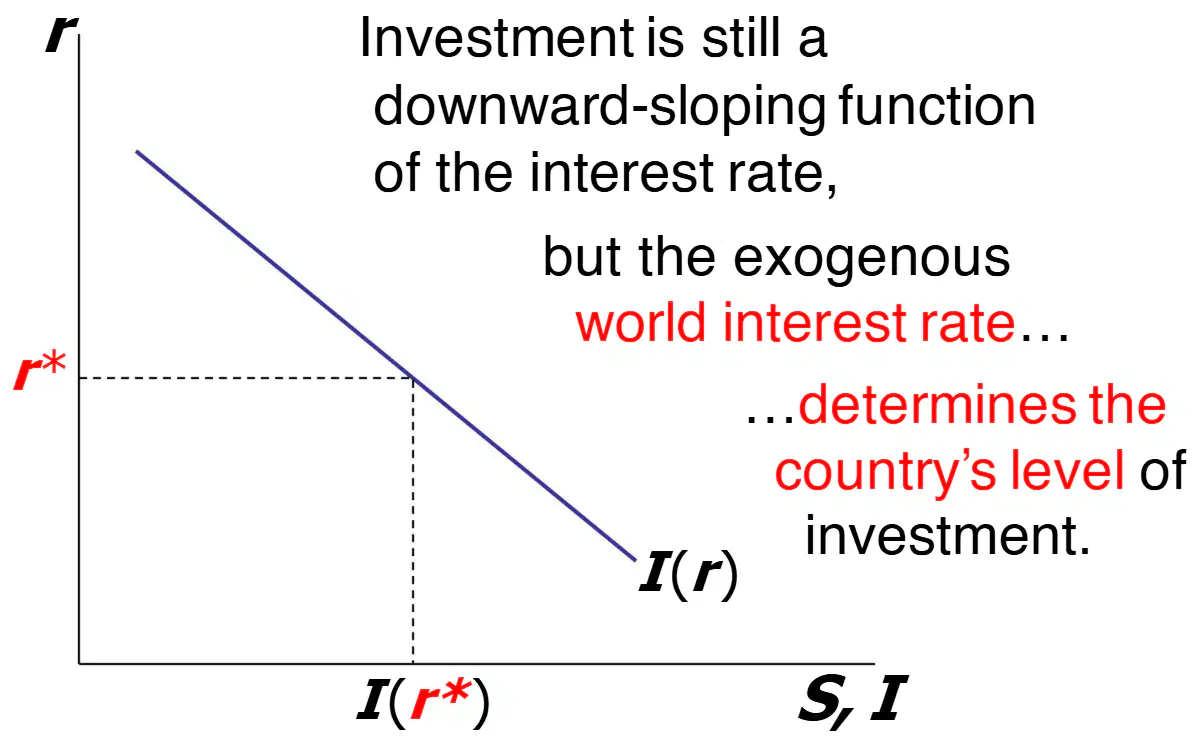
In a small open economy, what primarily determines the domestic level of investment shown by I(r)?
The exogenous world interest rate r*
The domestic saving schedule S
Government budget balance only
The current account target level
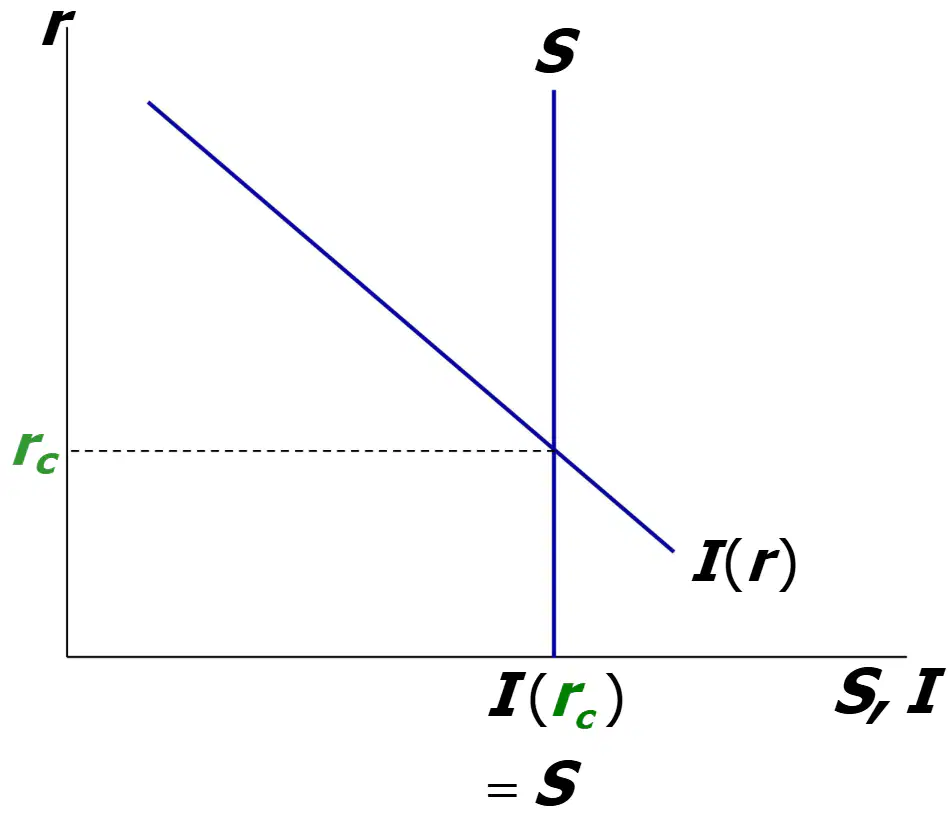
If the economy were closed, which condition sets the equilibrium interest rate r_c in the loanable funds market?
Net exports equal zero at r_c
Saving equals investment at r_c
World rate equals domestic rate r_c
Money demand equals money supply

Compared to a closed economy, a small open economy with r* below r_c will exhibit which outcome at r*?
Saving exceeds investment, implying NX surplus
Both saving and investment fall to zero
Investment exceeds saving, implying NX deficit
Saving equals investment, implying balanced NX
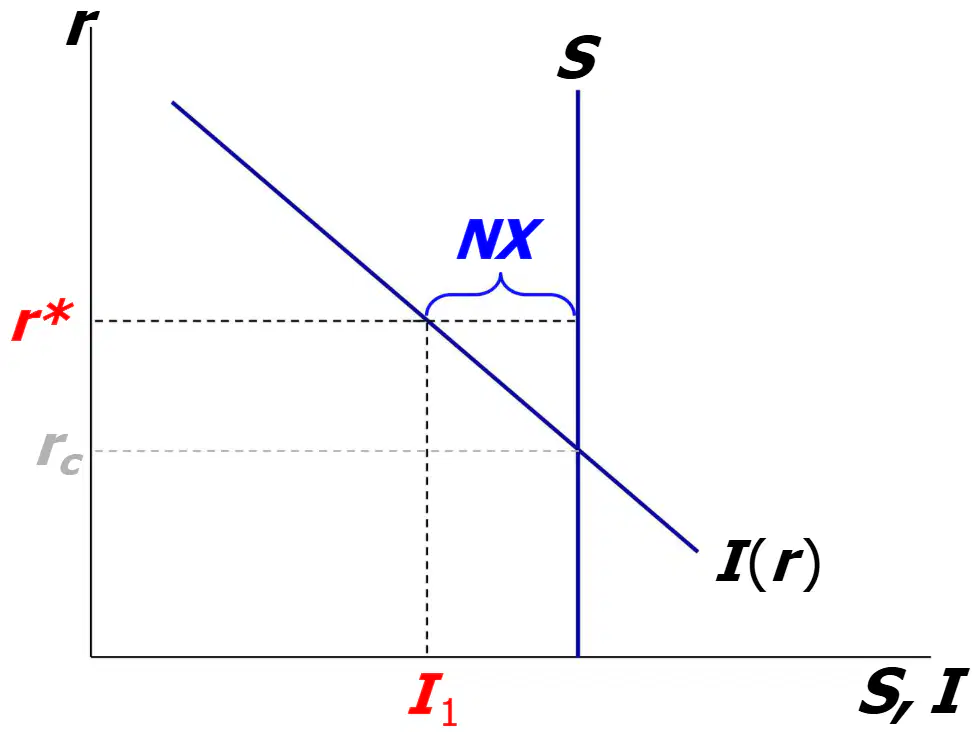
Which statement best explains how net exports (NX) are determined in the small open economy diagram?
NX equals the slope of I(r) line
NX equals saving minus investment at r*
NX equals investment minus saving at r_c
NX equals world interest rate minus r_c
Holding the saving schedule S fixed, what happens when the world interest rate r* rises?
Investment rises, NX falls if S unchanged
Investment unchanged, NX unchanged always
Investment falls, NX rises if S unchanged
Saving falls, investment unchanged
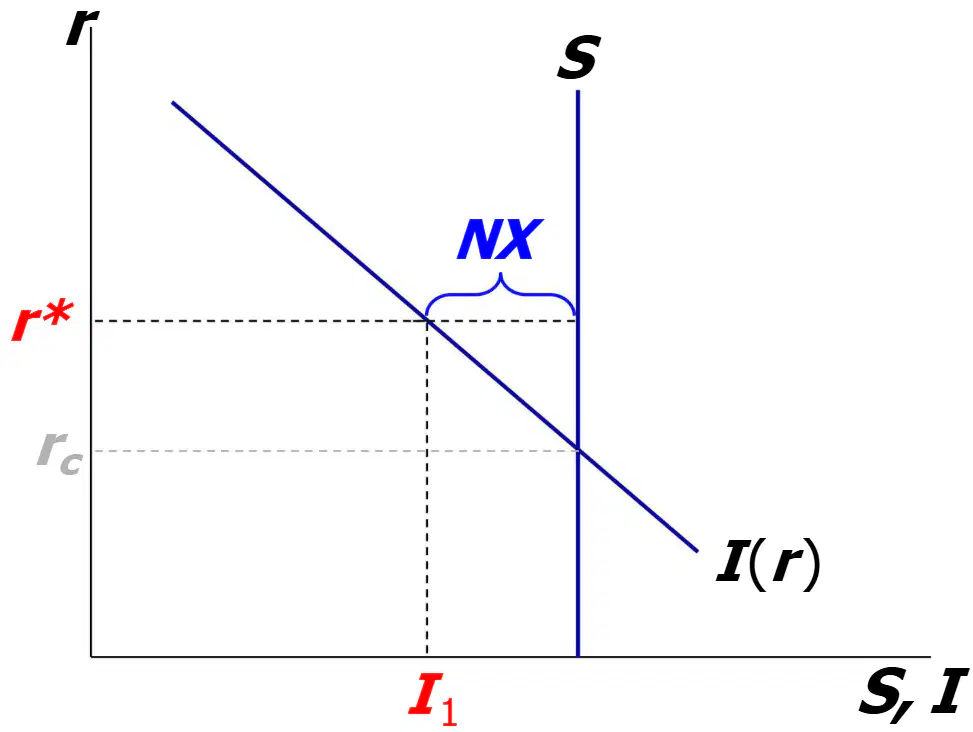
Which curve’s position would shift if firms become more optimistic about future profitability, and how would NX change at a given r*?
S shifts left; NX increases
I(r) shifts right; NX decreases
S shifts right; NX increases
I(r) shifts left; NX increases
Why does the small open economy take r* as given in these diagrams?
It is too small to affect world markets
Domestic saving equals domestic investment
Capital controls fix the domestic rate
Its central bank pegs the interest rate
Which statement best defines an exchange rate in finance?
Price of one currency in another currency
Interest paid on international government bonds
Tax charged on foreign financial transactions
Fee banks charge for currency conversion services
In the notation e, what does the nominal exchange rate represent?
Interest rate differential across two countries
Real purchasing power of a home currency basket
Domestic inflation rate over a given quarter
Relative price of domestic currency in foreign currency
Which unit is a correct example of a nominal exchange rate?
Yen per dollar as a quoted price
Percent change in CPI per year
Price index points per month
Dollars of real GDP per capita
If e = 118.0 yen/$, what does this quote mean?
One pound equals 118.0 yen
One dollar trades for 118.0 yen
One yen trades for 118.0 dollars
One dollar equals 118.0 euros
Which table entry is measured as foreign currency per U.S. dollar?
0.66 pounds/$ for U.K.
65.85 rubles/$ for Russia
11.50 rand/$ for South Africa
0.85 euro/$ for Euro area
Which quotation uses a domestic-per-foreign convention if the domestic currency is yen and the foreign is dollars?
0.66 pounds/$ in London
11.50 rand/$ in South Africa
$0.0085 per yen in retail
118.0 yen/$ as the market quote
Which best describes the real exchange rate (ε) conceptually?
Central bank policy rate across two nations
Growth rate of nominal GDP per capita
Relative price of domestic goods to foreign goods
Face value ratio of two nominal currencies
Holding foreign prices and the nominal rate fixed, what raises the real exchange rate ε for domestic goods?
An increase in domestic price level
A fall in domestic money supply
A decrease in foreign demand deposits
A reduction in trade balance surplus
Which quotation indicates a stronger domestic currency when the home currency is the U.S. dollar?
A fall from 14.6 to 13.0 pesos/$
A rise from 0.66 to 0.75 pounds/$
A fall from 118.0 to 110.0 yen/$
A rise from 11.50 to 12.80 rand/$
Which pair correctly matches symbol and meaning in exchange rate notation?
e: euro rate, ε: efficiency rate
e: equity rate, ε: elasticity rate
e: nominal rate, ε: real rate
ε: nominal rate, e: real rate
Which statement best defines the real exchange rate, ε?
Nominal price level of domestic goods in dollars
Relative price of domestic goods in foreign goods
Number of foreign currencies per domestic currency
Quantity of exports expressed in domestic currency
Given ε = (e × P) / P*, what do e, P, and P* represent?
Trade balance, domestic income, foreign income
Interest rate, domestic inflation, foreign inflation
Real exchange rate, domestic output, foreign output
Nominal exchange rate, domestic price level, foreign price level
If ε rises, holding other factors constant, how is the trade balance (NX) most likely affected in the standard NX function?
NX decreases because domestic goods become relatively expensive
NX increases because imports become relatively cheaper
NX is unchanged because ε only affects prices
NX increases because exports rise with higher ε
In the macro model with one composite good, ε is interpreted as which relative price?
One country’s output in terms of the other country’s output
Foreign currency in terms of domestic currency units
Domestic capital in terms of foreign capital goods
Domestic labor in terms of foreign labor hours
Which scenario illustrates the units of ε when the U.S. trades with Japan?
Units of U.S. goods per unit of Japanese currency
Yen per dollar per unit of exports
Dollars per yen per unit of output
Units of Japanese goods per unit of U.S. goods
A trade-weighted index primarily serves to do what with exchange rates?
Track only the dominant bilateral currency pair
Measure real GDP growth using price indexes
Aggregate bilateral rates using partner trade shares
Compute interest differentials across countries
Which factor would shift the NX(ε) curve outward at every ε in a small open economy model?
An increase in foreign income that boosts export demand
An appreciation that raises the real exchange rate
A decrease in trade partner tariffs on imports
A rise in domestic prices holding foreign prices constant
Suppose ε appreciates by 10% due to higher domestic inflation relative to foreign inflation. What is the most plausible short-run effect on exports and imports?
Exports fall and imports rise, reducing NX
Exports rise and imports fall, increasing NX
Exports and imports both rise equally, NX unchanged
Exports and imports both fall, NX improves
In the slide, ε denotes the real exchange rate. According to the bullet points, when ε rises, what is the immediate relative price effect described?
Foreign and U.S. goods stay equally priced in all markets
Foreign goods become more expensive relative to U.S. goods
U.S. goods become more expensive relative to foreign goods
U.S. goods become less expensive relative to foreign goods
Based on the slide’s sequence, if ε rises, what happens to exports and imports?
Exports rise and imports fall
Exports fall and imports rise
Both exports and imports fall
Both exports and imports rise
Using the causal chain on the slide, a rise in ε ultimately leads to what change in net exports (NX)?
Net exports fall
Net exports rise
Net exports are unchanged
Net exports become positive

Consider the graph of U.S. net exports and the real exchange rate, 1973–2015. When the trade-weighted real exchange rate index is relatively high, what pattern is often observed in NX (% of GDP)?
NX shows no clear correlation
NX stays constant near zero
NX tends to be more positive
NX tends to be more negative
In a foreign exchange market diagram with a vertical net capital outflow curve (supply of dollars), what does the vertical shape imply about net capital outflow with respect to ε?
It is independent of ε
It fluctuates cyclically with ε
It increases with ε
It decreases with ε
Suppose a policy change increases desired saving, shifting the vertical net capital outflow curve rightward. In the foreign exchange market, what happens to ε and NX at the new equilibrium?
ε falls and NX falls
ε unchanged and NX unchanged
ε rises and NX falls
ε falls and NX rises
In the long-run adjustment, ε moves to equate NX with net capital outflow. If domestic investment opportunities surge and reduce NCO, what adjustment restores equilibrium?
ε falls until NX increases to the lower NCO
NX rises regardless of ε movements
ε rises until NX decreases to the lower NCO
ε remains fixed as NX adjusts automatically

