
 Worksheets
Robotics Revision Quiz
Total questions: 85
Worksheet time: 44mins
Robotics is best defined as:
The study of machines only
Programming of computers
An interdisciplinary field dealing with design, construction, and use of robots
Electrical engineering alone
Which component of a robot converts electrical signals into movement?
Sensor
Controller
Actuator
Power supply
Which engineering field focuses on algorithms and decision-making in robots?
Mechanical Engineering
Electrical Engineering
Computer Science
Civil Engineering
UNIMATE was significant because it was the:
First humanoid robot
First service robot
First industrial robot
First medical robot
Which sensor measures distance using sound waves?
Color sensor
Gyroscope
Ultrasonic sensor
Infrared sensor
Which robot type is designed mainly to assist humans in daily life?
Industrial robot
Service robot
Military robot
Mobile robot
The “brain” of the robot is called the:
Sensor
Actuator
Controller
End effector
Which application of robotics focuses on Mars exploration?
Agriculture
Healthcare
Defense
Space exploration
Which is a major ethical concern related to robotics?
Battery charging
Robot design
Job displacement
Robot speed
Robots that make decisions using sensors and AI are called:
Manual
Semi-autonomous
Fully autonomous
Remote-controlled
Robotics aims to reduce error and increase (a) .
A (a) robot is commonly used in manufacturing and assembly lines.
Robots used to defuse bombs improve (a) for soldiers and civilians.
Which of the following is NOT a key feature of an algorithm?
Precise
Infinite
Ordered
Finite
Which step comes FIRST in a robotics algorithm?
Stop motors
Move robot
Start program
End program
What is the first step when writing a good algorithm?
Draw a flowchart
Identify the problem clearly
Write code
Add decisions
Why should algorithms be written in simple language?
To make them longer
To avoid confusion
To add complexity
To use fewer steps
Which flowchart symbol represents Start/End?
Rectangle
Diamond
Oval
Parallelogram
Which symbol is used for decision-making in a flowchart?
Oval
Rectangle
Arrow
Diamond
What is the purpose of arrows in a flowchart?
Show calculations
Represent decisions
Show direction of flow
Represent input
Which symbol is used for input or output?
Rectangle
Parallelogram
Diamond
Oval
What does an IF statement do?
Repeats steps
Ends the program
Checks a condition and performs an action
Displays output
When is an IF–ELSE statement used?
When no decision is needed
When two possible actions exist
Only in flowcharts
Only in real life
In a line-following robot, what happens if the color sensor sees black?
Stop robot
Turn right or left based on logic
End program
Reverse motors
Why are flowcharts useful in programming and robotics?
They replace coding
They make programs longer
They visually represent algorithms
They reduce robot speed
A student writes an algorithm but places the “STOP” step before “MOVE FORWARD.”
What is the main issue with the algorithm?
It is not finite
It is not precise
Steps are not in correct order
It lacks a decision
A robot uses this logic:
“If distance < 10 cm, stop.”
The robot stops too often due to sensor noise.
What is the BEST solution?
Remove the condition
Increase speed
Add a repeat check before stopping
End the program
How many input/output ports are available on the SPIKE Prime Hub?
4
5
6
8
Which feature allows the Spike prime hub to display icons, text, and animations?
Speaker
Gyroscope
LED Matrix
USB Port
Why are ports A–F called interchangeable ports?
They only connect motors
They only connect sensors
They can be used for both motors and sensors
They work only in fixed positions
Which of the following is NOT a benefit of interchangeable ports?
Flexible robot design
Easier repairs
Faster battery charging
Multiple robot configurations
Which button is used to start or select a program on the hub?
Power button
Directional buttons
Center button
Bluetooth button
7. What does the internal gyroscope measure?
Distance
Sound
Rotation and tilt
Color
Which motor is best suited for driving robot wheels?
Medium Angular Motor
Servo Motor
Large Angular Motor
Stepper Motor
Which motor is lighter and ideal for grippers and attachments?
Large Angular Motor
Medium Angular Motor
DC Motor
Hydraulic Motor
Which sensor is MOST commonly used for line-following robots?
Ultrasonic sensor
Force sensor
Gyroscope
Color sensor
The ultrasonic sensor detects distance using:
Light waves
Infrared rays
Sound waves
Magnetic fields
13. Which sensor works like a “robot button”?
Color sensor
Gyro sensor
Force sensor
Distance sensor
Pitch, roll, and yaw measurements come from which built-in sensors?
Color and force sensors
Accelerometer and gyroscope
Ultrasonic and gyro sensors
Touch and distance sensors
Which block starts program execution?
Control block
Event block
Motion block
Variable block
What is the default motor speed if it is not specified?
50%
75%
100%
25%
Which block category allows text or patterns to be shown on the hub?
Motion blocks
Sensor blocks
Light/LED blocks
Sound blocks
A point turn occurs when:
Both motors move forward
One motor stops and the other moves
One motor moves forward and the other backward
Both motors move at the same speed
What is usually the first step in a robot movement program?
Turn off motors
Initialize sensors
Start robot movement
End program
When the robot makes a 90-degree right turn in place,
The left wheel spins backward and the right wheel spins forward
The right wheel spins backward and the left wheel spins forward
The right wheel spins while the left wheel does not move
The left and right wheels both spin forward at the same time
Program Flow is referred to as...
the way a robot executes a program from bottom-to-top.
the way a robot executes a program from top-to-bottom.
the way a robot executes a program by alphabetical order.
the way a robot executes a program in a random order.
The Simulator tab in GearsBot is used to:
Write Python code only
Design robots physically
Run the virtual robot program
Print certificates
To make the robot move forward in GearsBot using blocks, you would place your command under:
If block
Forever block
When Started block
Start/Stop button
When writing a loop to read sensor values repeatedly, which block is useful?
Sleep
Repeat/Forever
Stop
Variable
GearsBot’s World Builder allows users to:
Save PDF files
Create custom worlds and environments
Edit Python code only
Print certificates
What does a “2-state” line-following algorithm mean?
The robot uses two sensors
The robot switches between two behaviors based on sensor input
The robot follows two lines
The robot moves in two directions only
In a 2-state line follower, what are the two states?
Start and Stop
Fast and Slow
Line detected and Line not detected
Forward and Backward
What condition is checked repeatedly in a 2-state line-following algorithm?
Motor speed
Battery level
Color sensor value
Time elapsed
What happens when the color sensor detects the black line?
Robot stops
Robot turns toward the line
Robot reverses
Robot ends the program
What action does the robot take when the line is NOT detected?
Stops completely
Turns in the same direction
Turns in the opposite direction to search for the line
Plays a sound
Why is a forever (loop) block necessary in a line-following program?
To increase speed
To repeat sensor checking continuously
To store data
To end the program
How does the robot turn using motors in a 2-state algorithm?
Both motors run at the same speed
One motor runs faster than the other
Motors stop and start randomly
Motors run backward only
If the left motor is slower and the right motor is faster, the robot will:
Turn right
Turn left
Move straight
Stop
Which block structure is essential for decision-making in line following?
Start block
Variable block
IF–ELSE block
Sound block
Why does a 2-state line follower often move in a zig-zag pattern?
Motors are faulty
Only two corrective actions are used
Sensors are inaccurate
The robot moves too fast
Which of the following is a limitation of a 2-state line-following algorithm?
It cannot use sensors
Movement is less smooth
It cannot follow straight lines
It stops frequently
What happens if the IF–ELSE block is removed from a line-following program?
Robot follows the line better
Robot cannot make decisions
Robot moves faster
Robot detects colors better
A robot keeps turning in one direction and never finds the line. What is the MOST likely issue?
Wrong sensor selected
Incorrect motor speed logic
Low battery
Missing start block
Which real-world application is MOST similar to a line-following robot?
Robot vacuum mapping
Automated guided vehicles (AGVs) in warehouses
Drone flying
Voice assistants
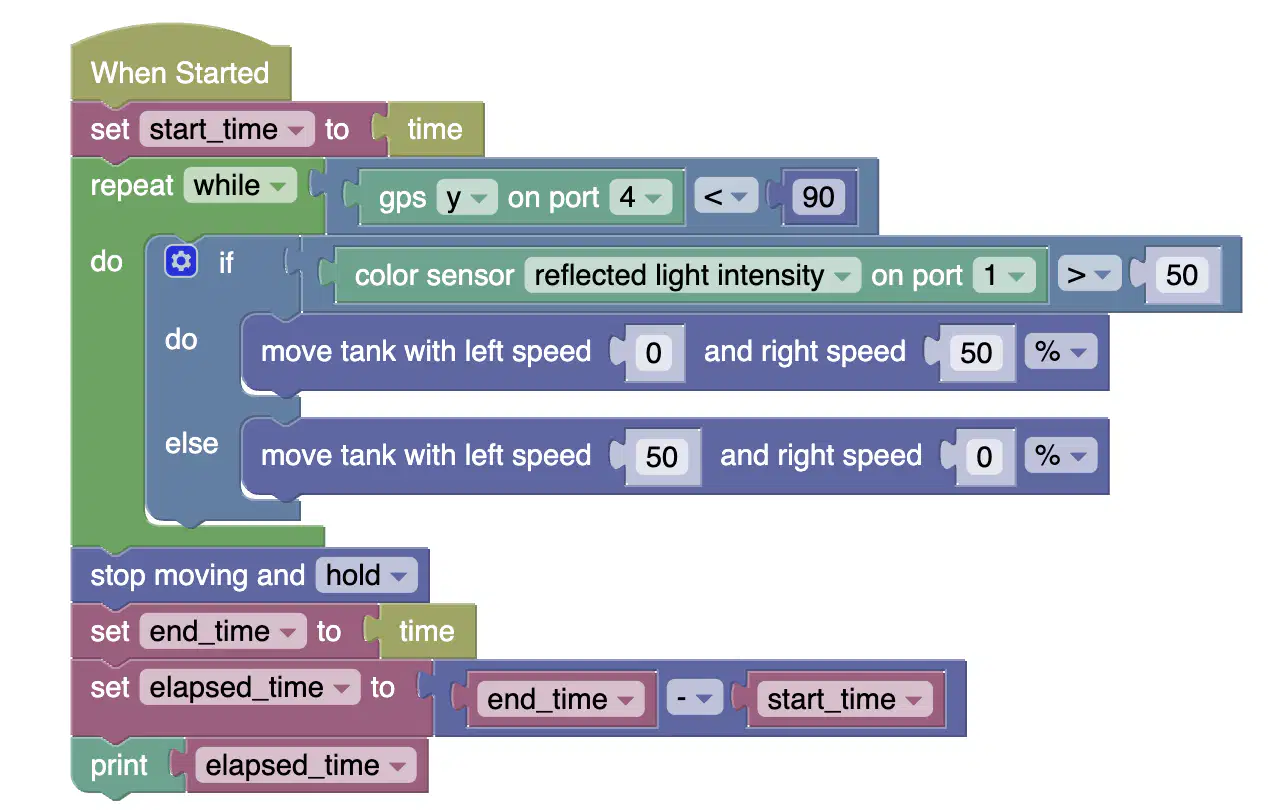
What causes the robot to turn instead of move straight in this program?
The GPS sensor value
Different speeds on the left and right motors
The elapsed time calculation
The stop moving block
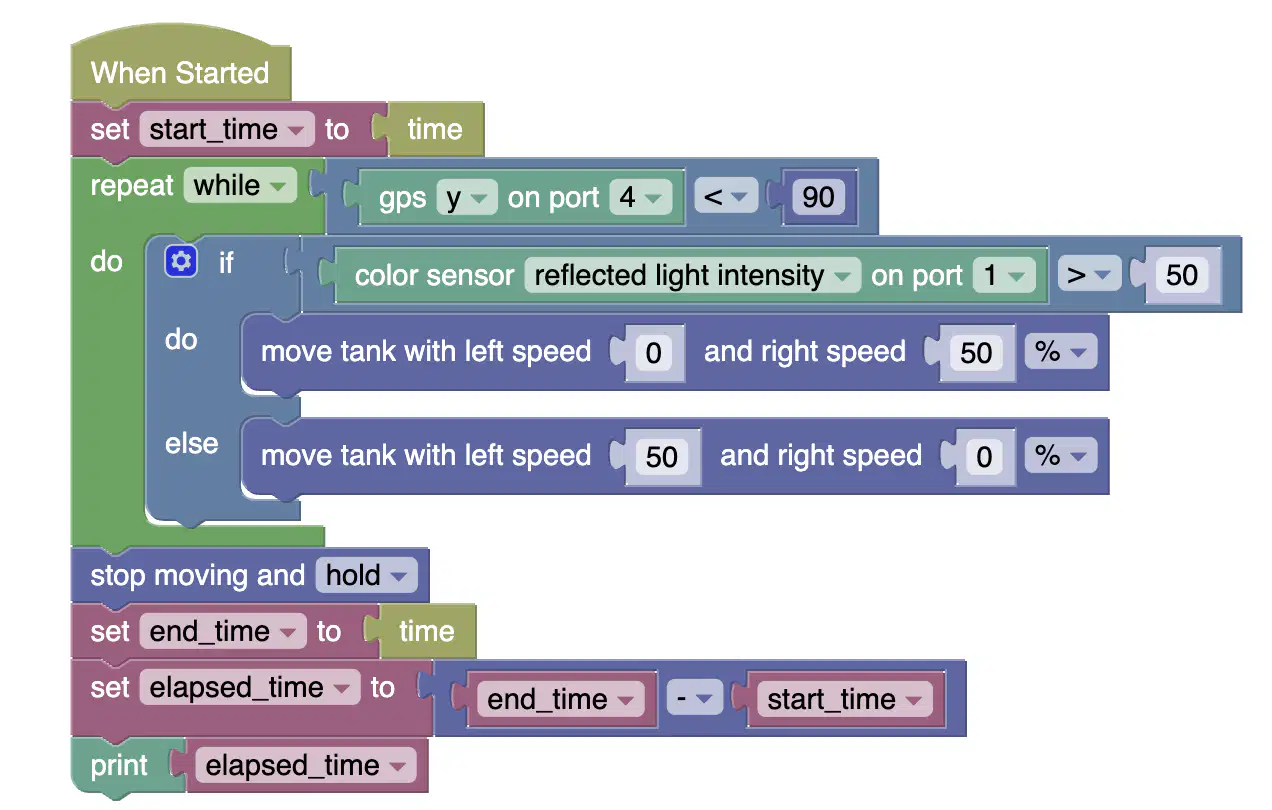
When the reflected light intensity is greater than 50, which movement does the robot perform?
Move straight forward
Turn left
Turn right
Stop completely
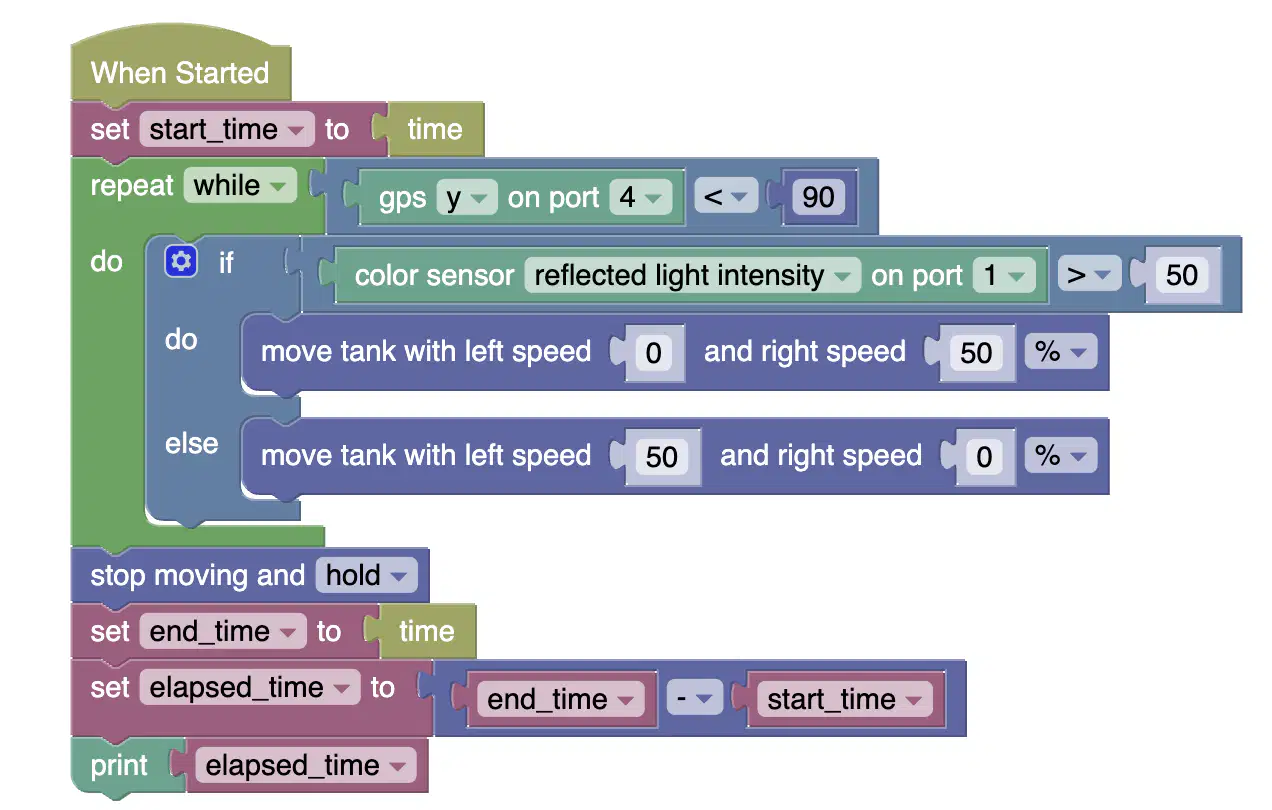
Why is the color sensor checked inside a repeat while loop?
To store the sensor value
To continuously correct the robot’s path
To stop the robot early
To calculate elapsed time
What is the role of the condition gps y < 90?
To control turning direction
To measure light intensity
To decide when the robot should stop
To calculate speed
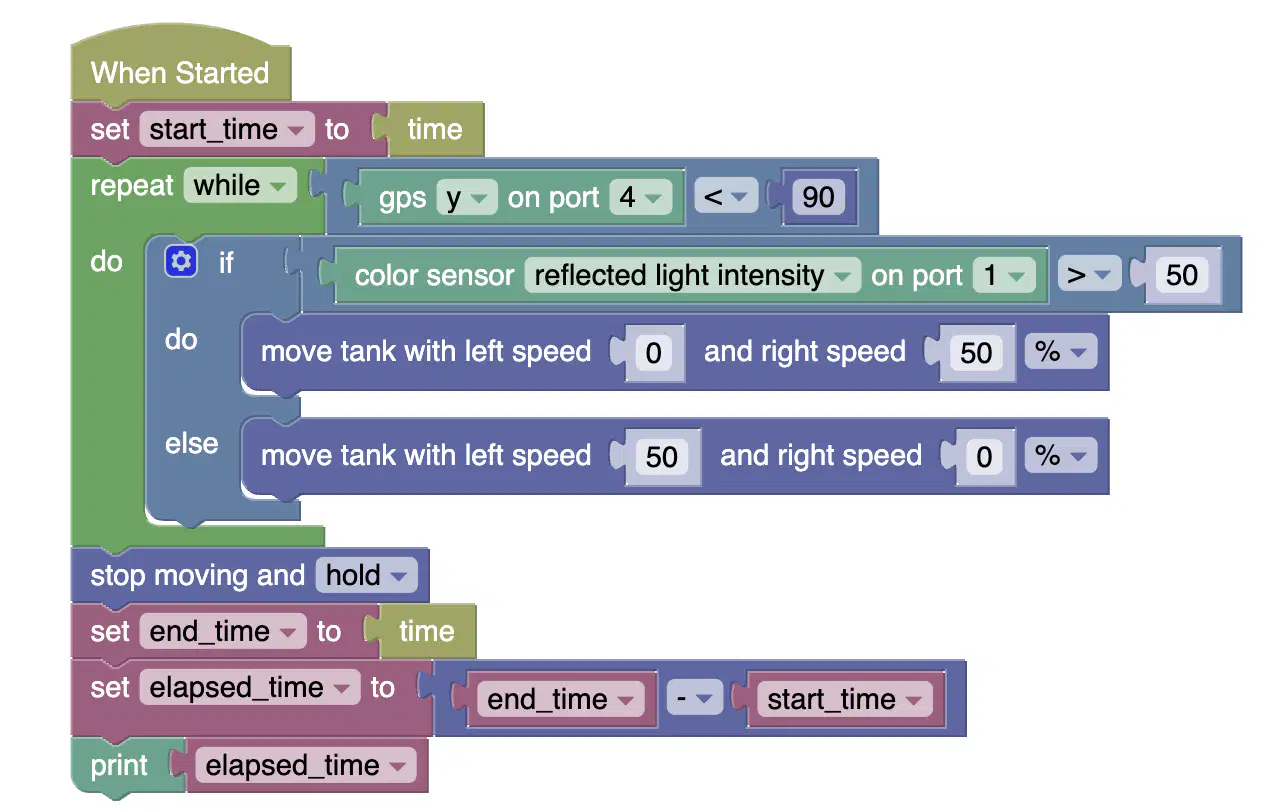
Which concept best describes the robot’s behavior while the loop is running?
Random movement
Event-driven execution
Continuous decision-making
Manual control
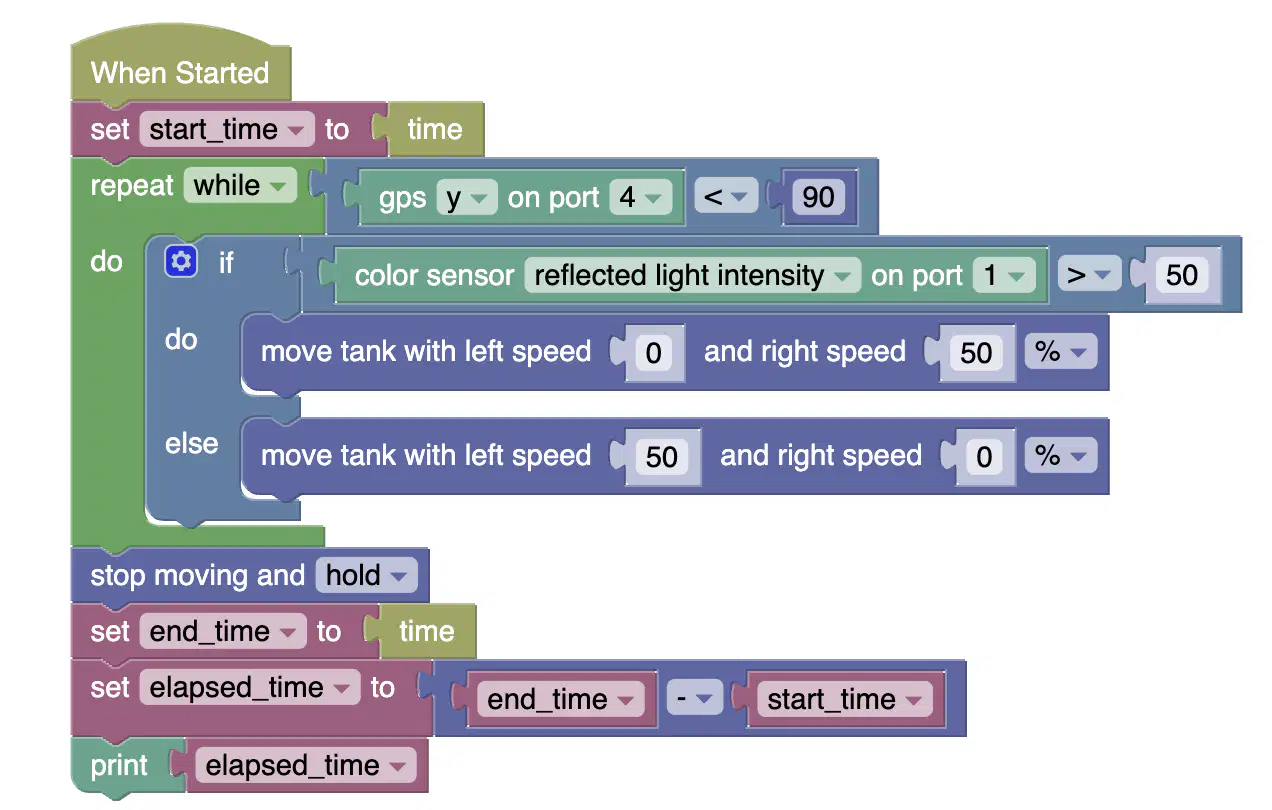
What happens immediately after the robot exits the repeat while loop?
The robot turns left
The robot speeds up
The robot stops and holds position
The program restarts
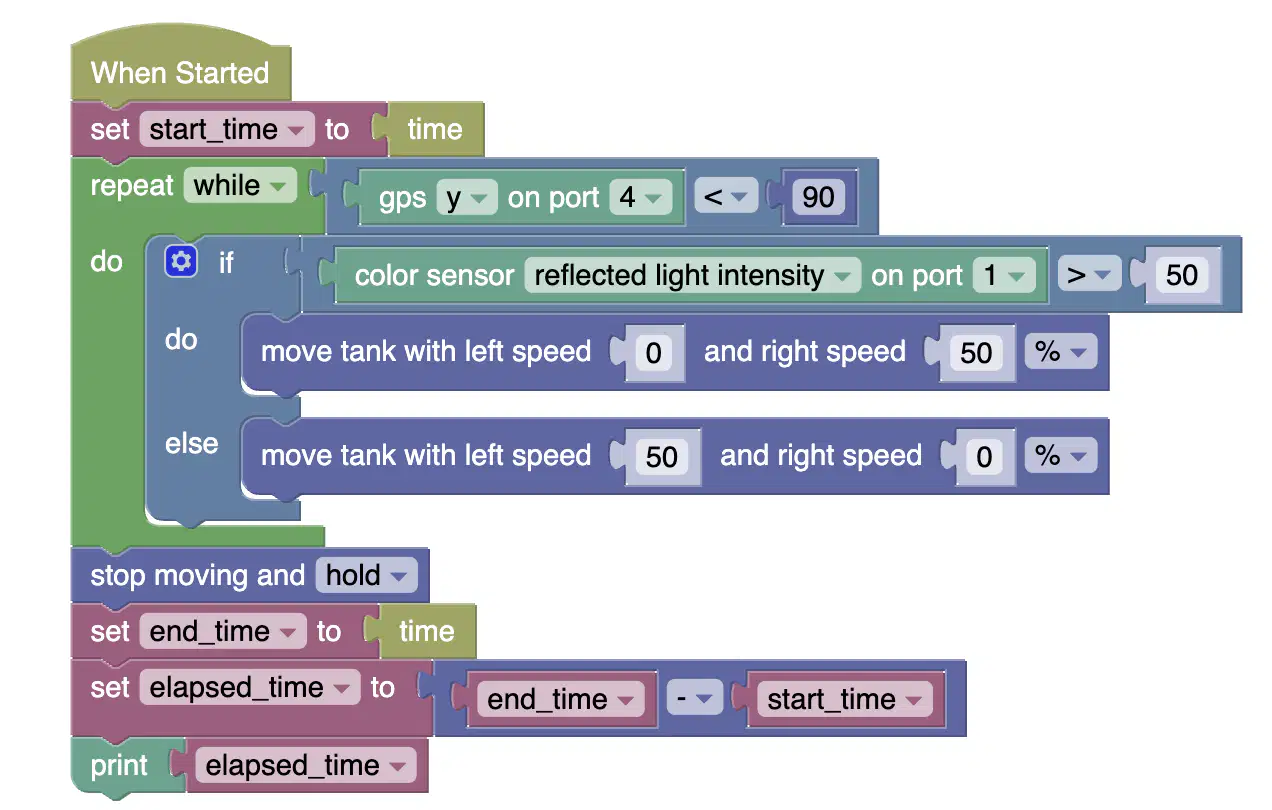
Why are the values 0% and 50% used for motor speeds instead of equal values?
To reduce battery usage
To create turning motion
To increase accuracy of GPS
To calculate time
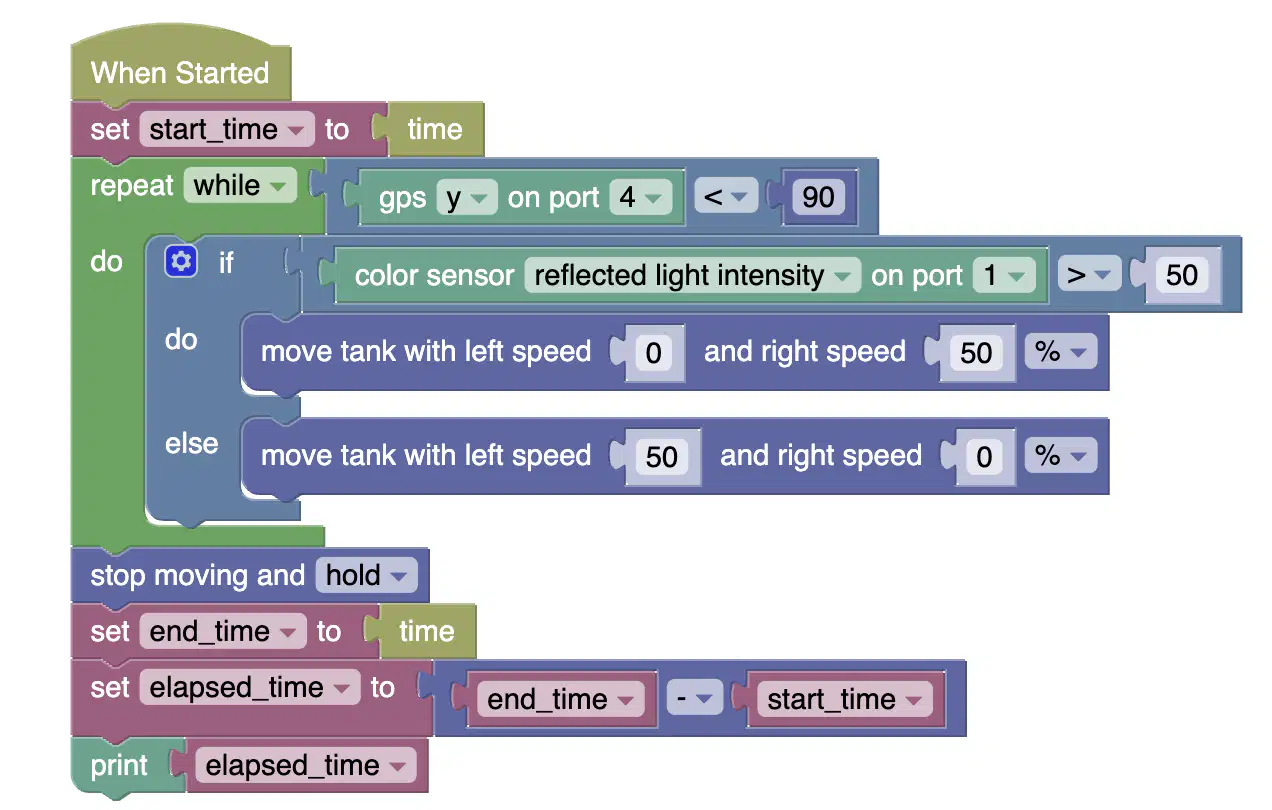
Which part of the program ensures this is a 2-state algorithm?
GPS condition
Elapsed time calculation
IF–ELSE structure based on sensor input
Print block
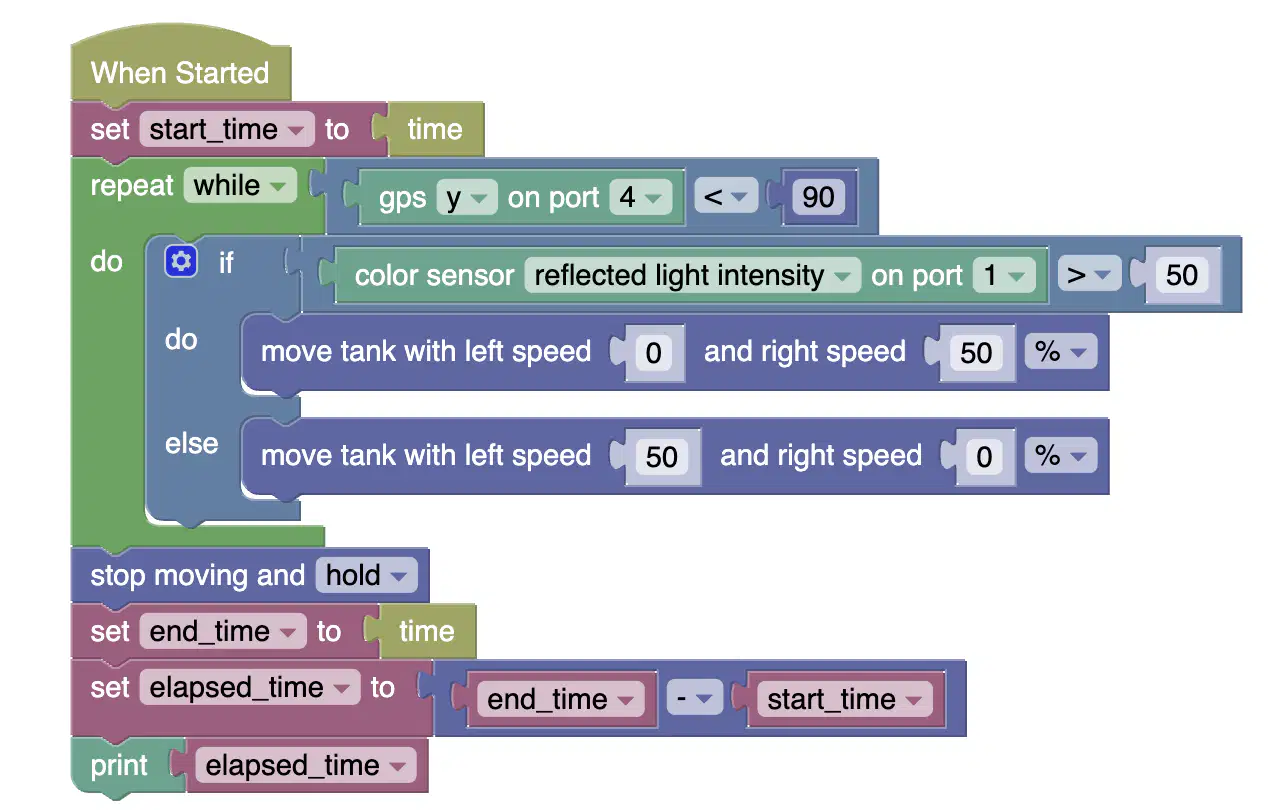
9. If the reflected light value stays constantly above 50, the robot will:
Move straight
Continuously turn in one direction
Stop immediately
Exit the loop
What does the elapsed_time variable represent?
Time taken to detect the line
Time taken to stop the robot
Total time the robot was moving
Delay between sensor readings

If the threshold value 50 is changed to 70, what is the MOST likely effect?
The robot will detect the line less often
The robot will stop earlier
The robot will move faster
The GPS condition will change
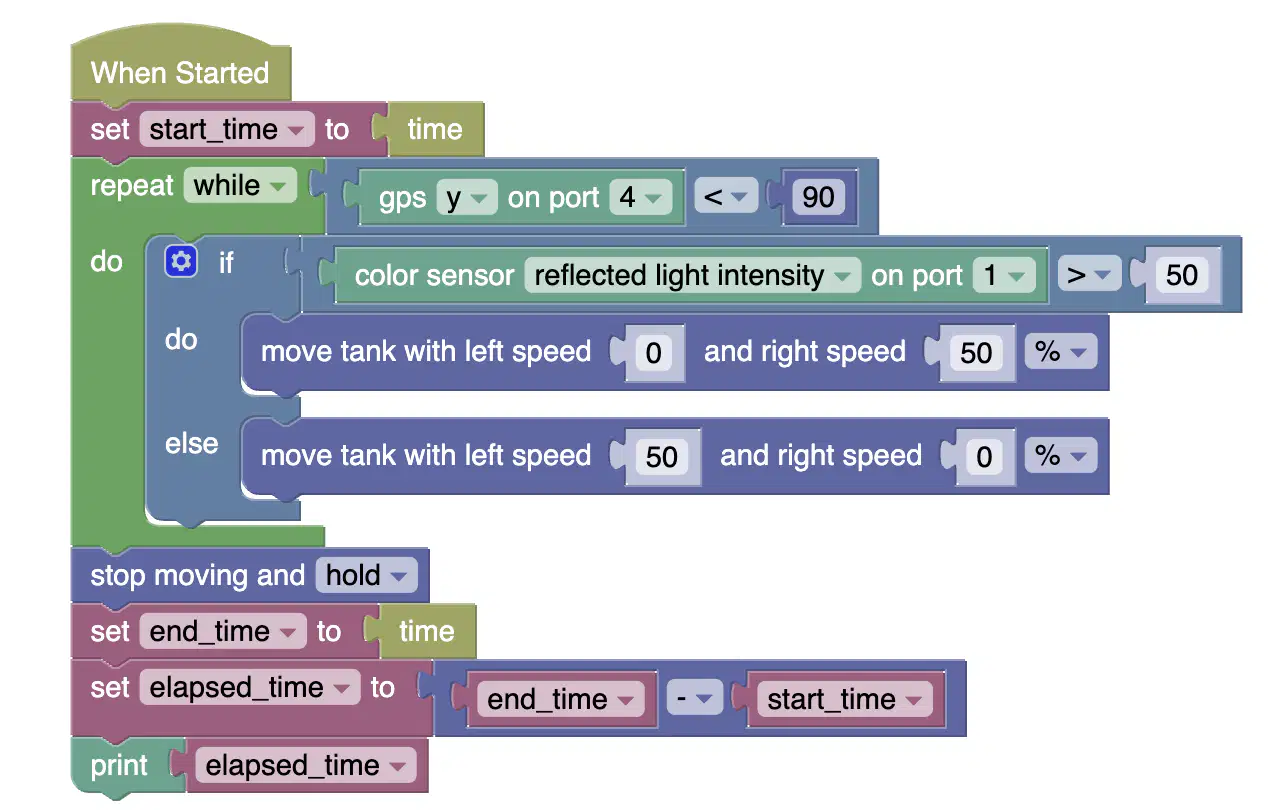
Why is GPS-based stopping more reliable than time-based stopping in this program?
GPS replaces the color sensor
GPS increases motor speed
GPS consumes less power
GPS responds to position, not assumptions
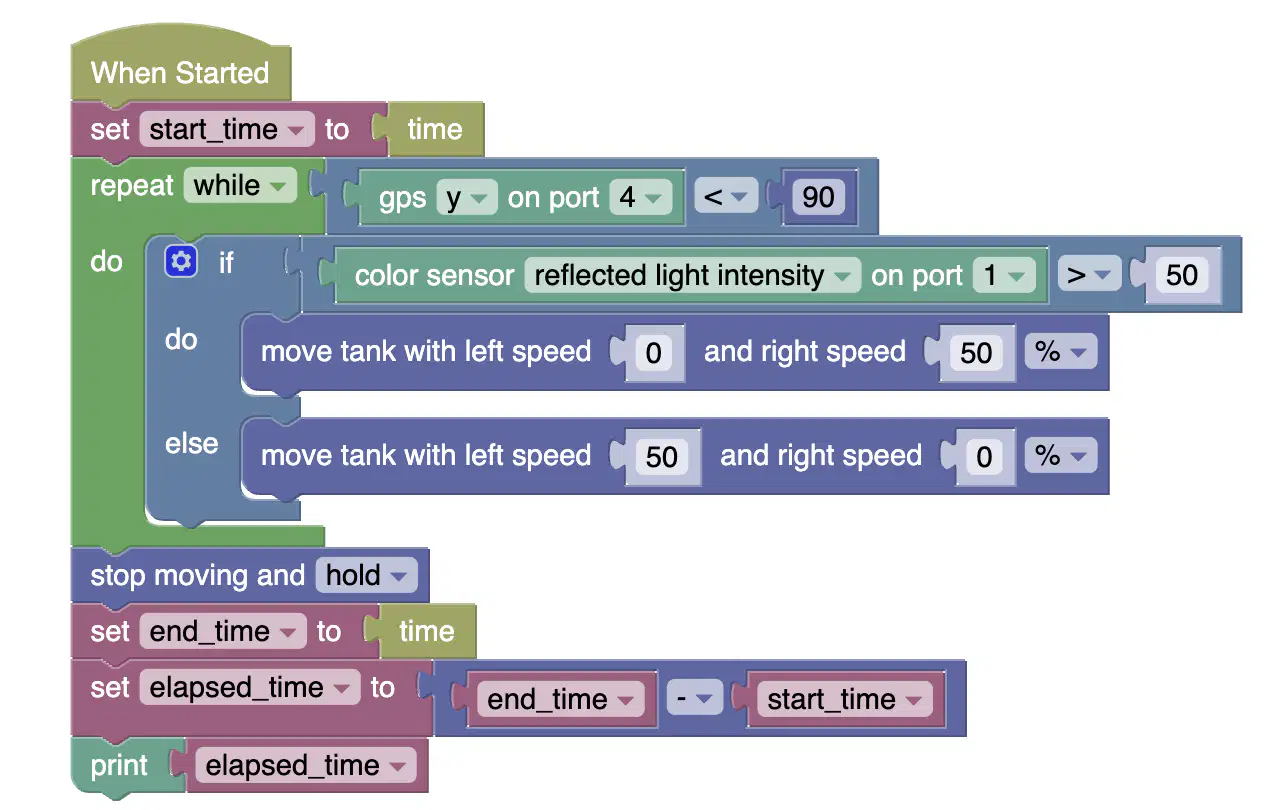
What would happen if the stop moving and hold block was placed inside the loop?
The robot would stop after every sensor check
The robot would never move
The robot would move faster
The elapsed time would increase
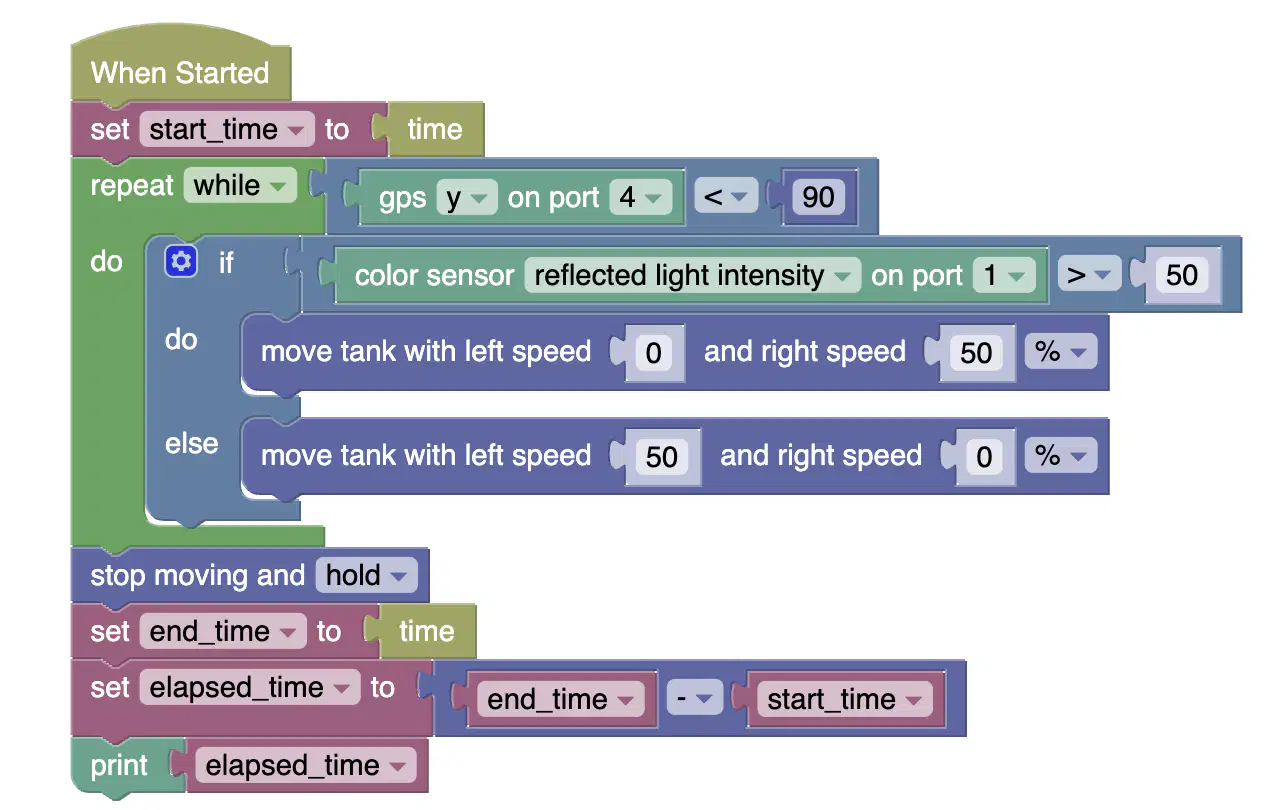
If both motors were set to 50% in both IF and ELSE blocks, the robot would:
Turn sharply
Stop moving
Exit the loop immediately
Move straight without correction
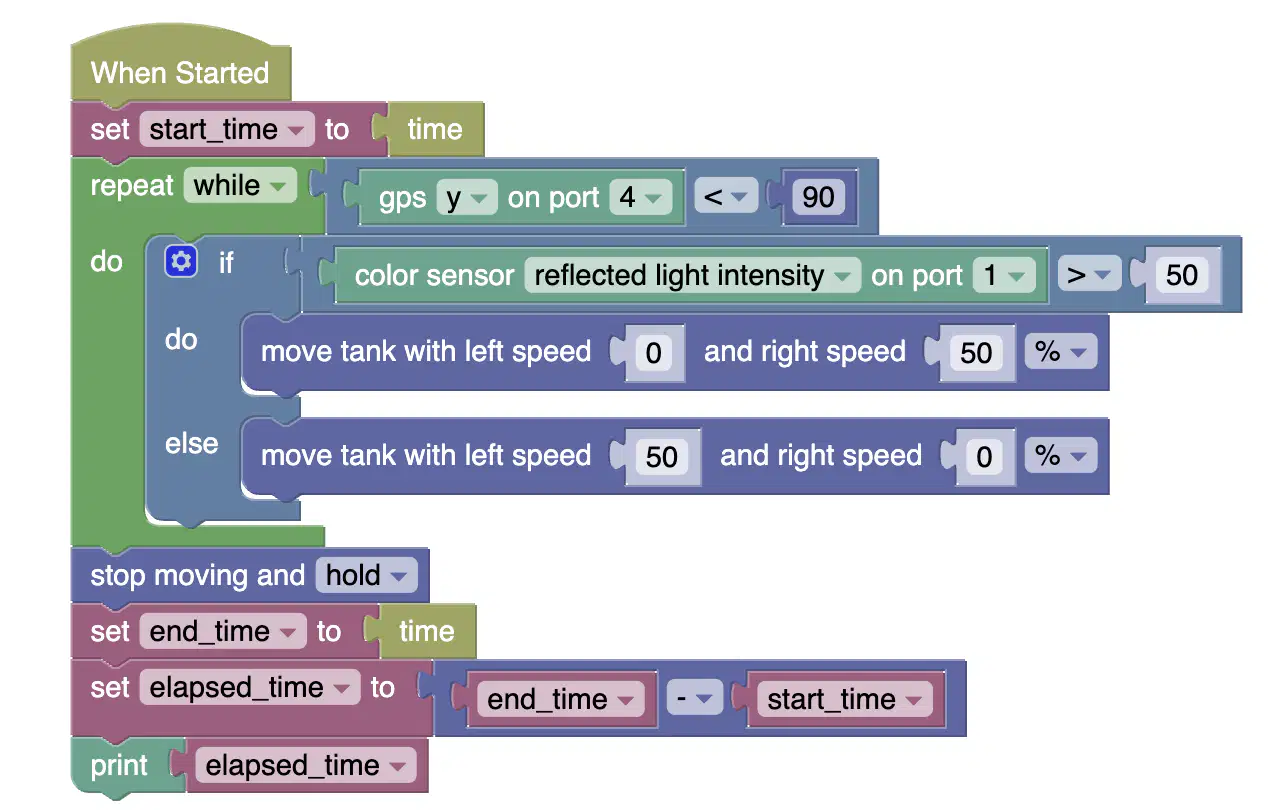
Why is start_time recorded before entering the loop?
To measure the full movement duration
To check GPS values
To control motor speed
To reset the color sensor
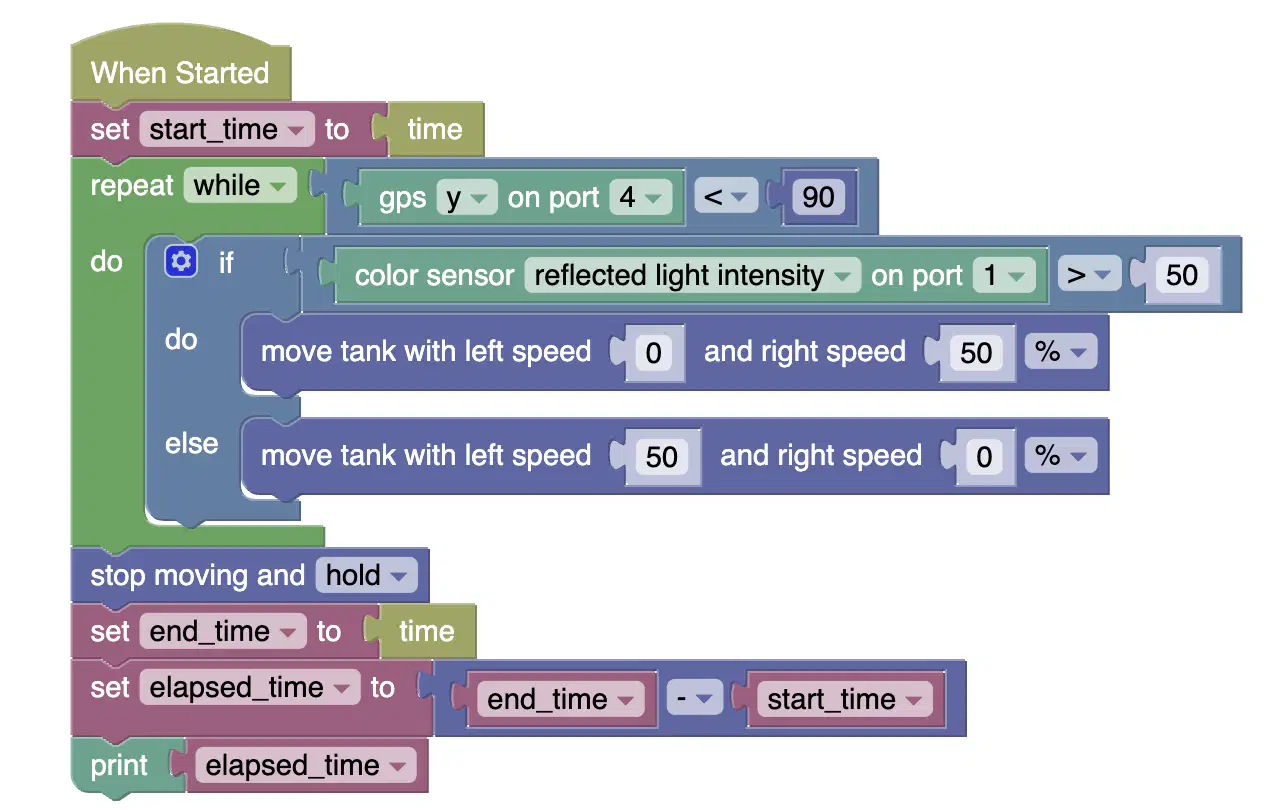
Which real-world system uses logic MOST similar to this program?
Voice assistants
Line-following warehouse robots
Image editing software
Online games
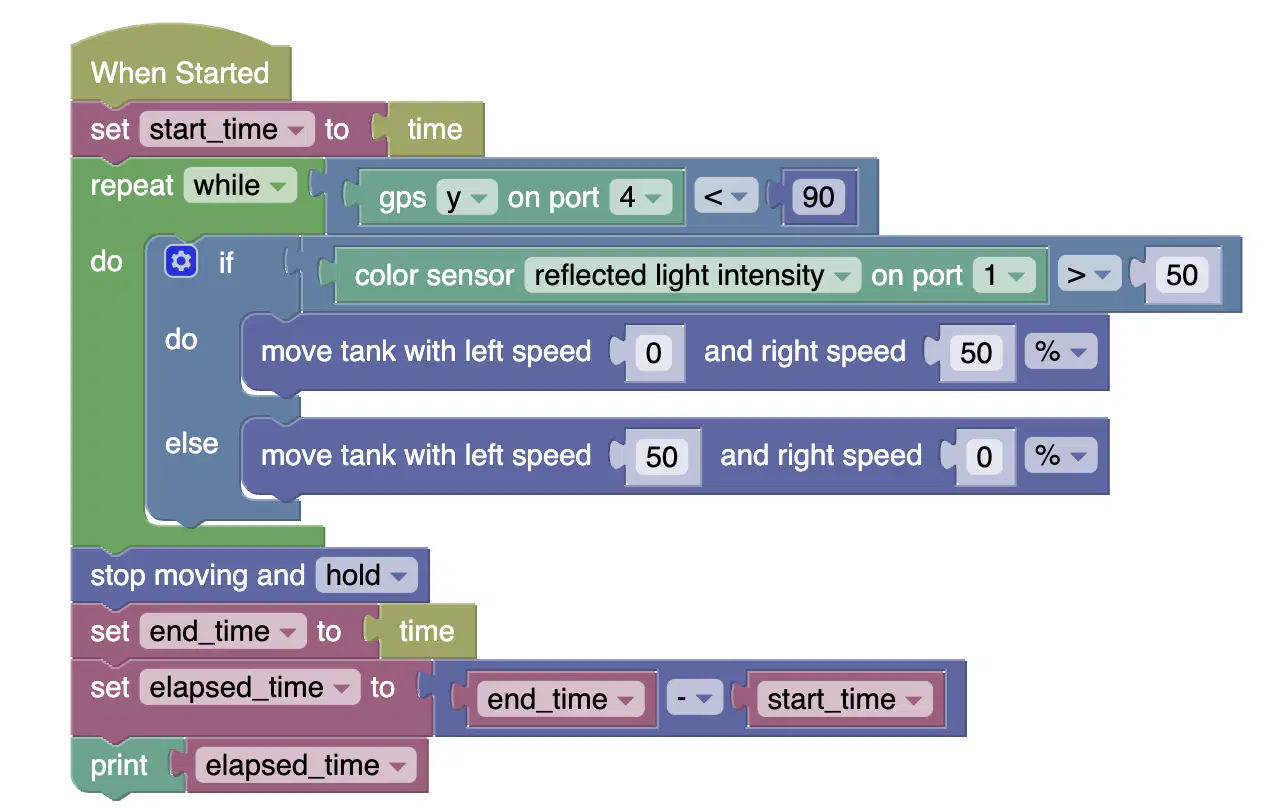
What would be the impact of removing the ELSE condition?
The robot would follow the line more accurately
The robot would stop immediately
The robot would always turn right
The robot would stop turning when the line is lost
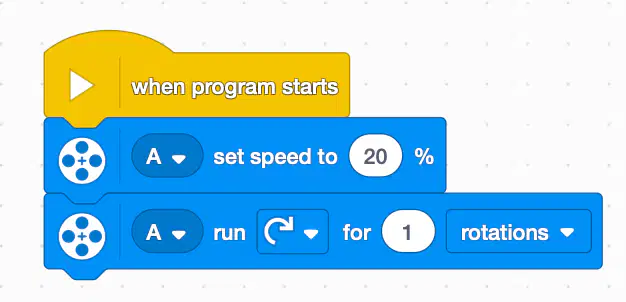
What does the block “run for 1 rotation” mean?
The motor runs for 1 second
The motor runs continuously
The motor completes one full turn
The motor stops immediately
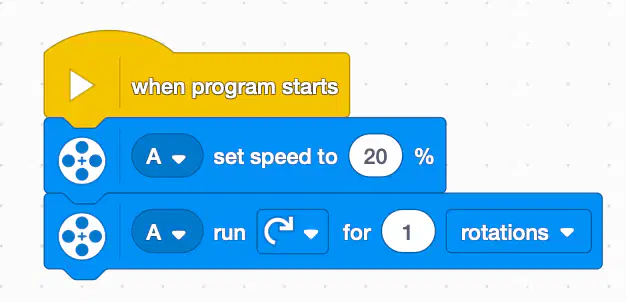
Which change would make the robot move a longer distance?
Reduce speed
Reduce rotations
Increase number of rotations
Remove the start block
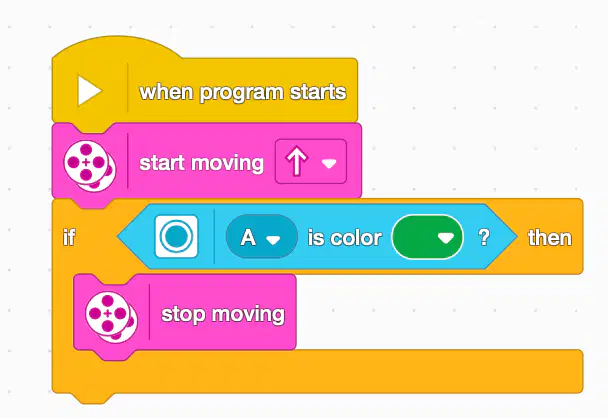
What condition is being checked in the IF block?
Whether the robot is moving
Whether the motor is running
Whether the battery is low
Whether the sensor detects a specific color
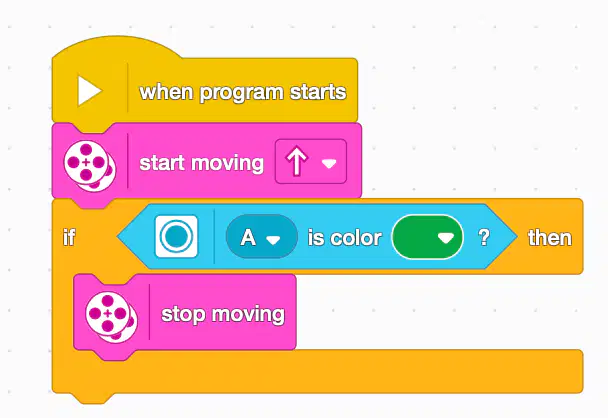
What will the robot do if the specified color is NOT detected?
Stop moving
Continue moving forward
Turn left
End the program

