
 Worksheets
Preface and Introduction to Amharic Grade 5
Total questions: 111
Worksheet time: 56mins
Which best describes communicative language teaching in this curriculum?
Translating texts word-by-word into the first language
Prioritizing grammar drills in isolated lessons
Focusing on real-life communication and interaction
Memorizing vocabulary lists without context
Which combination of skills is emphasized through integration?
Pronunciation with culture study
Grammar with test-taking strategies
Reading with writing activities
Listening with speaking tasks
Minimum learning competency in this context refers to what?
Baseline skills all students should achieve
Teacher preferences for classroom materials
National examination grading rubrics
Optional enrichment standards for advanced learners
In a listening task about Adeye, which skill is most essential to demonstrate during the activity?
Active note-taking on key ideas
Silent reading of a transcript
Writing a detailed essay summary
Memorizing vocabulary lists
Which criterion best indicates a healthy friendship when discussing daily activities with peers?
Keeping secrets to gain power
Avoiding honest conversations
Mutual trust and respect
Constant competition and rivalry
When preparing to speak about daily routines with friends, what should you prioritize?
Clear structure and simple language
Fast speaking and long sentences
Complex grammar with rare terms
Reading directly from notes
During listening practice, what strategy helps decode unfamiliar words without pausing the audio?
Stop the audio after each word
Translate every word immediately
Use context clues from sentences
Ignore unknown words completely
Which pair shows effective turn-taking in a conversation about plans?
Speak continuously, never pause
Interrupt, speak loudly, finish
Ask, listen, respond briefly
Answer with one-word replies
While discussing Adeye’s day, what question type elicits richer information?
Multiple-choice prompts only
Imperative commands to answer
Closed yes-or-no questions
Open-ended questions with why/how
Which behavior supports empathy in friendship dialogues?
Changing topics abruptly
Debating emotions aggressively
Paraphrasing feelings accurately
Correcting grammar mid-story
Choose the best listening summary technique after hearing a short account of Adeye.
Focus on speaker’s accent
Rewrite the passage verbatim
List every adjective used
Identify main events and order
In peer practice, what is the most suitable feedback to improve clarity?
Vague praise without detail
Silence to avoid conflict
Only negative criticism
Specific, kind, actionable points
Which statement aligns with friendship criteria about conflict?
Blame one person repeatedly
Win arguments at any cost
Avoid all discussions forever
Resolve disagreements respectfully
When retelling Adeye’s schedule, which detail is most relevant for coherence?
Background music volume
Street names mentioned
Time order of activities
Exact brand of clothing
Which set of prompts best supports a role-play on planning a study session with friends?
When shall we meet?
How can we divide tasks?
Why is your grade low?
What materials do we need?
To demonstrate active listening, which actions should you perform?
Use minimal encouragers
Summarize key points
Maintain eye contact
Check your phone often
Which features characterize a strong closing in a short oral report about Adeye?
Restate main points briefly
Offer a clear final thought
Introduce new unrelated facts
Invite a concise question
During a peer interview on daily activities, which follow-up techniques improve depth?
Probe for reasons
Ask for examples
Interrupt to change topic
Clarify ambiguous terms
In a polite self-introduction in a world languages class, which opening best models appropriate social greeting etiquette?
Sup, I’m … You all cool or what
Yo, I’m … What’s up everybody
Hello, my name is … Nice to meet you
Listen up, I am … Pay attention now
Choose the statements that reflect respectful social greetings when meeting peers for the first time.
Maintain eye contact and say hello
Interrupt to correct pronunciation
Use a friendly tone and smile
Avoid names and keep it vague
When introducing yourself in a new group, what information is most appropriate to include first?
Your long personal history
Your opinions on controversies
Your name and a brief greeting
Your detailed schedule
In early conversation with a new classmate, which follow-up is suitable after exchanging names?
Test their vocabulary immediately
Critique their speaking style
Request their private contacts
Ask how they are doing today
A reading passage on the nature of friendship begins by describing core qualities. Which pair best captures those main ideas?
Competition and secrecy
Trust and mutual support
Authority and compliance
Transaction and obligation
Identify behaviors that strengthen friendships during everyday interactions.
Sharing only to gain favors
Mocking accents in conversation
Keeping promises consistently
Listening actively to others

During small-group speaking practice, which prompt best helps students exchange introductions naturally?
Present a full autobiography
Describe advanced literary theories
Debate the merits of complex grammar rules
What is your name and where are you from?
Which statement most closely summarizes an early paragraph about friendship’s essence in a beginner reading segment?
Friends must agree on everything without question
Friends care for each other and communicate openly
Friends rely on constant gifts to stay connected
Friends avoid sharing feelings or personal stories
In the story, why does Sami hesitate to confront his friend after feeling betrayed by a shared secret?
He thinks the rumor might fade on its own
He fears damaging the fragile trust between them
He plans to gather more proof before talking
He believes silence shows mature restraint
Which action best reflects loyalty within a close friendship when conflicts arise?
Defend your friend in public, discuss concerns in private
Avoid conflict by ignoring the issue entirely
Seek a new social circle to replace the friend
Reveal more secrets to balance the situation
A meaningful apology in the passage is characterized primarily by which feature?
Acknowledging harm and offering amends clearly
Explaining intentions and shifting blame gently
Expressing sadness without proposing change
Promising future secrecy without reflection
What motivates the narrator to reconsider ending the friendship completely?
Advice from an older cousin to be patient
Remembered history of support during hardships
Pressure from mutual classmates to reconcile
Fear of losing access to shared social events
During the difficult conversation, what communication strategy helps reduce defensiveness?
Using I-statements to describe feelings and needs
Comparing the friend to more trustworthy peers
Presenting evidence in a confrontational tone
Listing past mistakes in chronological order
Which outcome shows growth in both friends after conflict resolution?
Setting boundaries and agreeing on new norms
Celebrating together without discussing issues
Avoiding sensitive topics indefinitely
Relying on third parties to manage disputes
Identify the most likely theme developed through the events and reflections.
Trust requires maintenance through honest dialogue
Popularity ensures stability in relationships
Secrets are inevitable and should be tolerated
Distance is the best cure for all conflicts
Which detail most strongly supports the narrator’s claim that trust was damaged?
A private confession spreads among peers quickly
Friends skip lunch together for several days
Group messages become less frequent at night
A teacher notices tension during class
Which pair of qualities is presented as essential for repairing friendship?
Empathy and accountability
Humor and distraction
Competition and dominance
Silence and avoidance
How does the narrator use reflection to interpret the friend’s mistake?
As trivial gossip unworthy of discussion
As acceptable behavior within modern social norms
As deliberate malice intended to cause harm
As a breach caused by insecurity and poor judgment
Choose the statement that best captures contextual meaning of the word reconcile in the passage.
Ignore the problem until time heals wounds
Replace a friend with someone more reliable
Restore a working relationship through dialogue
Report the issue to authority for mediation
Which inference about the narrator’s values is most reasonable?
Winning arguments proves personal strength
Integrity matters more than short-term comfort
Secrecy is the only measure of loyalty
Public reputation outweighs private trust
Select all the behaviors that demonstrate respect during the conversation.
Validating emotions before proposing solutions
Keeping score of past mistakes to leverage
Using calm tone and clear, specific language
Listening without interruption to understand
Which statement clarifies the distinction between forgiveness and trust rebuilding?
Trust rebuilding requires secrecy only
Both occur instantly after an apology
Forgiveness can be immediate; rebuilding takes time
Neither is possible after a breach of privacy
What consequence does the passage suggest when boundaries remain vague?
Teachers help friends define expectations
Misunderstandings escalate into repeated breaches
Rumors disappear due to mutual caution
Friends feel freer and more spontaneous
Which choice best expresses a nuanced synonym for betrayed in this context?
Comforted by communal understanding
Stabilized through open disclosure
Empowered by shared vulnerability
Compromised by a broken confidence
Identify the most appropriate boundary agreed upon after reconciliation.
Replace private messages with public posts
Avoid meeting outside of school entirely
Limit conversations to neutral topics only
Seek consent before sharing any personal details
Which evidence would most convincingly show trust repair over time?
Consistent discretion about sensitive matters
Frequent jokes about past mistakes
Public posts praising each other’s honesty
Declining to discuss feelings in future
Which sentence best functions as a topic sentence for a paragraph about friendship based on trust?
Friends share hobbies and weekend plans
Trust is the foundation of lasting friendship
Some friends live in different cities
Many people meet friends at school
Select the statements that qualify as supporting details for a paragraph with the topic sentence: "Trust is the foundation of lasting friendship."
Friends keep promises even when it is hard
Trust helps friends share personal stories safely
When trust grows, friends rely on each other more
Trust means friends never disagree about anything
Which option describes an effective topic sentence for a paragraph about resolving conflicts between friends?
Conflicts end friendships every time
People text differently during arguments
Arguments are common in every classroom
Healthy friendships use empathy to resolve conflicts
Choose the sentences that serve as relevant supporting details for the topic sentence: "Healthy friendships use empathy to resolve conflicts."
Paraphrasing a friend’s concern reduces tension
Apologizing acknowledges a friend’s feelings
Listening carefully shows respect during disagreements
Blocking a friend’s messages stops all problems
In paragraph structure, where should the topic sentence typically appear?
Only after three examples
In the title only
Always at the very end
Usually at the beginning
Which sentence lacks unity in a paragraph focused on friendship communication?
Friends clarify misunderstandings quickly
A recipe for pasta uses tomatoes and garlic
Active listening prevents repeated conflict
Taking turns speaking improves understanding
Identify the pair that are antonyms related to friendship behaviors.
trust — loyalty
kind — friendly
patient — supportive
honest — deceitful
Which set contains TWO antonym pairs?
friendship — companionship; talk — speak
loyal — faithful; helpful — supportive
forgive — resent; unite — divide
care — empathy; honest — truth
Choose the best revision that turns these details into a clear topic sentence: "Sharing ideas, giving feedback, solving problems together."
Ideas can be shared in many ways
Giving feedback improves people
Collaborative friendship builds through shared problem-solving
Friends sometimes work on projects
Which supporting detail best fits a paragraph with the topic sentence: "Mutual respect strengthens friendships"?
People respect famous singers
Respect is written in school rules
Respectful friends avoid gossip about each other
A friend once visited a museum
Which sentence is an appropriate concluding statement for a paragraph that begins, "Trust is the foundation of lasting friendship"?
Many people have friends
Therefore, trust remains essential to keep friendships strong
Trust is a word in many languages
Trust is more important than food and sleep
Select the topic sentence that introduces a paragraph about recognizing unhealthy friendships.
Some friends enjoy hiking or cooking together
Warning signs of unhealthy friendships include manipulation
Many people make friends online
Hobbies can connect people
Which best describes a daily diary entry for friendship-focused writing?
Bulleted research outline
Step-by-step experiment log
Short date-stamped reflection
Formal persuasive letter
Choose the sentence most appropriate for a diary opening line.
In summary, one finds
Abstractly, it emerges
Therefore, we conclude
Today I felt grateful
Which statement shows awareness of audience suitable for a diary?
I cite sources extensively
I write to remember
I grade classmates objectively
I market products here
Identify the common noun in this list: Addis Ababa, river, Meskerem.
Meskerem
Addis Ababa
river
All are proper
Which are proper nouns? Select all that apply.
city
Nile
month
Hanna
In diary writing, which detail strengthens clarity without breaking privacy?
Reveal passwords
Use first names only
Publish home address
Share ID numbers
Which sentence correctly capitalizes a proper noun?
selam met Hanna
Selam met Hanna
selam met hanna
Selam met hanna
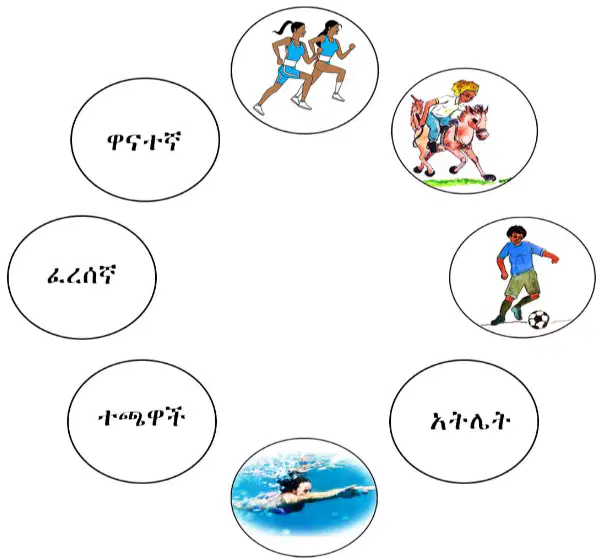
Select the best topic sentence for a diary paragraph about sports with friends.
Data were statistically analyzed
We train together daily
Revenue rose dramatically
Photosynthesis needs sunlight
Which choice correctly pairs noun type with example?
Common–city
Proper–friend
Common–Hanna
Proper–city
Which revision improves a diary sentence: “yesterday played ball friends”
Ball friends yesterday I played
Playing ball were yesterday friends
Yesterday I played ball with friends
Yesterday played ball were friends
Identify the category for the noun “teacher” in the language’s noun classification system described in Chapter 1.
natural phenomenon category
abstract concept category
inanimate object category
animate human category
Which pair best demonstrates singular–plural noun agreement for classroom items?
one broom – many brooms
one brooms – many brooms
one brooms – many broom
one broom – many broom
Choose all nouns that belong to the school hygiene context introduced in Chapter 2.
mountain
broom
chalkboard
river
trash bin
When listening to a short audio about cleaning a classroom, which details are most relevant to identify?
the music playing outside
sequence of actions
tools used for cleaning
the color of the sky
who is cleaning
Which statement best reflects proper classroom hygiene practices?
sweep floors daily after class
pile trash behind desks
leave spills until next week
share one towel for everyone
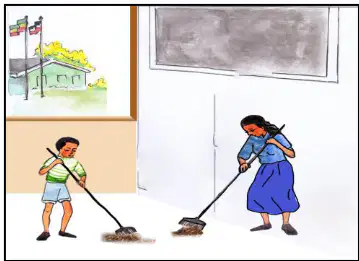
Look at the image of two people sweeping. What is the primary action shown?
sweeping the classroom floor
painting the classroom wall
repairing a broken window
reading a lesson aloud
Select all nouns from this list that classify as tools rather than places.
school yard
broom
mop
classroom
dustpan
Which noun would typically be classified as inanimate in the grammar exercise?
teacher
student
principal
blackboard
During a listening task on cleanliness, which clue helps you infer the time of the activity?
mention of after the lesson
number of students enrolled
brand of the broom used
distance to the school gate
Choose all actions that align with maintaining hygiene in a classroom.
leave food on desks
dispose trash in bins
block windows for airflow
sweep and mop floors
wipe chalkboard if dusty
Which choice shows correct noun classification pairing for animate vs. inanimate?
bench – animate, chalk – animate
bench – animate, student – inanimate
student – animate, bench – inanimate
student – inanimate, bench – animate
In a grammar fill-in exercise, which article correctly completes: ___ broom is used to clean the floor.
Those
An
The
A
Which action best reduces plastic’s environmental impact in communities like those shown, where waste is burned near homes?
Bury plastics in shallow pits beside homes
Separate plastics for proper recycling systems
Burn plastics quickly to reduce visible trash
Rinse plastics and throw them in mixed waste
In oral discussions on hygiene traditions, what is a key purpose of the ‘Hidar Sitan’ custom?
Annual market festival focused on trade
Household prayer without cleaning tasks
Private ritual unrelated to sanitation
Seasonal communal cleaning for public health
Which health risk most directly arises from burning plastic waste in neighborhoods?
Toxic smoke inhalation causing respiratory illness
Immediate water scarcity due to evaporation
Direct infection from unwashed hands nearby
Sudden soil erosion from ash displacement
During community hygiene days, which combination of actions most effectively improves sanitation?
Collecting litter from streets and drains
Separating recyclable plastics and metals
Educating residents on safe waste handling
Burning mixed waste to reduce volume
What cultural value is reinforced by the ‘Hidar Sitan’ practice when neighbors clean together?
Economic profit from selling decorations
Exclusive family-only household privacy
Collective responsibility for shared spaces
Competitive individual achievement records
Which statement best distinguishes environmental pollution from personal hygiene issues in this chapter’s context?
Pollution ignores plastics and outdoor waste entirely
Pollution concerns only private indoor spaces
Pollution focuses on tooth brushing and handwashing
Pollution affects shared ecosystems and air quality
When discussing plastic’s environmental impact, which practice aligns with sustainable waste management?
Organize community collection for recycling
Dump plastics in open fields and rivers
Reuse containers for storage and transport
Avoid single-use plastics when possible
In a reading about traditional cleaning, what outcome indicates successful community participation?
More smoke from frequent burnings
Less communication among neighbors
Larger dumps formed near residences
Cleaner shared areas and reduced waste piles
Which practice best reduces disease spread in urban neighborhoods with poor waste services?
Open dumping near residences
Throwing waste into rivers
Burning mixed household garbage
Collecting trash in sealed bins
Select effective methods for household solid waste disposal in densely populated areas.
Dumping waste behind markets
Community collection schedules
Burying plastic in shallow pits
Composting organics at home
Scientific cleaning differs from traditional cleaning primarily by emphasizing what?
Sweeping floors daily
Evidence-based sanitation steps
Use of scented detergents
Avoiding chemical disinfectants
Which items should be separated before disposal to improve waste management?
Organic food scraps
Used batteries and e-waste
Mixed paper and cardboard
All trash in one bag
What is the main health risk of dumping waste into water bodies?
Faster decomposition of plastics
Contamination of drinking sources
Improved irrigation quality
Reduced mosquito breeding
Choose practices aligned with hygienic street cleaning programs.
Night dumping to avoid fines
Protective gear for workers
Unregulated informal burning
Scheduled sweeping and collection
In a market area, what is the safest way to handle daily organic waste?
Leave piles for animals
Transport to municipal compost
Mix with medical sharps
Spread on sidewalks for drying
Which combination minimizes household pest infestation?
Rinsing bins monthly only
Covered bins and segregation
Uncovered bins and irregular pickup
Storing waste in living rooms
Select statements that reflect responsible community participation in waste programs.
Paying collection fees regularly
Blocking trucks with parked cars
Attending sanitation meetings
Dumping during public holidays
Why is burning mixed solid waste discouraged?
Creates valuable compost
Releases toxic smoke and dioxins
Eliminates all pathogens safely
Improves air quality in cities
A clinic disposes of sharps with general trash. What risk increases most?
Vector-borne diseases
Faster waste decomposition
Needlestick injuries for workers
Reduced landfill volume
Which practices characterize scientific sanitation training for cleaners?
Disinfecting high-touch surfaces
Ignoring PPE requirements
Standard operating procedures
Random sweeping habits
When households separate recyclables, what outcome is most likely?
Improved material recovery rates
Lower worker safety
Higher collection costs only
Increased illegal dumping
Choose the best approach to manage festival waste surges in towns.
Encourage river dumping
Temporary storage points
Deploy extra collection shifts
Suspend segregation rules
Which statement best explains the difference between cleaning and disinfection?
Cleaning removes dirt; disinfection reduces microbes
Both rely solely on natural drying
Cleaning increases microbes; disinfection spreads dirt
Both only change appearance of surfaces
Which practice best demonstrates daily personal hygiene in a short routine paragraph?
Brush teeth twice, wash hands often, shower daily
Rinse mouth sometimes, avoid toothpaste, shower weekly
Brush teeth monthly, avoid soap, skip showers
Use perfume only, never wash hands, change clothes rarely
Choose all actions that reduce germ transmission in shared classrooms.
Keeping nails trimmed and clean
Sharing towels and razors regularly
Covering coughs with elbow or tissue
Frequent handwashing with soap and water
In a fluent reading exercise about hygiene, which sentence transition best connects steps logically?
Before later, I then after however do it
Soon, yesterday, afterwards, meanwhile randomly
First, I wash my hands; next, I brush my teeth
Finally, I begin; finally, I start again
When writing a short hygiene paragraph, what tense and perspective are most appropriate for a personal routine?
Present tense, first person singular
Past perfect tense, third person plural
Future progressive tense, second person
Imperative mood, third person singular
Which pair shows correct sentence fluency through varied sentence openings?
Wake I brush wash random fragments throughout
Every sentence starts with I; I wake; I brush; I wash
I wake early. Then, I brush. After that, I wash
I wake I brush I wash no punctuation
Select all details that strengthen a hygiene paragraph without becoming a list.
Specific times like morning and evening
Purpose such as preventing illness
Sequence markers like first, next, finally
Exact brand names of products used
Which topic sentence effectively introduces a personal hygiene routine?
People may or may not wash occasionally
Hygiene could be important for some situations
Soap exists and water is sometimes useful
My daily habits keep me clean and healthy
Identify the common mistake that weakens fluency in a hygiene paragraph.
Using clear pronouns consistently
Including concise, parallel actions
Maintaining present tense throughout
Missing transitions between steps
In a reading fluency activity, what is the best pacing strategy for a five-sentence hygiene passage?
Read steadily with pauses at punctuation
Emphasize every word equally monotone
Race quickly without breathing pauses
Stop randomly mid-sentence frequently
Choose all revisions that improve this sentence: I wash my hands I brush my teeth I shower.
Change verbs to past perfect for variety
Combine with conjunctions: I wash my hands, brush my teeth, and shower
Insert product names to increase specificity
Add commas and transitions: First, I wash my hands; next, I brush my teeth; finally, I shower

