
 Worksheets
STAAR Cumulative
Total questions: 157
Worksheet time: 1hrs 19mins
Why did many people choose to settle in the English colonies of Maryland and Pennsylvania?
To obtain unique spices
To obtain stock ownership
To escape indentured servitude
To escape religious persecution
Which reason supports why France established North American colonies in the 1600s?
To establish trading posts
To search for valuable metals
To limit the spread of Christianity
To prevent the enslavement of African people
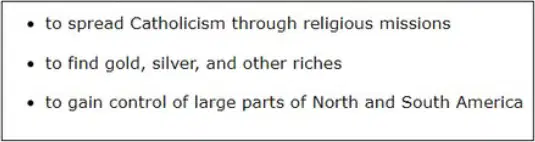
Which European country was motivated to colonize the New World for these reasons?
England
France
Germany
Spain
Why did European explorers search for the Northwest Passage?
To find the legendary Seven Cities of Gold
To discover new technology for crossing the Atlantic Ocean
To find the legendary waters of the Fountain of Youth
To discover a new sea route to Asia

How did this document contribute to the growth of representative government?
It defined the relationship between the branches of government.
It set forth the idea that colonists would agree to a government by majority rule.
It defined the relationship between the colonists and the founding company.
It set forth the idea that a separation should exist between the church and the state.
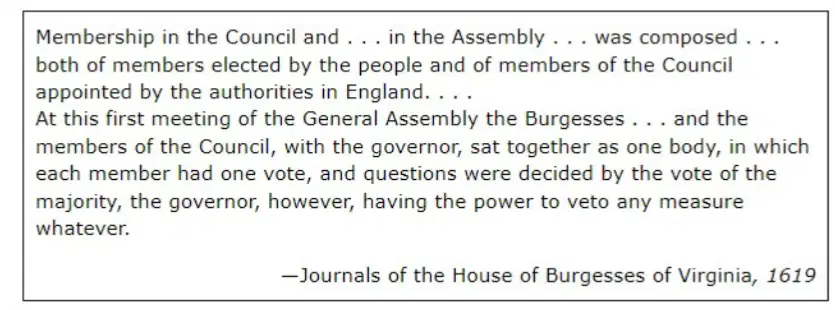
Based on the excerpt describing the House of Burgesses in Virginia (1619), which contributions best fit in the chart titled The Virginia House of Burgesses’ Contributions?
Established a representative government
Established a strict authoritarian government
Established a judicial branch for the government
Established a method of checks and balances
Established a system centered around political parties
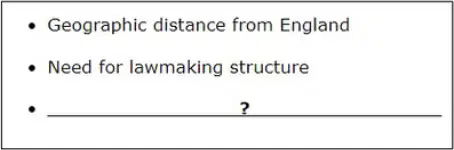
This list provides reasons for the growth of representative government during the Colonial Era. Which reason correctly replaces the question mark in the list?
Influence of John Locke and other Enlightenment philosophers
Ideas of John Smith and other English soldiers
Need to establish trading forts
Interest in growing cash crops
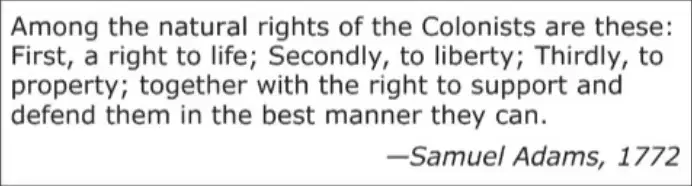
In the early days of the colonies, a belief in these rights helped lead to—
the establishment of royal courts
the growth of representative government
the implementation of the mercantile system
the abolishment of indentured servitude

This diagram shows a sequence of events in colonial history.
Why is this sequence of events important?
Colonists created a legislature with two houses.
Colonists declared independence from English rule.
Colonists defended the concept of unalienable rights.
Colonists established a tradition of self-government.
How did the First Great Awakening contribute to the rise of representative government in the British North American colonies?
The rise of religious participation led to people focusing less on politics.
The focus on equality in religion caused people to question authority.
Church leaders preached about creating a state ruled by religion.
Church officials taught about the virtues of monarchy.
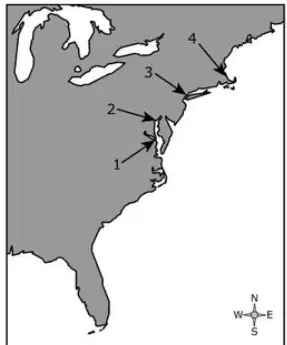
This map shows an eastern section of North America during the early 1600s. Which numbered arrow represents the area where the Pilgrims landed in 1620?
1
2
3
4
Which geographic feature allowed the Mid-Atlantic colonies to have a longer growing season than the New England colonies?
Thick forests
Navigable rivers
Flat land with rocky soil
Mild climate
How did the geography of New England affect its economic activities?
Coastal cities expanded business opportunities for mining metals and minerals.
Moderate climate allowed for longer growing seasons and a larger export of crops.
Rich soil promoted the international trade of cash crops such as cotton and tobacco.
Excellent harbors provided commercial opportunities such as shipbuilding and whaling.
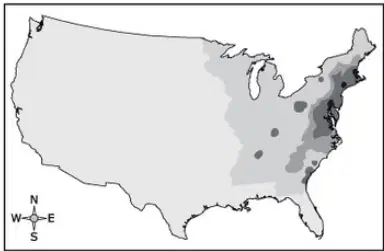
This map shows the population distribution of the United States in 1790. Which statement explains how physical geography affected the population distribution of the United States in 1790?
The southern states offered fertile farmland, allowing for the development of larger cities.
The Proclamation Line of 1763 prevented settlers from moving away from the East Coast.
The Appalachian Mountains served as a barrier that slowed westward expansion.
The Rocky Mountains posed risks to explorers, leading most people to remain in the East.
An immigrant sails to North America in the early 1700s hoping to start a tobacco farm. He has done some research on the best environment for tobacco farming. Where is the immigrant most likely to settle?
Massachusetts
Virginia
Rhode Island
Pennsylvania
Which statement correctly compares the southern colonies and the middle colonies?
The southern colonies required less labor than the middle colonies.
The southern colonies attracted more immigrants than the middle colonies.
The middle colonies had more diverse economies than the southern colonies.
The middle colonies were less dependent on skilled labor than the southern colonies.
Which factor of British North American colonial life MOST contributed to the transatlantic slave trade?
The demand for manufactured goods
The improvements in transportation
The need for building supplies
The growth of cash crops

This table summarizes characteristics of two colonial regions during the late seventeenth century. How did these characteristics influence life in the colonies?
The New England colonies supported financial growth through high-paying industrial work.
The Southern colonies supported the plantation production of cash crops because of long growing seasons.
The Southern colonies developed large urban centers in order to support increasing manufacturing businesses.
The New England colonies developed large rural populations in order to support increasing agricultural production.
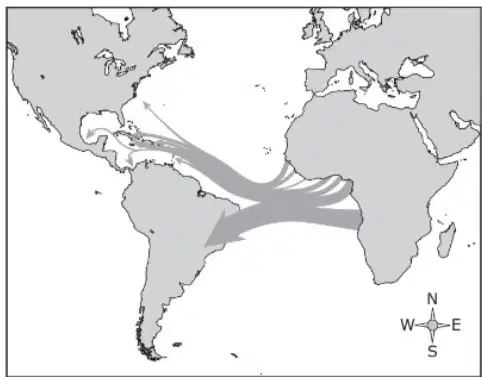
This map shows a trade system that emerged in the 1500s and reached its height in the 1700s. Which factor was a reason for the trade system illustrated on this map?
Labor demands of the factory system
Invention of the steamboat
Labor demands of the plantation system
Invention of the mechanical loom
Which group helped establish the colony of Maryland in the 1630s?
English Catholics seeking religious freedom
Spanish workers seeking job opportunities
Irish families escaping a natural disaster
Russian merchants escaping political conflict
This excerpt is from a book written by Thomas Jefferson:
"The poor Quakers were [fleeing] from persecution in England. They cast their eyes on these new [colonies for] religious freedom. ... Several acts of the Virginia assembly of 1659, 1662 and 1693 ... had prohibited the unlawful assembling of Quakers: had made it [illegal] for any [ship] to bring a Quaker into the state."
—Thomas Jefferson, Notes on the State of Virginia, 1801. Based on the excerpt, which statement explains
Thomas Jefferson’s view on religious freedom in the colonies?
Religious freedom was already protected by the colonies.
Although colonists left England to escape religious persecution, religious freedom was restricted by some colonies.
Due to religious persecution in England, religious freedom was valued above all other rights in the colonies.
Religious freedom was considered unimportant by the colonies.
This excerpt is from a state law enacted in the late 1700s:
"Be it enacted by the General Assembly, That no man shall be compelled to frequent or support any religious worship, place or ministry whatsoever ...; but that all men shall be free to [declare] ... their opinions in matters of religion."
—Code of Virginia.
Why was the passage of this law significant?
It limited the government’s power to establish a church.
It expanded the government’s power requiring church attendance.
It allowed citizens to speak out against political leaders.
It restricted citizens from practicing their religious beliefs.
This list shows events that occurred during the 1700s:
Boston Tea Party
Passage of Intolerable Acts
Battles of Lexington and Concord.
Which era correctly completes the title "Some Events from the Era of the ________?"
War of 1812
Great Awakening
American Revolution
French and Indian War
Which era is correctly associated with the characteristic "Conflict over issue of mercantilism"?
American Revolution Era
Civil War Era
Which era is correctly associated with the characteristic "Conflict over issue of slavery"?
American Revolution Era
Civil War Era
Which era is correctly associated with the characteristic "Ideas of Jefferson Davis inspired action"?
American Revolution Era
Civil War Era
Which era is correctly associated with the characteristic "Ideas of Thomas Paine inspired action"?
American Revolution Era
Civil War Era
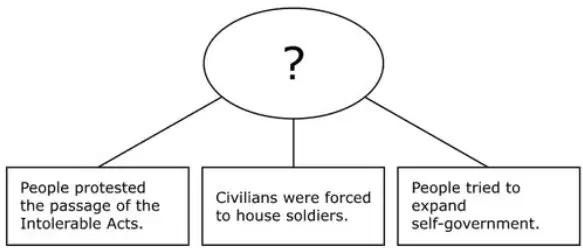
Which era in U.S. history correctly replaces the question mark for the title of this diagram?
Reconstruction
Sectionalism
The Revolutionary Period
The Early Republic
How did the American colonies react to enforcement of the Intolerable Acts?
By collecting funds to pay for the tea destroyed in Boston Harbor
By sending ambassadors to France to request military aid
By placing a tax on all goods imported from Great Britain
By holding the First Continental Congress to discuss unified resistance
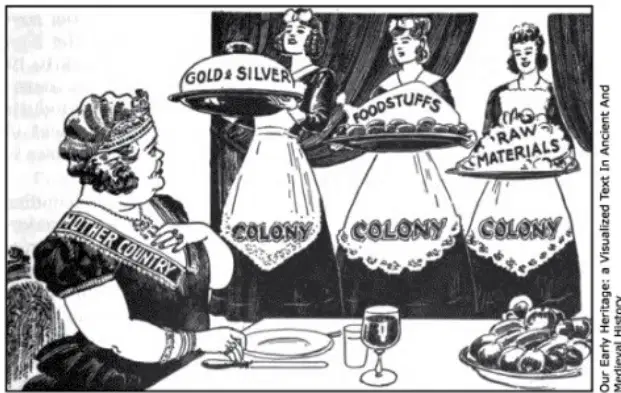
This cartoon shows a popular economic belief in Europe during the seventeenth and eighteenth centuries. Which events in U.S. history are directly associated with this cartoon? Select TWO correct answers.
Passage of the Northwest Ordinance
Passage of the Navigation Acts
Boston Tea Party
Great Awakening
Shays’s Rebellion
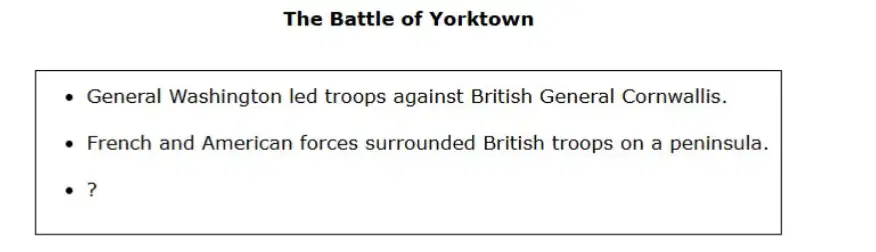
This list describes a battle during the Revolutionary War.
Which description of the battle correctly completes the list?
It was the second battle in the fight for independence.
It was the first battle fought with the help of foreign forces.
It was the last major battle of the war.
It was the battle that helped prolong the war.
Why was the victory at Saratoga a turning point in U.S. history?
It convinced France to support the American cause.
The battle led to the signing of the Declaration of Independence.
The battle represented the end of the American Revolution.
It marked a major change in the leadership of the Continental Army.
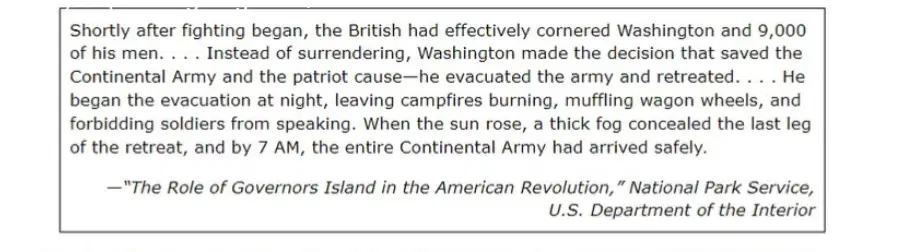
This excerpt describes an action taken by General George Washington in New York in 1776:
-National Park Service, U.S. Department of the Interior
Based on the excerpt and your knowledge of U.S. history, how was General Washington able to save the Continental Army?
He relied on superior transportation technology to overtake the British.
Weather conditions hid his escape from the British.
Swift-moving waterways allowed him to escape from the British.
He relied on shouted commands to confuse the British.
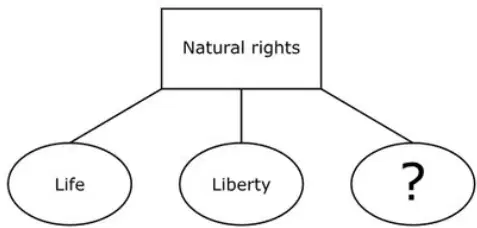
This diagram shows a political idea that John Locke wrote about during the seventeenth century. Which right completes the diagram?
Justice
Privilege
Property
Education
Why is Thomas Jefferson’s writing of the Declaration of Independence considered to be one of his greatest contributions to American history?
He showed responsibility by outlining the structure for a new government.
He helped define rights that would defeat tyranny.
He developed a military plan to defeat the British.
He outlined a strategy for acquiring the Louisiana Territory.
Why is John Paul Jones a significant figure in U.S. history?
He is considered to be the best Union general in the Civil War.
He was the first chief justice of the U.S. Supreme Court.
He is considered to be a founder of the U.S. Navy.
He was the writer of the Declaration of Independence.
Which statement explains why delegates from smaller states opposed parts of the Virginia Plan?
There were concerns that free states would have too much power.
There were concerns that the federal government would become too strong.
There were concerns that the legislature would be able to control the judicial branch.
There were concerns that some states would be able to easily control the government.
What is one way the ideas from the English Bill of Rights are reflected in the U.S. system of government?
Power is divided between the national government and the states.
People have the right to establish and campaign for political parties.
Power is divided among three branches of government.
People have the right to petition the government for a redress of grievances.

This excerpt is from the U.S. Constitution:
—U.S. Constitution, Article I, Section 1.
Based on the excerpt, how did the Great Compromise help create this governmental structure?
By settling the issues over voting rights in the North
By settling the issues between Federalists and Anti-Federalists
By settling the issues over taxation
By settling the issues between large and small states
Why did the Constitutional Convention agree to the Three-Fifths Compromise?
To settle debates over the issue of counting the enslaved population for representation
To settle debates over the issue of abolishing the importation of enslaved people
To create a government based on the principle of federalism
To create a government with a bicameral legislature
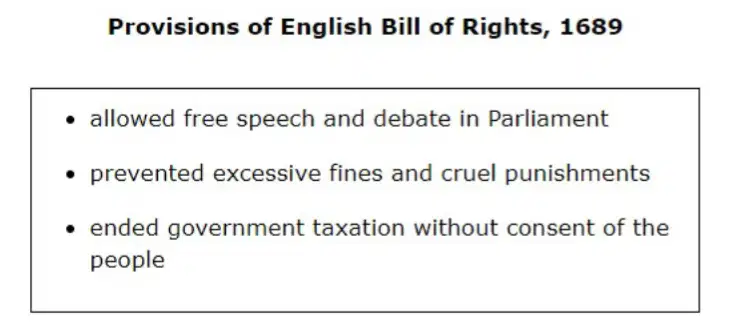
Provisions of the English Bill of Rights, 1689
Which principle in the U.S. Constitution is most closely related to the rights in this list?
Separation of governmental powers
Justice through judicial review
Funding of government through tariffs
Protection of individual liberties
Which historic document had the greatest influence on the first ten amendments to the U.S. Constitution?
The English Bill of Rights
The Mayflower Compact
The Fundamental Orders of Connecticut
The Articles of Confederation
Which weaknesses are associated with the Articles of Confederation? Select all that apply.
All states had to approve amendments
The one-house legislature was based on population
The central government held too much power
States coined their own money
Slavery was banned in the Northwest Territory
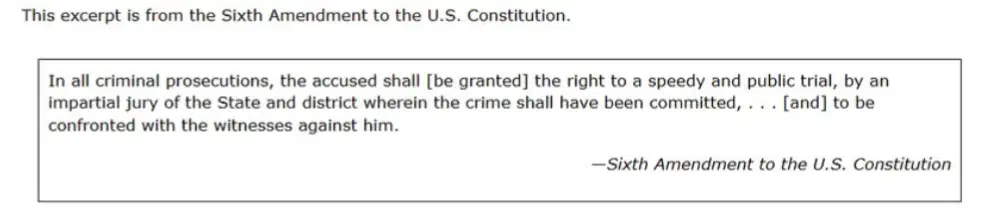
This excerpt is from the Sixth Amendment to the U.S. Constitution: -
Why was this amendment included in the U.S. Bill of Rights?
Colonists accused of crimes had been searched by British troops without consent.
Colonists accused of crimes had been denied fair treatment in British courts.
The British had used excessive force against colonists who were accused of crimes.
The British had housed troops in the homes of colonists who were accused of crimes.

Read the excerpt and answer the question that follows:
—Declaration of Independence.
Which statement shows how this grievance was addressed in the U.S. Constitution?
Congress may override a presidential veto.
Congress may ratify amendments.
The House of Representatives introduces tax bills.
The Senate may vote to turn down treaties.
Which constitutional principle is illustrated by the example: Cruel punishments and excessive fines are prohibited?
Limited government
Separation of powers
Federalism
Which constitutional principle is illustrated by the example: Only Congress can make laws?
Limited government
Separation of powers
Federalism
Which branch of government is given the power: Interprets the laws?
Legislative Branch
Executive Branch
Judicial Branch
Which branch of government is given the power: Declares wars?
Legislative Branch
Executive Branch
Judicial Branch
Which branch of government is given the power: Commands armed forces?
Legislative Branch
Executive Branch
Judicial Branch
Which branch of government is given the power: Declares laws unconstitutional?
Legislative Branch
Executive Branch
Judicial Branch
Which branch of government is given the power: Enforces the laws?
Legislative Branch
Executive Branch
Judicial Branch
Which branch of government is given the power: Makes the laws?
Legislative Branch
Executive Branch
Judicial Branch
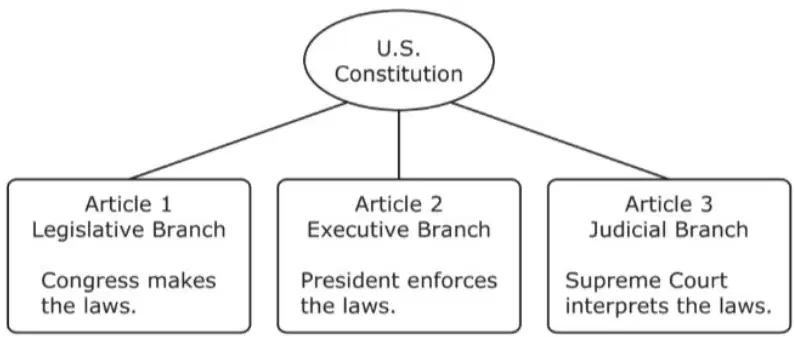
Which government principle is illustrated in this diagram?
Federalism
Popular sovereignty
Republicanism
Separation of powers
Why was the Third Amendment prohibiting the quartering of troops added to the U.S. Constitution?
To address colonial treatment by the British military
To maintain control over members of the British military
To ensure the national government could pay for the U.S. military
To reinforce the need for state militias in the United States
Which argument was made by Anti-Federalists such as Patrick Henry?
Constructing a strong central government is necessary to protect the rights of the upper class.
The Constitution needs to outline individual rights that are to be protected.
Ratifying the Constitution is necessary in order to protect states' rights.
The separation of powers within the government will help limit individual rights.
This excerpt explains the system of federalism:
"In a single republic, all the power surrendered by the people is submitted to the administration of a single government... In the [government separated into states] of America, the power surrendered by the people is first divided between two distinct governments, and then the portion allotted to each, subdivided among... separate departments. Hence a double security arises to the rights of the people. The different governments will control each other, at the same time that each will be controlled by itself."
—James Madison, Federalist, no. 51, 1788.
Which idea expressed by Madison in the excerpt provides evidence to support the answer to the previous question?
People surrender their power to the government.
A single government body is best.
Local governments should have the most power.
Power divided between governmental bodies protects the people.
Which amendment best applies to the circumstance: Being frisked by police without probable cause?
First Amendment
Fourth Amendment
Fifth Amendment
Seventh Amendment
Ninth Amendment
Which amendment best applies to the circumstance: Protesting the use of the death penalty?
First Amendment
Fourth Amendment
Fifth Amendment
Seventh Amendment
Ninth Amendment
Which amendment best applies to the circumstance: Defendant refuses to testify in court?
First Amendment
Fourth Amendment
Fifth Amendment
Seventh Amendment
Ninth Amendment
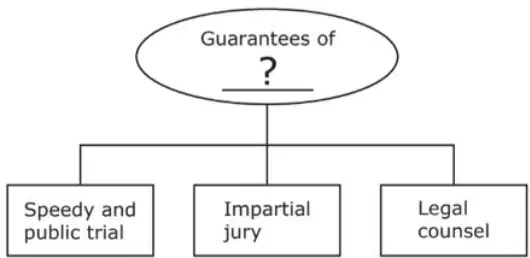
Which idea correctly replaces the question mark in this diagram?
Due Process
Eminent Domain
Free Speech
Federalism
Which requirement is expected of an immigrant after becoming a U.S. citizen?
To become an informed voter
To run for political office
To enlist in the military
To obey the law
This excerpt is from a letter written by a Founding Father:
"Our liberty depends on the freedom of the press, and that cannot be limited without being lost."
—Thomas Jefferson, Letter to James Currie, January 28, 1786.
Why did Jefferson believe this freedom was significant?
To prevent political parties from sharing information about opponents
To allow governmental review of information prior to publication
To allow different points of view to be shared with the public
To prevent criticism of elected officials who pass laws
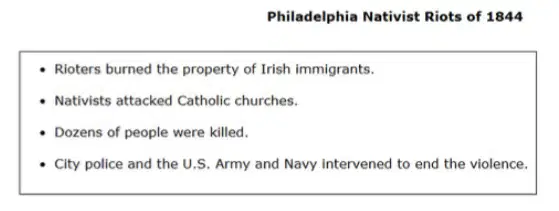
This list describes a conflict in Philadelphia in 1844:
Which statement describes the effectiveness of constitutional protections during the Philadelphia riots of 1844?
The Constitution protects religious freedom, but individuals sometimes violate the religious rights of others.
The Constitution protects religion from government control, but it allows individuals to limit religions they oppose.
The constitutional support of some religions over others provided the need for a constitutional amendment.
The constitutional funding of some religious groups over others can result in protests against the government.
How did the First Amendment protection of religious freedom affect U.S. society in the early history of the country?
It prevented conflict between individuals who were members of different religions.
It prevented the government from making laws prohibiting the practice of certain religious beliefs.
It allowed for state governments to unify their citizens under one common religion.
It allowed for the preservation of many religious places through government support.
Which statement shows an effect of the First Amendment?
Ministers can preach religious messages to anyone who chooses to listen.
Political leaders can require religious tests in order to hold public office.
Ministers can work together to establish a national religion.
Political leaders can require churches to pay taxes.
Which historical action was protected by the First Amendment guarantee regarding religion?
The nativist Know-Nothing Party attracted more members.
Eastern communities forced Mormons to migrate to the West.
City officials worked to reduce the political power of Catholic immigrants.
Evangelists led revivals in New England.
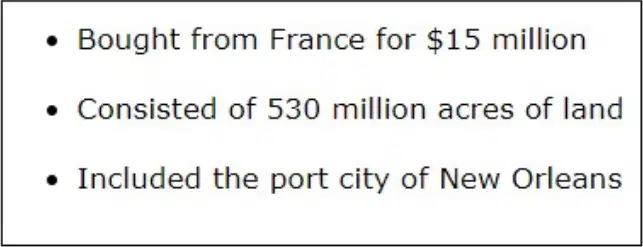
This list describes an event from early U.S. history:
Why was this 1803 event significant to the U.S. government?
It contributed to the formation of the first political parties.
It improved diplomatic relations with Mexico.
It led to a new understanding of presidential powers.
It showed the need to give the Senate the power to approve treaties.
Why did Alexander Hamilton want to create a national bank? Select two correct answers.
To encourage trade with Great Britain
To manage the country’s debt
To discourage the creation of plantations
To centralize the collection of federal taxes
To replace the states’ banks
Views regarding a national bank: Who argued the statement "A national bank would help maintain public credit."?
Alexander Hamilton
Thomas Jefferson
Views regarding a national bank: Who argued the statement "Holding public funds and paying government debts requires a national bank."?
Alexander Hamilton
Thomas Jefferson
Views regarding a national bank: Who argued the statement "The Constitution does not give the government the power to set up a national bank."?
Alexander Hamilton
Thomas Jefferson
Views regarding a national bank: Who argued the statement "A national bank would favor manufacturing at the expense of agriculture."?
Alexander Hamilton
Thomas Jefferson
Which issue was a factor in the formation of the Federalist Party during the early republic era?
Disagreements over how much the national government should collect in taxes
Disagreements over how much state governments should regulate manufacturing
Disagreements over the role that state governments should have in ratifying treaties
Disagreements over the role that the national government should have in printing currency
Which statement describes one result of the War of 1812?
Great Britain lost control of Canada.
The United States gained control of the Oregon Territory.
The United States stopped trading with Britain and France.
Great Britain stopped the practice of impressment.
This excerpt is from a presidential address. "The American continents, by the free and independent condition which they have assumed and maintain, are henceforth not to be considered as subjects for future colonization by any European power." —President James Monroe, Address to Congress, December 2, 1823 Which statement describes the impact of this presidential address?
The United States sent military forces into South American countries.
The United States started a policy of territorial expansion to the Pacific Ocean.
The United States assumed a role as protector of countries in the Western Hemisphere.
The United States developed a reliance on military assistance from European countries.
Read the excerpt and answer the question that follows. "The great rule of conduct for us in regard to foreign nations is in extending our commercial relations, to have with them as little political connection as possible." —President George Washington, Farewell Address, 1796 Why did President Washington give this advice about the future of U.S. foreign policy?
To end European colonization in the Western Hemisphere
To avoid being drawn into European wars
To use trade embargoes to stay neutral
To encourage economic growth through the transatlantic slave trade
This excerpt is from a document written in the late 1700s. "And, whenever any of the said States shall have sixty thousand free inhabitants therein, such State shall be admitted, by its delegates, into the Congress of the United States, on [equal terms] with the original States in all respects whatever, and shall be at liberty to form a permanent constitution and State government." —An Ordinance for the Government of the Territory of the United States North-West of the River Ohio Based on the excerpt and your knowledge of U.S. history, which statement describes an effect of this document?
It outlined the process for creating new states.
It authorized the expansion of slavery to new states.
It limited the individual rights of citizens in new states.
It discouraged the creation of schools in new states.
This excerpt is from an important document in U.S. history. "Religion, morality and knowledge, being necessary to good government and the happiness of mankind, schools and the means of education shall forever be encouraged." —Northwest Ordinance, 1787 Why did the U.S. government encourage education as part of the Northwest Ordinance?
A belief that education was necessary to maintain an orderly society
A belief that education was necessary to acquire land
A belief that education was necessary to preserve property rights
A belief that education was necessary to prevent foreign wars
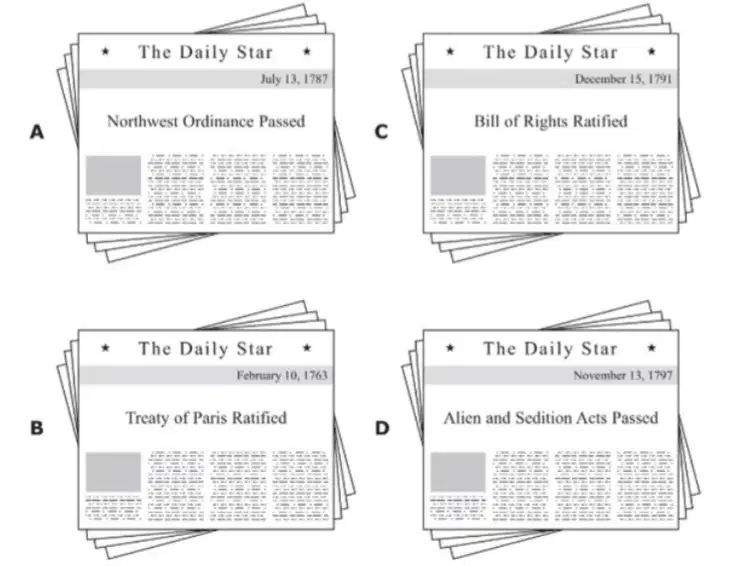
Which headline describes an event that established guidelines for the admission of new states to the United States?
Northwest Ordinance Passed
Treaty of Paris Ratified
Bill of Rights Ratified
Alien and Sedition Acts Passed
Read the passage and answer the question that follows. In the early 1800s, Great Britain was in a conflict with France. Both countries tried to prevent the United States from trading with the other country. As a result of British impressment of U.S. sailors, Congress passed the Embargo Act in 1807. This act closed U.S. ports to exports and placed restrictions on British imports. In 1809 Congress repealed this act and replaced it with a law that specifically prohibited trade with Great Britain and France. What was one effect of these actions on the United States?
The signing of the Treaty of Guadalupe Hidalgo
International criticism of the Monroe Doctrine
The expansion of manufacturing
Increased profits from international commerce
How did the U.S. government encourage the free-enterprise system in the early 1800s?
By setting the prices of goods and services
By protecting the rights of businesses
By monopolizing local and national markets
By owning the means of production
This excerpt is from a president’s annual message to Congress. "Agriculture, manufactures, commerce, and navigation, the four pillars of our prosperity, are the most thriving when left most free to individual enterprise." —President Thomas Jefferson, first annual message, December 8, 1801 Which economic principle is President Jefferson showing support for in this excerpt?
Protective tariffs
Limited competition
Minimal government regulation
Taxes to fund internal improvements
Which principle was established by the Supreme Court case Marbury v. Madison?
Individual rights
Separation of powers
Consent of the governed
Judicial review
This excerpt is from the U.S. Constitution: The Congress shall have Power . . . To regulate Commerce with foreign Nations, and among the several States. —U.S. Constitution, Article I, Section 8, Clause 3 How did the U.S. Supreme Court interpret this article in Gibbons v. Ogden (1824)? Select TWO correct answers.
States may control commerce within their borders that involves foreign countries.
States may be subject to federal regulation in matters of commerce.
States may possess the power to regulate interstate commerce.
States may pass legislation that restricts interstate commerce.
States may regulate commerce within their own borders.
Which issue was debated in Gibbons v. Ogden?
The status of slaves living in free territories
The regulation of interstate commerce by federal or state laws
The constitutionality of tariffs
The separation of powers among the branches of government
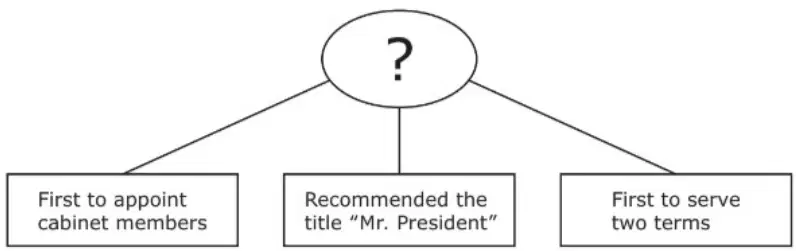
A diagram shows three traditions for the executive branch:
Which president established these traditions for the executive branch?
John Adams
Thomas Jefferson
James Madison
George Washington
Why did President Andrew Jackson oppose the Second Bank of the United States?
He believed it was inefficient and poorly managed.
He thought it was unconstitutional and favored the wealthy.
He considered it an obstacle to industrial progress and expansion.
He believed it favored the rights of states over the federal government.

Which effect correctly completes the diagram?
The Supreme Court’s power is expanded.
The First National Bank is established.
The Missouri Compromise is reached.
The Whig Party is formed.
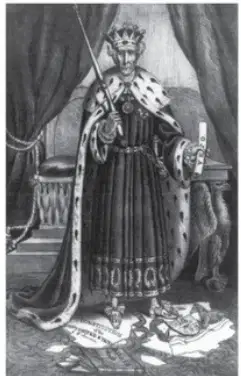
This political cartoon from 1833 portrays President Andrew Jackson titled "King Andrew the First."
Which statement describes a position of the party that agreed with the cartoonist’s view of Jackson?
They complained about Jackson’s extravagant lifestyle.
They opposed Jackson for his efforts to start a war with Great Britain.
They criticized Jackson as a leader with unrestrained powers.
They objected to Jackson’s attempt to reduce the number of Supreme Court justices.
This excerpt was published by a department of the U.S. government: "
According to the congressional inquiry, [Samuel] Swartwout [ran away] with 30 million dollars—a shocking sum by any standard. President Andrew Jackson rewarded his [loyal] supporter, Samuel Swartwout, with two consecutive appointments as collector of customs at New York, where he served from 1829 through 1837."
—U.S. Customs and Border Protection, www.cbp.gov (accessed February 28, 2020)
Based on the excerpt, which statement describes the administration of President Jackson?
He favored nullification, leading to increased sectional conflict.
He lacked the power to enforce laws, leading to abuses in power.
He failed to enforce term limits, leading to extended durations of service.
He preferred the use of the spoils system, leading to corruption in some cases.
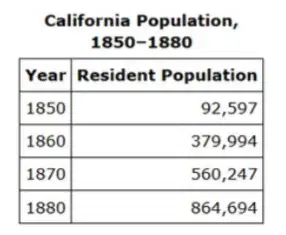
This table shows the population of California between 1850 and 1880 according to the U.S. Census:
Which reason explains the population increase shown in the table?
The Gadsden Purchase established new states in the West.
Farmers left northern cities for rural plains in the West.
The Louisiana Purchase opened up settlement in the West.
Gold was discovered in the West.
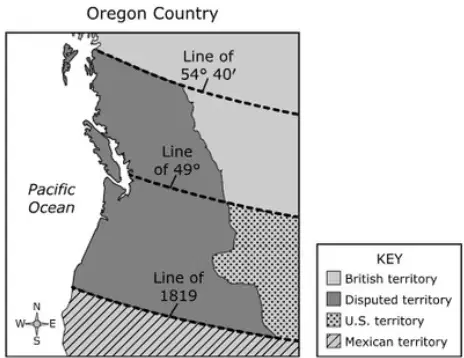
In 1846 the United States and Great Britain negotiated the boundary of the disputed territory shown in this map. Which factor made the negotiations more challenging?
Supporters of Manifest Destiny argued for "Fifty-four forty or fight."
The American Indians in the territory were hostile to settlers.
President James Polk opposed westward expansion to the Pacific Ocean.
Hazards along the Oregon Trail limited American settlement of the Northwest.
Why was the Mexican Cession a significant event?
It united different cultural groups living in western areas.
It intensified the debate over the expansion of slavery.
It created a temporary southern border.
It led to the development of canal systems to move goods.

The differences between these two maps resulted from the —
Missouri Compromise
Treaty of Ghent
Louisiana Purchase
Adams–Onís Treaty
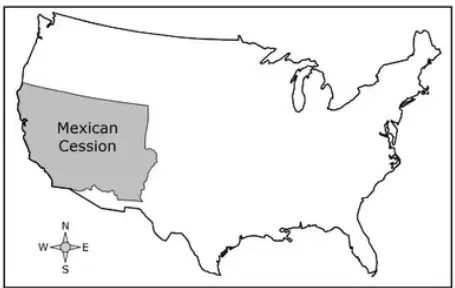
This map shows the land gained by the United States in the Mexican Cession of 1848. Which significant issue did the U.S. government face as a result of the addition of this land?
Experimenting with new farming and irrigation techniques in the new territory
Deciding on the official language for the new territory
Figuring out how to balance free and slave states within the new territory
Limiting the immigration of settlers into the new territory
Which effect did the Treaty of Guadalupe Hidalgo have on the United States?
It decreased the debate over civil disobedience.
It increased the debate over the spoils system.
It decreased the debate over immigration.
It increased the debate over slavery.
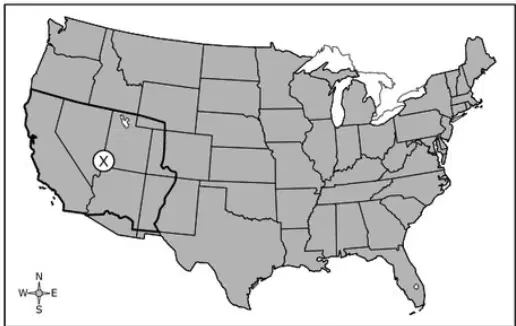
How did the United States acquire the territory marked with the X?
By purchasing the land from Spain
By winning a war against Great Britain
By purchasing the land from France
By winning a war against Mexico
Which event was one cause of the U.S.–Mexican War?
The United States banned slavery in territories acquired from Mexico.
The U.S. Congress debated statehood for New Mexico.
U.S. and Mexican soldiers fought over disputed territory north of the Rio Grande.
The United States acquired the Mexican Cession.
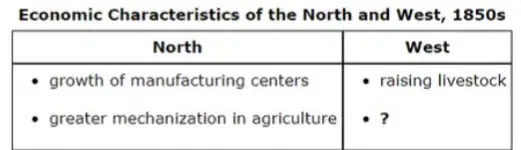
This chart compares economic characteristics of two regions of the United States in the 1850s. Which economic characteristic BEST replaces the question mark?
Increased reliance on high protective tariffs
Reduction in agricultural output
Reduction in demand for consumer goods
Increased mining of precious metals
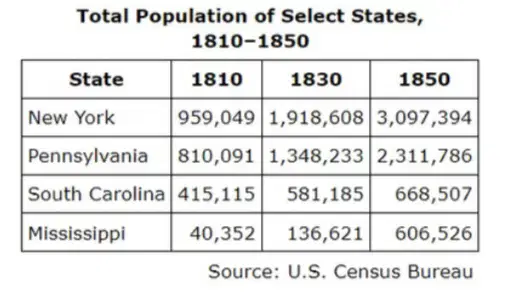
This table shows population data from the 1800s. Based on the table and your knowledge of U.S. history, which statement explains the population trends shown in the table?
The harsh climate in northern states made it hard for people to live there.
Southern states primarily consisted of urban hubs because of new transportation networks.
The warm climate in southern states was good for agriculture and led to urbanization.
Northern states had economic and social opportunities that attracted immigrants.
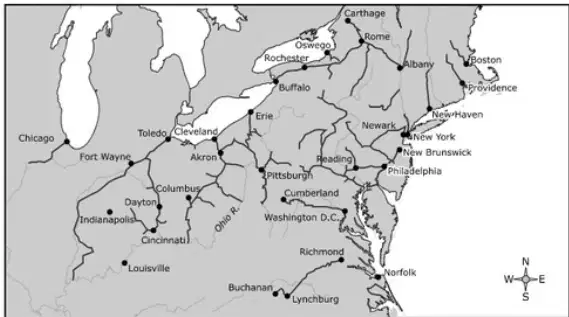
This map shows canals constructed in the United States between 1820 and 1860. How did the canals shown on the map affect this region of the United States?
They provided a source for the irrigation of farms and fields.
They served as a means of flood control for cities and towns.
They ensured safe supplies of freshwater for towns and cities.
They reduced transportation costs and the time to ship goods.
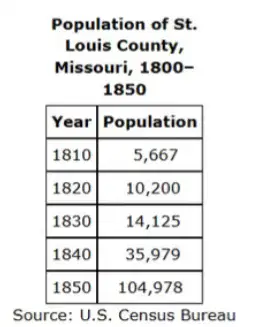
This table shows the population change of a U.S. county during the nineteenth century. How did rivers contribute to the change shown?
They provided power for electricity generation.
They prevented the rapid construction of railroads.
They provided easy access for trade opportunities.
They prevented the growth of large industrial centers.
Which statement explains how demand for cotton as a cash crop MOST affected the Southern United States?
It contributed to the growth of slavery.
It reduced the need for factories.
It contributed to the growth of railroads.
It reduced the need for large farms.
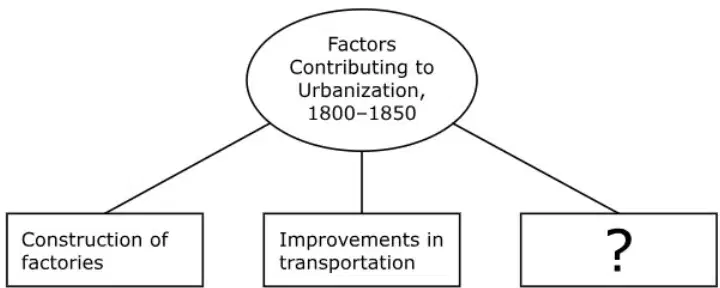
Study the diagram and answer the question that follows. Which factor correctly replaces the question mark on this diagram?
Nullification of federal labor laws
Increases in immigration
Invention of electric generators
Increased support for abolitionism
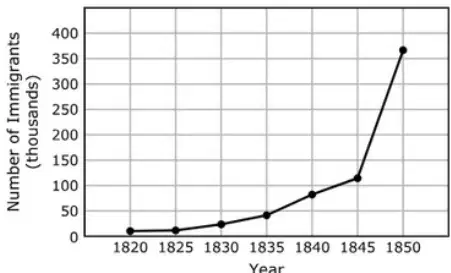
This graph shows immigration to the United States in the mid-nineteenth century. What was one effect of the trend shown on this graph on the U.S. economy?
It created widespread unemployment.
It increased the prices of imported goods.
It slowed westward expansion and growth.
It provided a large labor force for manufacturing.
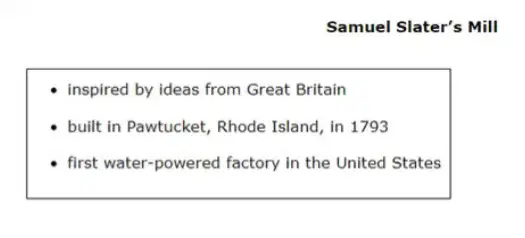
This list highlights information about a mill built by Samuel Slater. Which statement explains an effect of Samuel Slater’s mill?
It limited the need for child labor in factories.
It limited the need for interchangeable parts.
It led to expanded regulations on foreign trade.
It led to rapid growth in the textile industry.
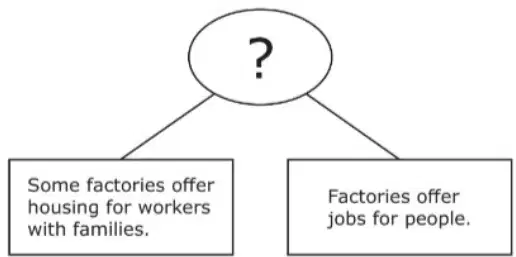
Which title best completes this diagram?
Innovations in the Cottage Industry
Causes of Rural Development
Expansion of Employees’ Rights
Reasons for Urbanization
In the U.S. free-enterprise system of the early 1800s, how did competition MOST affect the U.S. economy?
Competition resulted in strict regulation and low taxation of manufactured goods.
Competition promoted the fair pricing and high quality of goods.
Competition discouraged businesses and people from using banks.
Competition decreased exports of raw materials and manufactured goods.
Which issue led to the creation of the nativist Know-Nothing Party in the 1850s?
The use of enslaved labor in the economic system
The expansion of national borders toward the west
The involvement of immigrants in the political system
The expansion of governing power by the executive branch
Which statement BEST explains why Germans migrated out of their country?
They were part of a forced migration to provide labor in America.
They were fleeing a major famine caused by crop failure.
They were attracted by economic opportunities and available land.
They were searching for gold and other natural sources of wealth in America.
Which statement would MOST LIKELY have been said by someone who immigrated to the United States from China in the mid-1800s?
“I fled famine in my homeland only to find difficult conditions in the United States. I settled in Boston, but I found it difficult to find work because people discriminated against me for my religion and ethnicity.”
“I left my homeland because of political unrest there. I settled in Wisconsin, because the land there reminded me of home. I now have a successful farm.”
“I left my homeland to avoid harsh rule by the king who claimed my land. I settled in the Carolina backcountry with other members of my clan. We’ve built log cabins, and I make my living as a craftsman.”
“I left my homeland because I was inspired by stories of gold in California. When I didn’t find gold, I got a job helping build the railroad. I faced a lot of discrimination.”
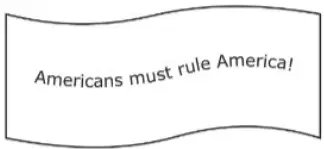
This political slogan is from the mid-1800s. American Platform of Principles, 1857: Americans must rule America! What motivated some people to support this nativist slogan?
An affirmation of states’ rights by Jefferson Davis and the belief that tariffs are un-American
Large-scale immigration to cities and the belief that immigrants stole jobs from native-born citizens
The desire for an independent country free from foreign rule and unfair mercantile economic policies
A rejection of anti-American influence following the Battle of San Jacinto and the addition of new territories
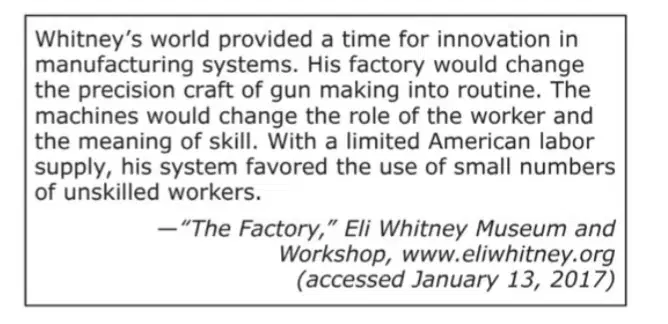
What is being described in this excerpt?
Spinning jenny and the textile industry
Interchangeable parts and mass production
Cotton gin and the plantation system
Steam engine and railroad commerce
How did factories contribute to economic growth in the United States during the early 1800s? Select TWO correct answers.
Power-driven machinery produced large quantities of goods quickly and inexpensively.
Increases in income closed the wealth gap between the owners of industrial facilities and their employees.
Workers organized labor unions, which allowed them to demand better working conditions.
Government regulations required industrial companies to invest part of their profits and shares in their communities.
Women could become industrial workers, which allowed them to earn an income.
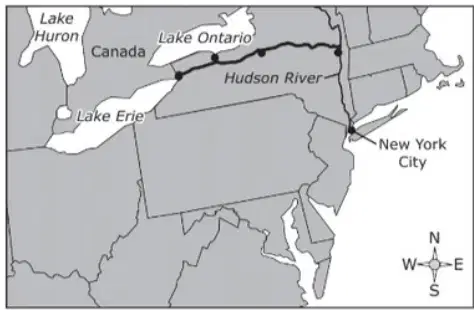
What were two effects of this canal on the United States during the early-to-mid 1800s?
The Northeast gained access to new trade networks, and the Midwest opened for more settlement.
The South became less dependent on slave labor, while the North became more dependent on indentured servants.
The West became the commercial center of the nation, while the Northeast increased dependence on agricultural production.
The South experienced lower shipping costs, and the West expanded international trade.
How did industrialization in the 1800s affect life in the United States?
It led to an increased reliance on imported goods.
It led to increased isolationist views about conflicts in other countries.
It led to nativist feelings against the growing immigrant population.
It led to concerns about the growing population of enslaved people.
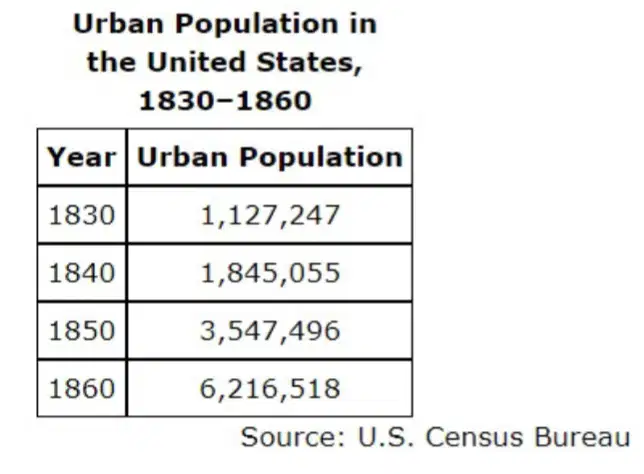
Which factor BEST explains the trend shown in the table?
Favorable living conditions in cities
Decreasing land prices in rural areas
Industrial working opportunities in cities
Decreasing agricultural output in rural areas

How did Thoreau justify this act of civil disobedience?
He disagreed with increasing taxes for the lower classes.
He disapproved of increasing taxes to fund mainly urban areas.
He objected to tax money being used to pay for the U.S.–Mexican War.
He refused to provide tax money to a government that supported the Civil War.
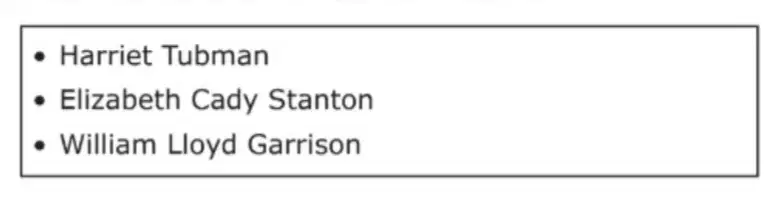
Read the list and answer the question that follows. The people on this list are similar because their actions —
promoted interest in agricultural innovation
promoted support for westward expansion
showed dedication to sectionalism and states’ rights
showed commitment to rights and freedoms

This excerpt is from the Declaration of Sentiments in 1848:
Based on the excerpt and your knowledge of U.S. history, how did the Declaration of Sentiments affect U.S. history?
It highlighted inequalities that existed in society and called for changes in the system of suffrage.
It presented facts about the dangers of alcohol consumption and called for immediate prohibition.
It highlighted reasons why slavery was unethical and called for enslaved people to be freed.
It presented problems caused by a lack of education and called for children to attend school.

This excerpt is from an essay by a writer and philosopher from the 1800s:
Which U.S. historical movement is reflected in this excerpt?
Industrialism
Romanticism
Reconstruction
Transcendentalism
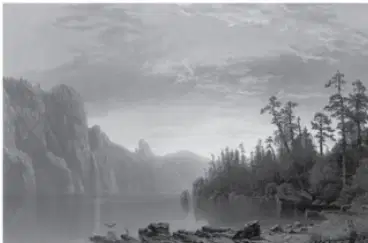
This painting is by Albert Bierstadt, who is associated with the Hudson River School. Title: Sunset (California Scenery), 1864.
How did artists who produced works such as this reflect changes in U.S. society during the nineteenth century?
They promoted the natural resources of the United States to encourage trade with businesses in Europe.
They attempted to bring unity to the United States as a response to growing regional tensions within the country.
They created pieces to celebrate the connection between European culture and the natural heritage of the United States.
They showed a romantic attitude about nature as a response to increasing industrialization in the United States.

This excerpt is from a poem from the 1850s:
How does Whitman demonstrate the American way of life in the mid-1800s in this poem?
He explains the civic responsibilities that all citizens have.
He describes the individualism that citizens highly valued.
He provides an example of the ideas of the temperance movement.
He puts into words the ideals shown in the Hudson River School of art.
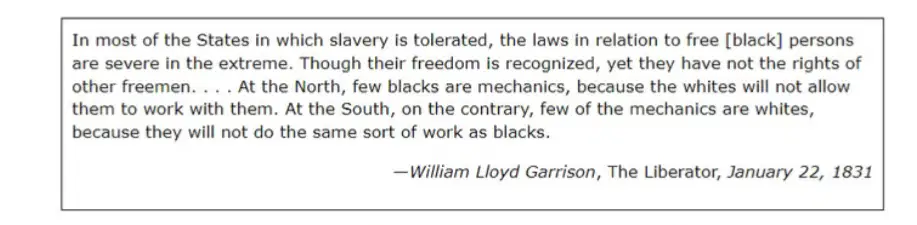
Read the excerpt and answer the question that follows:
According to Garrison’s observations, how were slaves and free blacks treated similarly in both the North and the South?
Both slaves and free blacks could travel without restrictions.
Both slaves and free blacks experienced discrimination.
Both slaves and free blacks often owned businesses.
Both slaves and free blacks were not paid for their work.
Which condition did both slaves and free blacks in the United States experience in the antebellum period?
Both groups were allowed to testify in court.
Both groups were able to vote in elections.
Both groups were forced to pay taxes.
Both groups were denied citizenship rights.
Which issue about slavery was temporarily resolved by using popular sovereignty in the territories?
Extending citizenship to former slaves in the territories
Abolishing slavery by an amendment to territorial constitutions
Extending voting rights to former slaves in the territories
Allowing slavery to exist in western territories
Why was there significant opposition to the Fugitive Slave Act?
Because fugitive enslaved people wanted to establish a new government in territories in the West
Because fugitive enslaved people were provided with paid passage out of the country
Because it was part of a scheme by Northern officials that expanded slavery into the territories
Because it was used to provide federal support for the institution of slavery
Which statement correctly matches a historical event with one of its immediate results?
The Nullification Crisis led to South Carolina seceding from the United States over slavery.
The Missouri Compromise led to Missouri being admitted to the union as a free state.
The Kansas–Nebraska Act led to Kansas being allowed to decide whether it would permit slavery.
The Compromise of 1850 led to California being admitted to the union as a slave state.
Which statement describes the roles of George McClellan and Ulysses S. Grant during the Civil War?
They were Confederate generals who captured Fort Sumter.
They were Union generals who commanded the Army of the Potomac.
They were Confederate generals who surrendered at the Battle of Vicksburg.
They were Union generals who committed war crimes at the Battle of Gettysburg.
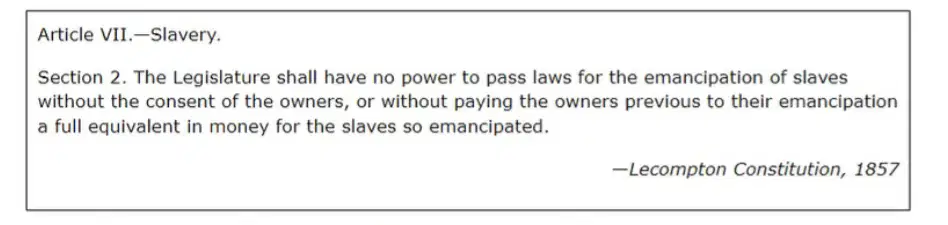
This excerpt is from a proposed constitution for the Kansas Territory that contributed to sectional conflict:
Based on the excerpt, which group wrote the Lecompton Constitution?
Opponents of westward expansion
Supporters of abolitionism
Anti-slavery Northerners
Pro-slavery Southerners
Which statement describes how the passage of the Kansas-Nebraska Act of 1854 increased sectionalism?
It allowed slavery to expand into the territories.
It gave tax cuts to manufacturers who relocated to the territories.
It allowed slaves who escaped to the territories to purchase their freedom.
It granted homesteads to immigrants who settled in the territories.
Why was the Battle of Vicksburg a strategic victory in the Civil War?
The battle opened the way for a full-scale Union attack on Atlanta.
The battle gave the Union control of the Mississippi River.
The battle prevented a Confederate invasion of the North.
The battle allowed President Lincoln to issue the Emancipation Proclamation.
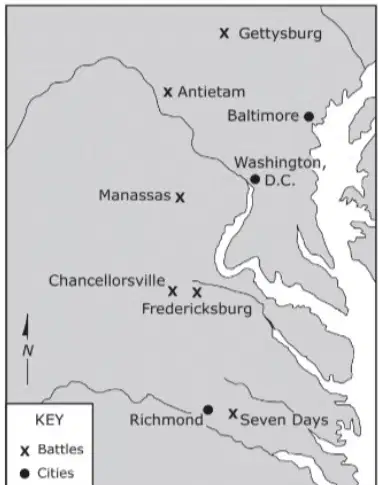
Selected Battles of the Civil War map:
What made the battles at Antietam and Gettysburg different from the other battles illustrated on this map?
They were victories for the Confederacy.
They were battles fought in Union territory.
They were attempts to keep Virginia in the Union.
They were battles defending the Confederate capital.
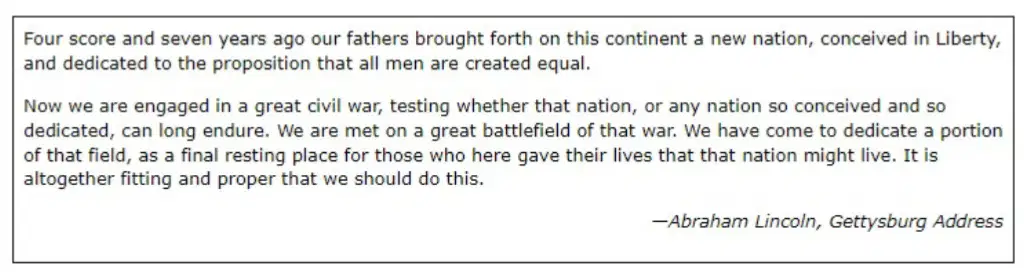
This excerpt is from a presidential speech given in 1863:
How does President Lincoln define the reason for the conflict?
As a fight to protect the provisions outlined in the Kansas-Nebraska Act
As an attempt to uphold the Bill of Rights and the powers granted to states in the Constitution
As a struggle to maintain the ideals contained in the Declaration of Independence
As an effort to prevent Southern states from increasing their representation in Congress
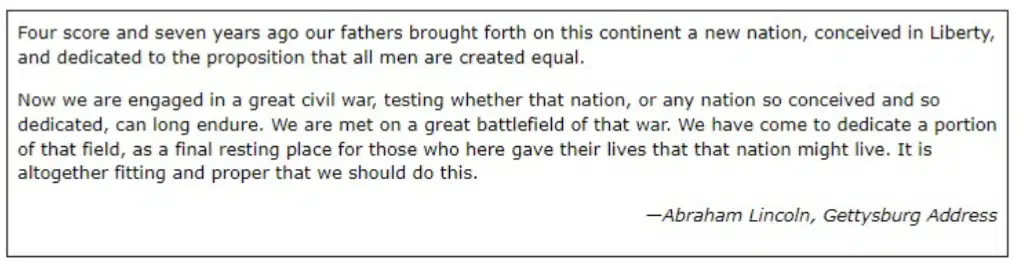
Using the same excerpt from Abraham Lincoln’s Gettysburg Address: Which evidence from the excerpt supports the answer to the question about the conflict’s purpose?
"Four score and seven years ago our fathers brought forth on this continent a new nation, conceived in Liberty, and dedicated to the proposition that all men are created equal."
"We are met on a great battlefield of that war."
"We have come to dedicate a portion of that field, as a final resting place for those who here gave their lives that that nation might live."
"It is altogether fitting and proper that we should do this."
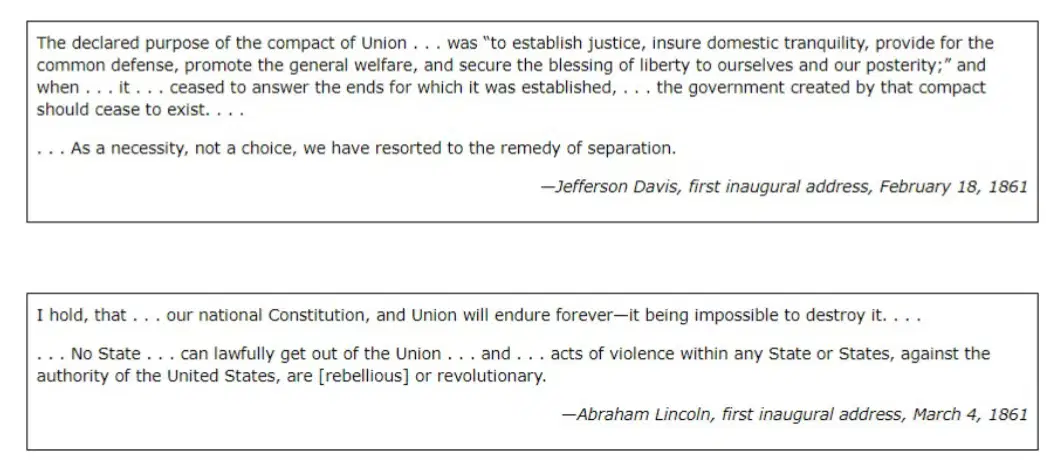
These excerpts are from presidential inaugural addresses. Jefferson Davis, first inaugural address, February 18, 1861:
Based on these excerpts, which statement describes the ideas of Presidents Davis and Lincoln?
Both Davis and Lincoln believed that it was unlawful for a state to break from the union.
Both Davis and Lincoln believed that states had the authority to wage war against the union.
Davis believed that the federal government made secession necessary, while Lincoln believed the union must be preserved.
Lincoln believed that a state must prove the right to secede, while Davis believed that any state could secede at any time.
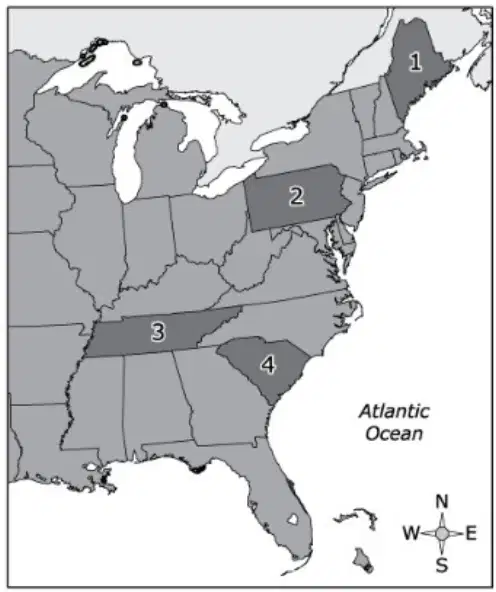
Which number on the map represents the site of the Battle of Gettysburg and President Lincoln’s Gettysburg Address?
1
2
3
4
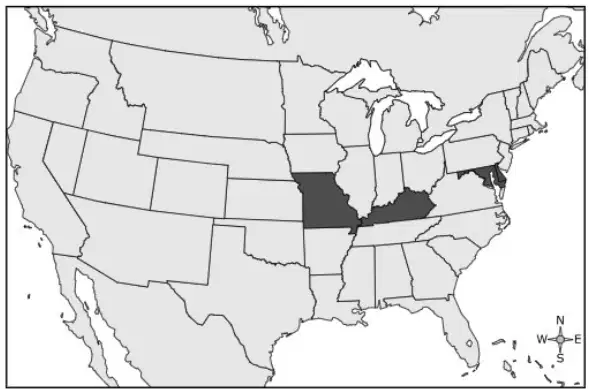
This map shows state and territorial borders of the United States in 1861. Which characteristic was shared by the darker-shaded states on this map?
They were states that joined the Confederacy before the firing on Ft. Sumter.
They were slave states that remained in the Union during the Civil War.
They were states that voted against declaring war on the Confederacy.
They were slave states that supported Abraham Lincoln in the 1860 presidential election.
Which human geographic factor helped the Union win the Civil War?
A network of railroads in the North allowed Union soldiers to be moved quickly over long distances.
The Oregon Trail allowed Union military supplies to be moved quickly to the West.
Northern farms started producing cotton used to make Union military uniforms.
Canals in the Midwest allowed food for Union soldiers to be moved quickly to the front lines.
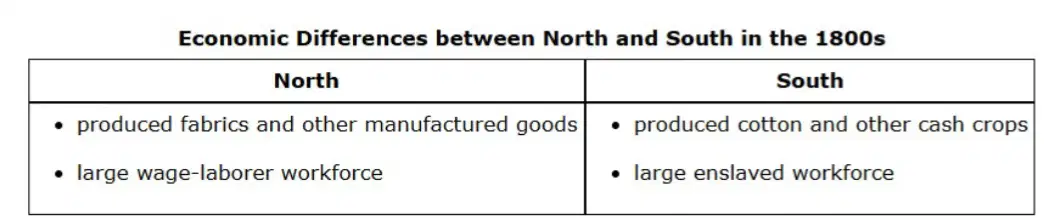
Which statement describes a cause of the economic differences in this chart?
The Southern region had better conditions for plantation farming than the North had.
The Northern region had less access to railroads for transporting goods than the South had.
There were higher rents for workers in the South than there were in the North.
There were fewer geographic barriers isolating the North than there were in the South.
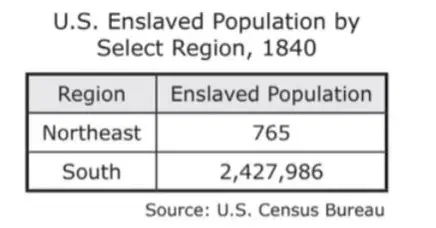
Which statement describes a factor that most contributed to the population difference shown in the table?
The South had a society that relied on wage labor.
The South had an economy that relied on cotton.
The South had a variety of natural resources.
The South had an abundance of large cities.
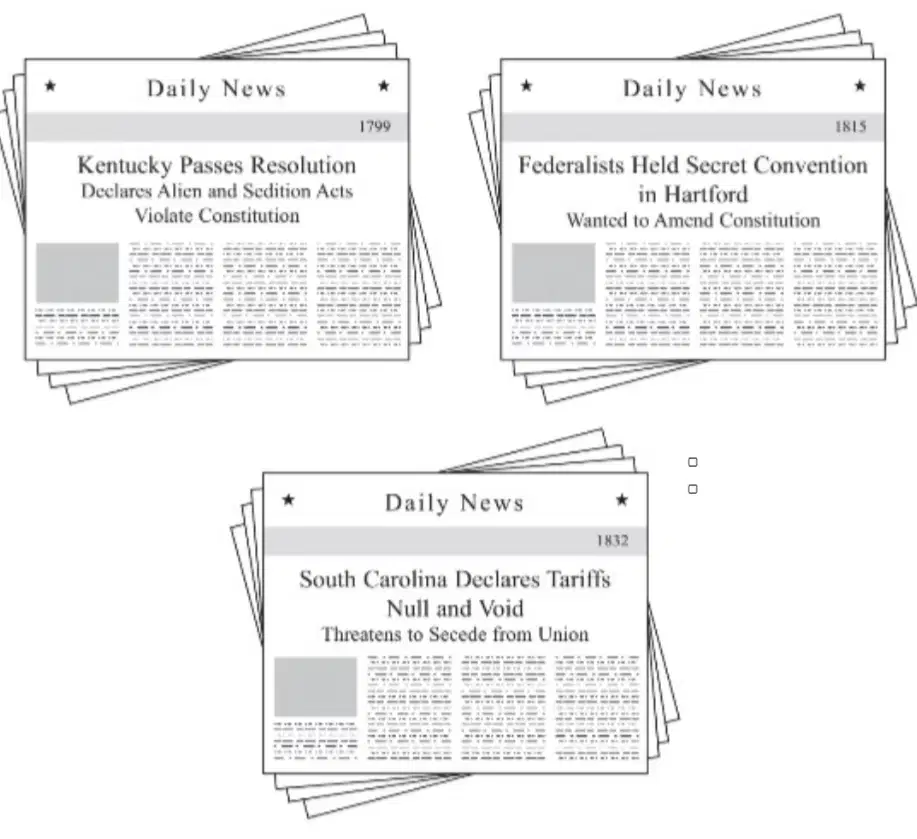
Which issue do the events in these headlines have in common?
Expansion of slavery
States’ rights
Taxation without representation
Popular sovereignty
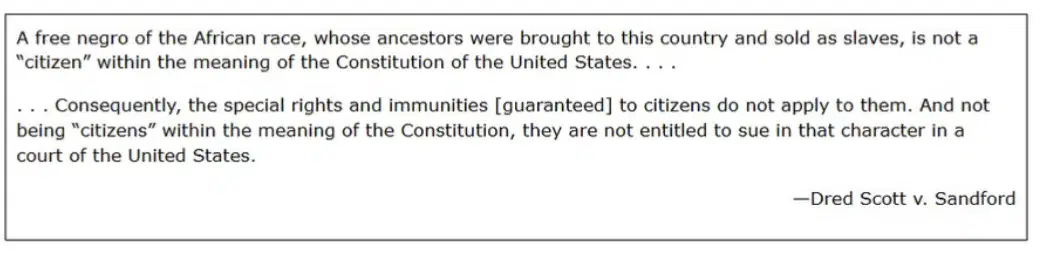
This excerpt is from a U.S. Supreme Court case in 1857-
How did this ruling affect black people in the United States before the Civil War?
It gave free blacks a route to citizenship but denied that right to enslaved people.
It denied rights for enslaved people but allowed free blacks the right to sue.
It restricted enslaved people and free blacks from having a voice in federal courts.
It gave enslaved people and free blacks their freedom in the United States.
How did the U.S. Supreme Court decision in Dred Scott v. Sandford affect the lives of free and enslaved African Americans?
As long as they were peaceful, both groups were able to participate in political protests.
Because they were not considered taxpayers, both groups were unable to attend religious services.
As long as they were lawful, both groups were able to seek out economic opportunities.
Because they were not considered citizens, both groups were unable to use the legal system.
Which statement explains an effect of the Missouri Compromise?
The compromise maintained the balance between the number of free states and slave states in the Senate.
The compromise allowed slaves to be counted toward a state’s population for representation in Congress.
The compromise enabled Southerners to pursue fugitive slaves into the North.
The compromise ended the slave trade in Washington, D.C.
Which era involved legislation enacted by the Radical Republicans?
Civil War
Reconstruction
Early republic
Antebellum
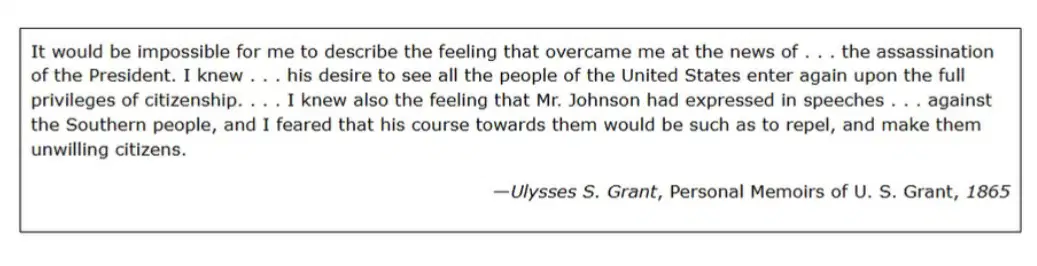
Based on the excerpt, what did Ulysses S. Grant fear might happen after the assassination of President Lincoln?
The government would impose strict requirements on the Southern states.
The Southern states would deny equal rights to those in the Northern states.
The Southern states would be welcomed back into the Union.
The government would favor the Southern states over the Northern states.

Which statements BEST describe the purpose of this program following the Civil War? Select TWO correct answers.
It provided job training and education to formerly enslaved people.
It reestablished trade relationships between the North and the South.
It assisted with the distribution of food throughout the South.
It detailed the terms of the South being admitted back into the union.
It oversaw the forced migration of people to other parts of the country.
Which action highlights an accomplishment of the Reconstruction Era Freedmen’s Bureau?
Offering an alternate route to full citizenship for newly freed enslaved people
Granting voting rights to newly freed enslaved people
Providing educational opportunities for newly freed enslaved people
Building factories to provide jobs for newly freed enslaved people
Which breakthrough did Hiram Rhodes Revels accomplish during Reconstruction?
He became the first African American to publish literature.
He became the first African American to build wealth as a carpetbagger.
He became the first African American to win a seat in the U.S. Congress.
He became the first African American soldier to serve in an integrated Union Army unit.
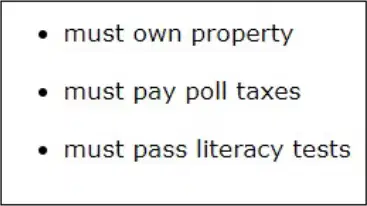
This list shows requirements that were written into certain laws in Southern states after the Reconstruction Era:
Which aspect of society was affected by these requirements?
U.S. citizens’ ability to take out loans
U.S. citizens’ right to vote in elections
U.S. citizens’ option to join the military
U.S. citizens’ choice to operate a business
Which statement explains the purpose of military government in the South during Reconstruction?
It prevented carpetbaggers from operating former Confederate businesses.
It protected and ensured the rights of newly freed enslaved people.
It provided money and weapons to newly freed enslaved people.
It prohibited African Americans from running for public office.
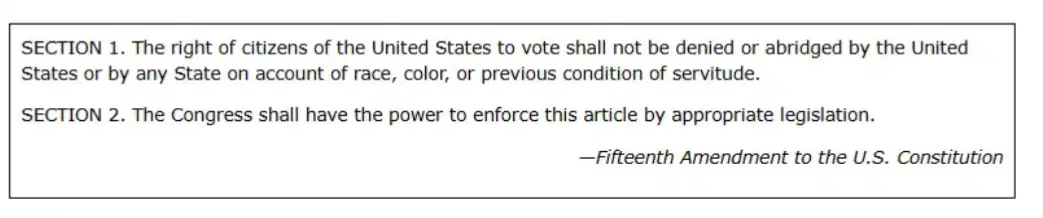
This excerpt is from the U.S. Constitution-
What was the PRIMARY purpose of this amendment?
To allow American Indian men to vote for the first time
To offer voting rights to all citizens
To conduct voting through the electoral college system
To extend voting rights to African American men
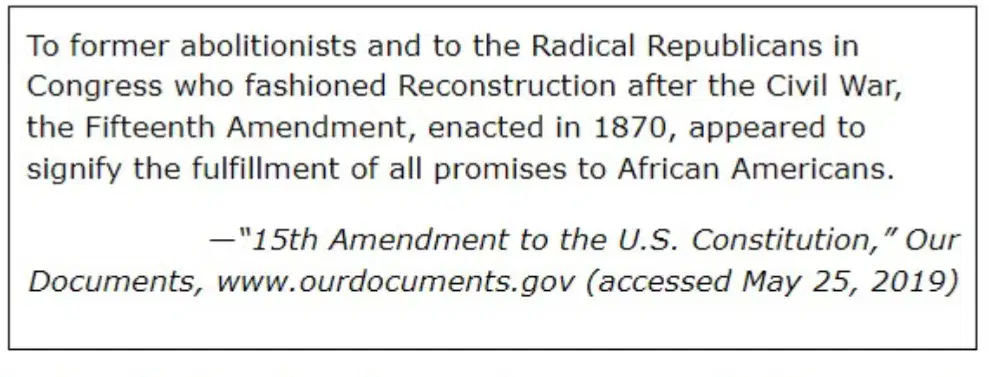
Which result shows how the amendment described in this excerpt "appeared to signify the fulfillment of all promises to African Americans"?
African American children were given access to education.
African American families were given free land to farm.
African American men were elected to public office.
African American men were allowed to serve in the military.
What was one effect of the Fifteenth Amendment?
Immigrants faced less discrimination.
Black voters helped bring the Republican Party to power in the South.
Electors selected the president and vice president on separate ballots.
American Indian tribal land was divided into individual plots.
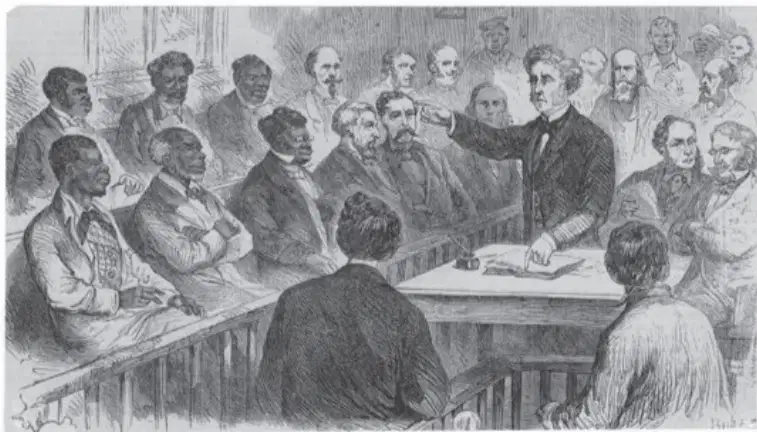
The sketch titled "Jury of Whites and Blacks" appeared in Frank Leslie’s Illustrated Newspaper in 1867. Which event is most associated with the change in American life shown in this sketch?
The adoption of the Great Compromise
The establishment of a two-party political system
The ratification of the Fourteenth Amendment
The election of more qualified judges

