
 Worksheets
Knee Injury Assessment
Total questions: 12
Worksheet time: 21mins
A High School Soccer Player's ACL Injury
During a high-stakes soccer match, a high school athlete attempted a sudden pivot to evade an opponent. The sharp change in direction placed excessive strain on her knee, causing her to injure her knee.
Immediately after the incident, the player felt a popping sensation in her knee, followed by intense pain. She struggled to bear weight on the injured leg and noticed significant swelling within minutes.
In the days following the injury, the athlete experienced persistent discomfort and limited range of motion in her knee. Bruising became visible, and her knee felt unstable during simple activities like standing or walking. These symptoms highlighted the severity of the injury, causing her to seek medical evaluation.
What caused the high school soccer player's knee injury?
Sudden pivot during a soccer match
Collision with another player
Overuse from excessive training
Improper warm-up before the game
Based on this athleteś MOI and Symtpoms, what injury do you suspect?
MCL Tear
Meniscal Tear
ACL Tear
PCL Tear
Which of the following is NOT a hallmark sign of an ACL tear?
Popping sensation in the knee
Intense pain
Significant swelling
Complete lack of pain
What type of movements are most likely to cause an ACL tear?
Rapid deceleration and twisting
Slow jogging
Stretching exercises
Walking on uneven surfaces
Which of these symptoms would indicate a possible ACL injury?
Popping sensation, intense pain, and swelling
Complete numbness in the leg
Bruising and instability
Sharp pain in the ankle
What is often required to restore full function after a severe ACL injury?
Surgical intervention
Physical therapy only
Rest and ice
Use of a knee brace
During the second half of a playoff game, Maya was sprinting down the sideline. She attempted to make a sharp, 90-degree "cut" to the inside to avoid a defender. As she planted her right foot and rotated her torso to change direction, her cleats caught in the turf. She felt pain on the inside of her knee and immediately fell to the ground.
Maya was able to limp off the field with assistance. She reported that the pain was sharp but localized to the medial joint line (the space between the femur and tibia). She didn’t notice immediate "grapefruit-sized" swelling, so she iced it and went home.
Maya arrives at the athletic training clinic the next morning with the following complaints:
Delayed Swelling: The knee looks puffy today, whereas it looked normal immediately after the game.
Mechanical Issues: She describes a "catching" or "clicking" sensation when she tries to walk. Twice this morning, her knee felt like it "locked" in a slightly bent position, and she had to shake her leg to get it to straighten out.
Pain Profile: Sharp pain when she tries to squat or when she walks up the stairs.
Point Tenderness: She is extremely tender directly along the medial joint line.
Maya's knee felt like it 'locked' in a bent position during her morning walk. What is the most likely cause of this mechanical symptom in the context of her injury?
A fragment of torn fibrocartilage is physically impeding the joint's range of motion.
The quadriceps muscle has gone into a protective spasm to prevent movement.
The ACL has completely ruptured, causing the tibia to shift forward and jam.
The patella has subluxed and is no longer tracking within the femoral groove.
Maya noticed that her knee looked 'puffy' 24 hours later, rather than immediately after the 'pop.' What does this delayed effusion (swelling) suggest to a clinician?
The joint capsule has been injured allowing fluid to leak out into the surrounding calf tissue.
The athlete has a high pain tolerance and didn't notice the internal bleeding right away.
The injury involves a structure with poor blood supply, leading to a slow accumulation of synovial fluid and inflammation
The medial collateral ligament (MCL) has been completely severed.
The athletic trainer finds point tenderness specifically along the medial joint line. Which structure is most likely being palpated in that specific anatomical space?
The anterior talofibular ligament.
The pes anserine tendon.
The lateral collateral ligament.
The medial meniscus.
Based on the information provided; what type of injury do you suspect?
Patella Subluxation
Medial Meniscal Tear
PCL Tear
MCL Tear
Which of the following special tests would be most appropriate for the athletic trainer to perform to confirm the suspected meniscus injury?
Valgus Stress Test
Thompson Test
Lachmanś Test
McMurrayś Test
Most MCL injuries occur from a (a) force that occurs when the knee bends inward
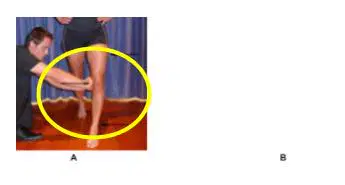
Which ligament would most likely be injured with this type of MOI?
ACL
MCL
LCL
PCL
Put these steps of "basic" rehab in the correct order
Restablish ROM
Increase Strength
Regain Functional Ability
Return to Sport
Match these signs/symptoms to the correct injury
Pain on medial side of knee
Medial side swelling
Positive Valgus Stress Test
Pain on lateral side of knee
Lateral side swelling
Positive Varus Stress Test
Pop
Immediate Swelling
Unable to bear weight
Positive Lachman Test
Tenderness behind the knee
Positive Posterior Drawer Test
Mild swelling behind knee
Which of these mechanisms could result in a torn PCL?
Valgus Force
Valgus force with external rotation
Hyperextension
Hyperflexion with knee at 90 degrees
How long can a person expect to be out after ACL surgery?
4-6 days
4-6 weeks
4-6 months
4-6 years
Match the MOI to the injury it typically causes
Cutting or Squatting
Meniscal Tear
Sudden ior forceful knee flexion
Quad Strain
Rotation with knee extended
Patella Dislocation
Sudden or rapid growth spurt
Osgood Schlatters
Repeated running and jumping
Patellar Tendinitis
A common overuse injury among females is (a) whereas males are more likely to have (b) .
Injuries to ACL will most likely have (a) swelling while injuries to the meniscus usually hav (b) d

