
 Worksheets
26-52
Total questions: 114
Worksheet time: 57mins
What is the ratio of the paths traveled by the body for 2 s and 3 s after the beginning of its free fall? (Initial speed V₀=0, air resistance is disregarded).
(2)1/2:(3)1/2
4;9
3;5
1;5
2;3
What characterizes the normal acceleration a^n?
Velocity change during curvilinear motion in magnitude.
Change angular velocity.
Change of speed during linear motion.
Change of speed in direction during curvilinear movement.
>Average acceleration
Specify the nature of movement of the material point if a^n=const a^t=0
Uniform rectilinear.
Uniformly accelerated around the circle.
>Uniformly accelerated rectilinear.
Uniform around the circumference.
Nonuniform.

I.2, II.3, III.1, IV.4,
I.1, II.2, III.3, IV.4
I.3, II.2, III.3, IV.1
I.4, II.1, III.2, IV.3
I.1, II.4, III.2, IV.3
The body moves around the circle of radius R. Determine the modulus of the vector of movement after a quarter period after the beginning of movement.
2R
R
0.5R
(2)1/2R
4R
Specify the formula of the module of total acceleration when a point moves around a circle:
a= 2S/t2
W= dф/dt
а=W2R
a=(a^2+an^2)1/2
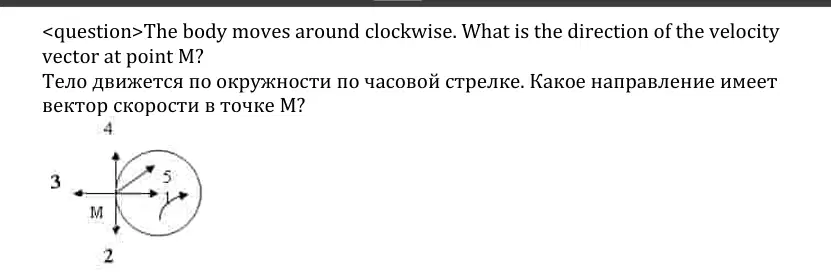
1
2
3
4
5
>At a distance R /2 from the edge of the rotating disk with the angular speed W1 is the body. How will the angular velocity of the body change if you move it to the edge of the disc?
>will not change;
will increase 4 times;
will decrease by 4 times;
will increase by 2 times;
will decrease by 2 times.
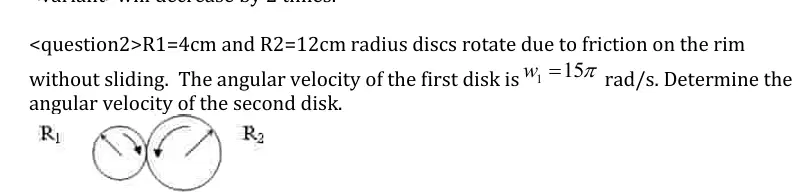
3п
5п
6п
8п
12п
The stone is thrown vertically upwards at a speed of 10 m/s. At what height will the kinetic energy of the stone be equal to the potential? Air resistance to be neglected. (g=10 m/s^2)
5m
10m
20m
30m
40m
The body suspended on the rope moves down with acceleration "a". What is the ratio between free fall acceleration "g" and "a" when the rope tension equals to zero?
a>g
a<g
a=g
a/g=2
a>>g
>In what systems are the laws of Newton not valid?
In systems moving rectilinearly and uniformly
In inertial reference systems.
In systems at rest.
In a reference system associated with a body moving with acceleration
Always valid
A body has kinetic energy Ek=100DJ and momentum P=40kgm/s . What is the body mass?
1kg
2kg
4kg
8kg
16kg
Using the law of universal gravitation, find the unit of measurement for the gravitational constant.
H*kg/m^2
m/s^2
H*m^2/kg^2
H*m/kg
H * m/s^2
>Тhe work done is negative if the angle between the force and displacement vectors is equal to:
a=30*
a=0*
a=60*
a=90*
a=180*
What relationship exists between the work done by the force and the change in the speed of the body, if V1 and V2 are the magnitudes of the velocity vectors at the beginning and end of the path?
A=mV1^2/2-mV2^2/2
A=mV2^2/2-mV1^2/2
A=mV^2/2
A=F*s
A=F*S*cosa
Under what condition does a force applied to a moving body do no work?
When force and displacement are directed in the same direction.
If a body moves under the influence of force, then work is always done
When force and displacement are mutually perpendicular.
Work does not depend on force
When force and displacement have opposite directions
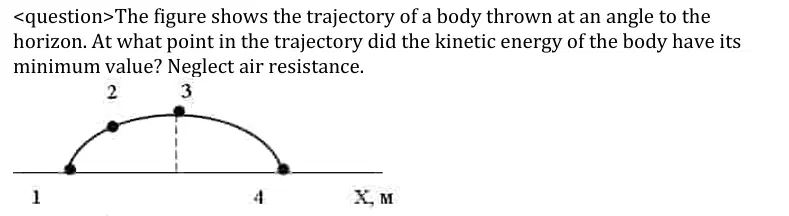
1
2
3
4
is the same at all points
Determine the force under which a body weighing 500 kg moves along a straight section of path if the equation of motion has the form: S=3t+0.4t^2(m)
80N
160N
320N
400N
100N
The movement of a material point is described by the equation: x=5-8t+4t^2. Taking its mass equal to 2 kg, find the momentum after 2s
>8 kg∙m/s
20 kg∙m/s
15 kg∙m/s
2 kg∙m/s
16 kg∙m/s
What is the work of gravity performed on an artificial Earth satellite weighing 100 kg, moving in a circular orbit of radius 7000 km at a speed of 7 km/s, for one full revolution?
700J
49000J
100J
7000J
0J
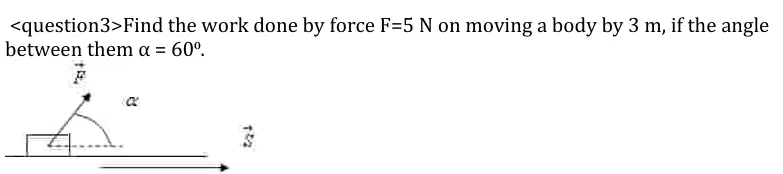
A=0
A=7.5J
A=15J
A=12.9J
A=25.8J
Given that the mass of the Moon is 81 times less than the mass of the Earth, find the ratio of the gravitational force F₁ acting on the Earth from the Moon to the force F₂ acting on the Moon from the Earth.
9
3
81
1
1/9
A bullet of mass m2=5g flies out of a gun m1=5kg . with a speed of V2=600m/s.Find the recoil speed of the gun.
1.6m/s
6m/s
3m/s
1m/s
0.6m/s
>Which of the following expressions corresponds to the law of conservation of mechanical energy?
A=mV2^2/2-mV1^2/2
m1V1+m2V2=,1V1^1+m2V2^1
A=mgh1-mgh2
Fdt=mV2-mV1
Ek1+Ep1=Ek2+Ep2

P=32kg*m/s
Р=16 kg∙m/s
Р=0
Р=-16 kg∙m/s
Р=-32 kg∙m/s
>Indicate the formula for the kinetic energy of a body during rotational motion.
mv
mv^2/2
Iw^2/2
mgh
mV^2/2+Iw^2/2
Select the formula for the moment of force about point O.
L=[rP]
M=[r*F]
M=F*I
I=mr^2
L=Iw
Determine the moment of inertia of a thin homogeneous rod with a length of 30 cm and a mass of 100 g about an axis perpendicular to the rod and passing through the center of the rod.
1,5∙10^-3 кг∙м^2
1∙10^-3 кг∙м^2
0,75∙10^-3 кг∙м^2
3∙10^-3 кг∙м^2
4,5∙10^-3 кг∙м^2
Give the dynamics equation for rotational motion.
P=mV
F=dP/dt
M=[rF]
M=I*dw/dt
L=Iw
Which of the following formulas expresses Steiner's theorem?
J=mr^2
J=1/12mL^2
J=J0+ma^2
J=1/2mR^2
J=2/5mR^2
Which of the following expressions corresponds to Bernoulli's equation?
v=v0(1-r^2/R)
Q=(p1-p2)пR^4/8пL
pv^2/2+pgh=P=const
F=knlv
Re=pvl/n
elect the characteristics of a turbulent flow: 1) the flow is stationary, 2) thin layers of liquid slide relative to each other, 3) in an ideal liquid, laminar flow remains so at any speed, 4) the friction forces between the layers of a real liquid are small, and the average over the cross section pipes, the flow rate is low, 5) hydrodynamic characteristics (speed, pressure, etc.) change quickly and irregularly over time, 6) layers of moving liquid are intensively mixed.
1,2,3,4;
1.2.3
1.4
5.6
Select the signs of laminar flow: 1) the flow is stationary, 2) thin layers of liquid slide relative to each other, 3) in an ideal liquid, laminar flow remains so at any speed, 4) the friction forces between the layers of a real liquid are small, and the average over the cross section pipes, the flow rate is low, 5) hydrodynamic characteristics (speed, pressure, etc.) change quickly and irregularly over time, 6) layers of moving liquid are intensively mixed.
6
5
1.2.3.4
1.2.3.5.
5.6
>What formula is used to determine the resistance force acting on a ball of radius r and density P1, falling at a constant speed V in a large vessel filled with a viscous liquid with a coefficient of dynamic viscosity n and density P2 ?
4/3пr^3p2g
4/3пr^3p1g
4/3пr^3p2g
6пnrv
4/3пr^3p1a
Indicate the degree of speed of motion in the formula for the force of viscous friction in laminar flow:
v^2
v^(–1)
v
v^(3/2)
(v)1/2
Water flows through a horizontal pipe of variable cross-section. In what section of the pipe will there be minimum pressure?
in the widest part of the pipe
where the extension begins
where the narrowing occurs
in the narrowest part of the pipe
the pressure is the same throughout the pipe
Which of the given equalities represents the jet continuity equation?
V1=V2
S1v1=S2v2
P1=P2
S1=S2
F1=F2
>Liquid flows in a pipe with a variable cross-section. The ratio of the areas of some two sections is equal to S1/S2=5/6. Determine the ratio V1/V2 of fluid velocities in these sections.
5/6
6/5
1/6
1/5
25/36
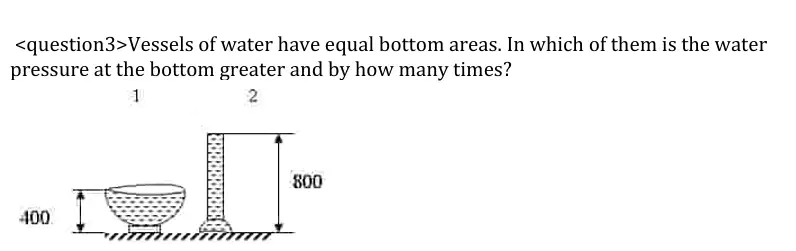
in 1, twice as much
p1=p2
in 1, three times more
in 2, twice as much
five times more
Choose the formula for the rest energy of the body.
E=mc^2
E=m0v
E=mv^2/2
E=m0V^2
E=m0c^2
>A mathematical pendulum makes 30 oscillations per minute. What is the length of the pendulum? П^2 = 9.86; g= 9.86 m/s^2.
0.5m
1m
2m
2.2m
9.86m
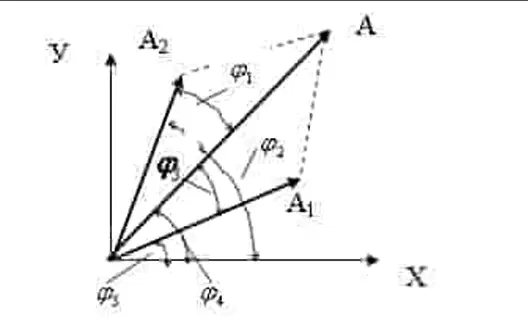
The figure shows a vector diagram of two oscillations. Specify the initial phase of the resulting oscillation.
ф2
ф1
ф3
ф4
ф5
The oscillation equation has the form: X= А coswt, where w=п rad/s. Determine the period of oscillation.
1.5 seconds
2.5seconds
How will the period of oscillation of a mathematical pendulum change if it is moved from the Earth to the Moon? The acceleration of gravity on the Moon is 1.6 m/s^2, and on Earth 9.6 m/s^2.
will decrease by a (6)1/2 factor
will not change.
will increase 6 times
will decrease by 6 times.
will increase by (6)1/2 times
Select the formula for the logarithmic damping decrement:
Q=ln(п/b)
lnx=x0sinwt
b=lnA(t)/A(t+T)
л=ln(vT)
lnw=ln(2п/T)
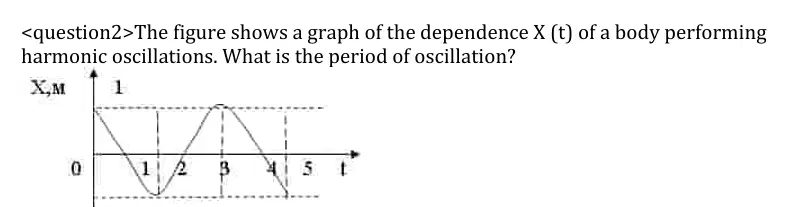
2s
1s
3s
4s
2.5s
>Two identically directed harmonic oscillations of the same period with amplitudes A₁ = 10 cm and A₂ = 6 cm and initial phases ф01 and ф02 add up into one oscillation with amplitude A = 14 cm. Find cos(ф₀₁-ф₀₂) of the added oscillations.
1/3
1/4
1/6
1
1/2
>Determine the displacement from the equilibrium position of a material point performing harmonic oscillations according to the equation:x=0.06cos(п/3t+п/6)
2cm
1cm
(3)1/2/2cm
0.03m
0.06m
Select ultrasonic vibration frequency
20hz
<20000hz
25hz
2000hz
>20000hz
The equation for harmonic vibrations has the form Х = 4sin2пt . What is the period of oscillation?
2s
4s
1s
0.5s
0.25s

п m
72m
1.5m
3m
0m

0.5J
0.2J
2J
0.4J
4J
>The point oscillates with a period equal to П s . What will be the cyclic frequency of oscillations of a given point during resonance under the influence of an external driving force?
2π s^-1
π s^-1
2 s^-1
1 s^-1
4 s^-1

4m
3m
1m
5m
7m
The maximum displacement of an oscillating point from the equilibrium position is called ...
amplitude
frequency
phase
>cyclic frequency
period
The time during which an oscillating point completes one complete oscillation is called...
period
amplitude
frequency
phase
displacement
The phenomenon of a sharp increase in the amplitude of oscillations as the oscillation frequency of the external driving force approaches the frequency of natural oscillations is called...
anharmonic vibrations
resonance
damping oscillations
free vibrations
non-periodic oscillations

1.5s
1s
2s
2.5s
3s
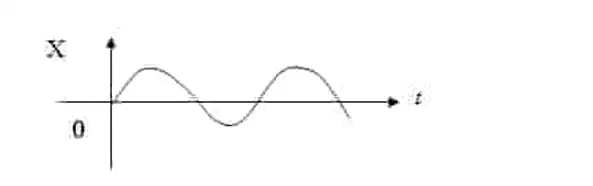
>The figure shows a graph of oscillations of a material point, the equation of which has the form: x = A cos( wt+ф0 ) . What is the initial phase?
п/3
2п/3
2п
п/2
п/6
>How much will the period of oscillation of a physical pendulum change when its mass increases by 4 times?
will decrease by 2 times
will increase 4 times
will increase 2 times
>will decrease by 4 times
will not change
In the process of harmonic oscillations of a body along a straight line, the amplitude of the oscillations is 0.5 m. What is the distance traveled by the body during the period of oscillation?
0,5m
1.5m
1m
0m
2m
>Which of the following answers determines the frequency of oscillation of a mathematical pendulum?
2p(1/g)
2p(g/1)
1/2p(1/g)
(1/g)
1/(1/g)
How much will the phase change during one complete oscillation?
p/2
p
2p
0
4p/3
The equation of harmonic oscillations in differential form has the form:
x/x-W=0
x-w^2x=0
x+w^2x=0
x-w/x^2=0
x=w/x^2=0
Find the period of oscillation of a mathematical pendulum, length 𝓵= 4.9 m and mass m = 13 kg (g = 9.8 m/s^2).
Т=52,4 s
Т=7,2 s
Т=3,2 s
Т=4,4 s
T=13.2s
Oscillation frequency of the wave source ν = 0.2 s^-1, wave propagation speed 10 m/s. What is the wavelengt
2m
0.02m
30m
50m
It is impossible to determine the wavelength based on the conditions of the problem
n the plane wave equation: Z=Z₀cos(t – kx) indicate the wave number.
W
t
Z0
k
x
Determine the depth of the sea under the ship if, when measured using an echo sounder, 6 seconds passed from sending the sound signal to its return. The speed of sound in water is 1500 m/s.
3000m
9000m
4500m
2250m
6000m
The condition that must be met in order for a gas to be considered ideal:
predominance of repulsive forces between gas molecules
small distance between molecules compared to their sizes
negligibly small interaction forces between gas molecules
negligible molecular speeds
predominance of attractive forces between gas molecules
The temperature of 2 g of nitrogen occupying a volume 820 см^3 at a pressure 0,28 МPa (M = 28 g/mol) is equal to:
300k
270k
280k
2*10^5k
3.1*10^4k
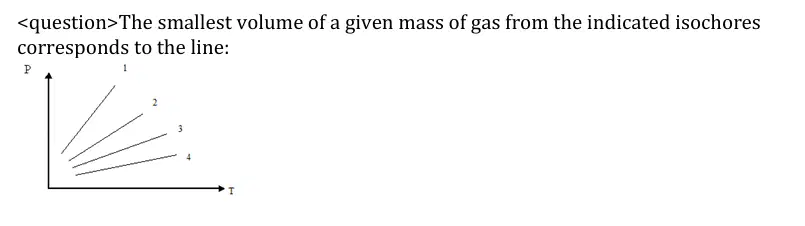
1
2
3
4
T axis
The energy of an ideal gas molecule is:
mechanical
sum of kinetic and potential
kinetic
potential
internal
A container 12 l is filled with nitrogen at pressure 8,1 Mpa and temperature 17°C. The container contains a mass of nitrogen equal to:
1.78kg
2.5kg
1.24kg
1.13kg
2*10^5kg
The number of independent coordinates for determining the position in space of a diatomic molecule is equal to:
three
one
five
six
seven
The density of hydrogen at temperature 15°C and pressure 730 mm Hg is:
0.061kg/m^3
0.07kg/m^3
0.081kg/m^3
0.15kg/m^3
0.7kg/m^3
The largest number of degrees of freedom is:
Ar
He
H2
O2
N2O5
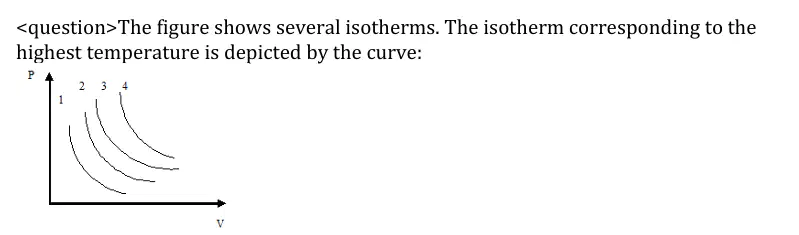
4
1
2
3
V axis

8.5m/s
800m/s
500m/s
400m/s
300m/s
The mean square speed of an oxygen molecule O2 at 20°C is equal to:
600m/s
520m/s
340m/s
440m/s
500m/s
The relationship expressing the mean free path of gas molecules has the form:
I=1/z
z=nv
z=nbd^2v
I=vz
I=1/(2)пd^2n
>Argon molecules under normal conditions experience 6*10^9 collisions per second at an average mean free path 6.35*10^-8. The average speed of translational motion of argon molecules is:
400m/s
381m/s
4*10^5m/s
2*10^3m/s
41*1^3m/s
>The number of degrees of freedom of translational motion of a molecule is equal to:
3
5
6
7
2
>The number of degrees of freedom of a monatomic molecule is equal to:
6
3
7
5
2
The gas is compressed to half its original volume at constant temperature. The average energy of ideal gas molecules relative to the original...
increases 4 times
decreases by 2 times
decreases by 4 times
increases 2 times
does not change
Choose the correct ratio of the average kinetic energies of oxygen and hydrogen molecules at the same temperature:
Eox>Ehyd
Eox<Ehyd
Eox=Egyd
the ratio depends on the mass of the named gases
the ratio can be arbitrary
Which gas has a higher concentration: one mole of oxygen or one mole of hydrogen, if the gases are under normal conditions?
it all depends on the gas pressure
there is not enough data to answer
more for oxygen
more for hydrogen
are the same
Which of the following formulas expresses the Maxwell distribution function for the velocities of gas molecules?
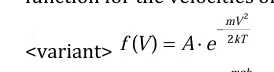

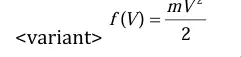
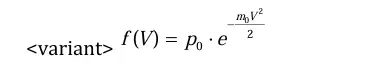

Choose an expression that describes the distribution of air pressure in the Earth's atmosphere.
А=Р·V
F(v)=А· [е^(-mv)]·VdV
Р·V = const
Р= n·к·Т
Р=Рo exp(- mgz/ kT)
At what temperature does thermal motion stop?
-27C
273k
-200C
0C
0k
Select the correct ratio of the root mean square velocities of oxygen (V₁) and hydrogen (V₂) molecules at the same temperature:
V1>V2
V1<V2
V1=V2
the ratio for speeds can be any
mean square velocities of molecules do not depend on temperature
How will the pressure of an ideal gas change if in a given volume the speed of each gas molecule decreases by 2 times, but the concentration of the molecules does not change?
increased 4 times
increased by 2 times
decreased by 2 times
has not changed
decreased by 4 times
How will the concentration of molecules of a gas with an initial temperature of 300 K and an initial pressure of 100 kPa change if the gas is isobarically cooled to -1230°C?
will decrease by 2 times
will increase by 4 times
will increase 2 times
will decrease by 4 times
will not change
Which of the following values corresponds to the order of magnitude of the molecular mass of an element or compound?
10^-27 kg
10^-6 kg
10^-16 kg
10^-10 kg
10^27 kg
The concept of “ideal gas” is used in molecular physics. This concept is applicable when …. can be neglected (choose the most complete and accurate answer)
particle speed
particle mass
kinetic energy of particles
potential energy of particle interaction
potential energy of interaction of particles and their sizes
>Oxygen weighing 0.1 kg occupies a volume of 200 liters at a temperature of 200 K. What pressure does this state of gas correspond to?
Р=26 kPa
Р=0,26 mPa
Р=2,66 kPa
Р=0 Pa
Р=390 kPa
>What happens to the pressure of a gas when the root mean square speed of its molecules decreases?
pressure does not depend on speed
pressure does not change
pressure increases
pressure decreases
will increase threefold
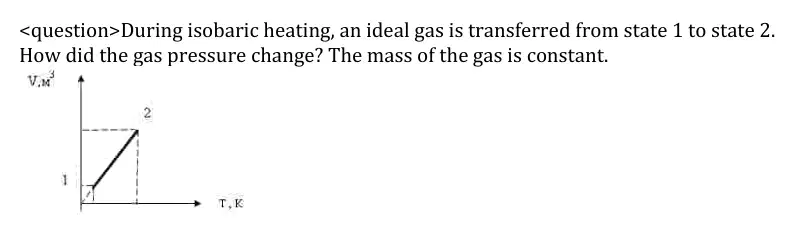
How will the density of an ideal gas change when it is cooled isobarically?
there is not enough data to answer the question
decrease
will increase
can change in any way
won't change
The mass of hydrogen gas in the vessel is 4 g. Approximately how many hydrogen molecules are in the vessel?
10^23
4*10^23
12*10^23
2*10^-23
10^-23
How will the root mean square speed of nitrogen molecules change if the temperature of the gas increases 4 times?
will not change
>will decrease by 2 times
will increase 4 times
will decrease by 4 time
will increase 2 times
What causes Brownian motion?
thermal movement of liquid particles
collision of liquid (or gas) molecules with each other
collision of molecules of a liquid (or gas) with particles suspended in it
collision of particles suspended in a liquid (or gas)
none of the above reasons
A vessel with a capacity of 0.83 m^3 contains helium. Gas mass 0.16 kg. At what temperature does helium exert a pressure of 60 kPa on the walls of the vessel?
Т=300⁰С
Т= 300К
Т=150⁰С
Т= 150 К
Т= 2,4•10^3 К
Estimate approximately the mass of 1 m^3 of air at normal atmospheric pressure and temperature 300 K. Select from the values below the closest to the result you obtained.
1kg
1g
10g
100g
10kg
>If a gas is under normal conditions, then its pressure and temperature are equal:
Р= 1 atm, temperature could be any
Р=10^5 Pa, Т= 0 К
Р= 0 Pa, t=0⁰ C
Р= 0, Т= 273 К
Р= 100 kPa, Т= 273 К
The mean square speed of molecules of a certain gas in the first vessel is 3 times greater than the mean square speed of molecules of the same gas in the second vessel. What is the ratio of gas densities in the first and second vessels if the gas pressure is the same?
1/3
1/9
3
1
3
How many degrees of freedom does a diatomic gas molecule have?
i=3
i=5
i=6
i=7
could be any
When an ideal gas was heated, the mean square speed of thermal motion of molecules increased 4 times. How did the absolute temperature of the gas change?
increased 12 times
increased 16 times
increased 2 times
increased 4 times
increased 8 times
Which of the following formulas is the basic equation of the molecular kinetic theory of an ideal gas?



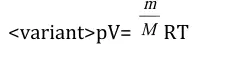
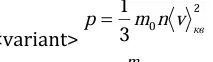
increased.
there may be different answers for different gases.
you need to know the mass of the gas.
decreased.
has not changed.
The internal energy of a gas consists of Eₖ - the total kinetic energy of the molecules and Eₚ - the potential energy of their interaction. At what ratio between Eₖ and Eₚ can the state of a gas be described by the Mendeleev-Claiperon equation?
Eₖ> 0 and Eₚ >0
Eₖ≠0, Eₚ =0
Eₖ =0, Eₚ≠0
Eₖ = Eₚ
Eₖ=0 and EₚП<0
Determine the number of degrees of freedom of oxygen molecules (O₂).
9
5
3
6
1
What formula is used to determine the average number of collisions of a molecule in 1 s?
N/Na
3/2kT
m/m0
m/M
V/L
Give the adiabatic equation.
рV =RT
рV=const
р/V=const
рV^y =const
V/T=const
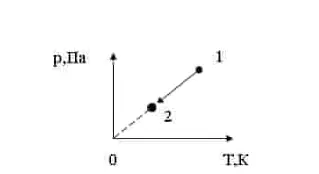
The graph shows the process of cooling a given mass of gas from T₁ to T₂. How did the gas density change in this process?
has not changed
increased twice
increased
decreased
halved

