
Font size
 Worksheets
Robotics Quiz
Total questions: 98
Worksheet time: 49mins
Which of the following is a key feature that robots have in common with living systems?
Ability to simulate digital inputs and outputs
Ability to sense, compute, and act
Ability to store large amounts of data
Ability to fly
What is an embedded system?
A system that is only used for entertainment
A system that is built into a larger device to perform specific functions
A system that can only be used in computers
A system that is always visible and separate from other devices
Which part of a robot is responsible for movement?
Microcontroller
Actuator
Input module
Frame
What do robotics engineers/designers do?
Design and build robots for various applications
Write stories about robots
Teach robots how to speak
Paint pictures of robots
Which module in an embedded system receives information from the environment?
Output module
Input module
Control system
Actuator
Which of the following is NOT a type of actuator used in robots?
DC motor
Servo motor
Input module
Speed controller
Why is it important to investigate the appropriate use of sensors for a specific system?
To ensure the robot can sense and respond to its environment correctly
To make the robot look more realistic
To increase the robot's weight
To reduce the robot's cost
Which of the following is a simple procedure related to robotics?
Simulating digital inputs and outputs in an embedded system
Writing a novel about robots
Painting a robot
Making a robot out of clay
What is the role of actuators in controlling robots?
They help robots move and perform actions
They store information
They provide energy to the robot
They make robots look attractive
Which of the following is a task that robots use data to carry out?
Painting a picture without any instructions
Carrying out a task using collected data from sensors
Sleeping during the day
Reading a book aloud
What is an example of an automated solution in robotics?
Manually moving a robot
Using a flowchart to control a robot’s actions
Ignoring sensor data
Turning off the robot
Which programming construct is used to control a robot?
Poem
Flowchart
Painting
Song
What is the purpose of building a robot using the RC car robotics kit?
To create a piece of art
To build a robot that can be programmed to move
To write a story
To play music
Which of the following best describes an ethical AI decision?
A decision made without considering data
A decision that is fair and unbiased
A decision based on incomplete information
A decision that ignores safety
What should you do when encountering AI-generated content?
Share it without checking
Discuss safe and responsible practices
Ignore it completely
Assume it is always true
How can AI generate false media?
By creating real events only
By generating false text, images, or videos
By ignoring all data
By deleting information
Why is it important to analyse real-world cases of AI outcomes?
To ignore mistakes
To understand how biased or incomplete data can lead to unethical results
To make AI decisions without evidence
To avoid using AI
What does programming the actions of a robot in response to sensory input involve?
Ignoring sensor data
Making the robot move based on sensor information
Turning off the robot
Painting the robot
Which of the following is NOT a step in building a robot using the RC car kit?
Assembling the kit
Programming robot movements
Writing a poem about robots
Using algorithms and flowcharts
Which of the following is a reason why rules and regulations are needed to guide AI behaviour?
To ensure AI systems operate safely and ethically.
To make AI systems faster.
To reduce the cost of AI development.
To make AI systems more entertaining.
What is one risk of sharing personal information with AI systems?
Loss of privacy.
Improved internet speed.
Better video quality.
More accurate weather forecasts.
Which term refers to the process of testing how well a robot performs its tasks?
Performance testing
Programming
Self-reflection
Planning
What is the main purpose of a systems development lifecycle in a project?
To organize and manage the stages of creating a system.
To play games with robots.
To decorate the classroom.
To increase the number of students.
Who is responsible for the decisions and outcomes produced by AI systems?
The people who design and use the AI systems.
The robots themselves.
The computers only.
The internet service providers.
Which of the following is an example of a robot action in response to sensory input?
Obstacle avoidance
Painting a picture
Writing an essay
Singing a song
What should students do after completing a project to improve their future performance?
Evaluate the project and reflect on individual performance.
Ignore the results.
Start a new project immediately.
Ask someone else to do the evaluation.
Why is it important to identify the requirements for a project before starting?
To ensure the project meets its goals and runs smoothly.
To make the project more expensive.
To finish the project faster.
To avoid using any technology.
Which of the following is NOT included in the scope and sequence schedule of Term 2?
The midterm break week for students
Regular teaching weeks
The last two weeks allocated for Group A School-Based Summative Assessment (SSA)
Holiday weeks
According to the Student Assessment Policy Guide, what is required during the SSA week(s)?
Students can skip classes
Teaching period timetable is not fulfilled
Full student attendance is mandatory
Only teachers need to attend
Which topics are supported by the Grade 6 Computing, Creative Design and Innovation Scheme of Work?
Embedded Systems, Algorithms and Programming, Data and Analysis
Biology, Chemistry, Physics
History, Geography, Economics
Art, Music, Physical Education
What is one purpose of the Grade 6 Scheme of Work guide?
To provide structured and detailed learning objectives
To teach only mathematics
To focus on sports activities
To ignore curriculum standards
How does the guide ensure consistency and alignment with curriculum standards?
By integrating best practices for differentiated instruction, inclusive education, and adaptive learning
By removing all assessment criteria
By focusing only on one subject
By excluding real-world applications
Why are targeted intervention strategies included in the guide?
To support mastery learning
To reduce student participation
To limit teacher involvement
To avoid real-world applications
Which of the following is a function of a microcontroller in an embedded system?
To control input and output components
To provide internet access
To store large amounts of data
To display graphics
What is one thing that humans have which robots could never possess?
Ability to process data
Human characteristics
Sensors
Actuators
Which component is used to control the movement and speed of a robot?
Sensor
Actuator
Display
Battery
What is the role of sensors in robots?
To provide power
To predict robot behavior based on readings
To store information
To create movement
Which software is mentioned as a resource for learning robotics in this unit?
Photoshop
Ardublockly
Excel
PowerPoint
Why is it important to select the right sensor for a robotic system?
To make the robot look attractive
To ensure the robot functions correctly in different situations
To increase the robot's speed
To reduce the robot's size
How do students learn about robotics and automated systems according to the pedagogical considerations?
By memorizing facts
By understanding how sensors, actuators, and controllers work together
By watching movies
By drawing robots
Which hardware is listed as a resource for this unit?
Maker with Expansion Shield
Raspberry Pi
Laptop
Smartphone
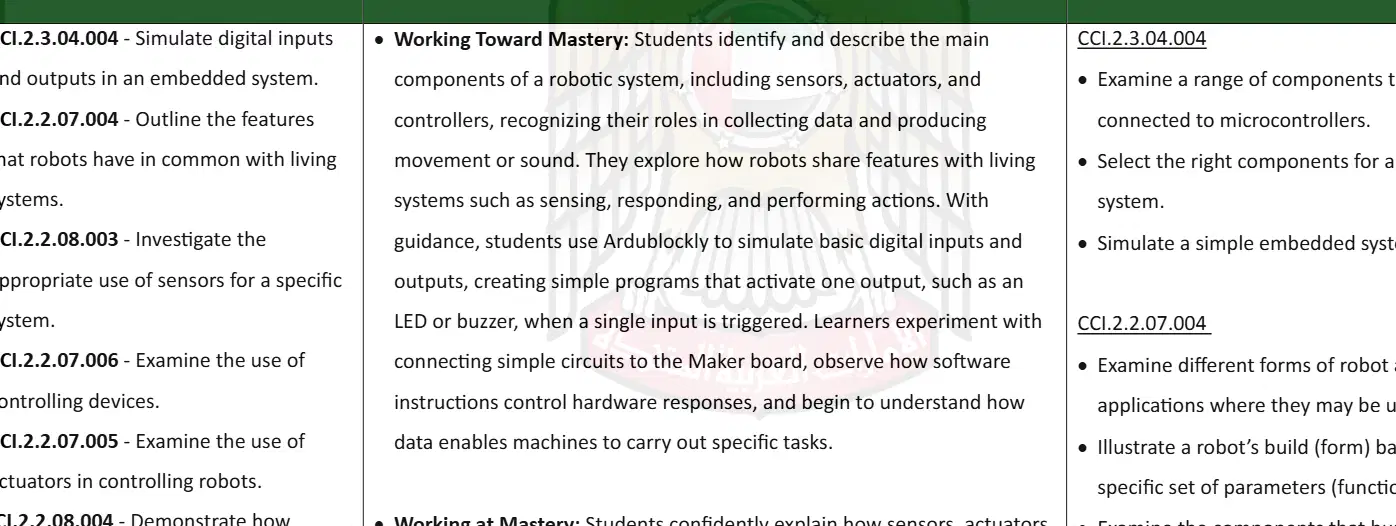
Which of the following is a feature that robots have in common with living systems?
Ability to sense and respond
Ability to eat food
Ability to sleep
Ability to grow plants

What is the main purpose of using sensors in a robotic system?
To decorate the robot
To sense and respond to the environment
To make the robot heavier
To store data
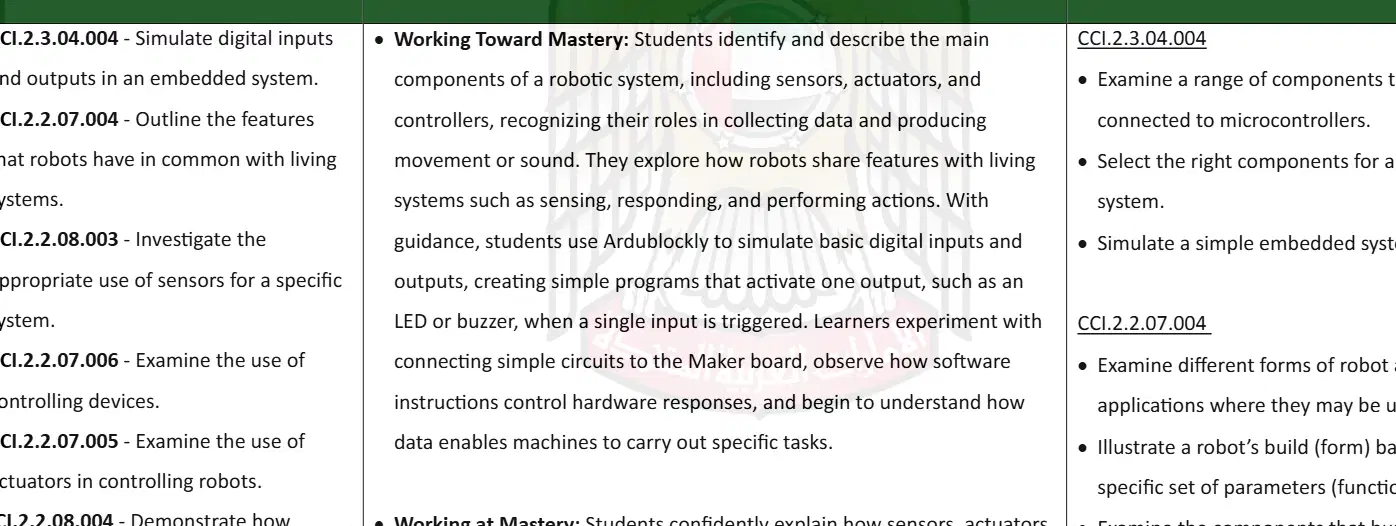
Which device is used to control robotic movement and responses in the activities described?
Maker board and Expansion Shield
Television remote
Smartphone
Calculator
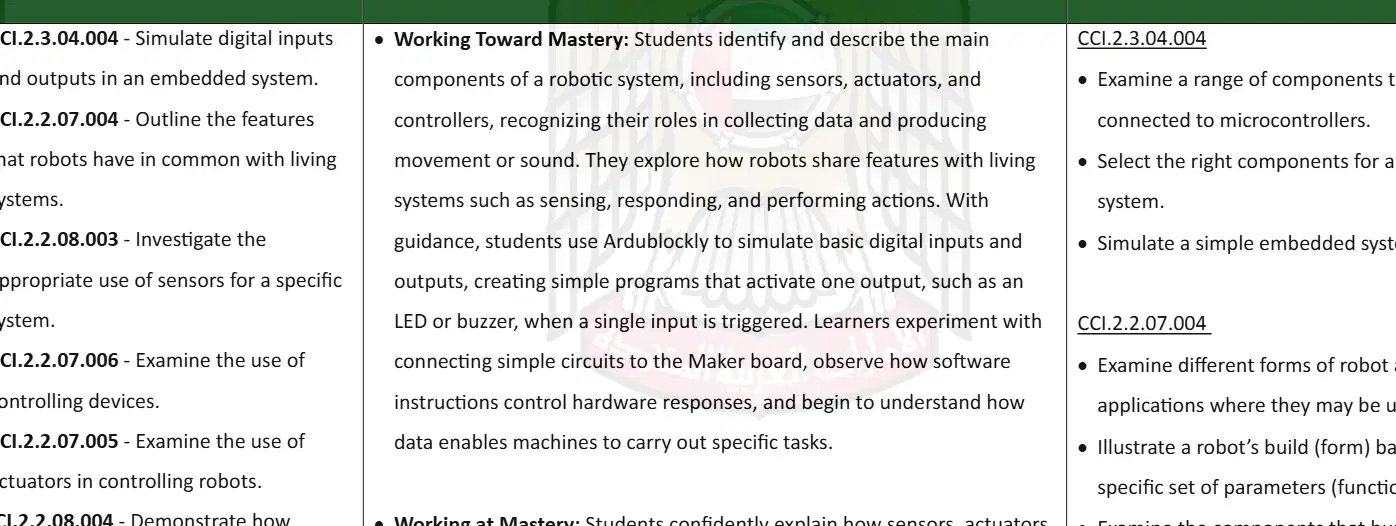
What is the role of actuators in a robotic system?
To produce movement or sound
To store information
To display images
To connect to the internet
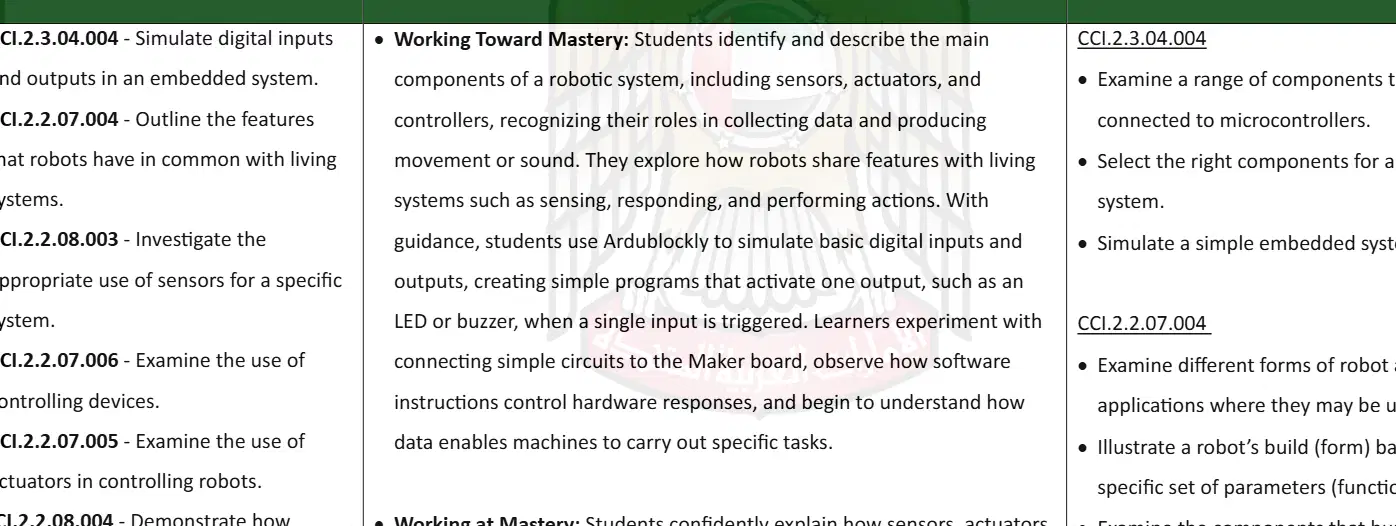
Which programming tool is mentioned for controlling robot movement and responses?
Ardublockly
Photoshop
Excel
PowerPoint
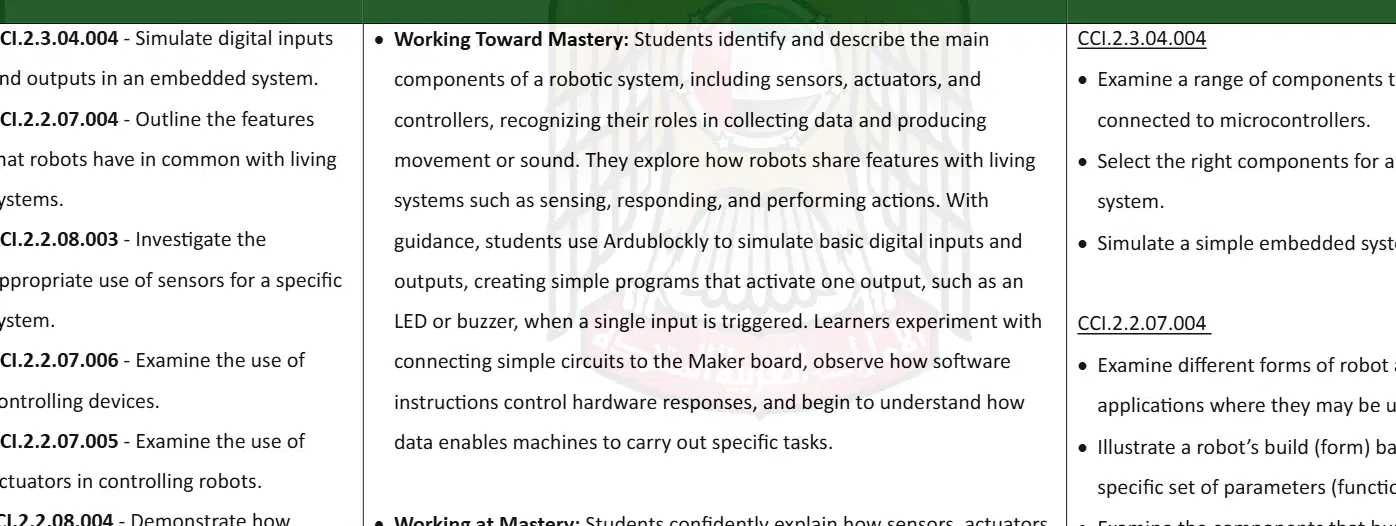
Why do students experiment with connecting simple circuits to the Maker board?
To observe how software instructions control hardware responses
To make the robot look colorful
To increase the robot's weight
To play music
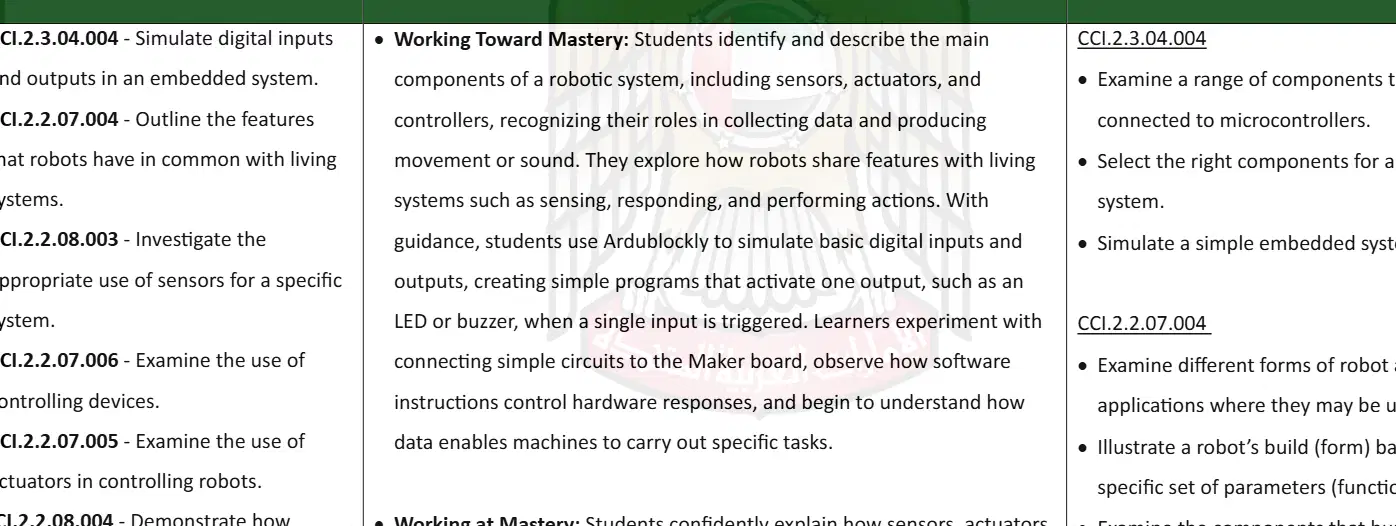
Which of the following is NOT a component that can be connected to microcontrollers in a robotic system?
DC motors
Servo motors
Plants
Sensors
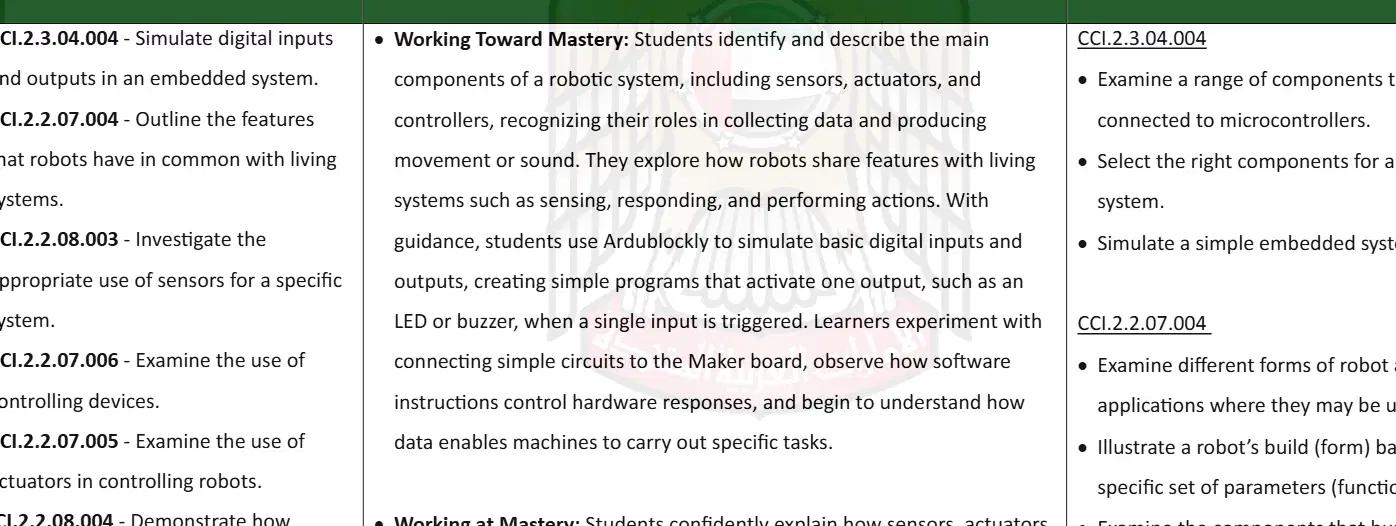
What is one example of a simple program students might create using Ardublockly?
Activating an LED or buzzer when a single input is triggered
Drawing pictures on paper
Sending emails
Browsing the internet
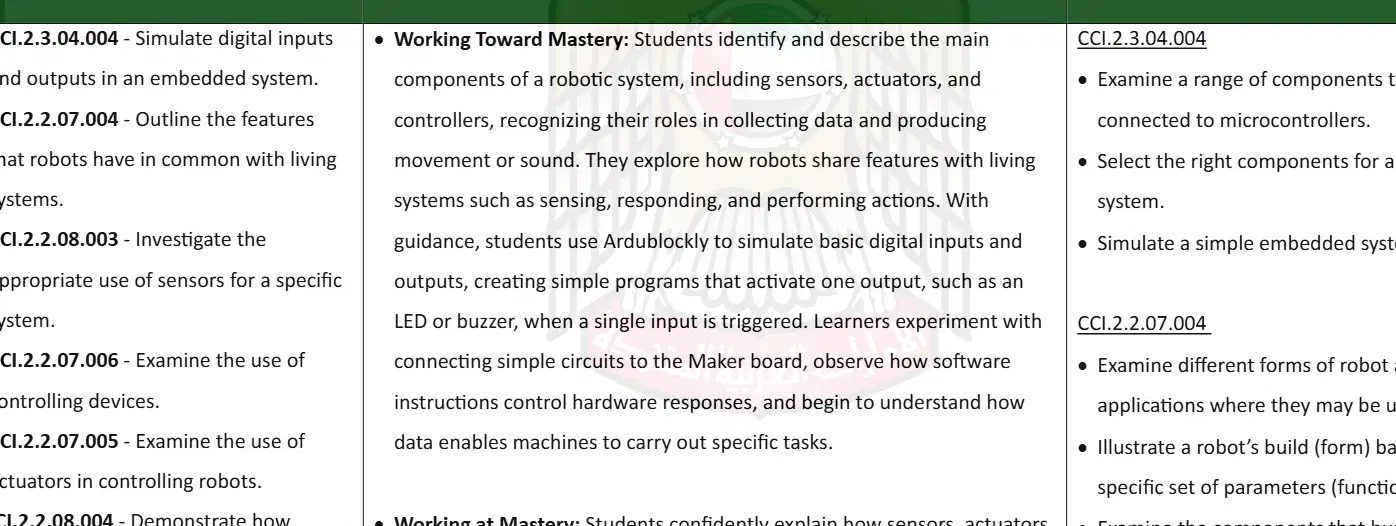
Which of the following is a task that demonstrates how machines use data to carry out a task?
Responding to light or detecting obstacles
Painting a wall
Cooking food
Reading a book
What is one way robots and humans can cooperate, as mentioned in the document?
Mimicking cooperative behavior in living systems
Competing in sports
Singing together
Traveling to space
Which of the following is an example of an advanced actuator control in robotics?
Programming variable motor speeds
Changing robot color
Adjusting robot height
Turning robot on and off
What is the main purpose of integrating multiple sensors and actuators in a robotic system?
To perform coordinated actions
To make the robot look attractive
To reduce the robot's size
To increase the robot's weight
Which tool is mentioned for simulating and optimizing digital inputs and outputs before implementation in robotics?
Ardublockly
Scratch
Python
Excel
How do students demonstrate creativity and problem-solving in robotics according to the material?
By designing innovative robotic solutions that use automation to address practical challenges
By copying existing robot designs
By ignoring technical and ethical awareness
By focusing only on speed
What should students do to test code efficiency and improve timing, control, and accuracy in robotics?
Simulate and optimize digital inputs and outputs before implementation
Ignore sensor data
Focus only on hardware
Avoid using software commands
Which of the following is NOT a task listed under CCI.2.2.08.003?
Develop electronic circuit to control a robot using a microcontroller board
Choose the right sensor for the robotic system
Predict the behaviour of the robot based on the sensor readings
Examine the sensor for different situations
What is one way students can assess how data collected from sensors influences robotic behaviour?
By analyzing sensor data in real-world applications
By ignoring sensor data
By only using manual controls
By focusing on robot appearance
Which of the following is a similarity that students analyze between robotic and living systems?
How robots can mimic human and animal functions
How robots can change color
How robots can fly
How robots can speak different languages
What is one ethical consideration students should keep in mind when designing robotic solutions?
Presenting and justifying their design decisions with technical and ethical awareness
Ignoring safety rules
Focusing only on cost
Copying other designs without permission
Which of the following is a skill students should demonstrate according to CCI.2.2.07.006?
Demonstrate how to integrate electronics devices with microcontroller boards
Discuss the types of actuators used in a range of situations
Explain how DC motors work
Choose the right sensor for the robotic system
Which of the following is a main component of robotic systems?
Sensors
Wheels
Paint
Batteries
What is the primary function of actuators in a robotic system?
Convert electrical energy into mechanical motion
Store data
Sense environmental changes
Display images
How do robots differ from living organisms in responding to stimuli?
Robots use sensors and actuators, while living organisms use biological senses and muscles
Robots use only sensors, while living organisms use only muscles
Robots do not respond to stimuli
Living organisms do not process information
Why is it important to ensure proper polarity and circuit layout when integrating sensors and actuators?
To prevent damage and ensure correct operation
To make the robot look better
To increase the robot's speed
To reduce the robot's size
Which activity involves simulating actions such as a light turning on or a buzzer sounding when a condition is met?
Introducing digital inputs and outputs through Ardublockly
Painting the robot
Charging the robot's battery
Programming the robot to dance
How can students test how different sensor inputs affect system response in robotic systems?
By building and simulating simple robotic systems like automatic lights or motion detectors
By drawing pictures of robots
By reading about robots in books
By watching robot movies
What is the purpose of collecting and processing data from sensors in robots?
To help machines use data to make decisions
To decorate the robot
To make the robot heavier
To slow down the robot
If you wanted to match different types of sensors and actuators, which activity would you use?
Classification and matching exercises
Painting exercises
Speed tests
Battery replacement
Why is it important to compare robots to living organisms when learning about sensors and actuators?
To understand how both sense, process, and respond to stimuli
To learn how to build robots faster
To make robots look like animals
To teach robots to eat food
How do DC and servo motors contribute to robotic systems?
They convert electrical energy into mechanical motion
They store information
They sense temperature
They display images
Which of the following is a function of sensors in a robotic system?
Collect input data
Perform physical actions
Store information
Display images
What is one way robots are used in the field of healthcare?
Painting pictures
Assisting in surgeries
Playing music
Writing stories
Which component in a robotic system performs actions based on input from sensors?
Actuator
Battery
Display screen
Speaker
Why is it important to select appropriate sensors for different environments or purposes in robotics?
To ensure robots can perform tasks effectively
To make robots look more attractive
To reduce the cost of robots
To increase the size of robots
How do students use Ardublockly in learning about robotics?
To simulate digital inputs and outputs
To draw pictures of robots
To write stories about robots
To build robot costumes
What is the relationship between inputs, processing, and outputs in a robotic system?
Inputs provide data, processing interprets it, and outputs perform actions
Inputs create music, processing stores it, and outputs play it
Inputs display images, processing changes colors, and outputs print pictures
Inputs write text, processing erases it, and outputs delete files
If a student is testing sensors for light detection and distance measurement, which skill are they practicing?
Identifying suitable sensors for specific purposes
Building a robot from scratch
Writing a story about robots
Painting a robot
What is a key trait shared by both robots and living organisms?
Sensing and responding to the environment
Ability to fly
Ability to write books
Ability to cook food
How can students demonstrate the use of Ardublockly code in robotic systems?
By making LEDs or buzzers respond to virtual input triggers
By drawing pictures of robots
By writing poems about robots
By building robot costumes
When integrating sensors and actuators with the Maker board, what kind of tasks can students design systems to perform?
Following a line or detecting obstacles
Writing stories
Painting pictures
Singing songs
Which component is used to control the direction and speed of DC motors and servo motors in robotics?
Actuator
Resistor
Capacitor
Transformer
What is an example of a machine using sensor data to make decisions?
Activating a light when darkness is detected
Turning a fan on manually
Using a remote to change TV channels
Writing code without sensors
What do students refine and troubleshoot to adjust delays, loops, and conditionals for desired behaviors?
Ardublockly code
Circuit board
Battery pack
Mechanical gears
Why do students analyse how robots mimic living systems?
To compare cooperative or responsive behaviours in machines to biological examples
To learn about plant growth
To study weather patterns
To understand computer viruses
How does data-driven automation enhance precision and efficiency in engineering and everyday contexts?
By making decisions based on input data
By ignoring sensor data
By using only manual controls
By reducing the use of technology
Which activity involves students reflecting on the limitations and ethical aspects of robotics?
Activities 2 & 15
Activities 9 & 11
Activities 13 & 14
Activities 10 & 12
What is a key step in building a complex robotic system at mastery level?
Integrating multiple sensors and actuators
Using only one sensor
Avoiding the use of actuators
Ignoring input data
Why do students evaluate the effectiveness of different sensors and actuators for specific environments or tasks?
To justify component selection
To avoid using sensors
To make random choices
To ignore environmental needs
What is the final step for students working at mastery with greater depth in robotics?
Designing and presenting a unique robotic solution using embedded systems
Reading about robotics history
Watching a robotics movie
Writing a report on sensors
Which of the following is a key focus of Unit 3: Robots in Action for Grade 6 students?
Learning how algorithms are used to control robotic systems
Studying ancient history
Practicing creative writing
Learning about plant biology
What is one example of a computer-controlled object mentioned in the unit?
RC car
Bicycle
Television
Microscope
Which software will students use for hands-on programming in this unit?
Ardublockly
Photoshop
Excel
PowerPoint
What is the purpose of using flowcharts in robotic programming according to the unit?
To plan robotic actions before translating them into code
To decorate the robot
To measure the robot’s speed
To record the robot’s temperature
Which of the following is NOT listed as hardware for robotic activities in this unit?
Microscope
DC motors
Servo motors
Wheels
Why is debugging important in robotic programming?
To ensure the code works as expected and correct errors
To make the robot look better
To increase the robot’s size
To change the robot’s color
How does learning about robotics in this unit connect to real-world applications?
By discussing modern innovations and careers in robotics
By learning to cook
By studying poetry
By practicing sports
What is one role of AI in robotics that students will examine?
How AI influences robotic engineering
How AI helps plants grow
How AI creates music
How AI paints pictures

