
 Worksheets
Unit 2 US II Test
Total questions: 70
Worksheet time: 35mins
Name
Class
Date
1.
Full Name
4 lines
2.
All of these are downsides of "Island Hopping in the Pacific except"
a)
it was deadly
b)
it was costly
c)
it could cause resources to be stretched too thin
d)
it broke the Japanese spirit
3.
What event finally brought the United States into World War II?
a)
Sinking of the Lusitania
b)
Japanese attack of Pearl Harbor
c)
the creation of the Atlantic Charter
d)
Americans' horror at the persecution of people by the Nazi's
4.
Over a third of all military equipment made during WWII was manufactured by the
a)
textile industry
b)
aircraft industry
c)
chemical industry
d)
automobile industry
5.
All of these were "big three" leaders of the Yalta Conference except
a)
Winston Churchill
b)
Franklin Delano Roosevelt
c)
Harry S Truman
d)
Joseph Stalin
6.
All of this is true about the Korean War except
a)
it lasted longer than the Vietnam War
b)
it is considered the "forgotten war"
c)
It is the only time America is directly involved with fighting a communist country
d)
It kicked off the Cold War
7.
In the 1950's The wife was the one who typically went to work in the family.
a)
True
b)
False
8.
Doctor Spock wrote a book called Baby and Child Care. It did 'not' sell a lot of copies at that time.
a)
True
b)
False
9.
The post WWII economy was doing well at this time in the United States.
a)
True
b)
False
10.
How much did a gallon of gas in the 1950's cost?
a)
20 cents
b)
30 cents
c)
40 cents
11.
Were Westerns popular on TV during the 1950's?
a)
Yes
b)
Maybe
c)
No
12.
Which 'fad' (regarding movies) was popular during the 'early' 1950's?
a)
3D
b)
Drive-in movies
13.
Peter Pan was one of the popular Disney movies during the 1950's.
a)
True
b)
False
14.
Jazz and Big Band was the highlight of the 1950's musically.
a)
True
b)
False
15.
Who was called the 'king of rock and roll'?
a)
Chuck Berry
b)
Elvis
c)
Option 3
d)
Buddy Holly
16.
President Harry Truman received ____ to go to war against North Korea
a)
Approval from Nato and Congress
b)
Approval from Congress but not NATO
c)
Approval from NATO but not Congress
d)
neither approval from NATO or Congress
17.
McCarthur's advance to the Yalu River in North Korea
a)
caused China to push the US back to the 38th Parallel
b)
caused the Soviet Union to invade North Korea
c)
caused North Korea to surrender
d)
caused the US to withdraw from conflict
18.
All of this is true about the Korean War except
a)
its was expensive
b)
there were over 4 million Korean civilian casualties
c)
it set the precedent that the President can go to war without the approval of Congress
d)
it was a major victory in the fight against communism
19.
South Vietnam originally belonged to the
a)
French
b)
Japanese
c)
Koreans
d)
British
20.
The Vietnam war started during the ____ administration
a)
Kennedy
b)
Johnson
c)
Eisenhower
d)
Nixon
21.
The Gulf of Tonkin Resolution
a)
Allowed Johnson to fight in Vietnam under "any means necessary"
b)
may be based on an event that may not have really happened
c)
may have been a false justification to contain communism
d)
all of the above
22.
The Tet Offensive
a)
Was a major victory for the US
b)
Was a slight defeat for the Vietnamese
c)
cast doubt on the success US Forces had in Vietnam
d)
virtually ended the Vietnamese advances
23.
All of these were reasons Vietnam became unpopular with public opinion except
a)
television coverage showed the brutality of the engagement
b)
it showcased the rich's ability to be differed from serving by going to college
c)
draftee's tended to be from less educated and lower socio-economic statuses than previous wars
d)
people stopped wanting to fight communism
24.
Vietnamization was the practice of
a)
withdrawing American troops and letting the Vietnamese fight
b)
increasing American troops and having the Vietnamese lead the soldiers
c)
increasing Vietnamese spies while decreasing the amount of American Troops
d)
colonizing Vietnam to incorporate it into America
25.
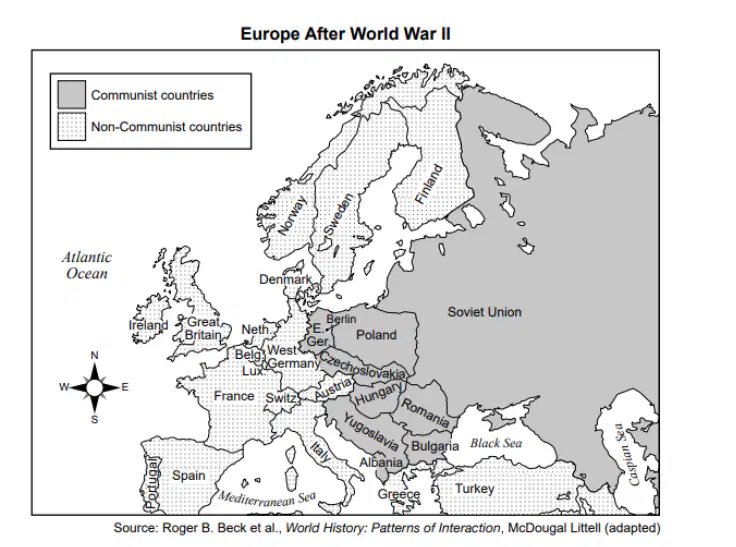
As a result of the situation shown on the map, the foreign policy of the United States during the Administration of of President Harry Truman was dominated by the fact that
a)
communist expansion in Europe should be contained.
b)
scientific cooperation between the U.S. and Soviet Union should be encouraged.
c)
satellite nations of the Soviet Union should not be recognized as legal states.
d)
economic aid was not likely to help nations in Western Europe.
26.
The Korean War pitted the military forces of North Korea and China against
a)
the United Nations
b)
Japan.
c)
the Soviet Union.
d)
the Allied Powers.
27.
The Truman Doctrine resulted in
a)
the rearming of East Germany.
b)
the economic recovery of the Soviet Union.
c)
a pledge to fight communism.
d)
the Red Scare.
28.
The purpose of the Marshall Plan was to
a)
prevent Germany from rearming.
b)
punish Germany for World War II.
c)
help Western Europe recover.
d)
keep Communist countries weak.
29.
When the United States, Britain, and France merged their zones in Germany in 1947, the Soviet Union responded by
a)
organizing a military alliance.
b)
building the Berlin Wall.
c)
blockading West Berlin.
d)
threatening to declare war.
30.
NATO formed for the purpose of
a)
mutual defense against Soviet expansion.
b)
spreading democracy.
c)
settling international economic disputes.
d)
promoting free trade among members.
31.
To prevent Communists from staging revolutions in countries like Guatemala, Eisenhower used
a)
nuclear retaliation.
b)
embargoes.
c)
appeasement.
d)
covert operations.
32.
Due to the Cold War the government spent money on all of these except
a)
Transportation and Roadways
b)
Public Healthcare
c)
Education
d)
Research, Science, and computers
33.
Ethel and Julius Rosenberg were charged with
a)
plotting to overthrow the U.S.
b)
planning acts of terrorism.
c)
being Communist Party members.
d)
passing atomic secrets to the Soviets
34.
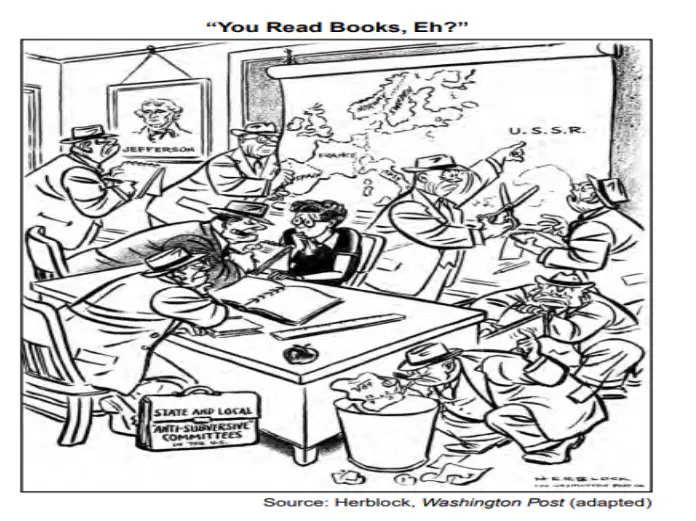
The tactics illustrated in the cartoon were most closely associated with
a)
isolationists supporting neutrality policies during the 1930s.
b)
Congress promoting increased security after the Pearl Harbor attack.
c)
government leaders investigating communist activities after World War II.
d)
increased federal spending for education during the 1960s.
35.
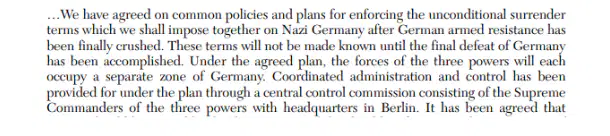
Based on this passage, a major purpose of the Yalta Conference was to
a)
prepare for control of Germany after World War II.
b)
give up demand for a Soviet “zone” in Germany.
c)
prevent Germany’s membership in the United Nations.
d)
offer Germany generous terms of surrender to shorten the war.
36.
The Common objectives Churchill and FDR shared at the Yalta Conference were all of these except.
a)
Russia to return to capitalism
b)
Germany reconstructed as a Democratic Nation
c)
The Soviet Union to play their part in the UN
d)
Russia to strengthen its borders
37.
The Objectives that Stalin wanted for the USSR at the Yalta conference were all of these except
a)
Build Germany as a militarized communist state
b)
The Soviet Union to create a “buffer zone” of countries between Germany and Russia
c)
Maintain Germany as a weakened state
d)
Spheres of influence over Eastern Europe
38.
The Big Three at The Yalta conference decided that Germany would be split into four areas to be rebuilt by all of these countries except
a)
France
b)
The Soviet Union
c)
Italy
d)
England
39.
The German City that is also divided to be rebuilt by the Allies was
a)
Dusseldorf
b)
Nuremburg
c)
Munich
d)
Berlin
40.
The sole reason Russia agreed to help fight against Japan after the Yalta Conference was to
a)
learn and develop plans for a nuclear weapon
b)
gain back land the Russians had lost in the Russo-Japanese war
c)
regain economic control of Asia
d)
move forces into Asia to potentially combat the US
41.
The Percentages agreement did all of these things except
a)
allow Stalin to create a sphere of influence in Eastern Europe
b)
create economic sanctions against Germany
c)
define how much involvement each country should have in other countries affairs
d)
Allow England to create a sphere of influence in Greece
42.
American Critics of the Yalta Conference will say that all of these were issues except
a)
Russia being able to excerpt its influence over Western Asia
b)
not taking advantage of a weakened Soviet Union
c)
England and the United State appeasing Stalin too much
d)
Russia being able to excerpt its influence over Eastern Europe
43.
Critics of FDR could argue that all of these were reasons for Roosevelts weak negotiations at Yalta except
a)
he was near death
b)
he was naive on soviet foreign affairs
c)
he had unreliable military intelligence on the soviets.
d)
he was willing to keep the big three together
44.
By 1944 the War Industry board could create a plane every
a)
5 Weeks
b)
5 minutes
c)
5 Hours
d)
5 Days
45.
During World War II, women were recruited into the military to serve in all of the following areas EXCEPT
a)
administrative roles
b)
nurses
c)
Combat soldiers
d)
Military intelligence
46.
All of these are examples of FDR's Four Freedoms except
a)
Free From want
b)
Freedom of Speech
c)
Freedom of government
d)
Freedom of Worship
47.
All of these are effects of the G.I. bill except
a)
an increase of veteran unemployment
b)
an increase of veterans attaining affordable housing
c)
an increase of veterans attending college
d)
a decrease in veteran unemployment
48.
All of these groups still faced discrimination in America during the war effort except
a)
African Americans
b)
Women
c)
Jewish Immigrants
d)
Mexican Americans
49.
The difference between the Great Migration of the 1920's to the Great Migration of the 1960's was that African Americans were now moving into more ____ cities.
a)
Eastern
b)
Western
c)
Southern
d)
Northern
50.
The "Double V" campaign meant
a)
victory in North Africa and victory in the Pacific
b)
victory over Hitler's racism abroad and victory over racism at home
c)
victory over the Nazi's and victory over the Fascists 3
d)
victory over fascism and communism
51.
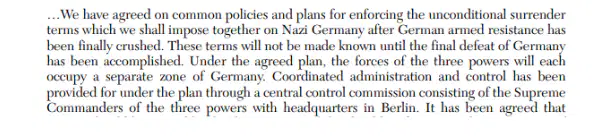
Based on this passage, a major purpose of the Yalta Conference was to
a)
give up demand for a Soviet “zone” in Germany.
b)
prevent Germany’s membership in the United Nations.
c)
offer Germany generous terms of surrender to shorten the war.
d)
prepare for control of Germany after World War II.
52.
By the end of World War II only the US and ___ were powerful enough to manage foreign affairs
a)
France
b)
England
c)
Soviet Union
d)
China
53.
If British and American troops opened a second front by attacking Germany from the West, it would take pressure off the
a)
French
b)
Pacific Fleet
c)
Italians
d)
Soviet Union
54.
The beginning of the end for the Nazi's in Europe is traditionally considered
a)
the Battle of Midway
b)
D-Day
c)
Bastone
d)
Cherbourg
55.
The most famed World War II correspondent for America was
a)
Ernest Hemmingway
b)
Gomer Pyle
c)
Ernie Pyle
d)
Erich Remarque
56.
All of these were true of the Soviet military except
a)
it had over 20 million casualties
b)
they captured Berlin
c)
they fought only in Europe
d)
they used nuclear weapons
57.
The end of the Pacific campaign of World War II came after the nuclear bombing of
a)
Hiroshima
b)
Nagasaki
c)
Tokugawa
d)
Tokyo
58.
The Secret program to develop the atomic bomb was called
a)
The Manhattan Project
b)
The Chicago movement
c)
The New Mexico Case
d)
The Allen Parsons Project
59.
All of these would be arguments for either using or not using the Atomic Bomb except
a)
it would send a message to the Soviets that we had such a weapon
b)
it was efficient
c)
more people died in the two bombings than all Allied forces in the Pacific
d)
it would be the only way to show the emperor of Japan that he needed to surrender
60.
The percentage of civilians that died during World War II was ___ percent
a)
10
b)
20
c)
30
d)
40
61.
The Nuremberg Laws
a)
took citizenship rights away from Jewish Germans.
b)
required all Jewish Germans to move to concentration camps.
c)
required all Jewish Germans to leave the country.
d)
authorized German police to shoot Jewish Germans.
62.
The Nazis’ “final solution” referred to their plans to
a)
defeat France.
b)
conquer Britain.
c)
exterminate Europe’s Jews.
d)
rule Europe after conquering it.
63.
A night of anti-Jewish violence became known as
a)
Anschluss
b)
blitzkrieg.
c)
Gestapo.
d)
Kristallnacht.
64.
In the case Korematsu v. the United States, the Supreme Court ruled that relocation of Japanese Americans was
a)
constitutional, but the government had to pay them for property losses.
b)
unconstitutional, and they had to be released at once.
c)
unconstitutional because it was based on race
d)
constitutional because it was based on military urgency.
65.
Holocaust literally translates to
a)
Arian strength
b)
Jews captured
c)
whole burnt
d)
German purity
66.
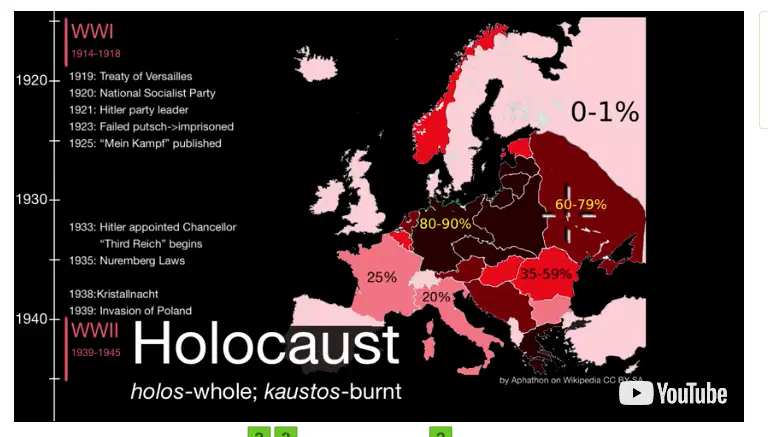
The area under Axis control that had the highest concentration of Jewish population killed was located in
a)
Russia and the Baltic states
b)
France Italy and the Netherlands
c)
Germany, Chekoslovokia, and Poland
d)
Hungary Turkey and Greece
67.
Executive order 9066 allowed the government to detain Japanese Americans in
a)
internment camps
b)
prisons
c)
refugee shelters
d)
military states
68.
The Attack on Pearl Harbor had all of the following effects on America except
a)
Franklin Delano Roosevelt signing Executive Order 9066
b)
Increased surveillance of Nazi sympathizers in the US
c)
an increased suspicion of Japanese Americans by the government
d)
an increase of Japanese Americans joining the war effort
69.
The Central Utah Relocation Center used converted____ as temporary housing for Japanese Americans.
a)
housing developments
b)
Horse Stalls
c)
Hotels
d)
Schoool houses
70.
"No one should ever be locked away simply because they share the same race, ethnicity, or religion as a spy or a terrorist." is a quote from
a)
Paul Robeson on alienation of the film Industry
b)
Dr. Martin Luther King Jr. on segregation in the south
c)
Fred Korematsu on Japanese Internment
d)
Anne Frank on the Holocaust
100 %

