
 Worksheets
Ch. 19 Paralleling Technique
Total questions: 10
Worksheet time: 5mins
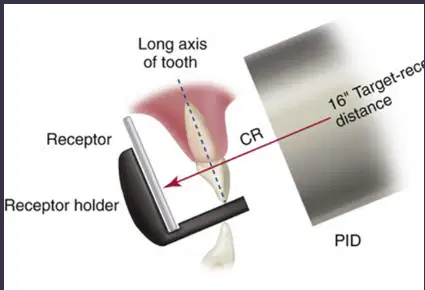
In the paralleling technique, how should the central ray be oriented relative to both the receptor and the tooth’s long axis?
Perpendicular to both structures to reduce elongation
Directed obliquely to match object–receptor distance
Parallel to both structures for minimal distortion
Angled slightly to compensate for magnification
Which device is recommended to decrease patient radiation during intraoral radiography and is shown attached to the tube head?
Rectangular collimator for beam restriction
Circular spacer increasing source distance
Thyroid collar protecting cervical area
Lead apron shielding the torso
In the paralleling technique, what is the primary purpose of beam alignment devices and receptor holders?
Align receptor parallel to tooth long axis
Reduce exposure time by half
Magnify the image for clarity
Stabilize the tube head during sweep
In dental X‑ray paralleling technique, how should the central ray be directed relative to the receptor and the tooth’s long axis to avoid distortion?
Toward the occlusal plane at a shallow angle
Oblique to receptor and tooth long axis
Parallel to receptor and tooth long axis
Perpendicular to receptor and tooth long axis
When capturing posterior teeth with the paralleling technique, which step best helps visualize apices while reducing mandibular floor sensitivity?
Place bite block higher toward occlusal surfaces
Seat bite block low near the floor of mouth
Angle receptor closer to lingual soft tissues
Push receptor against mandibular tori firmly
When compensating for a shallow palate during the paralleling technique, what adjustment best maintains indicator rod parallelism and proper PID alignment?
Rotate the PID to increase horizontal angulation
Lower the bite block and tilt PID slightly
Raise the bite block and angle PID downward
Use a cotton roll to level the bite block
Which simple modification helps manage a low palatal vault during receptor placement?
Use two cotton rolls on each side
Use one cotton roll under the chin
Avoid cotton rolls entirely
Use three cotton rolls behind molars
For shallow palate cases, by how much can vertical angulation be increased to compensate?
Increase by 2 to 4 degrees
Increase by 18 to 25 degrees
Increase by 5 to 15 degrees
Increase by 30 to 40 degrees
What is the primary purpose of adding cotton rolls around the bite-block in shallow palate management?
Prevent receptor fogging from saliva
Stabilize the bite-block against tilting
Increase horizontal angulation consistency
Reduce exposure time needed
If vertical angulation is increased too much in shallow palate situations, which error is most likely?
Elongation of tooth image
Foreshortening of tooth image
Cone-cut artifacts only
Magnification without distortion

