
NEW
Font size
 Worksheets
Nervous System Part Two
Total questions: 31
Worksheet time: 16mins
Visual Processing, Memory of Objects
The Frontal Lobe
The Parietal Lobe
The Occipital Lobe
The 4 Lobes
Walking, Reasoning, Memory, Planning, Decision Making, Verbal Communiation
The 4 lobes
The Parietal Lobe
The Frontal
The Occipital Lobe
Touch, Temp, Visual Spatial Processing, Body positions
The Occipital Lobe
Frontal Lobe
The Parietal Lobe
4 Lobes
What are the 4 lobes?
Frontal
Parietal
Occipital
Temporal
Hypothalamus
thalamus
mid brain
Meninges
cerebrum
cerebellum
meninges
occipital
temporal
mid brain
thalamus
cerebrum
Memory creation + storage, emotions, hearing, organization, sequencing
Temporal Lobe
Frontal Lobe
Parietal Lobe
Occipital Lobe
What is the function of the cerebellum?
Regulates + coordinates posture, movement, balance
Memory creation + storage, emotions, hearing, organization, sequencing
Reasoning, judgement, decision making, planning, self-awareness, personality, language formation, voluntary body movements
Somatosensory (pain, pressure, touch). Creates map of body in relation to space
Thalamus
Regulates secretion of hormones
Temperature, metabolism, blood volume, regulates emotions + feelings of pleasure, controls the pituitary gland.
Relays sensory impulses to cerebral cortex for processing + sorting
Hypothalamus
Temperature, metabolism, blood volume, regulates emotions + feelings of pleasure, controls the pituitary gland.
Regulates secretion of hormones
Relays sensory impulses to cerebral cortex for processing + sorting
Pineal Gland
Relays sensory impulses to cerebral cortex for processing + sorting
Regulates secretion of hormones
Temperature, metabolism, blood volume, regulates emotions + feelings of pleasure, controls the pituitary gland.
Dura mater
Thin, cobweb-like layer
Thin layer containing lots of blood vessels
Thick, tough layer
Arachnoid mater
Thin, cobweb-like layer
Thick, tough layer
Thin layer containing lots of blood vessels
Pia mater
Thick, tough layer
Thin, cobweb-like layer
Thin layer containing lots of blood vessels
What is the function of the cerebrospinal fluid? Where is it created?
Transmits impulses between spinal cord/brain, controls blood pressure, coughing, swallowing, heart rate
It protects the brain from contacting the skull and maintains the blood-brain barrier, which prevents friction and infection and maintains homeostasis. It’s created in the 4 ventricles of the brain.
Made of white matter that links cerebral cortex and cerebellum, controls breathing and carries info from one side of brain to the other
Midbrain
Transmits impulses between spinal cord/brain, controls blood pressure, coughing, swallowing, heart rate
Made of white matter that links cerebral cortex and cerebellum, controls breathing and carries info from one side of brain to the other
Relays info to cerebrum + controls body movement and posture
Pons
Relays info to cerebrum + controls body movement and posture
Made of white matter that links cerebral cortex and cerebellum, controls breathing and carries info from one side of brain to the other
Transmits impulses between spinal cord/brain, controls blood pressure, coughing, swallowing, heart rate
Medulla Oblongata
Relays info to cerebrum + controls body movement and posture
Transmits impulses between spinal cord/brain, controls blood pressure, coughing, swallowing, heart rate
Made of white matter that links cerebral cortex and cerebellum, controls breathing and carries info from one side of brain to the other
Mening-
Brain
Membrane
Brain
Cereb-
Between
Brain
Membrane
Enceph
Brain
Smaller
Between
-ellum
Brain
Brain
Smaller
Infer
Membrane
Between
Brain
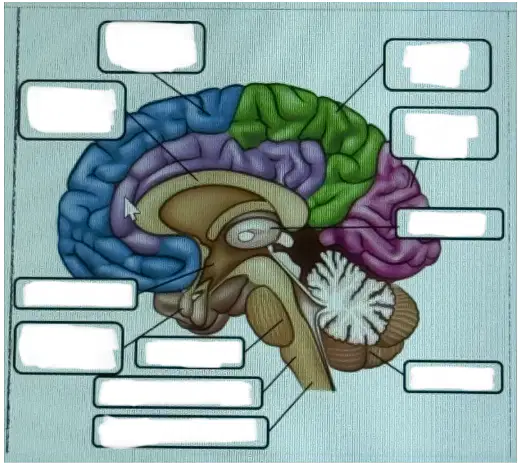
What part of the brain does the green section demonstrate?
Temporal Lobe
Parietal Lobe
Occipital Lobe
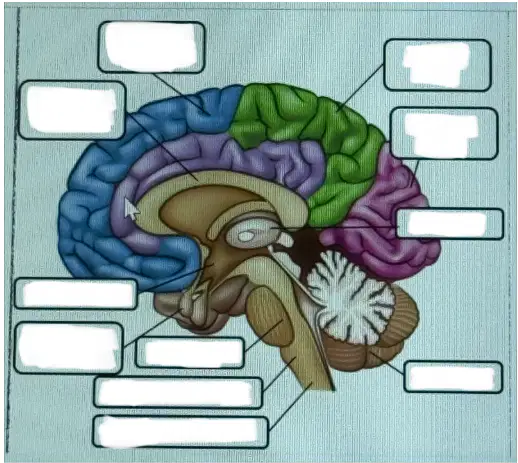
What part of the brain does the blue section demonstrate?
Temporal Lobe
Frontal Lobe
Occipital Lobe
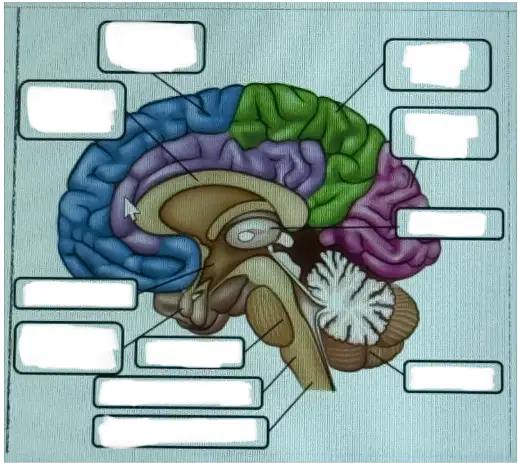
What part of the brain does the pink section demonstrate?
Parietal Lobe
Occipital Lobe
Thalamus
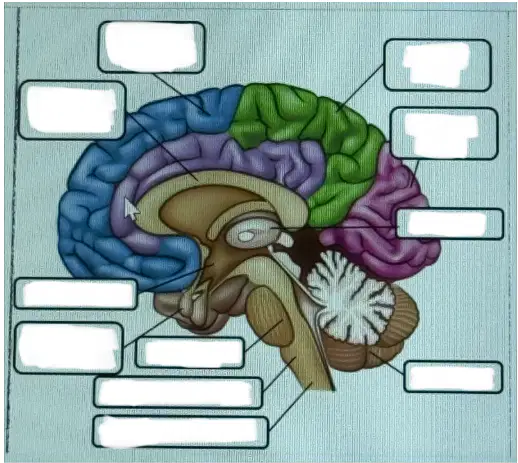
What part of the brain does the purple / tan section demonstrate?
Corpus Callosum
Hypothalamus
Temporal Lobe
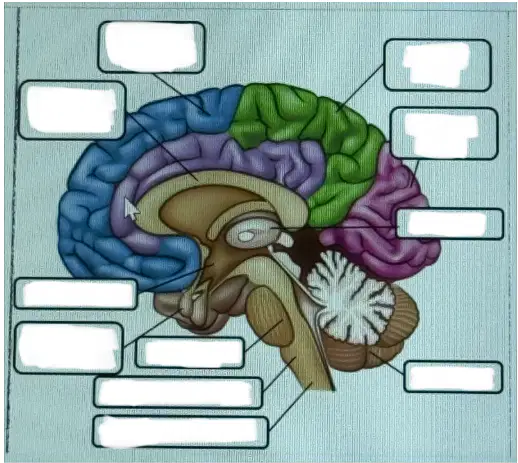
What part of the brain does the center circle demonstrate?
Occipital Lobe
Thalamus
Parietal Lobe
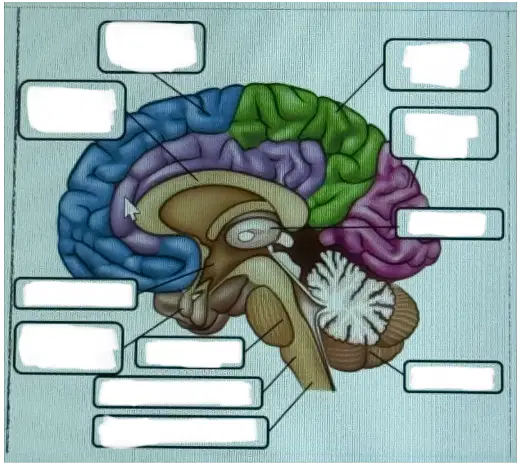
What part of the brain does the balls section demonstrate?
Pituitary Gland
Thalamus
Parietal Lobe

What part of the brain does the second lower circle demonstrate?
Frontal Lobe
Pons
Parietal Lobe

What part of the brain does the before spinal section demonstrate?
Parietal Lobe
Medulla oblongata
Frontal Lobe
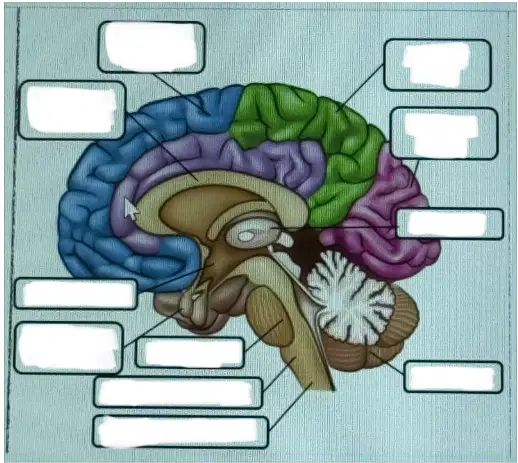
What part of the brain does the long skinny section demonstrate?
Spinal Cord
Thalamus
Frontal Lobe

What part of the brain does brown lower right section demonstrate?
Parietal Lobe
Cerebellum
Thalamus

