
Font size
 Worksheets
TEST: Impact on Global Climate Savvas
Total questions: 15
Worksheet time: 8mins
Global and regional climate is determined by the amount and movement of (a) . While climate can remain stable for long periods of time, scientists have found evidence that different kinds of events can rapidly change the climate. One example is the El Chichón volcanic eruption in the years 539–540 in southern Mexico. The volcano gave off ash and sulfur dioxide . The ash and sulfur dioxide (b) sunlight. (c) sunlight reached Earth’s surface, (d) the climate.
The Gulf Stream moves from near the equator to near Western Europe. The current (a) heat near the equator and then (b) the heat as it goes north. As a result, countries in Western Europe are (c) than other areas at the same latitude. If the Gulf Stream weakens or stops, Western Europe will likely have a (d) climate.
What changes would likely occur if the Gulf Stream stopped flowing? Select two answers.
A new current will bring warm water to western Europe.
The climate in western Europe will cool.
The climate near the equator will warm.
There will be no change in climate.

Each of the following scenarios would have either a cooling or a warming effect on the climate.
Which scenarios would have a cooling effect on the climate? Select the two that apply.
1
2
3
4
A mass extinction event is when many animal species go extinct at once. Mass extinctions have occurred several times in Earth’s history. Climate change is a cause of mass extinctions. One such mass extinction event occurred about 66 million years ago. Scientists found that sedimentary rock layers from this period contain a substance that is found in meteors. Which option best describes how a meteor strike might have affected the global climate?
Huge amounts of dust in the air blocked sunlight and caused the climate to cool.
Huge amounts of dust in the air caused high winds, which caused condensation and increased rainfall.
Huge amounts of dust in the air attracted sunlight and caused the climate to warm.
Events that add or remove carbon dioxide from the atmosphere can change the climate over many years. Scientists have been experimenting with ways to sequester (capture and store) atmospheric carbon dioxide. If scientists succeed in capturing and storing large amounts of carbon dioxide, what effect would it have on Earth’s climate? Select the two that apply.
Sequestering carbon dioxide would reduce global warming because there would be less greenhouse gas in the atmosphere.
Sequestering carbon dioxide would cool the climate because there would be less carbon dioxide to trap heat.
Sequestering carbon dioxide would increase climate change because other gases would increase and trap heat.
Sequestering carbon dioxide would cause the temperature of Earth’s core to heat, increasing the warming of Earth.
Greenhouse gases such as carbon dioxide are released by various human activities, including burning fossil fuels. As the level of these gases in the atmosphere has increased, the global climate has gotten warmer. How do greenhouse gases cause global warming?
Greenhouse gases react together and release heat into the air.
Greenhouse gases reflect the heat from the sun down to Earth.
Greenhouse gases sink down and heat up the surface of the Earth.
Greenhouse gases trap heat and prevent it from moving into space.
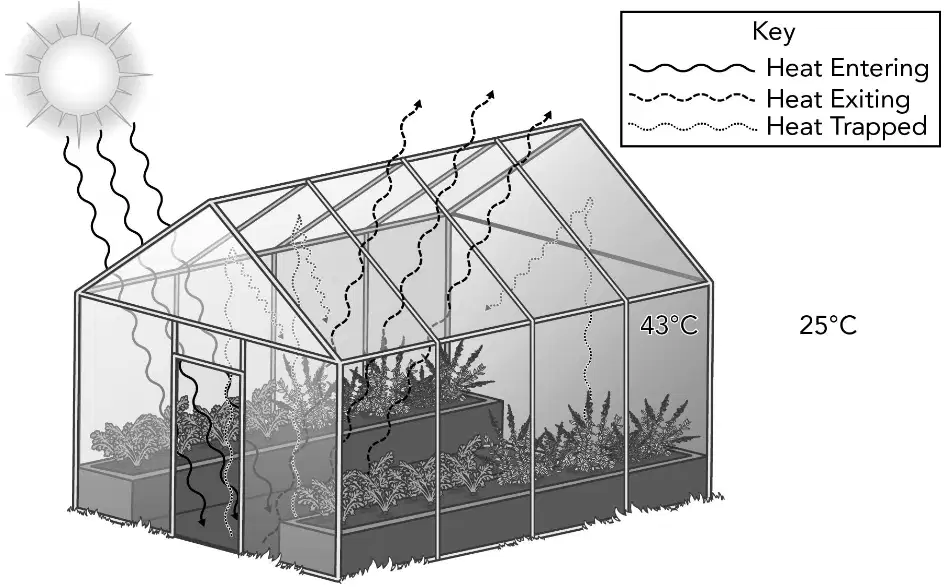
The image shows a greenhouse with a key indicating heat entering, heat exiting, and heat trapped. The temperature in the greenhouse is warmer than the temperature outside the greenhouse. Many plants grow in the greenhouse. Sunlight enters the greenhouse, warming the ground and other surfaces. Heat is trapped by the glass and cannot escape. Choose the statement that best compares greenhouse gases to this greenhouse.
Greenhouse gases in the atmosphere trap heat like the glass in the greenhouse.
Many plants in the greenhouse absorb carbon dioxide, which is why it is a greenhouse gas.
The glass greenhouse shelters the plants inside it from the outside environment, so the air inside it is a greenhouse gas.
The sun’s rays shine on Earth as they do on the glass greenhouse.
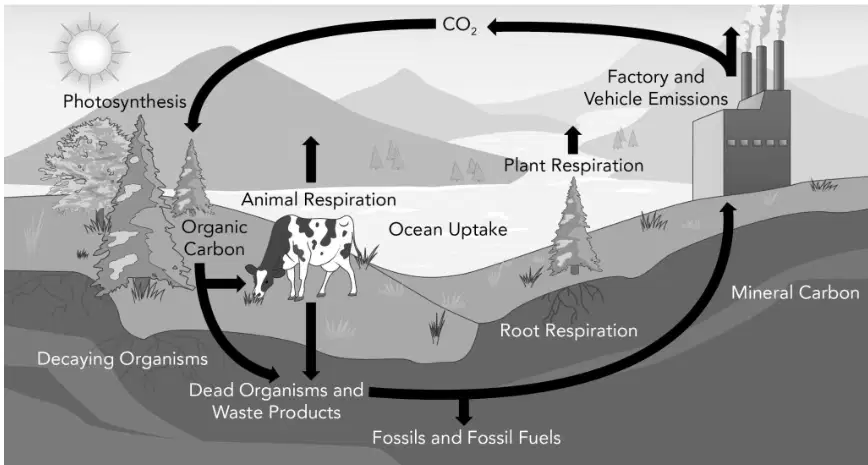
Look at the image of the carbon cycle. During the carbon cycle, carbon is stored in reservoirs and moves from place to place through different processes. Which activities show how carbon is absorbed?
Animal respiration
Photosynthesis
Fossil fuel combustion
Carbon fixation by consumers
Which statements describe human activities that are causing global warming? Choose the two correct answers.
Humans are cutting down trees to build homes, causing deforestation.
Humans are ranching cattle, causing urbanization.
Humans are planting gardens in their backyards, releasing greenhouse gases.
Humans are driving to work every day, releasing greenhouse gases.
Which statement describes how raising cattle affects emissions of greenhouse gases into Earth’s atmosphere?
Raising cattle increases greenhouse gas emissions because cattle emit large quantities of methane, which is a greenhouse gas.
Raising cattle decreases greenhouse gas emissions because cattle eat grass, which contains carbon.
Raising cattle doesn’t affect greenhouse gas emissions because greenhouse gases are only produced by burning fossil fuels.
Raising cattle increases greenhouse gas emissions because of the perspiration of carbon dioxide and the respiration of methane.
In many parts of the world, deforestation occurs to clear land for cities and farms. How does deforestation affect the global climate?
Forests absorb carbon dioxide, so deforestation causes a decrease in greenhouse gases and cools global climate.
Forests absorb carbon dioxide, so deforestation causes an increase in greenhouse gases and warms the global climate.
Forests release carbon dioxide, so deforestation causes a decrease in greenhouse gases and cools the global climate.
Forests release carbon dioxide, so deforestation doesn’t affect greenhouse gases or the global climate.
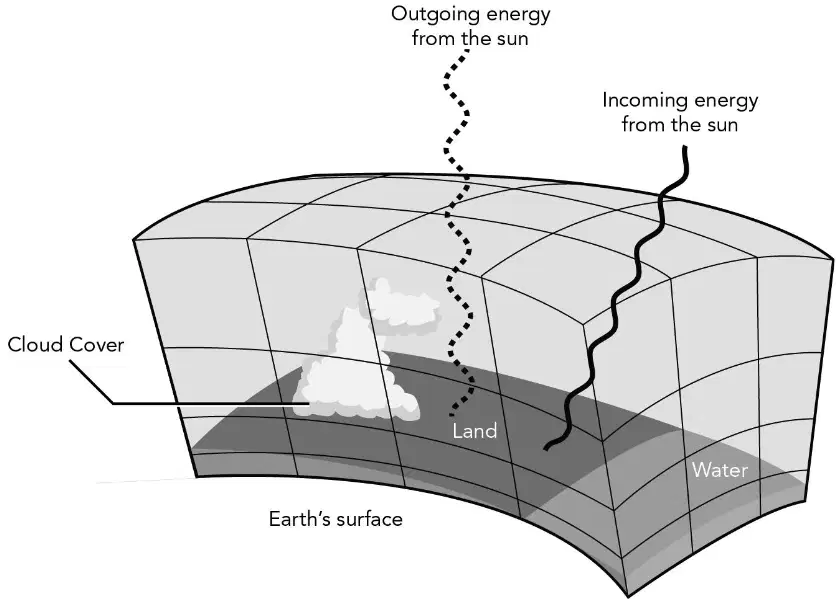
Read the passage and use the diagram to answer. Scientists model climate; the diagram shows elements of a climate model, including incoming energy from the sun, outgoing energy from the sun, cloud cover, land, water, and Earth's surface. A climate model quantifies the factors that have an impact on the climate. A scientist uses this model to study global climate change. Which options list a factor in the climate model and correctly explain how it affects climate? Select the two that apply.
Clouds, because they produce heat and warm the climate.
Clouds, because they block sunlight from reaching Earth's surface.
Greenhouse gases, because they trap heat, so it doesn't leave Earth.
Rain, because it absorbs heat and cools the climate.
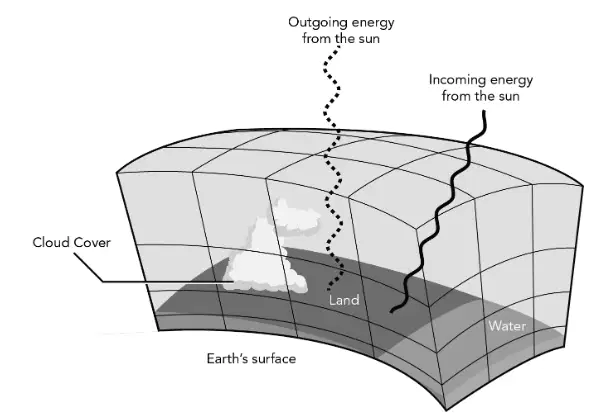
Based on the climate model, the scientist measures the amount of greenhouse gases added to the atmosphere and removed from the atmosphere. What human activities might decrease levels of greenhouse gases in the atmosphere? Select the three that apply.
A new car is invented that runs without fossil fuels.
Power plants burn more fossil fuels to generate electricity.
Governments enforce new policies to prevent deforestation.
During the summer, more people travel to vacation spots by airplane.
An area recently had a record low temperature on a winter day. Does this temperature record indicate that the evidence of climate warming is incorrect?
No, because daily temperatures are not part of climate measurements.
No, because the weather on one day cannot determine climate.
Yes, because the evidence for climate change didn’t include this record.
Yes, because it is the lowest recorded temperature.

