
 Worksheets
Energy
Total questions: 52
Worksheet time: 34mins
Fill in the blank: Energy is defined in science as the ability to ________ matter or change matter; the ability to do work.
move
see
hear
smell
When work is done, energy is transferred from one object to another.
True
False
Is the chemical energy in food kinetic energy or potential energy?
The chemical energy in food is potential energy.
The chemical energy in food is kinetic energy.
The chemical energy in food is electrical energy.
The chemical energy in food is thermal energy.
An example of kinetic energy is:
A moving car
A stretched rubber band
A battery storing energy
A rock on a hilltop
Energy is defined in science as:
the ability to do work
the amount of matter in an object
the speed at which something moves
the force applied to an object
The SI unit for energy is:
Joule
Watt
Newton
Volt
Energy may take which two of the following forms?
Kinetic and potential
Solid and liquid
Thermal and mechanical
Magnetic and elastic

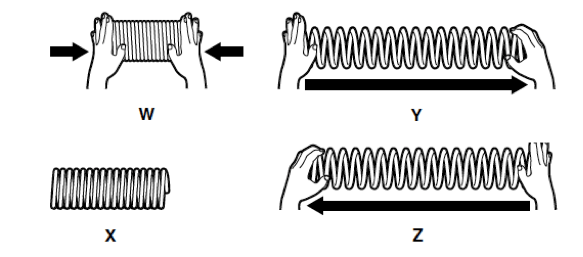
Elastic potential energy is energy stored in an object, such as a spring, due to the object being stretched or compressed. In which position is it most likely that the spring has lost its elastic potential energy?
W
Y
X
Z

At what point does the biker have the greatest Kinetic Energy?
Point A
Point B
Point C
Point D


a boy riding a bike has this type of ENERGY
Gravitational Potential
chemical
elastic
mechanical

Which form of energy is represented in the picture?
Mechanical Energy
Chemical Energy
Elastic Energy
Sound Energy
SI unit for energy
Newtons
Joules
Meters
Power

Energy stored in the nucleus of an atom
chemical energy
nuclear energy
gravitational energy
mechanical energy

Energy caused by the movement of electrons.
The energy of electric charges
thermal energy
sound energy
electrical energy
radiant energy
The total energy of motion in the particles of a substance
thermal energy
sound energy
electrical energy
radiant energy

Potential energy that depends on the height of an object
elastic energy
gravitational energy
electrical energy
chemical energy
The picture showing the energy conversion
Chemical → heat
is:


What energy transformation occurs as a mouse produces body heat?
Chemical --> Thermal
Thermal --> Chemical
Electrical --> Thermal
Thermal --> Mechanical
The ability to do work or cause change is called
friction
transfer
energy
velocity
On a roller coaster, where is maximum kinetic energy?
At the bottom of a big hill
When going around a corner
At the top of a big hill
Which is the best example of an object with only potential energy?
water being poured out of a pitcher
a ball being thrown across a field
a boulder resting on top of a cliff
a boat sailing through the water
What is the effect of friction on the motion of objects?
It speeds them up
It slows them down
It changes their direction
It has no effect
What happens to the potential energy of an object as it falls? (6.8A)
Potential energy increases
Potential energy is destroyed
Potential energy transforms (changes) to kinetic energy
None of the above
Which of the following is a unit of time?
mi/hr
m/s
s
kgm/s2
What is the unit for distance?
N
J
m/s
m
What is the unit of Mass?
kgm/s
kgm/s2
kg
kgm2/s2
A car Travels 30 m/s. What is 30 m/s?
Speed
Acceleration
Distance
Time
Which of the following relates to time?
How far it is?
How long does it takes?
How fast does it go?
How quickly does the speed change?
Which of the following best explains velocity?
How long does it take?
How far away is it?
How fast does it go?
How quickly does the speed change?
Newtons is the unit of?
Work
Energy
Force
Velocity
Gravity is a form of
speed
velocity
acceleration
momentum
Which of these is an example of the conversion of gravitational potential energy into kinetic energy?
a person running on a level track
an apple falling from a tree to the ground
a wind-up spring making a toy car move acroos the floor
a rubber band being stretched to twice its normal length
Matt and Kim use bowling balls with different masses. If they both roll their bowling balls at exactly the same speed, which claim could be supported by the evidence?
The bowling ball with less mass has more kinetic energy.
The bowling ball with more mass has more kinetic energy.
The kinetic energies of the two bowling balls are the same.
There is not enough information to compare the kinetic energies.
Which of these is an example of the conversion of elastic potential energy into kinetic energy?
a person running on a level track
an apple falling from a tree to the ground
a windup spring making a toy car move across the floor
a rubber band that is being stretched to twice its normal length


