
 Worksheets
Page 1
Total questions: 150
Worksheet time: 1hrs 15mins
Which pair correctly represents the two broad components that together provide a tool for solving problems on a computer?
Display and speakers working together
Hardware and software working together
CPU and printer working together
Mouse and keyboard working together
What role does the common bus play in a modern computer with multiple I/O devices?
Provides uninterrupted power supply
Increases CPU clock frequency
Permanently stores operating system
Facilitates communication among devices
Why does each I/O device in a computer have its own device controller?
To overclock the central processor
To manage device-specific operations
To replace the system memory cycle
To serve as the system bootstrap
What is a key constraint of the memory cycle when used by the CPU and device controllers?
Accessible to only one device at a time
Guaranteed parallel access for all devices
Dedicated solely to secondary storage
Reserved exclusively for graphics adapter
Which sequence best describes early startup events when a user powers on a computer?
Bootstrap initializes devices, then drivers load
User applications start before bootstrap
Operating system loads before bootstrap
Drivers load first, then bootstrap runs
In UNIX systems, which process is typically the first to run after the operating system loads?
xserver renders the desktop
cron schedules background jobs
shell executes user programs
init process starts system services
What is the primary purpose of an interrupt in computing?
To maintain constant CPU temperature
To expand main memory capacity
To send a signal to the CPU
To compress stored files automatically
Which statement best distinguishes software interrupts mentioned as sometimes being called system calls?
They are produced only by hardware devices
They occur only during graphics rendering
They permanently halt the operating system
They are generated by programs to request services
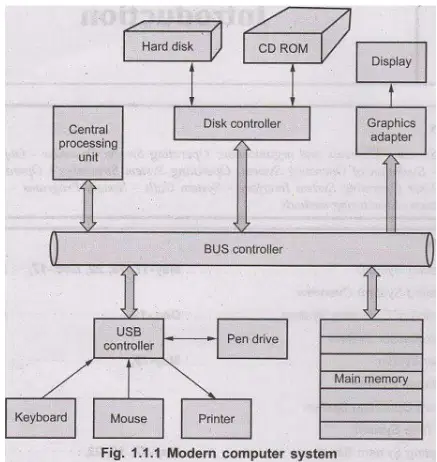
Consider the diagram of a modern computer system. Which component most directly connects peripherals like keyboard, mouse, and printer to the rest of the system?
Graphics adapter unit
CD ROM subsystem
Main memory module
BUS controller interface
A system designer reports contention on the memory bus when both the CPU and a disk controller attempt access. Which mitigation aligns with the one-at-a-time memory cycle constraint?
Implement arbitration to serialize access
Replace keyboard with wireless model
Increase screen refresh to reduce load
Disable bootstrap to free bandwidth
Which memory does the processor access before executing any instruction?
Optical disk buffer
Cache in magnetic disk
Secondary tape memory
Main memory called RAM
What type of memory is used in main memory?
Magnetic core
SRAM registers
Flash EEPROM
DRAM technology
Which statement best describes main memory?
Write-once and archival
Volatile and not stored permanently
Non-volatile and permanent
Removable and portable
What is typically true about cache memory capacity as noted?
Less than one megabyte
Exactly ten megabytes
Unlimited expandable size
Around one gigabyte
User programs and data are primarily stored in which component during execution?
Main memory (RAM)
Optical disk drive
Magnetic tape unit
External flash card
How are storage systems broadly classified in the given description?
Shared or dedicated
Temporary or permanent
Internal or external
Sequential or random
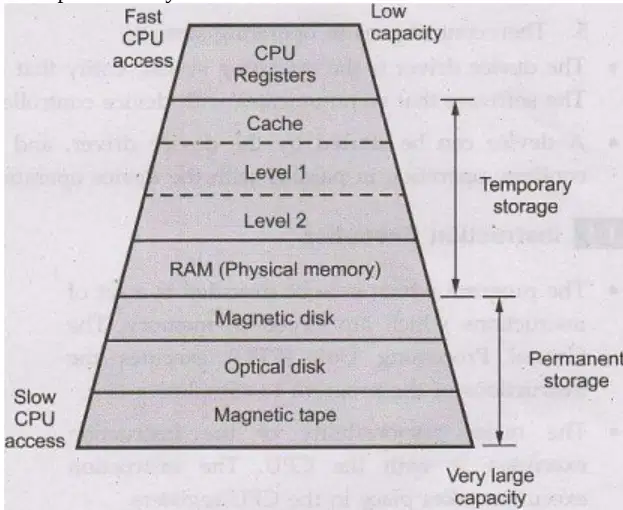
Which trend is correct regarding the hierarchy from top to bottom?
Access slows while capacity increases
Both access and capacity shrink
Access speeds up while capacity shrinks
Both access and capacity increase
What role does a device controller serve for an I/O device?
Connects device to address and data bus
Compresses files for storage
Encrypts network packets
Schedules CPU instructions
How can I/O devices be classified based on data transfer?
Buffered or unbuffered
Analog or digital
Synchronous or asynchronous
Block oriented or character oriented
Why are storage devices necessary when the computer is off?
To share printer queues
To cool system components
To increase CPU frequency
To retain data persistently
What connects all I/O devices, the CPU, and main memory together?
A dedicated GPU lane
A direct DMA cable
A wireless hub link
A common system bus
When an interrupt is triggered, what does the CPU do first?
Saves data to optical disk
Ignores and continues pipeline
Resets and reboots the system
Stops current instruction and transfers control
Where is the starting address stored for the service routine that executes after an interrupt?
At a fixed location
In random cache line
On magnetic disk
Inside device buffer
Which statement about interrupts is accurate?
They permanently halt the process
They recompile the current program
They do not alter the process control flow
They erase main memory contents
Which component manages data transfer between a peripheral device and its controller?
Device driver within operating system
Device controller hardware module
CPU arithmetic logic unit
System bus arbitration logic
What is the first step in the listed I/O operation steps?
Control returns to operating system
Data transfers to local controller buffer
Driver loads registers in controller
Controller sends an interrupt signal
During I/O, where is data transferred before notifying completion?
To main memory directly
To secondary storage cache
To CPU general registers
To controller local buffer
After data transfer completes, what happens next in the sequence?
Controller clears device status flags
Controller sends an interrupt to driver
Operating system preempts the CPU
Driver rewrites configuration registers
Which statement best describes a device driver?
A hardware adapter enabling DMA
A microcode routine inside the CPU
A user program that schedules tasks
An OS entity controlling CPU–I/O parallelism
Which claim about application and device operations is emphasized?
Controllers require manual polling
Drivers block all threads by default
Applications must halt during I/O
Applications can proceed in parallel
Which register role is highlighted for instruction execution?
It stores interrupt vector table
It caches decoded micro-ops
It mirrors memory-mapped I/O
It holds the next instruction address
Which pair correctly matches CPU actions in instruction execution?
Execute then fetch instruction
Writeback then decode opcode
Decode then fetch operands
Fetch operands then decode
What is the CPU’s major responsibility during instruction execution, as described?
Compiling source statements
Executing in the CPU registers
Managing disk seek operations
Paging virtual memory frames
Which scenario illustrates CPU–I/O parallelism enabled by drivers?
CPU pauses until buffer is emptied
CPU idles waiting for manual input
CPU computes while controller transfers
CPU polls continuously without tasks
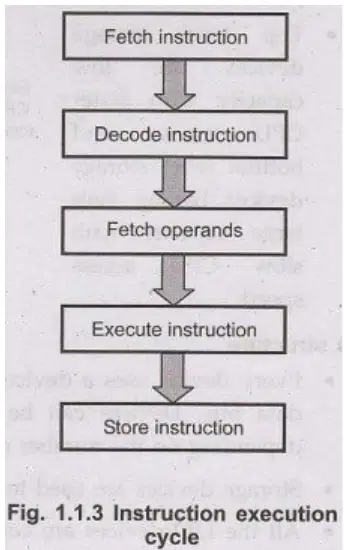
Which step directly follows decode instruction in the instruction execution cycle shown in the diagram?
Fetch operands
Store instruction
Fetch instruction
Execute instruction
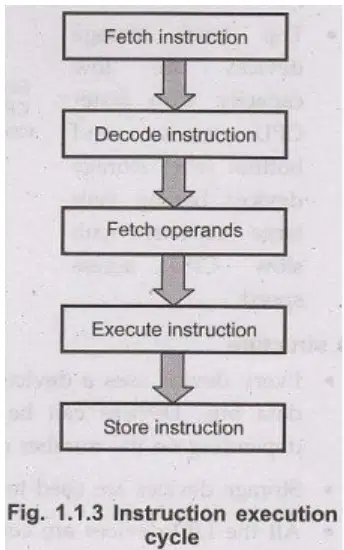
What is the primary role of the CPU during execute instruction in the cycle?
Perform the specified operation
Locate the next instruction
Transfer data to secondary storage
Load the program from disk
Which register specifies the memory address from which data is to be read or to which data is to be written?
Instruction Register
Program Counter Register
Memory Address Register
Memory Data Register
Which register keeps track of the next instruction after the current one completes?
Instruction Register
Memory Address Register
Program Counter
Stack Pointer
Where are instructions placed immediately before their execution within the CPU?
Program Counter
Cache Controller
Instruction Register
Memory Buffer
An interrupt is best described as which of the following?
A compiler optimization during linking
A cache miss inside the CPU pipeline
An external event that alters normal execution
A branch instruction with prediction
If an interrupt occurs, what is the immediate effect on the CPU's current activities?
They are erased from main memory
They continue without any change
They are paused so service routine runs
They complete and then power off
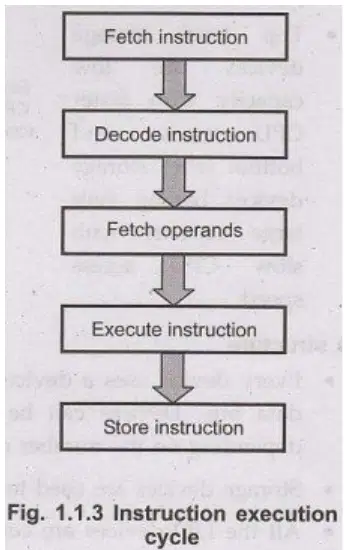
Which sequence correctly orders the first three stages of the instruction cycle?
Fetch, decode, fetch operands
Store, fetch, execute
Decode, execute, store
Execute, store, fetch
A design change moves operand fetch later, after execution. What likely problem would arise?
The IR would store invalid opcodes
Interrupts would stop being generated
The PC would overflow immediately
The CPU would lack data to execute
Which component executes the routine to handle an interrupt once it is signaled?
CPU using interrupt handler code
DMA engine microcode
I/O controller firmware module
User application main loop
What is the primary purpose of an Interrupt Service Routine (ISR)?
Handle user interface rendering tasks
Execute code responding to a hardware request
Schedule long-running background processes
Optimize cache replacement policies
Which statement best distinguishes hardware from software interrupts?
Hardware from devices; software from programs
Hardware from kernel; software from cache
Hardware from BIOS; software from firmware
Hardware from CPU; software from memory
What does the operating system use to locate the code to execute for a specific interrupt?
Linked list of process control blocks
Interrupt vector table mapping entries
Translation lookaside buffer entries
Page directory base register value
Which scenario would most likely trigger a trap?
User presses a keyboard key
Divide by zero during execution
Network card signaling packet
Disk controller completes DMA
Why must shared global memory variables be used for passing data between interrupt threads?
Globals execute faster than locals always
Caches cannot store local variables ever
Local variables are not shared across threads
Stacks are disabled on all ISRs universally
What differentiates synchronous interrupts from asynchronous ones in this context?
Synchronous caused by executing instructions
Synchronous masked by controller hardware
Synchronous caused by external devices
Synchronous delivered only by BIOS
Which best describes cache memory in this material?
External mass storage from flash
Virtual address space from disk
Large low-speed memory from DRAM
Small high-speed memory from SRAM
How do caches primarily solve component speed mismatch?
Duplicate all data in faster memory
Increase clock rate of slow device
Provide buffer at intermediate speed
Disable interrupts during transfer
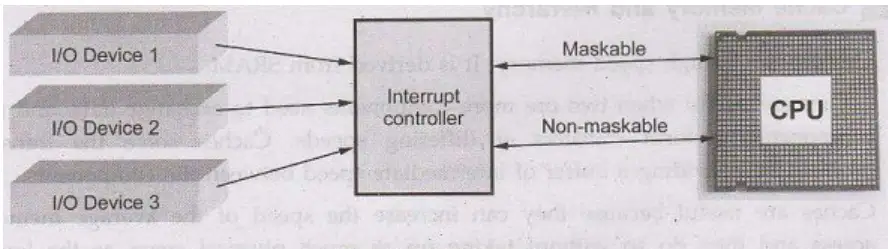
Which path shows how devices reach the CPU through the controller in the diagram?
I/O devices to interrupt controller to CPU
CPU to cache to I/O devices directly
CPU to DMA to I/O bus always
I/O bus to BIOS to CPU directly
What is the primary benefit of using cache in a computer system?
Increasing average memory access speed
Eliminating need for main memory entirely
Guaranteeing data never becomes inconsistent
Reducing persistent data corruption risk
When a device requests data, what is the first check performed to speed up access?
Whether disks have enough capacity
Whether data is in cache memory
Whether network latency is acceptable
Whether the CPU clock is throttled
Which statement best describes the requirement for cache data consistency?
Cache always overwrites main memory
Cache may diverge for performance
Cache must match its source data
Cache ignores multiprocess writes
In multiprocessor systems, what common issue requires cache updates?
Multiple processes modifying the same datum
Clock skew causing timing violations
Virtual memory exhausting page tables
DMA engines fragmenting large pages
Which component acts as a high-speed cache for main memory by holding frequently used control information?
Internal programmable registers like index registers
Secondary storage devices like HDDs
Network interface controller buffers
Graphics processing unit local memory
Why is a large disk unsuitable as a cache despite capacity advantages?
It would be too slow and non-volatile
It would be too fast and expensive
It would be too reliable and permanent
It would be too volatile and tiny
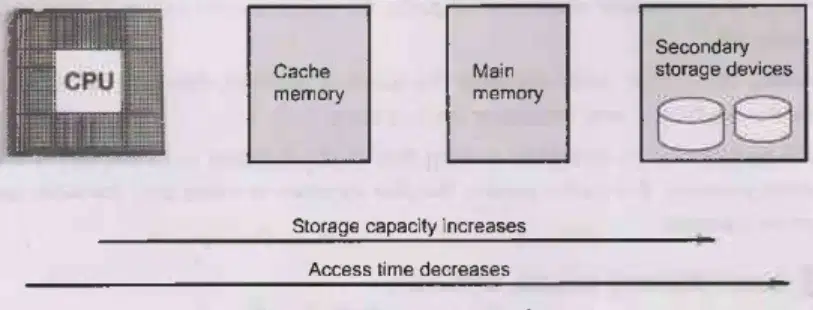
Which description aligns with the memory hierarchy trend shown in the diagram?
As access time increases, volatility always decreases
As storage capacity decreases, cost per bit decreases
As storage capacity increases, access time decreases
As storage capacity increases, access time increases
What distinguishes L1 cache from L2 cache in typical systems?
L1 is on CPU die, L2 on nearby chip
L1 is cloud-based, L2 is local
L1 is on disk platter, L2 in RAM
L1 is in BIOS ROM, L2 in GPU
What is the primary functional role of cache between devices of different speeds?
Replacing slower device permanently
Compressing files to save space
Encrypting data before transmission
Acting as a buffer between fast and slow
What is a typical small unit of allocation used by caches mentioned here?
Page arranged in slots or pages
Sector written in fixed cylinders
Block chained via linked lists
Frame swapped by TLB shootdown
What is the role of the tag RAM in a cache?
Holds addresses to identify cache blocks
Executes cache replacement algorithms
Buffers I/O transfers from devices
Stores data bytes for fast access
Which statement best defines a cache hit?
CPU finds data in cache memory
CPU fetches data from main memory
CPU writes data into backing store
CPU invalidates an outdated block
What does the valid bit associated with a cache block indicate?
Whether block is mapped to disk
Whether block contains usable data
Whether block is locked for DMA
Whether block is modified since load
Which factor primarily determines the size of a cache page or line?
Compiler optimization strategy
Processor and cache design
Operating system scheduler
Device driver interface
In a cache miss, which memory is effectively the slow memory during access?
Cache becomes slow memory
Secondary storage is slow
Register file is slow memory
Main memory is slow memory
Which fields together allow the cache to locate a block within a cache slot?
Program and page counters
Stack and heap pointers
Index and offset parts
Opcode and operand bits
Why is the modify (dirty) bit meaningful only when the valid bit is set?
Only valid blocks may differ from RAM
Write allocate clears dirty blocks
Invalid blocks ignore write policy
Dirty state needs a coherent bus
What is the main purpose of Direct Memory Access (DMA)?
Encrypt blocks during transfers
Move data without CPU intervention
Compress data inside main memory
Schedule tasks across processor cores
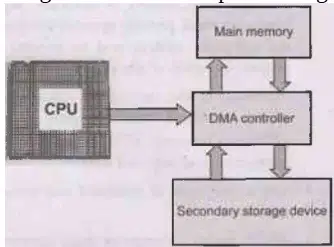
Which component coordinates data transfers in a DMA-based system, as shown in the diagram?
DMA controller unit
Level-one instruction cache
Arithmetic logic unit
Virtual memory manager
Without DMA, what additional responsibility falls on the processor during I/O transfers?
Interrupt masking control
Page table management
Physical movement of data
Clock frequency scaling
Which statement best describes a DMA controller in a computer system?
It replaces the CPU during normal instruction execution
It executes application programs for the operating system
It enables direct memory access between I/O and memory
It provides a graphical interface for user interaction
What is the role of HOLD and HOLD A signals in DMA operation?
They reset the CPU clock during interrupts
They request and acknowledge bus control transfer
They initialize device driver configurations
They allocate memory pages to user processes
How does block transfer with a device controller reduce interrupts compared to per-byte transfer?
It generates one interrupt per block of bytes
It duplicates data across two memory regions
It queues multiple CPUs for the same bus
It masks all interrupts until transfer ends
During DMA, when might the DMA controller stop the CPU?
When the CPU is fetching microcode tables
When it needs exclusive access to the bus
When the cache becomes fully associative
When virtual memory becomes fragmented
Which definition accurately characterizes an operating system?
A device that amplifies electrical signals
A firmware replacing peripheral controllers
A program controlling execution of application programs
A compiler translating high-level languages
From a user's perspective, why is an OS described as an abstract view?
It hides hardware complexity while providing features
It exposes all device registers to programmers
It removes the need for any application software
It guarantees infinite computational resources
Which is NOT listed as a major design goal of an operating system?
Automatic hardware fabrication
User convenience for interactions
Efficient use of a computer system
Ability to evolve over time
Why can an operating system introduce overhead to a system?
It forces all I/O to occur serially
It erases caches after each process
It disables CPU pipelines permanently
It consumes CPU time and memory resources
Which action supports efficient resource use by an operating system?
Disabling interrupts during user tasks
Monitoring and scheduling CPU and memory
Duplicating each process into two copies
Ignoring CPU scheduling decisions
What happens if memory is not free when loading a new program?
The I/O controller terminates all transfers
The user interface renders in safe mode
The CPU continues executing caches only
The CPU becomes busy with memory management
Which task is typically performed by an operating system in managing system resources?
Maintain the list of resources in the system
Compile high-level languages automatically
Design new hardware bus architectures
Encrypt every user file by default
What does scheduling in an operating system primarily coordinate?
Allocation of CPU and secondary storage
User interface color theme selection
Automatic software licensing checks
Physical assembly of hardware parts
Which item best describes the operating system’s role relative to hardware and system software?
It removes the need for application programs
It interacts with hardware to provide interfaces
It replaces hardware for faster execution
It stores user data without processes
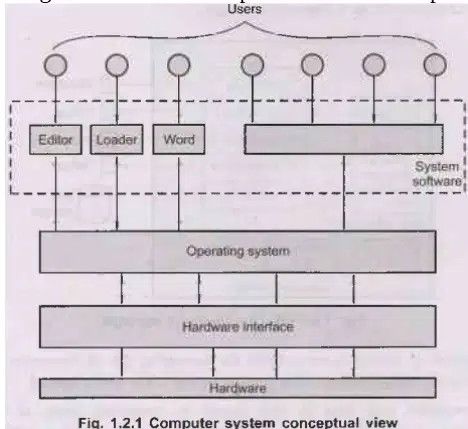
According to the conceptual computer system view, which layer sits directly above hardware?
Hardware interface and operating system
Users and application programs
Protection information database
Editor and word processor
Which list is the operating system expected to maintain to track access permissions?
List of network cables
List of printed documents
List of window themes
List of authorized users
Which statement best explains resource abstraction in operating systems?
It converts software into hardware modules
It hides applications from end users entirely
It physically duplicates hardware components
It presents simplified views of hardware resources
What is the relationship between application programs and the operating system?
Applications use OS services to solve specific tasks
Applications configure BIOS without OS support
Applications replace the OS during installation
Applications run only inside hardware interface chips
Which is NOT listed as a typical OS task in the material?
Initiate execution of programs and processes
Schedule CPU and secondary storage resources
Maintain resource usage and allocated lists
Develop new programming languages automatically
Why must an operating system be able to evolve effectively?
To add new functions without disrupting service
To remove the need for user authentication
To make hardware obsolete within months
To guarantee zero bugs in all applications
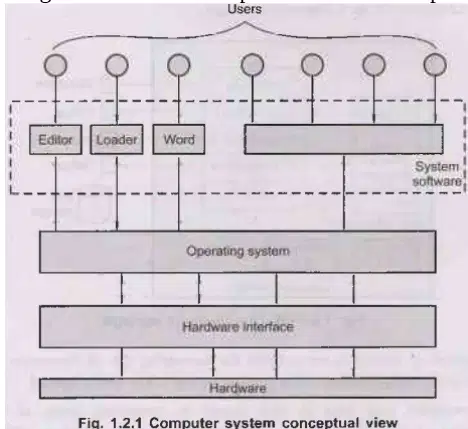
In the conceptual view, what connects users to system capabilities such as editors and loaders?
Protection information without processes
System software running on the operating system
Secondary storage independent of the OS
Direct wiring from users into hardware buses
What does an operating system primarily control when allocating and using computer resources among programs?
Distribution of CPU, memory, and I/O
Compilation of high-level code
Design of application interfaces
Encryption of stored backups
In the context of resource management, which statement best describes a computer according to the material?
A set of resources providing user functions
A single processor executing instructions
A network appliance routing traffic
A storage unit holding archived files
Which OS component resides in main memory and manages core operations?
Shell for command parsing
Kernel of the operating system
Driver for a specific device
Bootloader for system start
Which function is managed by the operating system with help from memory management hardware?
Allocation of main memory to programs
Compilation of source code to binary
Design of graphical user themes
Scheduling of print layout fonts
Which example best represents an I/O device that the operating system decides when a program may use?
Keyboard connected through a controller
Arithmetic logic unit in the CPU
Level‑one instruction cache
Virtual machine hypervisor
What role does the operating system play regarding the processor during program execution?
Converts scripts into machine code
Encrypts files with public keys
Replicates data across networks
Controls execution of user programs
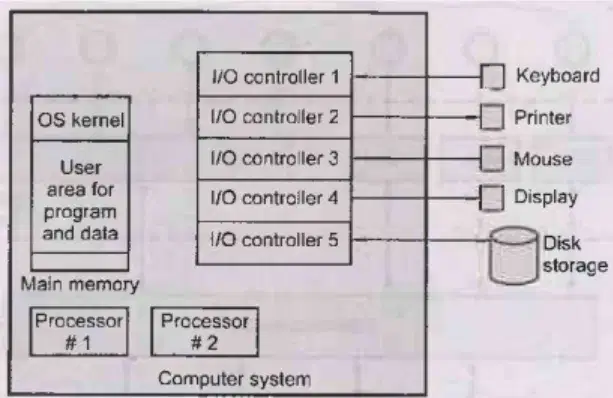
Which pair correctly matches OS resource controllers shown in the diagram?
I/O controller to keyboard device
Memory manager to network cloud
Process scheduler to web server
File system to arithmetic unit
Which task is NOT listed as a user-facing function provided through resources managed by the OS?
Editing and creation of programs
Data movement and storage tasks
Operation on data during processing
Real-time network routing policies
Which statement best captures the OS as a resource manager across CPU, memory, and I/O?
It arbitrates access and schedules usage
It replaces hardware with software emulation
It permanently owns all peripherals
It directly executes user applications
Which statement best describes time-based resource sharing in an operating system?
Each program gets a fixed time slot repeatedly
Each program occupies all memory permanently
Each program runs only after shutdown completes
Each program schedules itself without kernel
In space-based resource sharing for main memory, which is most accurate?
Memory is swapped only during boot time
Memory is reserved for I/O devices only
Memory is assigned to one job exclusively
Memory is divided among programs concurrently
Which function is typically included in a microkernel design?
High-level user application logic
Basic CPU scheduling and IPC services
Full device drivers and file systems
Graphical window management suite
What is the primary distinction of a thread in a process?
Lightweight flow of execution within code
Independent program with separate address
External module loaded from storage
Hardware interrupt handled by kernel
Which benefit is associated with distributed operating systems?
Manual scheduling by each process
Exclusive access to single processor
Transparency provided to the end user
Elimination of interprocess messages
Which sequence correctly orders early OS evolution through the 1980s?
Multiprogrammed, serial, time-sharing, simple batch, distributed, multiprocessor
Simple batch, serial, time-sharing, distributed, multiprocessor, multiprogrammed
Serial, simple batch, multiprogrammed, time-sharing, multiprocessor, distributed
Serial, multiprocessor, distributed, simple batch, time-sharing, multiprogrammed
Which description best fits a batch system?
Requires network transparency layer
Executes only one job at all times
Interacts with user for every command
Processes a collection of jobs as one unit
Which statement about jobs in a batch is most accurate?
Jobs cannot be predefined by users
Jobs are independent of other jobs in batch
Jobs must share variables across batch
Jobs require continuous user input
A user constructs a job control specification in a batch system primarily to do what?
Allocate exclusive physical memory pages
Configure graphical user interface skins
Trigger interrupts for device handlers
Define a file with a sequence of commands
What is the primary function of a batch processing system?
Service jobs sequentially without user interaction
Service jobs concurrently with interactive input
Prioritize shortest jobs with user prompts
Pause jobs frequently for operator feedback
In classic batch systems, which device commonly served as an input device?
Optical mice and keyboards
Magnetic disks with GUI
Card readers and tape drives
Touchscreens and scanners
Which component implements the batch processing system and is also called the kernel?
Disk scheduler on secondary storage
Batch monitor in main memory
Interpreter in virtual memory
Spooler service in user space
What role does the memory allocator play in a batch system?
Buffering only output to printers
Encrypting job control commands
Scheduling CPU with time slices
Managing main memory space allocation

According to the memory layout figure, which items reside in main memory during batch execution?
Only transient I/O buffers
Only user data archives
Only device drivers area
OS or batch monitor and jobs
What happens when a job completes execution in a batch system?
Job remains resident awaiting input
Memory is released and output is copied
CPU halts until operator intervenes
Kernel restarts all queued jobs
Which statement best describes job selection in a batch run?
Users interactively choose the next job
Jobs are chosen randomly by hardware
Operator types commands during each job
Kernel loads next job from the job queue
Why were jobs with similar needs batched together?
To enable constant screen interaction
To speed processing via shared setup
To reduce programming language variety
To increase manual operator steps
Which output devices are typical for batch systems mentioned in the material?
Monitors, speakers, graphic tablets
Touch panels, joysticks, microphones
Laser displays, plotters, webcams
Tape drives, card punches, line printers
In a batch system, jobs are typically processed using which scheduling approach?
First come first served order
Round-robin time slicing
Shortest job first policy
Priority-based dynamic queues
After a job finishes in a batch system, what commonly happens to its output?
It is deleted to free disk space
It is copied to an output spool
It stays in the job’s memory space
It is immediately printed directly
What does the acronym SPOOL most closely represent in operating systems?
Shared parallel operations over LAN
Synchronous processing of output lines
Simultaneous peripheral operation online
Sequential peripheral offline loading
Which resource is primarily used by spooling to buffer data for devices like printers?
Main memory cache pages
Secondary disk storage
CPU register windows
Network interface buffers
Why is spooling especially useful when device and CPU speeds differ significantly?
It locks the device to CPU speed
It lets faster components remain idle
It provides a waiting area buffer
It merges I/O and CPU instructions
Which statement best describes an optimization achieved by spooling?
It forces serial access to all devices
It eliminates the need for file management
It guarantees interactive debugging during execution
It overlaps I/O of one job with computation of another
Which is a common inconvenience of batch systems for end users?
Continuous real-time device management
Inability to interact to fix job problems
Unlimited random file access
Excessive parallel interactive sessions
What is a typical example of a batch system workload mentioned in the material?
Compiling a single small program
Interactive web browsing sessions
Generating monthly bank statements
Streaming high-definition videos
What is the most common real-world application of spooling cited in operating systems?
Network packet spooling
GPU shader compilation spooling
Keyboard buffering spooling
Print spooling for printers
In the context of spooling, what role does the spooled buffer play for devices?
Encrypts output for privacy
Queues jobs until the device is ready
Splits tasks into micro-threads
Allocates more CPU cycles
Which statement best describes spooling in operating systems?
Loading multiple OS kernels into memory
Keeping CPU busy with long CPU bursts
Replacing interrupts with polling routines
Using disk as a large buffer for I/O
Which is an advantage of spooling in a multiprogramming context?
Overlap I/O of one job with CPU of another
Reduce context switch frequency drastically
Eliminate need for secondary storage entirely
Guarantee real-time response for each job
Which is listed as an advantage of batch systems?
Interactive debugging becomes simpler
Jobs run with strict user isolation
Operator work moved to the computer
Turnaround time becomes negligible
Which is a disadvantage of batch systems from the user standpoint?
Large turnaround time for completion
High overhead of interactive shells
Excessive demand for virtual memory
Mandatory network connectivity always
Which risk is mentioned for batch systems without protection schemes?
User programs preempt the kernel
One batch job can affect pending jobs
Memory leaks are automatically fixed
Deadlocks are impossible to occur
What is the primary aim of a multiprogramming operating system as stated?
Providing deterministic real-time scheduling
Maximizing graphical user interface effects
Eliminating all forms of I/O operations
Resource management across system components
Why must more than one job be loaded for execution in multiprogramming?
To keep the CPU busy when I/O is idle
To reduce the size of the file system
To prevent transient area fragmentation
To avoid the need for command interpreters
In a multiprogramming OS, what is a program in execution commonly called?
Thread or socket or port
Module or macro or block
Frame or page or segment
Process or job or task
What does the multiprogramming OS do with the transient area?
Encrypts it to enforce user anonymity
Expands it into permanent ROM chips
Divides it to store multiple programs
Maps it only to device controller cache
What happens when two or more programs are in memory sharing the processor?
This is referred to as multiprogramming
This is known as direct memory processing
This is called monoprogrammed execution
This is defined as time-invariant scheduling
Which component selects one program from memory for execution in a multiprogramming system?
User interface directly starts execution
Operating system kernel selects a program
File system chooses active application
Device controller chooses executing process
What is the primary purpose of the job pool in a multiprogramming environment?
Cache frequently used files for speed
Store completed processes for logging
Hold processes on disk awaiting memory
Keep drivers needed for peripherals
Which scheduling concept is applied when there is insufficient primary memory for a process?
I/O scheduling for device prioritization
Job scheduling to select next process
Thread scheduling within a process
CPU scheduling for time quantum assignment
Why is memory management required in a multiprogramming operating system?
To virtualize network connections
To compile programs into machine code
To manage memory allocation for processes
To encrypt user data for security
In multiprogramming, while the CPU executes one program, what typically happens simultaneously?
I/O system services other programs
I/O system remains idle for safety
Memory is fully cleared repeatedly
Kernel halts all background tasks
Which statement best describes user interaction in a multiprogramming operating system?
Users interact directly with each running job
System provides minimal user interaction with programs
Users configure CPU time for each process
System requires manual memory partitioning by users
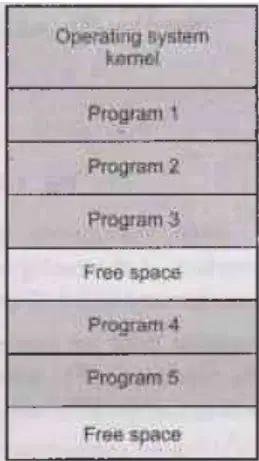
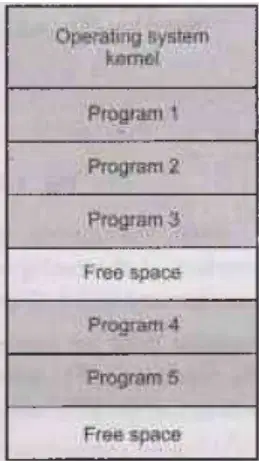
Given the memory layout shown, what does the presence of 'free space' blocks imply?
Areas reserved for device firmware only
Unused regions available for new programs
Segments containing swapped-out kernel code
Permanent space for user configuration files
Which pair of concepts together determine which process runs and where it resides in RAM?
Authentication and access control
Job scheduling and memory management
CPU scheduling and device drivers
File systems and paging tables
A system has multiple programs loaded; the CPU executes Program A while Program B performs disk I/O. What advantage does this illustrate?
Improved throughput by overlapping CPU and I/O
Reduced latency by disabling interrupts
Higher security by isolating address spaces
Lower power by suspending background tasks
Which statement about the OS kernel in the diagram is most accurate?
Kernel is swapped out during each context switch
Kernel resides in memory to coordinate execution
Kernel only manages I/O and not scheduling
Kernel shares space equally with user programs

