
 Worksheets
History and Status of the Conceptual Framework
Total questions: 127
Worksheet time: 1hrs 4mins
Which statement best describes the status of the IASB Conceptual Framework?
It guides standard setting but is not a standard
It replaces all existing IFRS Standards
It is optional guidance for preparers only
It is an IFRS Standard enforceable by regulators
In 2010, IASB and US FASB completed the first phase of a joint project. What was a key objective of this project?
Replace qualitative characteristics with quantitative metrics
Develop a converged conceptual framework for IFRS and US GAAP
Create rules-based standards for rapid implementation
Establish country-specific financial reporting policies
Which purpose of the Conceptual Framework helps when no IFRS Standard directly applies to a transaction?
Assist auditors to issue qualified opinions
Assist preparers to develop consistent accounting policies
Assist investors to perform ratio analysis
Assist regulators to impose disclosure penalties
Which chapters were issued in the 2010 framework revision mentioned?
Chapter on Measurement and Chapter on Reporting Entity
Chapter 1 on objective and Chapter 3 on qualitative characteristics
Chapter on Consolidation and Chapter on Presentation
Chapter on Fair Value and Chapter on Financial Instruments
What principle underpinned the objective of the 2010 Conceptual Framework?
Create detailed rules for each industry
Establish principles-based, internally consistent standards
Prioritize tax reporting over financial reporting
Align IFRS entirely with US private company GAAP
Which event occurred on March 29, 2018 regarding the Conceptual Framework?
The framework was made legally binding worldwide
US GAAP fully adopted IFRS Standards
A revised Conceptual Framework was issued by IASB
The first joint project was initiated
How does the framework assist the IASB according to its stated purpose?
By mandating disclosures beyond existing standards
By performing external audits of listed companies
By developing IFRS Standards based on consistent concepts
By drafting enforcement actions for non-compliance
Which statement correctly contrasts IASB and FASB involvement in the framework history?
FASB authored the 2018 revision alone
IASB and FASB jointly pursued an improved, converged framework
FASB mandated IFRS adoption in the United States
IASB opposed convergence while FASB promoted divergence
Which qualitative characteristic ensures information can influence decisions by helping users evaluate outcomes of past or future events?
Confirmatory value within relevance
Timeliness within enhancing characteristics
Verifiability within enhancing characteristics
Neutrality within faithful representation
A company delays issuing statements to include one more month of data. Which enhancing characteristic is most threatened by this decision?
Verifiability of reported amounts
Comparability across reporting periods
Understandability of classifications
Timeliness of reporting information
An amount is recognized only when it provides relevant information and faithful representation. In the framework, this statement refers to which area?
Recognition of elements section
Objective of financial reporting section
Measurement bases section
Presentation and disclosure section
To assess solvency, an analyst prioritizes a statement that reports resources and obligations at a date. Which financial statement is most appropriate?
Notes and disclosures
Statement of financial position
Statement of profit or loss
Statement of cash flows
Which underlying assumption supports preparing financial statements on the basis that the entity will continue operations?
Accrual basis assumption
Entity boundary concept
Going concern assumption
Cost effectiveness constraint
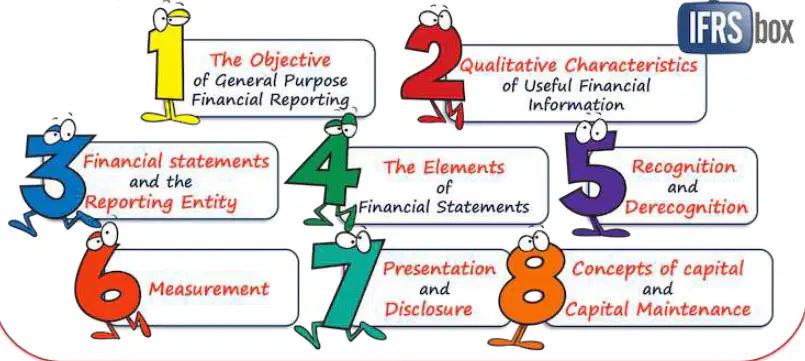
In the chapter overview image, which numbered topic addresses how items enter or leave the statements?
Number 2: Qualitative characteristics
Number 7: Presentation and disclosure
Number 5: Recognition and derecognition
Number 4: Elements of statements
Which statement best describes the objective of general‑purpose financial reporting?
Provide tax planning strategies for management
Provide financial information useful for resource decisions
Ensure compliance with internal control manuals
Forecast market prices for traded securities
Who are identified as the primary users of general‑purpose financial reports?
Customers and suppliers of the entity
Company employees and labor unions
Existing and potential investors, lenders, creditors
Government regulators and tax authorities
Which group is most likely to use financial reports to assess whether to provide funds to an entity?
Existing and potential investors and lenders
Industry trade associations
Product design teams and engineers
Retail customers and distributors
General‑purpose reports provide information about economic resources and claims. Which items represent claims against the reporting entity?
Liabilities and equity
Assets and revenues
Cash and inventories
Expenses and dividends
Financial position information primarily addresses which elements?
Assets and claims against the entity
Revenue recognition timing issues
Share price volatility measures
Cash flow forecasting models
Information on changes in economic resources and claims typically includes which area?
Financial performance and related events
Industry competitor benchmarking
Board governance and committee charters
Environmental sustainability initiatives
Why is the objective of financial reporting called the foundation of the Conceptual Framework?
It focuses solely on profit distribution rules
All other aspects revolve around this objective
It replaces all measurement standards
It is mandated by tax legislation only
Which purpose of the Philippine Conceptual Framework directly supports auditors?
Assisting FRSC in developing and reviewing IFRSs
Assisting auditors in judging conformity with Standards
Providing information about FRSC’s formulation approach
Assisting users in interpreting information in statements
Which purpose of the Philippine Conceptual Framework most helps standard‑setting activities?
Assist users in interpreting statements
Assist FRSC in developing and adopting IFRSs
Assist auditors in forming an opinion
Provide information to interested parties
Which purpose of the Philippine Conceptual Framework primarily benefits preparers of financial statements?
Reviewing FRSC’s formulation approach
Applying Standards and addressing emerging topics
Forming audit opinions on conformity
Interpreting information in statements
Users rely on general‑purpose financial reporting mainly to make what kind of decisions?
Decisions about internal staffing schedules
Decisions about providing resources to the entity
Decisions about advertising slogans
Decisions about product color selection
Which statement best differentiates financial position from changes in financial position?
Position reports resources and claims; changes report performance and events
Position reports budgets; changes report capital structure
Position reports profits; changes report cash flows only
Position reports market value; changes report tax expense
Which statement best describes external users of financial information in relation to an entity?
They approve budgets and oversee business units
They direct daily operations and set internal targets
They have financial interest but are not involved daily
They design management accounting information systems
Which group is primarily considered internal users of financial reports?
Customers and suppliers
Board of directors and executives
Creditors and bondholders
Stockholders and potential investors
Which need is commonly assessed using information on economic resources and claims?
Employee satisfaction survey outcomes
Marketing campaign effectiveness metrics
Financial strengths and weaknesses evaluation
Cash flow projections for tax filings
Liquidity most directly refers to an entity’s ability to:
Increase market share over time
Maintain steady profit margins
Generate long-term returns from assets
Meet short-term obligations when due
Solvency most directly refers to an entity’s capacity to:
Convert inventory to cash quickly
Reduce operating expenses consistently
Repay long-term debts as they mature
Forecast quarterly earnings accurately
Changes in economic resources and claims result primarily from:
Employee headcount fluctuations
Share price movements alone
Tax assessments and audits only
Financial performance and other events
Management accountants mainly design information systems to support:
Marketing and sales promotions
Investor relations presentations chiefly
Planning and control decisions internally
External compliance reporting only
Which distinction most clearly separates internal from external users?
Requirement to follow solvency regulations
Access to general-purpose statements only
Participation in daily operations and decision-making
Ownership of tradable equity instruments
Which set lists the two fundamental qualitative characteristics of useful financial information?
Relevance and faithful representation
Timeliness and understandability
Comparability and verifiability
Neutrality and completeness
Which statement best describes relevance in financial reporting?
Prepared on a timely schedule
Verified by independent auditors
Capable of influencing user decisions
Comparable across entities and periods
Predictive value most directly means that information can be used to:
Compare peer companies
Forecast outcomes and trends
Confirm past transactions
Meet statutory deadlines
Confirmatory value most directly means that information can be used to:
Predict future cash flows
Ensure timeliness of reports
Validate prior expectations
Enhance understandability
Faithful representation requires information to be:
Predictive, confirmatory, and material
Complete, neutral, and free from error
Timely, comparable, and understandable
Verifiable, entity-specific, and aggregated
Enhancing qualitative characteristics include which of the following sets?
Comparability, verifiability, timeliness, understandability
Predictive value, confirmatory value, feedback
Relevance, faithful representation, neutrality, completeness
Materiality, prudence, substance over form
Materiality is best described as:
Universal quantitative threshold
Enhancing characteristic category
Entity-specific aspect of relevance
Auditor-only determination
Which situation most likely indicates information is material?
Its omission could influence primary users’ decisions
It improves visual presentation only
It follows industry practice closely
It shortens report length slightly
Why does the Conceptual Framework avoid a single numeric threshold for materiality?
Auditors require discretion for all assertions
International standards prohibit quantitative measures
Materiality depends on entity-specific facts and circumstances
Quantitative thresholds conflict with comparability
Which step starts the materiality process described in the guidance?
Assess whether identified information is material
Review the complete set of financial statements
Identify information with potential to be material
Organize draft financial statement information
At which stage do you evaluate whether information identified earlier is in fact material?
Step 3: Organize content
Step 1: Identify items
Step 4: Revise drafts
Step 2: Assess materiality
What is the primary goal of Step 3 in the materiality process?
Quantify all potential misstatements
Select external benchmarks for peers
Remove immaterial disclosures entirely
Communicate information clearly within drafts
What is the main purpose of Step 4 in the materiality process?
Establish legal compliance for filings
Shift qualitative factors to appendices
Determine completeness and aggregate materiality
Create footnotes for every transaction
Which pair best captures the decision-usefulness of relevant information?
Verifiability and comparability
Neutrality and prudence
Timeliness and understandability
Predictive value and confirmatory value
Which statement aligns with the scope of qualitative characteristics in financial reports?
They apply to both statements and other information
They apply only to audited statements
They apply solely to management commentary
They apply exclusively to footnote disclosures
Which scenario best illustrates comparability in financial reporting?
Comparing one account within a single statement only
Comparing this year and last year of the same company
Comparing management’s estimates to external market rumors
Comparing cash flows to nonfinancial customer surveys
What does verifiability primarily require from independent users?
Ability to access proprietary internal systems always
Ability to reach a consensus about the depiction
Ability to predict future market movements precisely
Ability to perform complex statistical recalculations
Information is timely when it is available to users in time to do what?
Influence their decisions effectively
Eliminate estimation uncertainty entirely
Reduce audit fees significantly
Satisfy all regulatory filings universally
Which statement captures the essence of the cost constraint?
Benefits from information should outweigh reporting costs
Benefits and costs are impossible to balance in practice
Costs are irrelevant when information increases relevance
All potentially useful information must be reported always
A company provides quarterly results two weeks after quarter-end. Which characteristic is most directly addressed?
Timeliness of reporting to influence decisions
Comparability across unrelated industries
Verifiability through complex model replication
Neutrality by removing all managerial judgment
Comparability requires at least two items. Which pair satisfies this requirement?
Same entity across different periods
One revenue account only within a period
A forecast compared to a single invoice
An estimate contrasted with one transaction
Which choice best distinguishes intra-comparability from inter-comparability?
Same entity across periods versus different entities
Cash flows versus income statement comparisons
Same account within one period versus multiple accounts
Financial data versus nonfinancial operational metrics
Verifiability in practice most often involves what?
Auditors guaranteeing perfect numerical accuracy
Users relying solely on forward-looking projections
Managers revising results to appear favorable
Independent observers reaching similar conclusions
A firm delays publishing results to refine estimates extensively. Which trade-off is most relevant?
Verifiability versus understandability always
Comparability versus neutrality in disclosures
Timeliness versus precision under cost constraint
Faithful representation versus revenue recognition
Under the cost constraint, when is adding a disclosure justified?
When expected user benefits exceed preparation costs
When competitors disclose similar detailed metrics
When regulators might someday request the data
When management prefers more technical presentation
Which example best enhances comparability for users?
One-time presentation format changes frequently
Highly customized metrics each quarter
Consistent accounting policies across periods
Omitting prior-period figures in statements
Which situation undermines verifiability?
Clear documentation of estimation methods
Transparent reconciliation of data sources
No evidence allows independent agreement
Multiple observers reach similar measurements
Why is timeliness critical for investors making decisions?
Recent information affects choices before events pass
Old reports are always more detailed and complete
Delayed reports guarantee higher accuracy always
Timely data removes all uncertainty permanently
Which reporting approach aligns with the pervasive cost constraint?
Maximize every disclosure regardless of cost
Optimize disclosures where benefits outweigh costs
Eliminate estimates to cut verification efforts
Minimize all reporting to avoid any costs
Which statement best explains the general objective of financial statements for external users?
Predict future cash inflows to the entity
Set mandatory dividend rates for shareholders
Measure tax obligations for government only
Provide marketing insights about customer trends
Which financial statement recognizes assets, liabilities, and equity at a specific date?
Statement of changes in equity
Statement of financial performance
Statement of cash flows
Statement of financial position
Which item is typically disclosed in other statements and notes rather than recognized on the primary statements?
Issued share capital amount
Total assets and total equity
Sales revenue and expenses
Unrecognized assets and liabilities
Management stewardship in financial reporting most directly relates to which purpose?
Valuation of market competitors
Promotion of future sales volume
Accountability for economic resources
Computation of personal income taxes
Consolidated financial statements are prepared when the reporting entity includes which grouping?
Independent businesses in a joint venture
Separate segments without linkage
A single parent only
Parent and its subsidiaries
Unconsolidated financial statements most appropriately present which boundary?
Two unrelated entities combined
Parent with all subsidiaries
A legal entity plus its associates
Parent alone as the reporting entity
Combined financial statements are prepared for what type of reporting entity?
Single entity with multiple divisions
Parent with significant influence investees
Parent and wholly owned subsidiaries
Two or more entities without parent–subsidiary
Which statement about a reporting entity is accurate?
It must include at least two entities
It cannot be a business segment
It must always be a corporation
It is not necessarily a legal entity
Which scenario requires identifying the reporting entity boundary most carefully?
An individual’s personal budget
A marketing campaign analysis
A parent with multiple subsidiaries
A government tax assessment
The going concern assumption implies which expectation about the entity?
Ceases operations after one fiscal year
Plans liquidation at the reporting date
Suspends activities during interim periods
Continues operating for the foreseeable future
Which information is provided for a specified reporting period on general purpose financial statements?
Customer satisfaction survey scores
Assets, liabilities, income, expenses
Internal audit staffing schedules
Projected sales for ten years
Interim financial statements such as quarterly reports are best described as which requirement?
Prohibited under standards
Mandatory for all entities
Optional but permitted
Required only for subsidiaries
Which scenario best reflects the accounting entity assumption?
Owner’s grocery purchases recorded in company books
Company transactions recorded separately from owners’ personal dealings
Managers’ personal loans reported as entity liabilities
Shareholders’ tax payments merged with corporate expenses
What is the primary purpose of the time period assumption?
To subdivide an entity’s life into equal reporting periods
To combine all years into one lifetime report
To require monthly audits for every organization
To eliminate seasonal fluctuations from statements
Under the monetary unit assumption, which aspect is emphasized?
Only qualitative narratives are permitted in reports
Transactions must be measured in a stable currency unit
Non-monetary values should dominate disclosures
Foreign currencies must be converted using future rates
Which statement aligns with keeping transactions separate under the entity assumption?
Owner’s vacation costs capitalized by the business
Personal assets consolidated with corporate resources
Business expenses recorded without owner’s personal items
Employees’ private purchases expensed by the entity
Which option correctly defines an asset?
A present resource controlled due to past events
A future obligation expected from upcoming transactions
A residual claim after deducting all liabilities
A non-controllable benefit unrelated to past events
Which is an essential element in defining an asset?
A reduction of expenses from future operations
A transfer mandated by contract to others
A right with potential to produce economic benefits
A duty the entity cannot practically avoid
Which description best captures future economic benefits of an asset?
Benefits occurring only when liabilities decrease
Benefits realized only through donations received
Benefits limited strictly to the current month
Benefits expected across more than one period
Which example illustrates economic benefits from productivity?
Machinery used in operations generating outputs
Cash held with no plans for deployment
Inventory written off as obsolete stock
Idle equipment kept for aesthetic value
Which case demonstrates convertibility into cash as an economic benefit?
Goodwill with indefinite useful life
Trade receivables collected into cash
Long-term lease obligations increasing expenses
Deferred tax liabilities recognized this year
Which situation shows control over an asset’s benefits?
Temporary permission granted to competitors
Shared public license without restrictions
Exclusive right preventing others from accessing benefits
Open access by anyone to use the resource
Which statement defines a liability?
A present obligation to transfer economic resources
A voluntary promise with no enforceability
A possible duty depending on uncertain future events
A past cash inflow that increased equity
Which element is NOT part of the essential definition of liability?
The entity has an obligation
Obligation to transfer an economic resource
Obligation exists due to past events
Obligation expected only in distant future periods
Which statement best defines equity?
Residual interest in assets after liabilities
Total assets owned regardless of debts
Increase in benefits from owner contributions
Obligation to transfer resources next year
Which definition best describes income in financial performance?
Outflows that reduce assets and raise expenses
Owner investments causing equity growth directly
Increases in benefits via inflows or asset enhancements
Decreases in benefits from increased liabilities
A company lowers production costs using new equipment. Which benefit characteristic is illustrated?
Control lost due to shared access with others
Cost-saving by reducing cash outflows
Convertibility by turning receivables into cash
Productivity through higher output capability
Which statement best distinguishes revenue from gains within income?
Revenue arises from ordinary activities like sales and fees
Gains include distributions to equity claim holders
Gains arise only from ordinary sales transactions
Revenue represents other items that may arise irregularly
A dividend received by an entity is classified as which income subtype?
Revenue from ordinary activities
Loss from ordinary activities
Contribution from equity holders
Gain from non-operating activities
Which example best represents a gain rather than revenue?
Profit on disposal of a machine
Fees earned from consulting services
Rent received from tenants monthly
Interest earned on customer balances
Which statement correctly defines expenses in the Conceptual Framework?
Outflows measured unreliably during a period
Distributions to equity participants reducing assets
Increases in assets from ordinary activities
Decreases in economic benefits causing equity reductions
Which item is an expense arising from ordinary activities?
Depreciation on equipment
Gain on fair value remeasurement
Owner dividend payment
Proceeds from issuing shares
Losses are best described as which of the following?
Items that increase equity through contributions
Outflows always from ordinary operations only
Items meeting expense definition, may arise irregularly
Distributions to holders of equity claims
Recognition requires first meeting what prerequisite?
Approval by management committee
Existence of a historical transaction
Probable future cash inflows
Definition of the relevant element
Which combination satisfies the classic recognition criteria before 2018?
Probable economic benefits and measured reliably
Legal form and regulatory approval
Consistency with industry practice and prudence
Maximization of profit and cash collection
If an item is relevant but fails the reliability criterion, what is the appropriate treatment?
Ignore entirely with no disclosure
Capitalize as an intangible asset
Recognize fully and adjust next period
Do not recognize; disclose in notes if relevant
Which phrase captures the 2018 revision’s emphasis for recognition?
Materiality thresholds exclusively
Historical cost and conservatism
Only probability of cash flows
Relevant information and faithful representation
Recognition links elements to which primary statements?
Statement of financial position and performance
Management commentary and audit report
Cash flow statement and notes
Statement of changes in cash and equity
At period boundaries, which equality is highlighted for the statement of financial position?
Total contributions minus distributions equals total assets
Total assets plus total liabilities equals total equity
Total income minus total expenses equals total equity
Total assets minus total liabilities equals total equity
Recognized changes in equity during a period include which pair?
Revenue plus gains, and depreciation plus losses
Income minus expenses, and contributions minus distributions
Cash receipts minus cash payments, and share buybacks
Revaluations plus impairments, and dividends declared
Which scenario illustrates derecognition most clearly?
Removing an asset from the balance sheet after disposal
Recording depreciation expense for the period
Recognizing revenue when cash is received
Classifying a liability as current at year-end
Which measurement basis uses the historical price of a transaction to determine monetary amounts for recognition and carrying in financial statements?
Value in use measurement basis
Historical cost measurement basis
Fair value measurement basis
Current cost measurement basis
Under historical cost, what is included for assets when determining the carrying amount?
Transaction costs and recoverable amounts
Potential transaction costs on sale
Present value of future cash flows
Consideration to acquire an equivalent asset
Under historical cost for liabilities, what adjustment is made to consideration received?
Decrease by financing interest accrued
Increase by present value of future inflows
Decrease by potential sale transaction costs
Increase by excess estimated cash outflows
Fair value is based on which market perspective at the measurement date?
Orderly transaction between market participants
Historical price adjusted for financing
Entity-specific replacement transaction
Contractual fulfillment of future cash flows
Which statement best distinguishes fair value from value in use?
Liability consideration received versus asset replacement cost
Interest accruals versus transaction cost exclusions
Historical transaction costs versus current replacement costs
Market participant assumptions versus entity-specific cash flows
Value in use for assets primarily reflects which concept?
Consideration to acquire an equivalent asset today
Price to sell asset in an orderly market transaction
Present value of future cash flows from use and disposal
Historical price plus unconsumed transaction costs
For liabilities, fulfillment value includes which component?
Consideration received net of transaction costs today
Present value of future cash flows to fulfill obligation
Potential transaction costs on market sale or transfer
Interest accrued on any financing component only
Current cost for assets reflects what key attribute at measurement date?
Consideration to acquire an equivalent asset plus costs
Price received to sell in an orderly market today
Historical transaction price adjusted for financing
Present value of continuing use cash flows
Under current cost for liabilities, how are transaction costs treated?
Deducted from consideration to incur equivalent liability
Added to potential sale proceeds of liability
Capitalized into historical carrying amount
Ignored when measuring equivalent obligation
Derecognition of an asset normally occurs under which condition?
Future cash flows from use become negative
Market participants offer a fair value price to purchase
Entity estimates higher replacement cost at measurement date
Entity loses control of all or part of recognized asset
Derecognition of a liability normally occurs when what changes?
Entity no longer has a present obligation
Market offers lower transfer price for the liability
Historical cost exceeds current cost measurement
Financing interest accruals are fully settled
Which measurement basis explicitly excludes potential transaction costs on sale or transfer?
Historical cost including transaction costs
Fair value based on market participant assumptions
Current cost including acquisition transaction costs
Value in use based on future cash flows
When measuring assets using historical cost, unconsumed transaction costs are treated how?
Excluded due to market-based assumptions
Added only when replacing the asset today
Included if recoverable and related to financing
Discounted as future cash flow components
Which basis best aligns with entity-specific management plans for using an asset?
Value in use reflecting future cash flows
Fair value reflecting market participant views
Current cost reflecting replacement consideration
Historical cost reflecting past transaction price
Which measurement basis most directly captures the asset’s age and condition at the measurement date?
Value in use focusing on present value inflows
Fair value excluding sale transaction costs
Historical cost reflecting original transaction price
Current cost reflecting equivalent asset acquisition
Which best describes classification in financial reporting?
Measuring assets using fair value on each reporting date
Estimating future cash flows for impairment testing
Recording transactions chronologically in ledgers
Sorting elements by shared characteristics for disclosure
A unit of account is selected for an asset. When is separating components appropriate?
When components are immaterial to the financial statements
When management prefers fewer line items for simplicity
When components have different characteristics identified
When the asset is measured at historical cost only
Why might equity claims be classified separately?
Because all equity instruments must be measured at cost
Because different claims have different characteristics
Because classification eliminates disclosure requirements
Because equity is always presented before liabilities
Income and expenses should be classified based on which principle?
Tax regulations governing deductible expenditures
Management’s budgeting cycle and internal segments
Timing of cash receipts and cash payments only
Results from the selected unit of account or its components
What is aggregation in presentation and disclosure?
Eliminating unusual items to smooth reported earnings
Adding together items with shared characteristics within a classification
Converting narrative notes into numerical summaries only
Separating items into detailed components for each transaction
Which trade-off reflects the effect of aggregation on usefulness?
Reduces relevance by removing all comparative information
Increases transparency with unlimited line items
Maximizes precision while expanding item-by-item disclosure
Summarizes many details but conceals some specifics
A company issues preferred shares with cumulative dividends and common shares. How should equity be presented?
Measure both at fair value changes through profit or loss
Present both under liabilities because dividends are payable
Aggregate both shares in one equity line item
Classify claims separately due to different characteristics
An asset consists of a machine and an attached specialized module with distinct risks. For faithful presentation, what classification approach is most appropriate?
Combine the machine and module in one unit without distinction
Separate the asset into components and classify them separately
Reclassify the entire asset as inventory for reporting
Delay classification until the next reporting period

