
 Worksheets
World History Mid-Term REVIEW
Total questions: 83
Worksheet time: 42mins
Name
Class
Date
1.
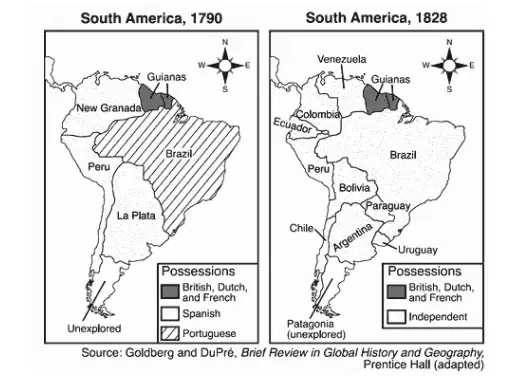
Based on a comparison of these maps of South America, which conclusion is accurate?
a)
Many regions of South America gained their independence between 1790 and 1828.
b)
All of South America was independent by 1828.
c)
Spain continued to gain South American colonies in the 19th century.
d)
Between 1790 and 1828, South American political boundaries remained unchanged except for Brazil.
2.
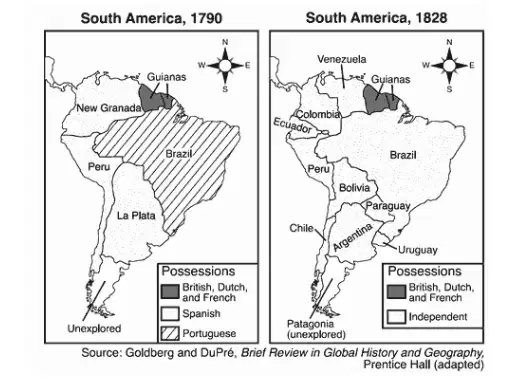
A historian could best use these maps to study which of the following?
a)
the results of nationalism in Latin America
b)
the impact of roads in the Andes Mountains
c)
the effects of globalization
d)
the causes of the French Revolution
3.
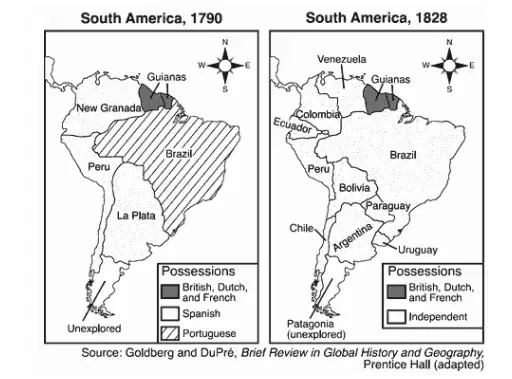
Which individual is most closely associated with the changes indicated on these maps?
a)
Emiliano Zapata
b)
Simón Bolívar
c)
Porfirio Diaz
d)
Pancho Villa
4.

According to the timeline, which period of Haiti's history had the greatest European influence?
a)
1492-1804
b)
1805-1914
c)
1915-1934
d)
1950-1986
5.

Select the correct invention that matches the image:
a)
cotton gin
b)
telegraph
c)
bessemer converter
d)
flying shuttle
e)
spinning jenny
6.
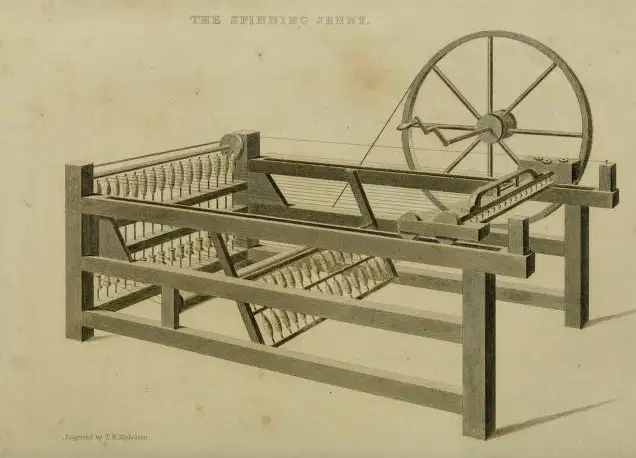
Select the correct invention that matches the image:
a)
spinning jenny
b)
telegraph
c)
bessemer converter
d)
flying shuttle
e)
steel plow
7.
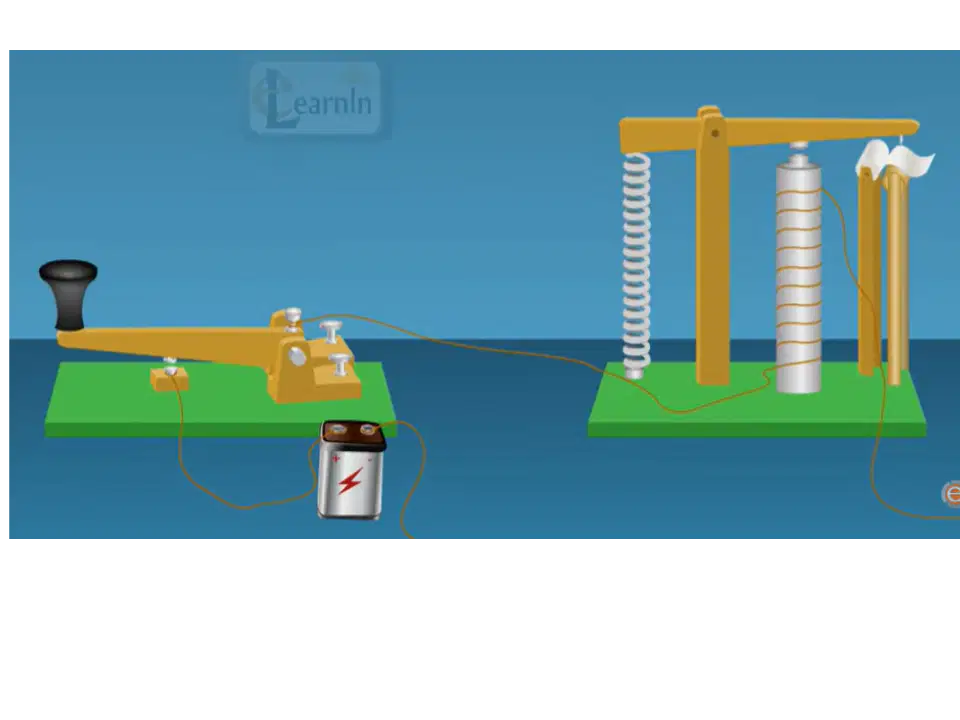
Select the correct invention that matches the image:
a)
telegraph
b)
bessemer converter
c)
flying shuttle
d)
spinning jenny
e)
steel plow
8.
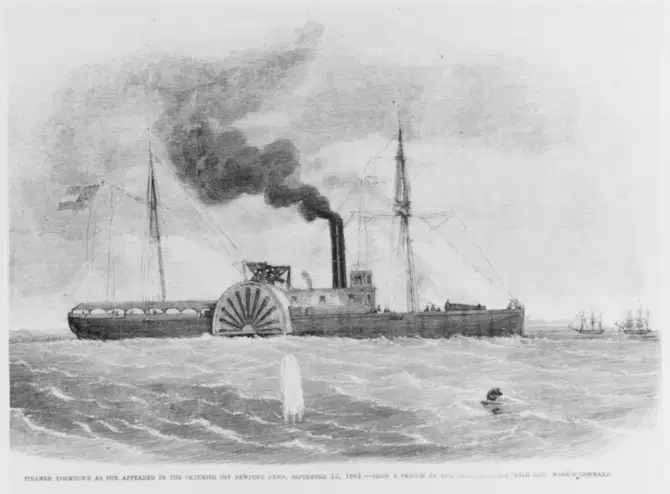
Select the correct invention that matches the image:
a)
steamboat
b)
telegraph
c)
bessemer converter
d)
flying shuttle
e)
spinning jenny
9.

Select the correct invention that matches the image:
a)
bessemer converter
b)
telegraph
c)
flying shuttle
d)
spinning jenny
e)
steel plow
10.
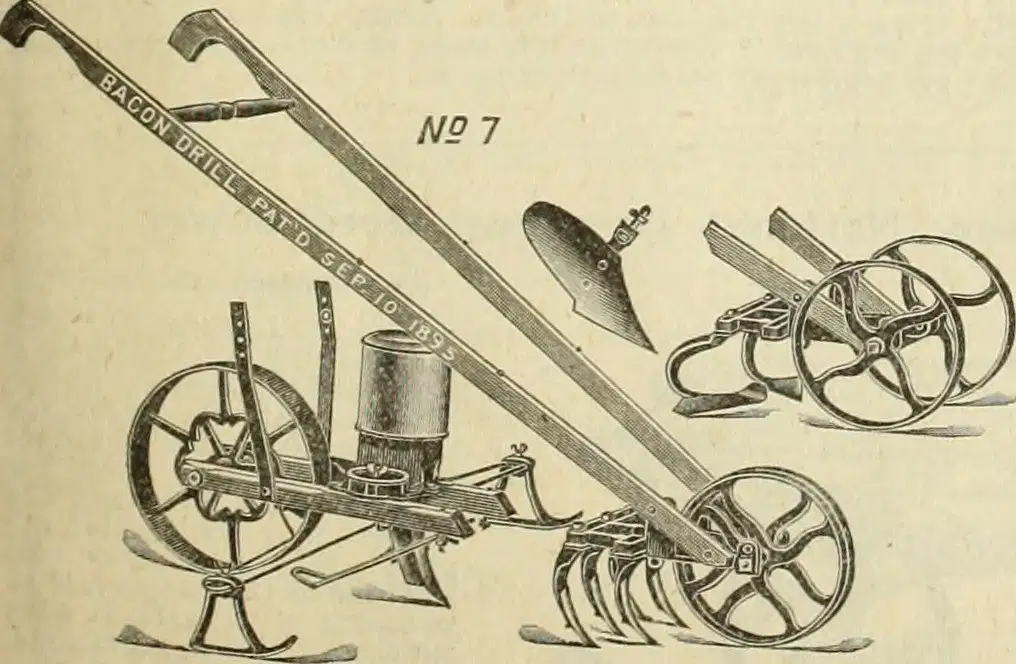
Select the correct invention that matches the image:
a)
seed drill
b)
telegraph
c)
bessemer converter
d)
flying shuttle
e)
spinning jenny
11.
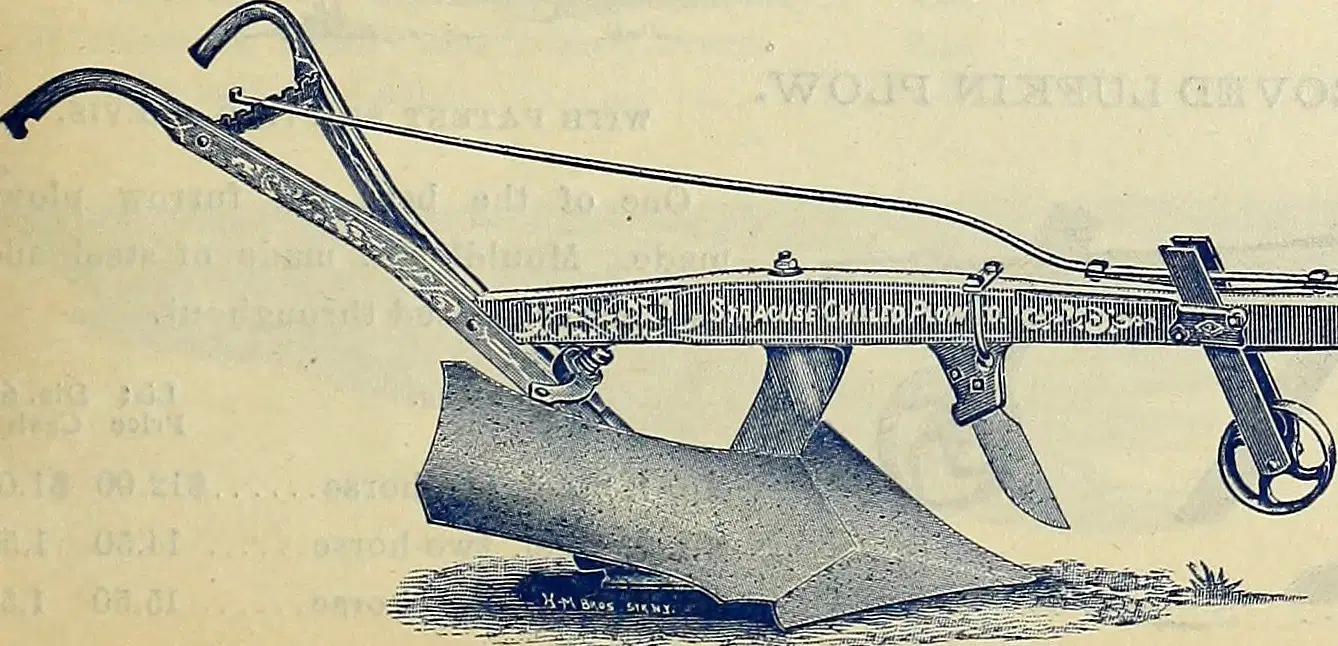
Select the correct invention that matches the image:
a)
steel plow
b)
telegraph
c)
bessemer converter
d)
flying shuttle
e)
spinning jenny
12.

Select the correct invention that matches the image:
a)
power loom
b)
telegraph
c)
bessemer converter
d)
flying shuttle
e)
spinning jenny
13.

Select the correct invention that matches the image:
a)
flying shuttle
b)
telegraph
c)
bessemer converter
d)
spinning jenny
e)
steel plow
14.
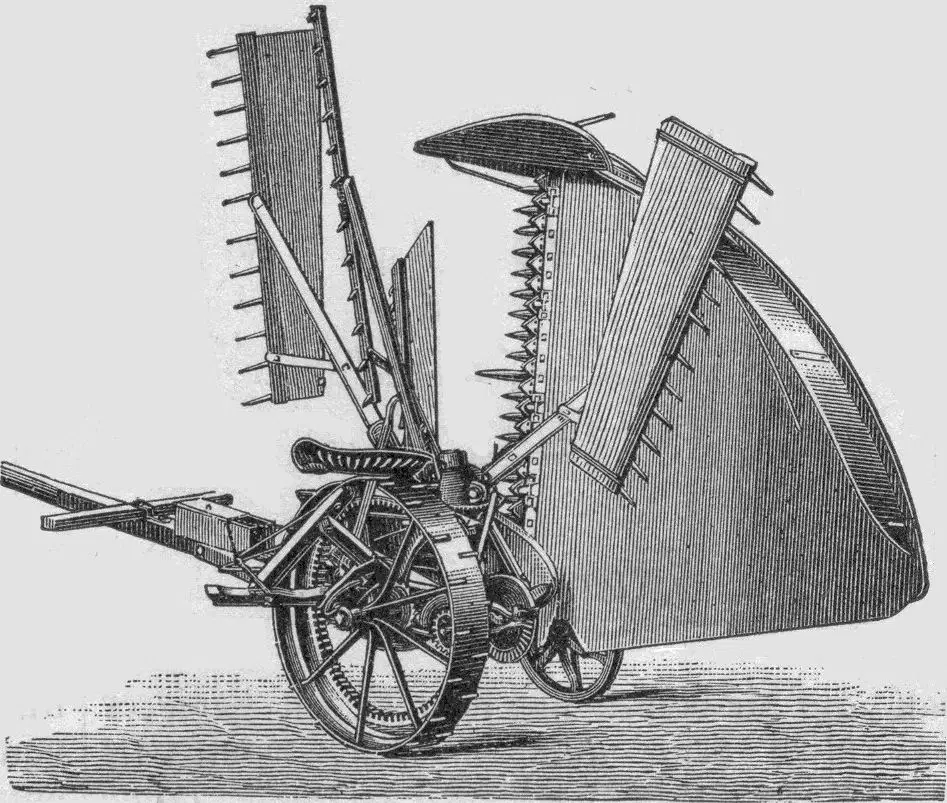
Select the correct invention that matches the image:
a)
mechanical reaper
b)
telegraph
c)
bessemer converter
d)
flying shuttle
e)
spinning jenny
15.
What percentage of the French population belonged to the Third Estate?
a)
50%
b)
10%
c)
97%
d)
25%
16.
Why was the Tennis Court Oath historically significant?
a)
Members committed to creating a fair constitution
b)
It established a new tax system
c)
It overthrew the monarchy immediately
d)
It declared war on Austria
17.
What key problem did Louis XVI face during his reign?
a)
Religious persecution
b)
Foreign invasion
c)
Massive national debt
d)
Lack of military power
18.
What percentage of taxes did the Third Estate pay?
a)
35%
b)
50%
c)
25%
d)
75%
19.
Why were the French parliaments opposed to tax reforms?
a)
They believed in total economic equality
b)
They wanted to protect their own economic interests
c)
They wanted to reduce government spending
d)
They supported the monarchy completely
20.
What was the Enlightenment's primary influence on the Third Estate?
a)
Support for religious control
b)
Desire for absolute monarchy
c)
Ideas of natural rights and social contract
d)
Maintaining existing social structures
21.
Why did the bourgeoisie storm the Bastille on July 14, 1789?
a)
To obtain weapons and free prisoners
b)
To overthrow the king
c)
To start a national holiday
d)
To protest bread prices
22.
What was the primary significance of the Declaration of the Rights of Man and the Citizen?
a)
It established complete democracy
b)
It abolished the monarchy entirely
c)
It created a new tax system
d)
It set forth fundamental human rights
23.
Who led the Committee for Public Safety during the Terror?
a)
Maximilien Robespierre
b)
Georges Danton
c)
Napoleon Bonaparte
d)
Louis XVI
24.
What unique action did Napoleon take during his coronation?
a)
He crowned himself
b)
He refused to be crowned
c)
He abdicated immediately
d)
He was crowned by the pope
25.
What happened to Louis XVI during the French Revolution?
a)
He negotiated a peace treaty
b)
He was tried and executed for treason
c)
He was exiled
d)
He remained in power
26.
Which of the following show events in the correct chronological order?
a)
Reign of Terror, Congress of Vienna, Tennis Court Oath, Women's March to Versailles
b)
Declaration of the Rights of Man and of the Citizen, Estates-General Convened, Storming of the Bastille, Napoleonic Code Established
c)
The Rise of Napoleon, Execution of Louis XVI, Congress of Vienna, Tennis Court Oath
d)
Estates-General Convened, Tennis Court Oath, Reign of Terror, Robespierre's Fall (Execution)
27.
Why was Galileo considered controversial during his time?
a)
He supported the Catholic Church completely
b)
He never published any scientific work
c)
He used the Scientific Method to challenge existing beliefs
d)
He supported absolute monarchy
28.
How did the Scientific Method fundamentally change human understanding of the world?
a)
By maintaining traditional beliefs
b)
By supporting absolute monarchies
c)
By reinforcing religious explanations
d)
By introducing direct observation and experimentation
29.
What was the primary significance of Copernicus's heliocentric theory?
a)
It had no scientific importance
b)
It challenged the Catholic Church's geocentric worldview
c)
It completely proved the Earth was flat
d)
It supported absolute monarchy
30.
How did Isaac Newton contribute to scientific understanding?
a)
He developed Laws of Motion
b)
He supported geocentric theory
c)
He discovered electricity
d)
He invented the telescope
31.
What was the primary intellectual shift during the Age of Reason?
a)
Relying on reason instead of faith
b)
Using faith to explain phenomena
c)
Rejecting all scientific inquiry
d)
Supporting absolute monarchy
32.
True/False
Copernicus was put on house arrest for the remainder of his life.
a)
True
b)
False
33.
Which period in European history inspired the Scientific Revolution?
a)
a) Renaissance
b)
b) Age of Exploration
c)
c) Enlightenment
d)
d) Middle Ages
34.
What was the main change brought about by the Scientific Revolution?
a)
a) A shift in power structures
b)
b) A revival of art and literature
c)
c) A change in the way people thought about science and the universe
d)
d) An increase in exploration and trade
35.
What was the outcome of Galileo Galilei's trial by the Catholic Church?
a)
a) He was executed for heresy
b)
b) He was put under house arrest for the rest of his life
c)
c) He was excommunicated from the Church
d)
d) He was declared innocent and released
36.
Which invention played a significant role in spreading the ideas of the Scientific Revolution?
a)
a) The telescope
b)
b) The printing press
c)
c) The microscope
d)
d) The steam engine
37.
What was the period of intellectual depth and reason that followed the Scientific Revolution called?
a)
a) Renaissance
b)
b) Enlightenment
c)
c) Age of Exploration
d)
d) Middle Ages
38.
Who believed that people are naturally bad and need a king to govern them?
a)
a) Thomas Hobbes
b)
b) John Locke
c)
c) Jean-Jacques Rousseau
d)
d) Baron de Montesquieu
39.
In which continent did the Enlightenment mainly take place?
a)
a) Europe
b)
b) Asia
c)
c) Africa
d)
d) North America
40.
What made the Scientific Revolution a turning point for the world?
a)
a) The discovery of new lands and resources
b)
b) The development of new artistic styles
c)
c) The advancement of scientific knowledge and understanding
d)
d) The establishment of new political systems
41.
According to Locke's view of human nature, people in a state of nature are fundamentally:
a)
Rational and capable of cooperation
b)
Completely selfish and destructive
c)
Incapable of forming social bonds
d)
Inherently violent and chaotic
42.
According to Hobbes' view of human nature, what best describes the state of nature?
a)
A harmonious communal existence
b)
A chaotic war of all against all
c)
A peaceful cooperative environment
d)
A structured tribal society
43.
How does limited government protect individual freedoms?
a)
By restricting government's ability to infringe on personal rights
b)
By eliminating democratic processes
c)
By centralizing political authority
d)
By expanding governmental powers
44.
Which development began the Industrial Revolution in Britain?
a)
The discovery of electricity
b)
A large gold discovery in Britain
c)
Agricultural improvements that increased productivity
d)
A major political revolution in Britain
45.
What was one major effect of the Enclosure Movement?
a)
It created more common land for poor villagers
b)
Small farmers were pushed off land and became available labor for factories
c)
It reduced food production dramatically
d)
It eliminated the need for seasonal labor
46.
Which invention by Jethro Tull increased farming efficiency?
a)
The seed drill
b)
The power loom
c)
The steam engine
d)
The spinning jenny
47.
Charles Townshend is known for which agricultural innovation?
a)
The four-field crop rotation system
b)
Invention of the seed drill
c)
The assembly line
d)
The power loom
48.
Why were early textile mills often located near rivers?
a)
Waterpower from rivers was used to run machinery
b)
Rivers provided free raw materials
c)
River water was used to dye clothing only in factories
d)
Rivers allowed farmers to live at factories
49.
Which energy source became major during the Industrial Revolution?
a)
Hydroelectric dams (modern type)
b)
Steam power (steam engine)
c)
Solar power
d)
Nuclear energy
50.
The Bessemer Process improved production of which material?
a)
Glass
b)
Steel
c)
Cotton
d)
Coal
51.
Which transportation improvement most directly connected mines, factories, and markets?
a)
Commercial airlines
b)
Paved highways for cars
c)
Subway systems
d)
Railroads
52.
What was a major social effect of the Industrial Revolution on cities?
a)
All cities got modern sanitation immediately
b)
Rapid urbanization that caused overcrowding and poor sanitation
c)
Cities became private for only the wealthy
d)
Urban populations decreased
53.
What described factory labor for many workers early in the Industrial Revolution?
a)
Short hours and high wages
b)
Guaranteed pensions and insurance
c)
Mostly remote work from home
d)
Long hours, low wages, and unsafe conditions
54.
What effect did mass production have on prices and availability of goods?
a)
Higher prices and fewer goods
b)
Lower prices and wider availability of manufactured goods
c)
No effect on prices
d)
Goods became available only to the elite
55.
How did industrialization affect global trade and empires?
a)
Global trade shrank
b)
Industrialization ended colonialism
c)
Demand for raw materials increased and colonial empires supplied resources
d)
Empires stopped trading
56.
Which sector supplied the raw materials needed by early factories?
a)
Local art galleries
b)
Tourism industry
c)
Small-scale retail only
d)
Agriculture and colonial sources
57.
Which social change resulted from industrialization in Europe?
a)
The growth of an industrial working class and an expanding middle class
b)
Return to feudal serfdom
c)
Elimination of social classes
d)
Society dominated by artisans only
58.
What is the primary definition of Imperialism?
a)
The takeover of a country by a stronger nation to dominate its political, economic, and social life
b)
A diplomatic relationship between countries
c)
A trade agreement between equal nations
d)
A peaceful cultural exchange between nations
59.
What was the primary economic motivation for European imperialism?
a)
Exploring new territories
b)
Reducing population pressure
c)
Spreading religious beliefs
d)
Acquiring natural resources and creating new markets for manufactured goods
60.
What concept suggested that some societies were naturally more equipped to be successful than others?
a)
Nationalism
b)
Social Darwinism
c)
Racism
d)
Colonialism
61.
What was the 'White Man's Burden'?
a)
A religious doctrine
b)
The belief that Western nations had a duty to 'civilize' people of 'inferior' races
c)
A scientific theory
d)
A trade policy
62.
What event regulated European imperialism and trade in Africa?
a)
The Paris Treaty
b)
The London Conference
c)
The Berlin Conference
d)
The African Summit
63.
What were the two primary methods of colonial rule?
a)
Cultural and Religious Rule
b)
Economic and Political Rule
c)
Direct and Indirect Rule
d)
Military and Diplomatic Rule
64.
What characterized Indirect Rule?
a)
Total cultural assimilation
b)
Military occupation
c)
Complete removal of local leaders
d)
Ruling through established indigenous leaders with limited power
65.
What motivated European nations' colonial expansion regarding nationalism?
a)
Promoting global cooperation
b)
Increasing national pride through colonial holdings
c)
Creating cultural exchanges
d)
Reducing international tensions
66.
What term describes the rapid European competition for African territories?
a)
The Colonial Race
b)
The Scramble for Africa
c)
The African Expansion
d)
The Imperial Contest
67.
Which European power was known for Indirect Rule?
a)
Great Britain
b)
Spain
c)
Germany
d)
France
68.
Which medical breakthrough allowed Europeans to survive in African territories?
a)
Penicillin
b)
Morphine
c)
Quinine
d)
Aspirin
69.
What was the primary purpose of the Berlin Conference of 1884-1885?
a)
To establish trade routes
b)
To negotiate peace treaties
c)
To divide Africa among European powers
d)
To study African cultures
70.
What were sepoys in the British colonial system?
a)
Trade merchants
b)
British officers
c)
Indian soldiers
d)
Political administrators
71.
Why was India called the 'Jewel in the Crown' of the British Empire?
a)
Its abundant raw materials and market potential
b)
Its strategic military importance
c)
Its large population of 300 million
d)
Its beautiful landscape
72.
What positive infrastructure did British imperialism bring to India?
a)
Full cultural preservation
b)
Railroads and modern road networks
c)
Complete political freedom
d)
Total economic independence
73.
Why were raw materials important to European imperial powers in Southeast Asia?
a)
They reduced the need for trade with other European nations.
b)
They supplied resources like rubber, sugar, and coffee needed for industrial economies.
c)
They were used mainly for military weapons production.
d)
They helped Europeans convert colonies to Christianity.
74.
How did the Dutch organize society in Indonesia?
a)
They created a rigid caste system placing Dutch at the top.
b)
They allowed equal rights for all groups.
c)
They abolished social classes entirely.
d)
They gave full political control to plantation workers.
75.
Which countries made up French Indochina?
a)
Indonesia, Malaysia, and Singapore.
b)
Vietnam, Laos, and Cambodia.
c)
Thailand, Myanmar, and Malaysia.
d)
China, Korea, and Japan.
76.
What type of society did Japan have from 1185 to 1853?
a)
A democratic republic.
b)
A capitalist industrial society.
c)
A feudal society led by military rulers.
d)
A communist government.
77.
What event ended Japan’s isolation from the world?
a)
The Opium Wars.
b)
The Boxer Rebellion.
c)
The arrival of U.S. warships led by Commodore Matthew Perry.
d)
The Taiping Rebellion.
78.
Why did Japan begin to expand outside its borders?
a)
It lacked natural resources like iron and oil.
b)
It wanted to spread democracy.
c)
It was forced by European powers.
d)
It wanted to isolate itself again.
79.
What was the purpose of the Opium Wars?
a)
China wanted to colonize Britain.
b)
Britain wanted to force China to continue trading opium.
c)
Japan wanted access to Chinese ports.
d)
Russia wanted control of Hong Kong.
80.
What was a result of the Treaty of Nanjing?
a)
Opium trade ended permanently.
b)
Britain gained Hong Kong and special trading rights.
c)
China gained control of British ports.
d)
China modernized immediately.
81.
What were Spheres of Influence in China?
a)
Military training zones.
b)
Areas dominated economically by foreign powers.
c)
Independent Chinese provinces.
d)
Chinese colonies in Europe.
82.
What was the Open Door Policy?
a)
A Japanese military strategy.
b)
A Chinese policy to expel foreigners.
c)
A treaty ending imperialism.
d)
A policy calling for equal trading rights in China.
83.
What was the goal of the Boxer Rebellion?
a)
To modernize China’s economy.
b)
To support European imperialism.
c)
To remove foreign influence from China.
d)
To create a communist government.
100 %

