
 Worksheets
6.3 Mastery 1 - Particle Motion
Total questions: 12
Worksheet time: 6mins
Name
Class
Date
1.
First Name
4 lines
2.
Last Name
4 lines
3.
1. What happens to the air molecules when the air near the ground warms up?
a)
They slow down
b)
They speed up and spread farther apart.
c)
They clump together
d)
They disappear
4.
2. What is the primary way light reaches the ground from the Sun?
a)
Through solid objects
b)
Through radiation in a vacuum
c)
Through convection in the air
d)
Through conduction in the air
5.
3. Which of the following statements best describes how different ground surfaces react to sunlight?
a)
All ground surfaces heat up at the same rate..
b)
Ground surfaces do not absorb sunlight.
c)
Different types of ground surfaces heat up differently
d)
Only water surfaces absorb sunlight
6.
4. At higher temperatures, how do the particles of a substance move?
a)
Slower
b)
They stop moving
c)
Faster
d)
They move in a zig-zag pattern
7.
5. What happens to air particles when they cool down?
a)
The air particles start moving faster and get further apart.
b)
The air particles start moving slower and get closer together.
c)
The air particles remain at the same speed and distance.
d)
The air particles begin to evaporate and disperse.
8.
6. What is evaporation?
a)
The process by which water changes from a liquid to a gas, usually due to heat.
b)
The process of water freezing into ice due to cold temperatures.
c)
The process of water being absorbed by soil and plants.
d)
The process of water being converted into steam without heat.
9.
7. What causes the ground to warm up?
a)
Light from the sun is absorbed by it and it warms up.
b)
The ground absorbs heat from the air above it.
c)
Rainwater seeps into the ground and increases its temperature.
d)
The ground is heated by geothermal energy from below.
10.
8. When molecules are moving fast, what state of matter are they most likely in?
a)
Solid
b)
Liquid
c)
Gas
11.
9. What happens to air molecules when they are heated?
a)
Heated air molecules move more quickly than cooled air molecules.
b)
Heated air molecules move more slowly than cooled air molecules.
c)
Heated air molecules remain at the same speed as cooled air molecules.
d)
Heated air molecules become denser than cooled air molecules.
12.
10. Which picture BEST shows what change occurs when heat is added to ice?
a)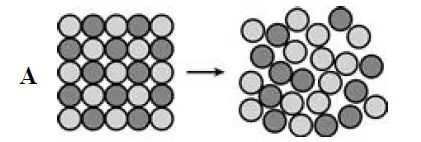
Option A
b)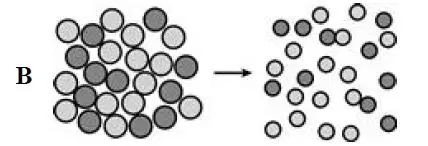
Option B
c)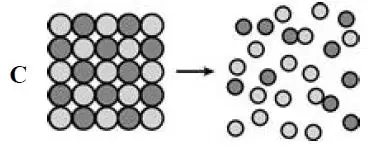
Option C
d)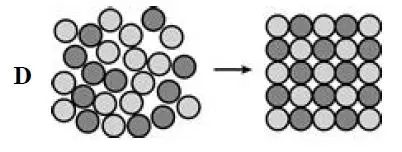
Option D
100 %

