
 Worksheets
T-Level Materials - Intermediate to Advanced Revision
Total questions: 32
Worksheet time: 16mins
Which property describes a material’s resistance to surface indentation?
Toughness
Hardness
Ductility
Malleability
Magnetic permeability measures:
Electrical resistance per metre
Degree to which a material becomes magnetised in an external field
Thermal expansion rate
Electrical permittivity
Electrical resistivity is the inverse of:
Thermal conductivity
Electrical conductivity
Magnetic permeability
Specific heat capacity
Which material is described as having an amorphous structure and softens over a temperature range?
Crystalline ceramic
Glass (borosilicate)
Steel
Carbon fibre composite
Which of the following is true about composites compared with alloys?
Constituents form a single homogeneous phase
Constituents remain physically distinct as matrix and reinforcement
Composites always have lower strength-to-weight ratio
All composites are metallic
Which reinforcement is used in CRP?
Glass-fibre strands
Carbon-fibre strands
Wood fibres
Ceramic particles
Which form of supply is typical for thermoplastic polymers used in injection moulding?
Sheets
Powders
Which thermoset is commonly used as an adhesive and in composites?
UF (Urea-Formaldehyde)
EP (epoxy resin)
PS (Polystyrene)
PLA (Polylactic acid, also known as poly(lactic acid) or polylactide)
Which elastomer has high resistance to chemicals, heat and UV light and is used for wetsuits?
Natural rubber
Neoprene (polychloroprene)
Polypropylene
Silicone
Which of these is a likely consequence of rapid cooling during casting?
Fine, uniform grains throughout
Large, coarse, irregular grains and porosity
Complete elimination of inclusions
Increased weldability
What is the recrystallisation temperature used to describe?
Temperature at which metals melt
Temperature above which new grains form relieving work hardening
Temperature where polymers crosslink
Temperature where ceramics become amorphous
Hot working typically results in which of the following compared with cold working?
Better surface finish and dimensional accuracy
Poor surface finish and reduced dimensional accuracy but less work hardening
No change in grain structure
Increased ductility loss due to work hardening
Which forging method causes recrystallisation mainly in the outer layer only?
Hot press forging
Drop forging
Cold forging
Sinter forging
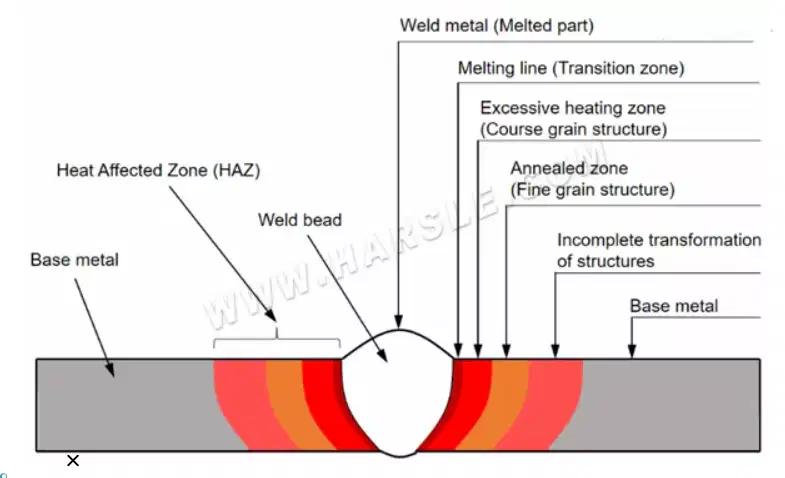
What does HAZ stand for in welding?
Heat-affected zone
High-accuracy zone
Heat and anneal zone
Hardened alloy zone
Why is brazing often preferred over welding for thin-walled components?
It melts the parent metal for stronger joints
It avoids melting the parent metal and reduces thermal distortion
It always produces a higher tensile strength than welding
It requires higher temperatures than welding
Which process fuses metal powders into near full density parts?
Casting
Sintering
Extrusion
Injection moulding
Which surface treatment uses electrostatic spray of thermoplastic particles followed by oven curing?
Painting
Powder coating
Galvanising
Electroplating
Sacrificial anode protection relies on which principle?
Cathodic protection where the protected metal becomes the anode
Anodic protection where the protected metal corrodes first
The sacrificial metal corrodes preferentially protecting the cathode metal
Physical barrier only
Which of the following accelerates rusting of steel?
Dry air only
Presence of salt in water increasing electrolyte effectiveness
Low humidity environments
Coating with zinc
Stress is defined as:
Force per unit volume
Force per unit area
Extension per original length
Energy per unit volume
Strain is a ratio of:
Load to area
Extension to original length
Stress to Young’s modulus
Force to displacement
Young’s modulus is calculated as:
Stress divided by strain
Strain divided by stress
Load times extension
Area divided by length
An M12 bolt example in the text had stress calculated from 1200 N. What is the approximate stress? Use your formula sheet!
10.61 x10⁶ Pa
2.65 Pa
10.61 Pa
194.25x10⁻⁹ Pa
Which test determines surface hardness using a diamond cone indenter and is common for steel?
Izod test
Rockwell HRC test
Pin-on-disc test
Wohler fatigue test
Which fatigue testing result indicates a load below which fatigue failure does not occur for steel?
Endurance limit
Fatigue limit
Yield strength
Ultimate tensile strength
Which material typically does not exhibit a fatigue limit and can fail at any load given enough cycles?
Steel
Cast iron
Aluminium
Ceramic
Electrical conductivity (sigma) is calculated from resistance R, length l and area A as:
σ=lRA
σ=RAl
σ=lAR
σ=RlA
Which stage of creep is characterised by steady, long-term deformation?
Primary creep
Secondary creep
Tertiary creep
Instantaneous creep
Why are single-crystal nickel-based turbine blades used in jet engines?
To increase grain boundary sliding and secondary creep
To eliminate grain boundaries and reduce secondary creep
Because they are cheaper to produce
To increase thermal expansion
Which of the following is NOT a common wear resistance test?
Pin-on-disc
Reciprocating wear test
Izod impact test
None of the above
Which heat-treatment process is used to produce a hard outer layer while retaining a tough core in mild steel?
Annealing
Case hardening
Normalising
Precipitation hardening
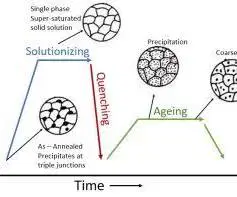
Which of the following best describes the role of precipitates in precipitation hardening?
They increase dislocation mobility
They pin dislocations and prevent movement, increasing hardness
They dissolve permanently during aging
They convert the matrix to martensite

