
 Worksheets
Week 1 Citizenship: Opportunities and Barriers to Participation
Total questions: 15
Worksheet time: 8mins
Which example best illustrates formal participation in a democracy rather than informal engagement?
Sharing campaign posts on social media during elections
Organising a community clean‑up with neighbours
Standing for election to become a local councillor
Donating to a charity that supports community causes
A citizen launches an online petition to be discussed by Parliament. Which concept does this action most directly demonstrate?
Legislation passed by elected officials
Apathy about political participation
Judicial Review challenging court verdicts
E‑democracy tools enabling digital petitions
Pressure groups believe a public body made an unlawful decision. Which route should they use to challenge it?
Mobilising supporters through viral social media
Starting a petition on a private website
Filing a case using the Judicial Review process
Lobbying MPs during constituency surgeries
Which reason reflects a common barrier to citizen participation?
Abundance of free time for civic activities
Confidence that institutions are fully accountable
High trust in politicians’ decision‑making
Belief that personal actions will not make change
Which change is suggested as a way to increase youth voter participation shown in the image?
Raise the voting age to twenty-one
Introduce compulsory voting nationwide
Limit early voting opportunities
Ban online registration systems
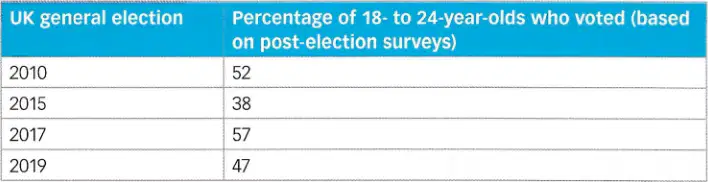
In the provided table, which year shows the highest reported voting percentage among 18–24-year-olds in UK general elections?
2015 shows thirty-eight percent turnout
2017 shows fifty-seven percent turnout
2019 shows forty-seven percent turnout
2010 shows fifty-two percent turnout
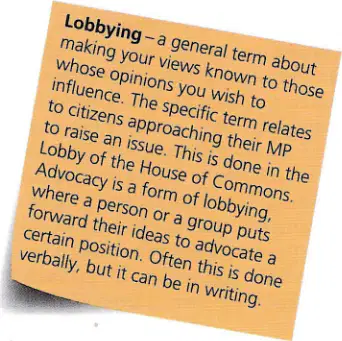
A citizen wants to directly present concerns to their Member of Parliament in the House of Commons. Which action best matches this plan?
Joining a local trade union group
Signing an online petition for support
Distributing leaflets for a viewpoint
Lobbying in the parliamentary lobby
Which example best illustrates non-violent direct action aimed at disrupting normal operations without physical harm?
Filing a formal complaint in court
Spreading rumors about officials online
Organizing a sit-in at a public office
Damaging vehicles during a protest
A boycott is most accurately described as which form of citizen participation?
Refusing to buy goods to pressure change
Joining a party to influence policy
Marching to raise awareness of issues
Writing letters to elected representatives
Joining an interest group offers a key advantage but also a typical drawback. Which pairing captures both?
Full participation; total freedom of action
Focused objectives; limited campaigning role
Publicity boost; universal media accuracy
Large voter base; guaranteed election success
Use of e-media in campaigning provides unique benefits. Which outcome is a realistic advantage highlighted for this method?
Rapid contact with supporters and corrections
Permanent immunity from legal consequences
Protection from party rules and discipline
Assured coverage by national television
Which statement best distinguishes public services from pressure groups?
Public services oppose projects; pressure groups fund libraries
Public services lobby for policies; pressure groups run schools
Public services are membership bodies; pressure groups deliver care
Public services are state providers; pressure groups campaign
A group that focuses on stopping a single infrastructure project while not addressing other issues is classified as which type of pressure group?
Single-cause group
Multi-cause group
Promotional group
Protective group
Which scenario best illustrates insider status for a pressure group?
Regular meetings with policymakers to shape proposals
Public rallies without official consultation access
Refusing participation in formal negotiations
Online petitions to gather widespread signatures
Greenpeace campaigning broadly for environmental protection is an example of which classification?
Public service
Promotional group
Protective group
Insider group

