
 Worksheets
FM-Practice
Total questions: 109
Worksheet time: 2hrs 41mins
Assume that the interest rate is greater than zero. Which of the following cash-inflow streams should you prefer?
Year1 =400
Year2 =300
Year3 =200
Year4 =100
Year1 =100
Year2 =200
Year3 =300
Year4 =400
Year1 =250
Year2 =250
Year3 =250
Year4 =250
Any of the above, since they each sum to $1,000.
You can use to roughly estimate how many years a given sum of money must earn at a given compound annual interest rate in order to double that initial amount .
RULE 415
RULE OF 72
RULE OF 78
RULE 44
It is defined as,
"The process of accumulating interest on an investment over time to earn more interest."
Compounding
Future Value
Simple Interest
Present Value
It is defined as.
"Interest earned only on the original principal amount invested."
Compound Interest
Simple Interest
Interest on Interest
Compounding
True or False.
The future value increases as you increase the time to the future.
TRUE
FALSE
TRUE OR FALSE.
The present value increases as you increase the time between the future value date and the present value date.
TRUE
FALSE
When a lottery price is offered as $10,000,000 but will pay out a series of $250,000 payments over forty years, is it really a $10,000,000 lottery prize?
YES
NO
Suppose you need $200 to buy textbooks next year. You can earn 5 percent on your money. How much do you have to put up today?
Answer needs to have two decimal points.
190.35
190.64
190.51
190.48
The rate used to calculate the present value of future cash flows, is known as
Discount Cash Flow
Discount Rate
Discount
Present Value
TRUE OR FALSE.
The time value of money is the concept that a sum of money is worth more now than the same sum will be at a future date due to its earnings potential in the interim.
TRUE
FALSE
Future value is the value of a future amount at the present time, found by applying compound interest over a specified period of time.
TRUE
FALSE
Interest earned on a given deposit that has become part of the principal at the end of a specified period is called compound interest.
TRUE
FALSE
In future value or present value problems, unless stated otherwise, cash flows are assumed to be
at the end of a time period.
at the beginning of a time period.
spread out evenly over a time period.
The amount of money that would have to be invested today at a given interest rate over a specified period in order to equal a future amount is called
future value.
present value.
annuity due
The annual rate of return is variously referred to as the
discount rate.
opportunity cost.
cost of capital.
all of the above.

Rita promises her daughter on her 12th birthday that she will give her $12,000 for college on her 18th birthday. How much does Rita need to put in the bank now if the interest rate on her account is 12% per year?
$5,248.19
$6,502.12
$11,685.87
$6,079.58
What is the definition of present value?
the future value of a current sum of money
the interest paid on a current sum of money
the current value of a future sum of money
the interest paid on a future sum of money
Randy saves money using an account which earns interest over the course of several years. Which statement is true?
The value of money in his account increases over time.
The present value of money in his account is greater than the future value.
The value of money in his account remains constant over time.
The future value of his account is equal to the present value.
Why does the value of money in a savings account increase over time?
because it earns interest
because it is not spent
because future value is always equal to present value
because future value is always less than present value

If you save $3,000 at an interest rate of 14 percent per year, how much will you have at the end of six years? The interest should be compounded.
$5,805.96
$6,502.34
$6,584.91

What would be the value of $100 after 10 years if you earn 11 percent interest per year?
$259.37
$283.94
$110.46

Kate wants to have $25,000 in 16 years. How much does she need to invest if the interest rate is 6 percent per year?
$10,431.63
$9,841.16
$7,353.88

Todd currently has $5,000. What was the value of his money four years ago if he's earned 4 percent interest each year?
$4,274.02
$4,113.51
$4,109.64

You want to deposit $12,000 in a bank at an interest rate of 8 percent per year. What is the future value of this money after five years?
$15,315.38
$17,631.94
$16,830.62

Nikita invests $2,000 into a bank account with a 4% annual interest rate. In seven years, which is the most expensive item she could afford to buy?
a beach vacation priced at $2,200
a sectional sofa priced at $2,700
a mountain bike priced at $2,500
a home theater system priced at $3,000
Why does the value of money in a savings account increase over time?
because it earns interest
because it is not spent
because future value is always equal to present value
because future value is always less than present value
Compound Value also Called
Present Value
Future Value
Net Value
Both a & b
Present Value also called
Compound Value
Future Value
Discount Value
Both a & b
Which of the following is not a goal of financial management?
Maximization of shareholder's Wealth
Minimization of Cost
Maximization of market value of Shares
Minimization of Revenue
You are currently employed as a Management Accountant in an insurance company. You are contemplating starting your own business. In considering whether or not to start your own business, what would your current salary level be?
A sunk cost
An incremental cost
An irrelevant cost
An opportunity cost
In decision making, costs which need to be considered are said to be relevant costs. Which of the following are characteristics associated with relevant costs?
(i) Future costs
(ii) Unavoidable costs
(iii) Incremental costs
(iv) Differential costs
(i) and (iii) only
(i) and (ii) only
(i), (iii) and (iv) only
All of them
A machine owned by a company has been idle for some months but could now be used on a one year contract which is under consideration. The net book value of the machine is $1,000. If not used on this contract, the machine could be sold now for a net amount of $1,200. After use on the contract, the machine would have no saleable value and the cost of disposing of it in one year's time would be $800.
What is the total relevant cost of the machine to the contract?
$1,200
$1,000
$2,000
$800
Which of the following would be part of the capital expenditure budget?
(i) Purchase of a new factory premises
(ii) Replacement of existing machinery
(iii) Refurbishment of existing factory premises
(iv) Purchases of raw materials
(i) and (ii) only
(iii) and (iv) only
(i), (ii) and (iii) only
(ii) and (iv) only
A building society adds interest monthly to investors' accounts even though interest rates are expressed in annual terms. The current rate of interest is 6% per year.
An investor deposits $1,000 on 1 January. How much interest will have been earned by 30 June?
$20.27
$30.38
$32.59
$19.26
A one-year investment yields a return of 15%. The cash returned from the investment, including principal and interest, is $2,070. What is the interest?
$250
$270
$300
$310.50
If a single sum of $12,000 is invested at 8% per year with interest compounded quarterly, what is the amount to which the principal will have grown by the end of year three? (approximately)
$15,117
$9,528
$15,219
$30,924
4 Which is worth most, at present values, assuming an annual rate of interest of 8%?
$1,200 in exactly one year from now
$1,400 in exactly two years from now
$1,600 in exactly three years from now
$1,800 in exactly four years from now
A bank offers depositors a nominal 4% pa, with interest payable quarterly. What is the effective annual rate of interest?
1%
4%
1.025%
4.06%
A project requiring an investment of $1,200 is expected to generate returns of $400 in years 1 and 2 and $350 in years 3 and 4. If the NPV = $22 at 9% and the NPV = –$4 at 10%, what is the IRR for the project?
9.15%
9.85%
10.15%
10.85%
A sum of money was invested for 10 years at 7% per year and is now worth $2,000. What was the original amount invested (to the nearest $)?
$1,026
$1,017
$3,937
$14,048
House prices rise at 2% per calendar month. What is the annual rate of increase correct to one decimal place?
24%
26.8%
12.7%
12.2%
What is the present value of ten annual payments of $700, the first paid immediately and discounted at 8%, giving your answer to the nearest $?
$4,697
$1,050
$4,435
$5,073
An investor is to receive an annuity of $19,260 for six years commencing at the end of year 1. It has a present value of $86,400.
What is the rate of interest (to the nearest whole percent)?
4%
7%
9%
11%
How much should be invested now (to the nearest $) to receive $24,000 per year in perpetuity if the annual rate of interest is 5%?
$1,200
$25,200
$120,000
$480,000
The net present value of an investment at 12% is $24,000, and at 20% is –$8,000. What is the internal rate of return of this investment?
State your answer to the nearest whole percent.
17%
18%
19%
20%
A capital investment project has an initial investment followed by constant annual returns.
How is the payback period calculated?
Initial investment ÷ annual profit
Initial investment ÷ annual net cash inflow
(Initial investment – residual value) ÷ annual profit
(Initial investment – residual value) ÷ annual net cash inflow
An investment project has a positive net present value (NPV) of $7,222 when its cash flows are discounted at the cost of capital of 10% per year. Net cash inflows from the project are expected to be $18,000 per year for five years. The cumulative discount (annuity) factor for five years at 10% is 3.791.
What is the investment at the start of the project?
$61,016
$68,238
$75,460
$82,778
8Which of the following accurately defines the internal rate of return (IRR)?
The average annual profit from an investment expressed as a percentage of the investment sum
The discount rate (%) at which the net present value of the cash flows from an investment is zero
The net present value of the cash flows from an investment discounted at the required rate of return
The rate (%) at which discounted net profits from an investment are zero
What is the effective annual rate of interest of 2.1% compounded every three months?
6.43%
8.40%
8.67%
10.87%
If the interest rate is 8%, what would you pay for a perpetuity of $1,500 starting in one year's time? (to the nearest $)
18650 $
18750 $
17650 $
18550 $
A project has an initial outflow of $12,000 followed by six equal annual cash inflows, commencing in one year's time. The payback period is exactly four years. The cost of capital is 12% per year.
What is the project's net present value (to the nearest $)?
$333
–$2,899
–$3,778
–$3,778

Diamond Co has a payback period limit of three years and is considering investing in one of the following projects. Both projects require an initial investment of $800,000. Cash inflows accrue evenly throughout the year.
The company's cost of capital is 10%
What is the non-discounted payback period of Project Beta?
2 years and 2 months
2 years and 4 months
2 years and 5 months
2 years and 6 months

Diamond Co has a payback period limit of three years and is considering investing in one of the following projects. Both projects require an initial investment of $800,000. Cash inflows accrue evenly throughout the year.
The company's cost of capital is 10%.
What is the discounted payback period of Project Alpha?
Between 1 and 2 years
Between 3 and 4 years
Between 4 and 5 years
Between 5 and 6 years
A machine has an investment cost of $60,000 at time 0. The present values (at time 0) of the expected net cash inflows from the machine over its useful life are: Discount rate 10% 15% 20%
Present value of cash inflows $64,600 $58,200 $52,100
What is the internal rate of return (IRR) of the machine investment?
Below 10%
Between 10% and 15%
Between 15% and 20%
Over 20%

An investment project has the following discounted cash flows ($'000):
The required rate of return on investment is 10% per year.
What is the discounted payback period of the investment project?
Less than 3.0 years
3.0 years
Between 3.0 years and 4.0 years
More than 4.0 years
An investor has the choice between two investments. Investment Exe offers interest of 4% per year compounded semi-annually for a period of three years. Investment Wye offers one interest payment of 20% at the end of its four-year life.
What is the annual effective interest rate offered by the two investments?
Investment Exe 4.00%
Investment Wye 4.66%
Investment Exe 4.00%
Investment Wye 5%
Investment Exe 4.04%
Investment Wye 4.66%
Investment Exe 4.04%
Investment Wye 5%
What is capital budgeting?
A technique for evaluating employee performance.
A method for calculating short-term profits.
A strategy for managing daily expenses.
Capital budgeting is the process of planning and managing long-term investments.
Why is capital budgeting important for businesses?
It guarantees immediate profits from all projects.
Capital budgeting is important for businesses because it enables informed decision-making regarding long-term investments, ensuring efficient resource allocation and risk management.
It helps businesses avoid all forms of investment risk.
It is only relevant for large corporations.
What are the main methods of capital budgeting?
Net Present Value (NPV), Internal Rate of Return (IRR), Payback Period, Profitability Index (PI)
Return on Investment (ROI)
Cost-Benefit Analysis (CBA)
Market Analysis (MA)
Explain the payback period method.
The payback period method is a financial metric used to determine the time it takes to recover an investment.
The payback period method is used to assess the risk of an investment.
The payback period method calculates the total profit of an investment.
The payback period method determines the interest rate of a loan.
What is the net present value (NPV) method?
A formula to determine the average return on investment
A method to calculate the total revenue of an investment
The net present value (NPV) method evaluates the profitability of an investment by calculating the present value of future cash flows minus the initial investment.
A technique for assessing market trends
How does the internal rate of return (IRR) work?
The IRR is the total profit divided by the total investment cost.
The internal rate of return (IRR) is the discount rate that makes the net present value (NPV) of an investment equal to zero.
The IRR is the average return of an investment over its lifetime.
The IRR is the rate of return that guarantees a profit on all investments.
What is the difference between NPV and IRR?
NPV measures total value in dollars, while IRR measures the rate of return as a percentage.
NPV is used for short-term projects, while IRR is for long-term projects.
NPV considers cash flow timing, while IRR ignores it.
NPV is a percentage, while IRR is a dollar amount.
What factors should be considered in capital budgeting decisions?
Market trends analysis
Employee satisfaction surveys
Customer feedback evaluations
Cash flow projections, cost of capital, risk assessment, project lifespan, tax implications, strategic alignment.
What is the significance of cash flow in capital budgeting?
Cash flow only affects short-term projects.
Cash flow is solely about managing expenses.
Cash flow is irrelevant to investment decisions.
Cash flow is significant in capital budgeting as it determines the profitability and feasibility of investment projects.
How do risk and uncertainty affect capital budgeting?
Uncertainty guarantees accurate cash flow predictions.
Risk has no impact on capital budgeting decisions.
Risk decreases the overall cost of capital.
Risk increases the required return and uncertainty complicates cash flow predictions in capital budgeting.
What is the role of discount rate in capital budgeting?
The discount rate sets the project's operational timeline.
The discount rate is used to calculate tax liabilities.
The discount rate determines the total project cost.
The discount rate helps assess the present value of future cash flows in capital budgeting.
Explain the concept of opportunity cost in capital budgeting.
Opportunity cost is the total cost of an investment including all expenses.
Opportunity cost is the profit gained from the investment itself.
Opportunity cost is the value of the next best alternative foregone when making an investment decision.
Opportunity cost refers to the time taken to make an investment decision.
What is a capital budgeting proposal?
A guideline for daily operational expenses.
A proposal for short-term financing options.
A summary of past financial performance.
A formal document outlining a plan for investing in long-term assets or projects.
How do companies prioritize capital projects?
Companies prioritize capital projects based on strategic alignment, ROI, risk, resources, and timelines.
By following a random selection process
According to the latest market trends only
Based on employee preferences and opinions
What is the difference between independent and mutually exclusive projects?
Independent projects are always more profitable than mutually exclusive projects.
Independent projects require more resources than mutually exclusive projects.
Mutually exclusive projects can be undertaken together, while independent projects cannot.
Independent projects can be undertaken together, while mutually exclusive projects cannot.
What are sunk costs and how do they relate to capital budgeting?
Sunk costs are irrecoverable expenses that should not affect future capital budgeting decisions.
Sunk costs are future expenses that should be included in budgeting decisions.
Sunk costs are recoverable investments that can be recouped later.
Sunk costs are costs that can be adjusted based on future projections.
How can sensitivity analysis be used in capital budgeting?
It determines the exact return on investment for a project.
It eliminates the need for forecasting in capital budgeting.
It guarantees project success by minimizing risks.
Sensitivity analysis helps identify critical variables affecting project outcomes in capital budgeting.
What is the role of inflation in capital budgeting?
Inflation only affects short-term investments in capital budgeting.
Inflation impacts capital budgeting by necessitating adjustments to cash flows and the cost of capital to reflect real value.
Inflation has no effect on cash flow projections.
Inflation decreases the overall cost of capital in budgeting.
How do tax implications affect capital budgeting decisions?
Capital budgeting decisions are solely based on market trends.
Tax implications significantly influence the net cash flows and profitability of capital budgeting decisions.
Tax implications only affect personal finances, not business decisions.
Tax implications have no effect on cash flows.
What are the limitations of capital budgeting techniques?
Capital budgeting techniques guarantee accurate forecasts.
Limitations include reliance on estimates, inadequate time value consideration, neglect of qualitative factors, complexity, and data requirements.
Qualitative factors are always prioritized over quantitative analysis.
All capital budgeting techniques are simple and easy to use.
What is the measure of of economic income on which most analysts today prefer to focus for valuation and capital investment project selection:
EBITDA
EBIT
Net Income
Net Cash Flow
In proper capital budgeting analysis we evaluate incremental
Accounting Income
Cash Flow
Earnings
Operating Profit
Taxing authorities allow the fully installed cost of an asset to be written off for tax purposes. This amount is called the asset's
Cost of Capital
Initial Cash Outlay
Depreciable value of asset
Sunk Cost
All of the following influence capital budgeting cash flows EXCEPT:
depreciation
Salvage value
Tax rate
Method of project financing used
Adam Smith is considering automating his pin factory with the purchase of a $475,000 machine. Shipping and installation would cost $5,000. Smith has calculated that automation would result in savings of $45,000 a year due to reduced scrap and $65,000 a year due to reduced labor costs. The machine has a useful life of 4 years and follows straight-line depreciation for tax purposes. The estimated final salvage value of the machine is $120,000. The firm's marginal tax rate is 34 percent. The incremental cash outflow at time period 0 is closest to
280000
380000
480000
580000
Which of the following is not a typical cash flow related to equipment purchase and replacement decisions?
Increased operating costs
Overhaul of equipment
Salvage value of equipment when project is complete
Depreciation expense
If a company's required rate of return is 10% and, in using the net present value method, a project's net present value is zero, this indicates that the
Project's rate of return exceeds 10%.
Project's rate of return is less than the minimum rate required.
Project earns a rate of return of 10%.
Project earns a rate of return of 0%.
If PI of the Project A is 1.2 ; Project B is 1.1 ; Project C is 1.4 and Project D is 1.8 then Rank will be as ______
A,C,B,D
D,C,A,B
C,D,B,A
B,D,C,A
If PI of the Project is 1.2 and Cash outflow is Rs 4 Lakh then cash Inflow is ____
Rs 4,00,000
Rs 5,00,000
Rs 6,00,000
Rs 4,50,000
If PVCIF is Rs 8,50,000 and PVCOF is Rs 4,50,000 then NPV is ______
Rs 4,00,000
Rs 40,000
Rs 40,00,000
Rs 13,00,000
___________ is the planning process used to determine whether an organization long term investments
Capital Rationing
Capital Budgeting
Cost of Capital
Leverage
A set of projects in which the acceptance of one project means that the others cannot be accepted
Replacement Decision
Expansion Decision
Independent Projects
Mutually Exclusive Projects
This answers the question, "How much is my asset worth right now?"
net present value
internal rate of return
discount rate
capital budgeting
The details of an investment project are as follows:
Cost of asset bought at the start of the project $80,000
Annual cash inflow $25,000
Cost of capital 5% each year
Life of the project 8 years
What is the net present value of the project?
-$120,000
$120,000
$81,575
-$81,575
A company is planning to open a new store in a new geographic location. An initial site
evaluation has taken place at a cost of $5,000 and a store location has been found. The new
store can be rented for $9,500 per annum. It will require refurbishment at a cost of $320,000.
Which of the following costs are relevant for an NPV calculation?
(i) $5,000
(ii) $9,500
(iii) $320,000
(i) only
(i) and (ii)
(ii) and (iii)
(iii) only
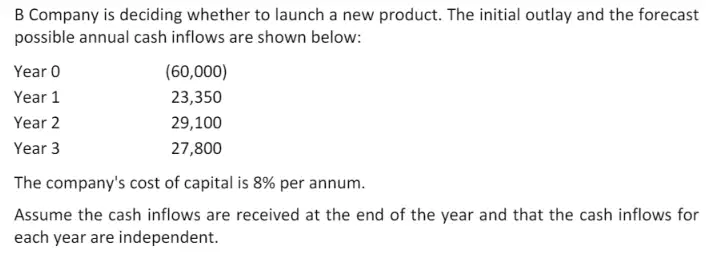
What is the net present value to the nearest $ for the product?
(a)
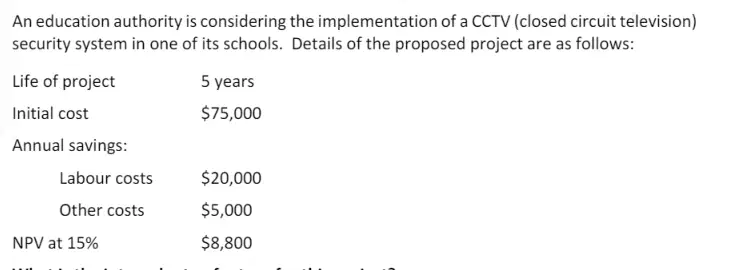
What is the internal rate of return for this project?
16%
18%
20%
22%
The following measures have been calculated to appraise a proposed project
The internal rate of return is 12%
The return on capital employed is 16%
The cost of capital is 10%
The payback period is 4 years
Which of the following statements is correct?
the payback is less than 5 years so the project should go ahead
the IRR is lower than the return on capital employed so the project should not go ahead
the IRR is greater than the cost of capital so the project should go ahead
The IRR is positive so the project should go ahead
CC Company is considering an investment of $300,000 which will earn a contribution of
$40,000 each year for 10 years at todavs prices. The company's cost of capital is
11% per annum.
What is the net present value of the project?
($64,440)
$23,556
$64,440
$235,560
JAH Company is about to invest $400,000 in machinery and other capital equipment for a
new product venture. Cash flows for the first three years are estimated as follows:
Year $000
1 210
2 240
3 320
JAH Company requires a 17% return for projects of this type.
What is the NPV of this venture?
-$154,670
$45,010
$220,450
$154,670
A company has determined that the net present value of an investment project is $17,706
when using a 10% discount rate and $(4,317) when using a discount rate of 15%.
What is the internal rate of return of the project to the nearest 1%?
(a)
A company is considering an investment of in new machinery. The machinery is
expected to yield incremental profits over the next five years as follows:
Year Profit
1 175,000
2 225,000
3 340,000
4 165,000
5 125,000
Thereafter, no incremental profits are expected and the machinery will be sold. It is company
policy to depreciate machinery on a straight line basis over the life of the asset. The
machinery is expected to have a value of $50,000 at the end of year 5.
What is the payback period of the investment in this machinery?
0.9 years
1.3 years
1.5 years
1.9 years
What is an interest rate that includes the effect of compounding known as?
Nominal interest
Simple interest
Compound interest
Effective interest
Which of the following statements about the IRR method are true?
(i) IRR considers the time value of money
(ii) if the IRR exceeds the companies cost of capital the NPV at the company's cost of
(iii) capital should be positive
it is possible for one investment to have 2 IRRs
(i) only
(i) and (ii) only
(ii) and (iii) only
(i), (ii) and (iii)
What is the annual rate of interest of 2.1% compounded every three months?
6.43%
8.40%
8.67%
10.87%
A bank offers different bank accounts with different interest rates:
Bank account I = 10% interest per year, interest calculated quarterly
Bank account 2 = 12% interest per year, interest calculated monthly
Bank account 3 = 1.2% interest per month
Bank account 4 = 3% interest per quarter
Which account gives the highest annual effective interest rate?
1
2
3
4
What is the formula to calculate yield to maturity?
Net Present Value (NPV) formula
Payback Period formula
Discounted Cash Flow (DCF) formula
Internal Rate of Return (IRR) formula
A bond with a coupon rate of 5% and a face value of $1,000 is currently trading at $950. What is the yield to maturity?
5.53%
6.25%
3.85%
4.75%
What is the coupon rate of a bond that pays an annual coupon of $80 and has a face value of $1,000?
8%
10%
15%
5%
A bond has a duration of 5 years. If interest rates increase by 1%, what is the approximate percentage change in the bond's price?
-5%
10%
-1%
0%
A zero-coupon bond with a face value of $1,000 is currently trading at $800. What is the yield to maturity?
0.2
0.1
0.3
0.5
An investor who owns a bond with a 9% coupon rate that pays interest semiannually and matures in three years is considering its sale. If the required rate of return on the bond is 11%, the price of the bond per 100 of par value is closest to:
95.00.
95.11.
105.15.
A portfolio manager is considering the purchase of a bond with a 5.5% coupon
rate that pays interest annually and matures in three years. If the required rate
of return on the bond is 5%, the price of the bond per 100 of par value is closest
to:
98.65.
101.36.
106.43.

