
 Worksheets
Math 106 Unit 1 Quiz
Total questions: 25
Worksheet time: 20mins
"Make sense of problems and persevere in solving them" encourages students to:
Understand the problem and work through productive struggle
Avoid making mistakes
Solve problems as quickly as possible
Memorize steps for every type of problem
Reason abstractly and quantitatively involves:
Memorizing formulas
Breaking apart problems using symbols or pictures
Only using standard algorithms
Avoiding manipulatives
To construct viable arguments and critique reasoning, students must:
Work silently
Avoid discussing errors
Use mathematical language to justify thinking
Follow only the teacher’s method
Modeling with mathematics means:
Using math only in math class
Solving real-world problems, organizing data, and using manipulatives
Avoiding graphs or visuals
Using only textbook examples
A key part of using appropriate tools strategically is:
Only using digital tools
The teacher choosing the tool
Avoiding manipulatives
Students selecting and justifying their tools
Attend to precision means students should:
Estimate answers without explanation
Use exact mathematical vocabulary and precise reasoning
Complete problems quickly
Skip steps when they know the answer
Rote counting is:
Telling what number comes before another
Comparing quantities
Saying numbers in order from memory
Assigning numbers to objects
Cardinal numbers tell:
Position of objects
How to form patterns
How many items in a set
How to sort objects
Seriation involves:
Identifying repeating patterns
Sequencing objects (smallest to largest)
Matching objects to numbers
Counting backwards
Preschool geometry includes:
Solving algebraic equations
Naming shapes and directional words
Reading numbers up to 100
Memorizing multiplication facts
Number talks involve:
Timed math fact tests
Students explaining mental strategies
Silent independent practice
Worksheet reinforcement
A low floor, high ceiling task:
Requires memorizing steps
Allows all students to engage at multiple levels and differentiation
Has one right answer
Only advanced students can do
In a number talk, what is expected from students?
Working silently without discussion
Explaining how they solved mentally
Following a worksheet procedure
Fast recall of facts only
An example of an ordinal number would be
13
22nd
-45
3/4
_____ is the first step to representation in an infant.
Object permanence
Rote Counting
Ordinal Numbers
Blocks
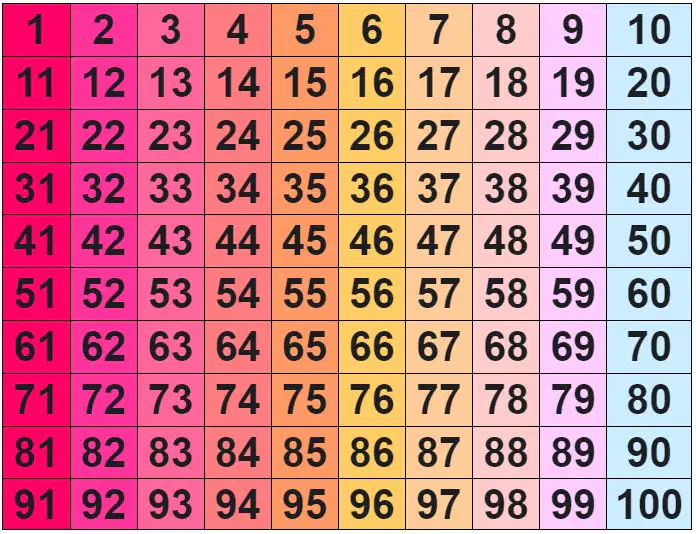
This is an example of a ____
multiplication chart
number chart
Graphic organizer
Number Diagram
Give an example of a math literacy lesson in any grade level.
Create a fact family tree for addition and subtraction from any given number.
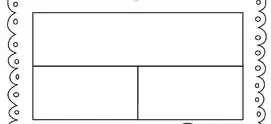
What is this an example of?
What is the basic math kindergarten standard?
Multiply single digit numbers
Add and subtract within 10
Add and subtract within 20
Add and subtract within 5
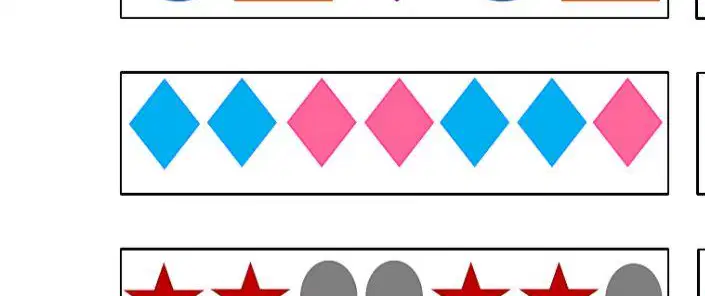
This image show what type of pattern
ABAB
AABB
ABCAB
ABBA
Construct viable arguments and critique the reasoning of others can be an example of
Rewarding students to push through challenges
Using a ruler for measurement
Using manipulatives for a visual
Number Talks
Activities parents and toddlers/preschoolers can do together to build numeracy skills include
sorting toys and building with blocks.
Race toy cars and talk about which came first, second or third.
When you’re preparing food, talk about what you’re doing. For example, ‘I’m cutting this orange in half’ or ‘Let’s share these sultanas – one for me and one for you’.
All the Above

The picture depicts a
Number talk
one to one correspondence
Base 10
10 frame
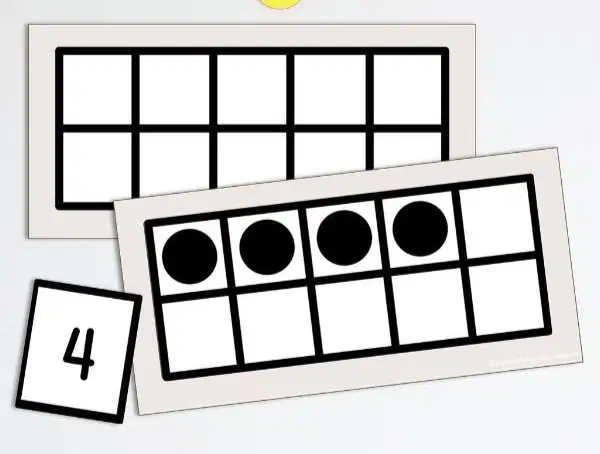
The picture depicts a
Base 10
Number Talk
10 Frame
One to One correspondence

