
 Worksheets
Page 1
Total questions: 150
Worksheet time: 1hrs 15mins
Which layer includes Earth’s crust together with the uppermost mantle, forming rigid tectonic plates?
Asthenosphere beneath the crust
Lithosphere including upper mantle
Lower mantle convection zone
Inner core of solid iron
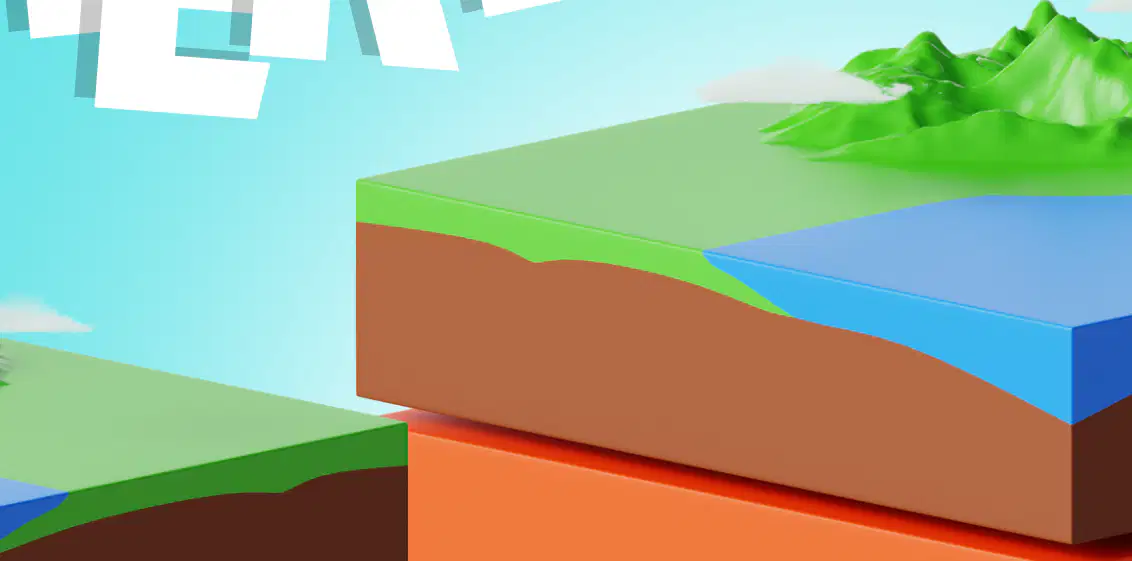
What best describes Earth’s crust compared with the mantle shown in the diagram blocks?
Thinner and less dense overall
Same thickness everywhere
Thicker and denser overall
Hotter and more fluid overall
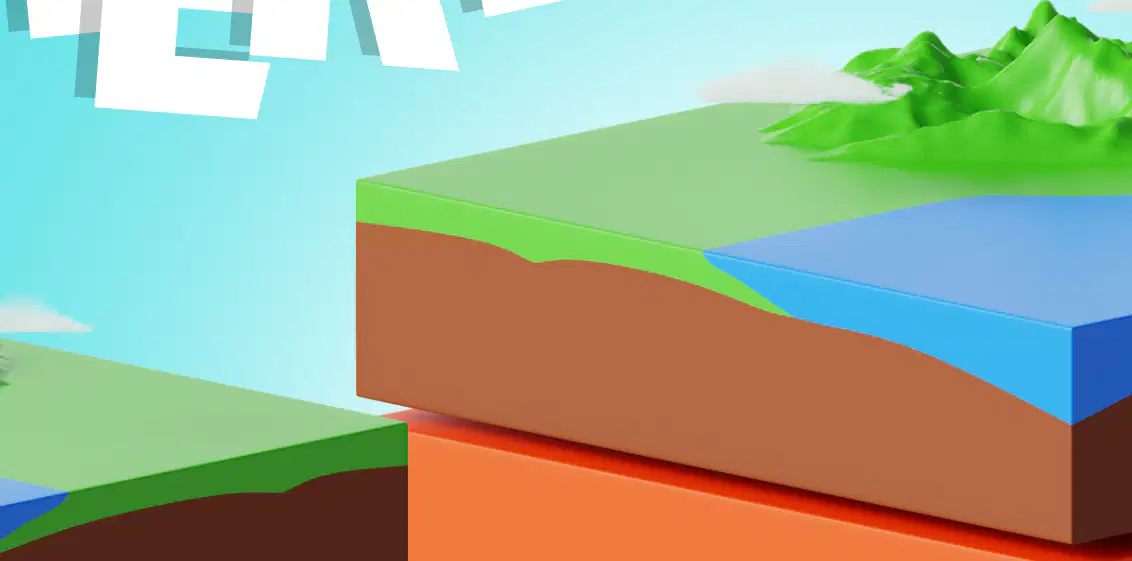
Mountains on the model surfaces most likely form at which plate interaction?
Divergent boundary spreading apart
Transform boundary sliding laterally
Convergent boundary colliding plates
Hotspot under oceanic ridge
The rigid plates of the lithosphere move over which softer, partially molten layer?
Mesosphere lower crust
Asthenosphere upper mantle
Outer core liquid metal
Exosphere thin atmosphere
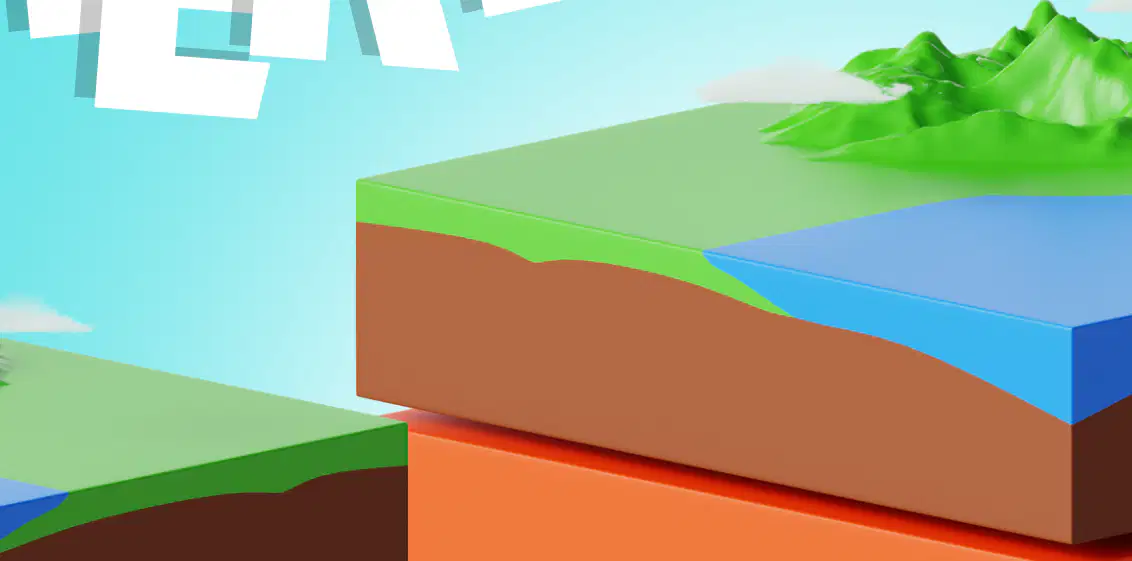
Which surface feature on the blocks indicates a continental crust area rather than oceanic crust?
Raised mountain range land
Deep blue basin widespread
Thin green strip only
Bright orange lower layer
Which statement about tectonic plates is most accurate for the scene?
Plates melt completely while moving
Plates move thousands of km daily
Plates move a few centimeters yearly
Plates are stationary forever
If two oceanic plates diverge at a mid-ocean ridge, what new crust forms?
Granite plutons from continents
Basaltic igneous from magma
Metamorphic schist from pressure
Sedimentary layers from erosion
A student claims the lithosphere is only the crust. What correction should be given?
Includes crust and inner core
Includes mantle and atmosphere
Includes mantle and outer core
Includes crust and upper mantle
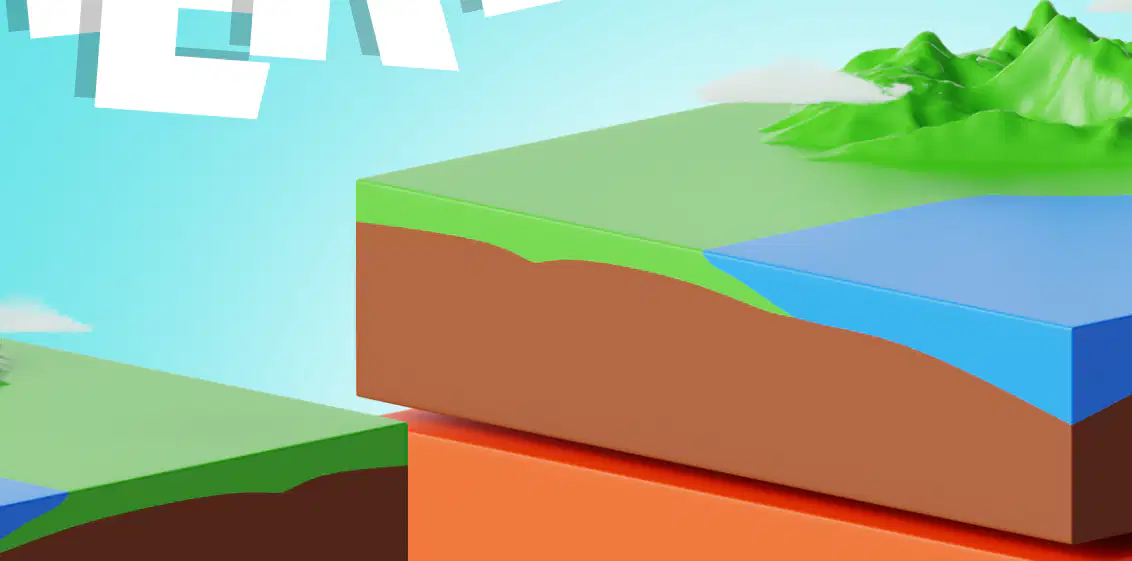
Which evidence would best support plate movement causing the mountain shown?
Similar fossils across the ocean
Ocean tides rising and falling
GPS measuring plate convergence
Seasonal weather changes
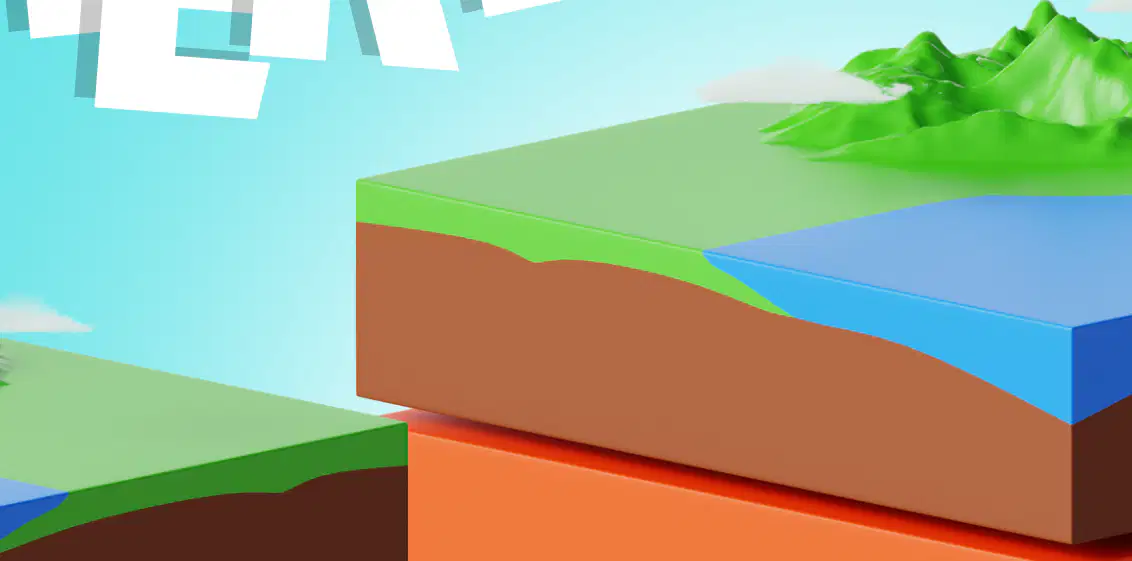
Where would earthquakes most likely occur in the illustrated landscape of plates?
Stable interiors of plates
Edges where plates interact
Deep within the inner core
Uniformly across all surfaces

In the diagram of Earth's layers, which outermost layer is shown surrounding the planet?
Outer core of liquid iron
Crust forming Earth’s surface
Inner core of solid metal
Mantle layer of hot rock

Which estimate best represents the proportion of Earth’s surface covered by water?
About 50 percent
About 30 percent
About 71 percent
About 85 percent

Which statement best distinguishes oceanic crust from continental crust?
Oceanic crust is thicker and less dense
Oceanic crust is felsic and buoyant
Oceanic crust is thinner and more dense
Oceanic crust is older and granitic

Which landform is most likely found on continental crust?
Deep-sea trench systems
Large interior mountain ranges
Abyssal plain regions
Mid-ocean ridge chains

If Earth’s surface is roughly 71 percent water, what percent is land?
About 39 percent
About 19 percent
About 29 percent
About 49 percent

Which evidence supports classifying a landform as oceanic crust?
Granite bedrock composition
Very old Precambrian rocks
High density basaltic rock
Thick buoyant continental roots

A map shows a chain of volcanoes along a narrow ocean trench. Which crust interaction is most likely?
Convergent boundary subducting slabs
Transform boundary sliding laterally
Divergent boundary forming rifts
Passive margin with no movement

Which step helps estimate the percent of land versus water on a world map?
Measure coastline lengths precisely
Count grid cells of land and water
Identify countries by population
Calculate mountain elevations globally

Why is continental crust generally higher in elevation than oceanic crust?
It has fewer tectonic plate boundaries
It is thinner and denser overall
It is thicker and more buoyant
It contains more liquid iron layers

Which location best matches oceanic crust features?
Himalayan plateau region
Atlantic mid-ocean ridge
African continental shield
Amazon Basin interior
Which statement best describes the inner core of Earth?
A gas layer with very low density
A semi-solid layer that slowly flows
A cool rocky outermost shell
A solid layer under immense pressure
What is the physical state of Earth’s outer core?
Solid and very cold
Liquid and extremely hot
Plasma and magnetic
Gas and low pressure
Why is Earth’s inner core solid despite high temperatures?
Lack of metals prevents melting
Immense pressure keeps particles tightly packed
Water content freezes the layer solid
Strong winds cool the material rapidly
Which pair correctly matches layer and property?
Inner core—solid due to pressure
Outer core—solid with low heat
Inner core—liquid and molten
Outer core—gas and very cool

Identify the layer responsible for generating much of Earth’s magnetic field.
Mantle with solid silicate rocks
Crust with thin sedimentary layers
Inner core with frozen water crystals
Outer core with moving liquid metal
Which evidence would best support the claim that the outer core is liquid?
Seismic S-waves do not pass through it
Mountains form at convergent boundaries
Ocean tides vary with the Moon’s pull
Volcanoes erupt from the crust only
In a simplified Earth model, which order from center outward is correct?
Crust, mantle, inner core
Mantle, inner core, outer core
Inner core, outer core, mantle
Outer core, crust, inner core
A scientist increases pressure on a hot metal sample. Which outcome models inner core conditions?
The sample dissolves in water
The sample boils and becomes gas
The sample remains solid under pressure
The sample cools into ice crystals
What makes the outer core hot enough to be molten?
Heat from Earth’s interior and radioactive decay
Sunlight warming deep rock layers
Friction from ocean currents
Cooling from polar ice caps
Which statement compares the cores accurately?
Inner core is solid; outer core is liquid
Both cores are solid under low heat
Inner core is liquid; outer core is gas
Outer core is solid; inner core is gas
Which Earth layer is described as the thickest and divided into upper and lower parts?
Inner core with two sublayers named
Mantle divided into upper and lower
Crust split into oceanic and continental
Outer core separated into fluid zones
What is the outermost solid rock layer of Earth called?
Mantle surrounding the hot core
Outer core made of liquid metal
Crust forming Earth’s surface
Lithosphere without any plates

Which statement best compares oceanic crust and continental crust?
Both types are identical in thickness and age
Oceanic crust is thicker and older overall
Continental crust is generally thicker and older
Oceanic crust is thicker but also more buoyant

In the image, the large orange layer above the crust represents which feature?
Mantle surrounding most of Earth
Outer core below the mantle
Crust covering the mantle
Inner core at the planet center

Why is the mantle said to make up most of Earth?
It has the greatest thickness overall
It forms the entire solid surface
It contains the densest materials
It lies at the planet’s center

Which feature is directly divided into upper and lower sections?
Crust forming land and ocean floors
Outer core near the mantle
Inner core at the deepest center
Mantle beneath the crust layer

If a geologist studies solid rock at Earth’s surface, which layer are they examining?
Inner core of solid metal
Mantle with semi-solid rock
Crust as solid rock layer
Outer core of liquid iron

Which statement best explains why continents float higher than ocean basins?
Outer core is more buoyant than crust
Mantle pushes continents upward directly
Oceanic crust is thicker and hotter
Continental crust is thicker and less dense

A student labels the layers from outside to inside. Which order is correct for the first two labels?
Mantle then crust
Crust then outer core
Mantle then inner core
Crust then mantle
Which layer classification helps explain differences between continents and ocean floors?
Upper and lower mantle levels
Inner and outer core regions
Oceanic and continental crust
Lower crust and molten mantle
Which layer of Earth includes continents and ocean floors as shown in the image?
Inner core layer of Earth
Outer core metallic layer
Crust layer forming surface
Mantle layer beneath crust
What is the best description of the Earth's crust?
Molten rock central zone
Dense gaseous envelope
Thin solid outer shell
Thick liquid metal region
Which statement explains why mountains and plains appear on the crust?
Crust has varying thickness
Atmosphere changes pressure
Core spins very quickly
Sun heats the outer core
Which material is most common in continental crust?
Basalt-rich oceanic rock
Granite-rich continental rock
Ice-rich polar deposits
Metal-rich core alloys
Which process at plate boundaries shapes crust characteristics?
Photosynthesis in forests
Evaporation of seawater
Tectonic plate movement
Condensation in clouds
A region has frequent earthquakes. What does that suggest about its crust?
Active boundary between plates
Stable single solid plate
Uniform thickness everywhere
Deep calm outer core
Which comparison correctly distinguishes oceanic crust from continental crust?
Oceanic crust thicker overall
Oceanic crust older than continents
Oceanic crust less dense overall
Oceanic crust made mainly of basalt
If two continental plates collide, what landform most likely develops?
Deep ocean trench forms
Broad mountain range rises
Wide volcanic island arcs
Large rift valley opens
A mid-ocean ridge indicates what about crust formation?
Crust is destroyed by erosion
New crust forms at spreading
Crust melts in subduction zones
Crust hardens under continents
Which observation best supports that the crust is divided into plates?
Random isolated volcanoes
Matching coastlines and fossils
Uniform global rock types
Identical mountain heights
Which rock type mainly composes continental crust?
Sedimentary rocks form continents
Granitic rocks compose continents
Metamorphic rocks mainly build continents
Basaltic rocks dominate continents
Compared to oceanic crust, continental crust is generally
Thicker and more dense overall
Thicker and less dense overall
Thinner and more dense overall
Thinner and less dense overall
Which surface features are common on continental crust?
Hotspots and guyots
Plains and mountain ranges
Seamount chains and abyssal plains
Mid-ocean ridges and trenches
Oceanic crust is mostly composed of which rock type?
Granite rich layers
Basaltic rock flows
Gneissic banded rocks
Quartz sandstone beds
Which pair best describes oceanic crust relative to continental crust?
Thicker and less dense overall
Thinner and denser overall
Thicker and denser overall
Thinner and less dense overall
Which process continuously creates new oceanic crust?
Erosion along shorelines
Seafloor spreading at ridges
Glacial deposition offshore
Weathering of continental rocks
Which process recycles or destroys oceanic crust?
Evaporation of seawater
Wind-driven currents
Subduction at trenches
Isostatic rebound
Where is oceanic crust primarily located?
Beneath large continents
Under polar ice sheets
Beneath the ocean basins
Under high volcanic plateaus
Which set of features is characteristic of oceanic crust?
Deep-sea trenches and ridges
Wide plains and plateaus
Fold mountains and cratons
River valleys and deltas
Why is continental crust less dense than oceanic crust?
It is thicker and granitic
It is thinner and basaltic
It is cooler and compacted
It is younger and hydrated

Which boundary involves two plates moving apart, creating new crust at a mid-ocean ridge?
Divergent boundary spreading apart
Intraplate hotspot stationary plume
Transform boundary sliding laterally
Convergent boundary colliding strongly

At a convergent boundary where oceanic and continental plates meet, what process most often occurs?
Sea-floor spreading builds ridges
Lateral shear offsets river courses
Rifting forms wide valleys
Subduction pulls oceanic plate downward
Which surface feature is commonly associated with transform boundaries?
Deep ocean trenches
Linear strike-slip faults
Fold-and-thrust mountains
Broad shield volcanoes

New oceanic crust is primarily produced by which geological mechanism?
Trench accretion from sediments
Reverse faulting during orogeny
Sea-floor spreading at ridges
Hotspot plume under continents

Which statement best explains why oceanic plates subduct beneath continental plates?
Oceanic plates are thicker and warmer
Oceanic plates are denser and cooler
Continental plates are thinner and hotter
Continental plates are denser and older
Volcanic island arcs usually form along which type of plate interaction?
Ocean–ocean subduction boundaries
Pure transform plate contacts
Continent–continent collision zones
Passive continental margins
Which evidence most supports the theory of plate tectonics?
Fixed positions of continents
Matching fossils across oceans
Random mountain distribution globally
Uniform crust thickness worldwide

A rift valley on land is most likely the early stage of which feature?
Stable craton interior
Ancient fold belt
Developing ocean basin
Future subduction trench

Which plate movement typically causes the largest earthquakes at great depths?
Transform slip along faults
Intraplate doming uplifts
Shallow spreading centers
Subduction at convergent margins

If two continental plates converge, which landform is most likely to develop over millions of years?
Volcanic island chains
Mid-ocean ridge crests
High fold-and-thrust mountains
Linear graben basins
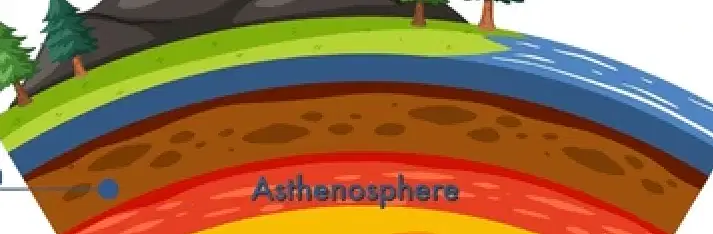
Which Earth layer combination makes up the lithosphere as shown in the diagram?
Crust and uppermost solid mantle
Outer core and lower mantle
Entire mantle and core
Asthenosphere and inner core
What is the mechanical behavior of the lithosphere described in the material?
Plastic gel, permanently soft
Rigid fluid, highly compressible
Viscous liquid, fully ductile
Elastic solid, elastic but brittle

Why can the lithosphere become deformed or fractured?
Erosion by ocean water circulation
Pressure from the inner core crystallization
Strain from asthenosphere rock movement
Cooling by outer core convection

What are the large segments of the lithosphere called?
Mantle plumes or hotspots
Crustal folds or ridges
Tectonic plates or lithospheric plates
Continental shelves
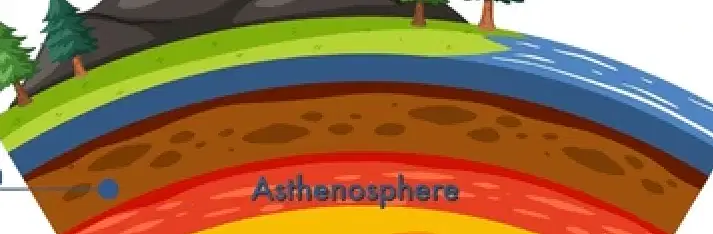
Which statement best describes the depth extent of the lithosphere?
Extends through the entire mantle
Extends to the liquid outer core boundary
Extends only across the continents
Extends down to upper portion of asthenosphere
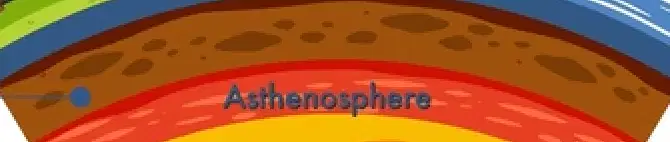
Using the diagram, which layer lies directly beneath the lithosphere?
Lower crust
Outer core
Asthenosphere
Inner core
If a tectonic plate experiences increasing strain, which outcome aligns with the lithosphere’s properties?
Fractures because it is brittle
Expands permanently without breaking
Flows smoothly like liquid
Melts instantly into magma
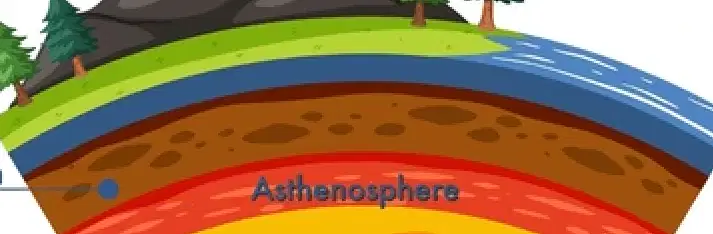
Which feature is NOT part of the lithosphere according to the diagram and text?
Asthenosphere
Plate segments
Crust
Uppermost solid mantle
In the context of plate tectonics, what does the term “elastic but brittle” imply for earthquakes?
Earthquakes originate only in the outer core
Stress accumulates then releases by fracturing
Plates bend permanently without stress release
Energy cannot build up in plates

Which pairing correctly matches a layer with a property visible in the diagram?
Outer core — solid metallic layer
Mantle — thick zone above the core
Inner core — liquid convecting shell
Crust — deepest interior layer
Which Earth layer lies directly beneath the lithosphere?
Outer core
Inner core
Continental crust
Asthenosphere
How deep is the asthenosphere approximately within Earth?
About 10–650 km
About 1000–2000 km
About 2900–5100 km
About 0–100 km
What term best describes the physical state of the asthenosphere?
Gaseous layer
Fully liquid
Plastic solid
Rigid solid
Why are rocks in the asthenosphere partially molten?
Low pressure and coolness
Presence of abundant water
Exposure to sunlight
High pressure and temperature
Which statement about asthenosphere rocks is accurate?
They are elastic and less rigid
They are gaseous and nonelastic
They are brittle and fully solid
They are frozen and very rigid

Look at the diagram showing Earth’s layers. Which labeled region includes both crust and uppermost solid mantle?
Inner core
Outer core
Asthenosphere
Lithosphere

Which pair correctly matches layer and depth shown in the diagram?
Mantle starts near 2900 km
Outer core ends at 5100 km
Inner core begins at 0–100 km
Crust extends to 6378 km
What property of the asthenosphere allows tectonic plates to move above it?
Completely molten magma
Gaseous convection only
Extremely rigid crystals
Elastic, less rigid rocks
If pressure in the upper mantle decreased significantly, what change would most likely occur in rock behavior there?
Become more rigid and less molten
Transform into gaseous clouds
Become fully liquid and flow fast
Freeze into icy crystals
Which statement compares the lithosphere and asthenosphere correctly?
Lithosphere is rigid; asthenosphere is plastic
Both are fully liquid and flowing
Lithosphere is deeper than the outer core
Asthenosphere sits above the lithosphere
Which layer described allows partially molten rocks to flow, driving convection currents beneath the crust?
Lithosphere beneath oceanic crust
Asthenosphere plastic solid layer
Continental crust upper surface
Mid-ocean ridge volcanic belt
What effect does movement in the asthenosphere have on the lithosphere carrying the crust?
It cools the crust permanently
It moves the overriding lithosphere
It thickens continental crust quickly
It halts crustal motion entirely
Scientists think extreme movement below the crust enables plates to do which of the following?
Collide, separate, or slide past
Only collide at subduction
Only separate at ridges
Only slide past in oceans

In the diagram, which feature marks where one plate is forced beneath another?
Continental crust plateau area
Asthenosphere convection cell
Subduction zone boundary region
Mid-ocean ridge spreading center
Which statement best describes the lithosphere in relation to the asthenosphere?
Gas layer separating continents
Fully molten oceanic surface
Liquid layer mixing with plates
Rigid plates carried above flowing
Why do convection currents form in the asthenosphere?
Gravity changes near ridges
Temperature differences within mantle
Sunlight heating continental crust
Wind patterns over oceans

At a mid-ocean ridge, plate motion is primarily characterized by what process?
Converging and thickening crust
Sliding past with no creation
Diverging and new crust forming
Subducting beneath continents
Which pairing correctly matches crust type with typical plate setting shown?
Continental crust only at trenches
Oceanic crust only under continents
Continental crust at mid-ocean ridge
Oceanic crust with subduction zone
If convection currents intensify beneath a boundary, which geological outcome is most likely?
Enhanced plate separation or collision
Immediate volcano extinction
Reduced plate motion globally
Permanent crust cooling everywhere
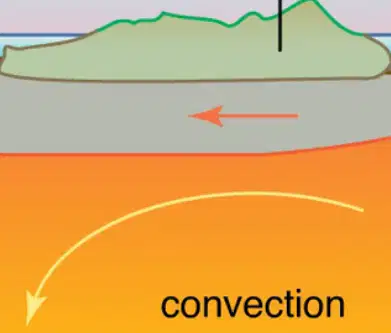
A student claims the asthenosphere is fully solid and immobile. Which evidence from the diagram contradicts this claim?
Presence of oceanic crust layer
Arrows showing convection currents
Labels for continental crust region
Text naming tectonic plates
How many major tectonic or lithospheric plates are identified globally?
Eleven major plates worldwide
Nine major plates worldwide
Five major plates worldwide
Seven major plates worldwide
Which list correctly names only major tectonic plates?
African, Eurasian, Australian, Antarctic
Pacific, North American, South American
African, Arabian, Indian, Caribbean
Juan de Fuca, Cocos, Nazca, Scotia
What term describes the place where two tectonic plates meet?
Plate interior region
Plate margin zone
Plate boundary area
Plate central axis
When two plates collide, what type of plate interaction is occurring?
Transform plate movement
Converging plate movement
Subplate shearing motion
Diverging plate movement
Which statement best describes transform plate movement?
Plates sink beneath continental crust
Plates slide past each other laterally
Plates move directly away from each other
Plates move directly toward each other
Look at the world map. Which plate spans most of the western Pacific Ocean?
Pacific Plate region
Indian Plate zone
Nazca Plate domain
Filipino Plate area
Which plates border the Atlantic Ocean on both sides of the equator?
African and Eurasian plates
South American and African plates
Australian and Antarctic plates
North American and Indian plates
Which small plate lies west of North America near the Pacific Northwest?
Nazca Plate domain
Cocos Plate region
Juan de Fuca Plate area
Caribbean Plate zone
Which plate includes most of the Indian subcontinent?
Australian Plate domain
Indian Plate area
Eurasian Plate zone
Arabian Plate region
If a new ocean ridge forms where plates move apart, which interaction is responsible?
Subducting plate shearing
Transform plate movement
Converging plate movement
Diverging plate movement
Which feature most commonly forms where two tectonic plates collide?
Mid-ocean ridge structures
Deep ocean trench systems
Hotspot island chains
Transform fault landscapes
At divergent plate boundaries, what geologic feature is typically created?
Deep subduction trenches
Mid-ocean ridge with rifting
Linear volcanic island arcs
Tall fold mountain belts
Which statement best explains why earthquakes cluster along plate boundaries?
Boundaries release steady geothermal heat
Boundaries are zones of intense stress
Boundaries trap ocean sediments uniformly
Boundaries have widespread magma chambers
The Ring of Fire around the Pacific is mainly associated with which process?
Subduction of oceanic lithosphere
Extensive continental rifting activity
Transform sliding of major plates
Hotspot plumes under continents
Which pairing correctly matches boundary type with typical landform?
Convergent — mid-ocean ridge
Convergent — shield volcano plateau
Transform — volcanic arc
Divergent — rift valley
What most directly causes the formation of deep-sea trenches?
Erosion by strong ocean currents
Subduction of a denser plate
Accumulation of thick sediments
Mantle upwelling beneath continents
Mountain ranges like the Himalayas primarily form when:
An oceanic plate splits apart
A hotspot pierces ocean crust
Two continental plates collide
A transform boundary locks up
Which scenario best predicts where volcano chains will develop?
Areas above inactive ancient faults
Regions dominated by wind erosion
Edges of plates with subduction
Stable interiors of large plates
If a map shows frequent shallow earthquakes along a linear boundary, which boundary is most likely?
Intraplate hotspot province
Transform strike-slip fault zone
Passive continental coastline
Convergent subduction margin
Which evidence would best support that plate movements shape global geologic patterns?
Uniform elevation across all continents
Alignment of trenches with plate edges
Equal earthquake depths everywhere
Random distribution of volcanoes worldwide
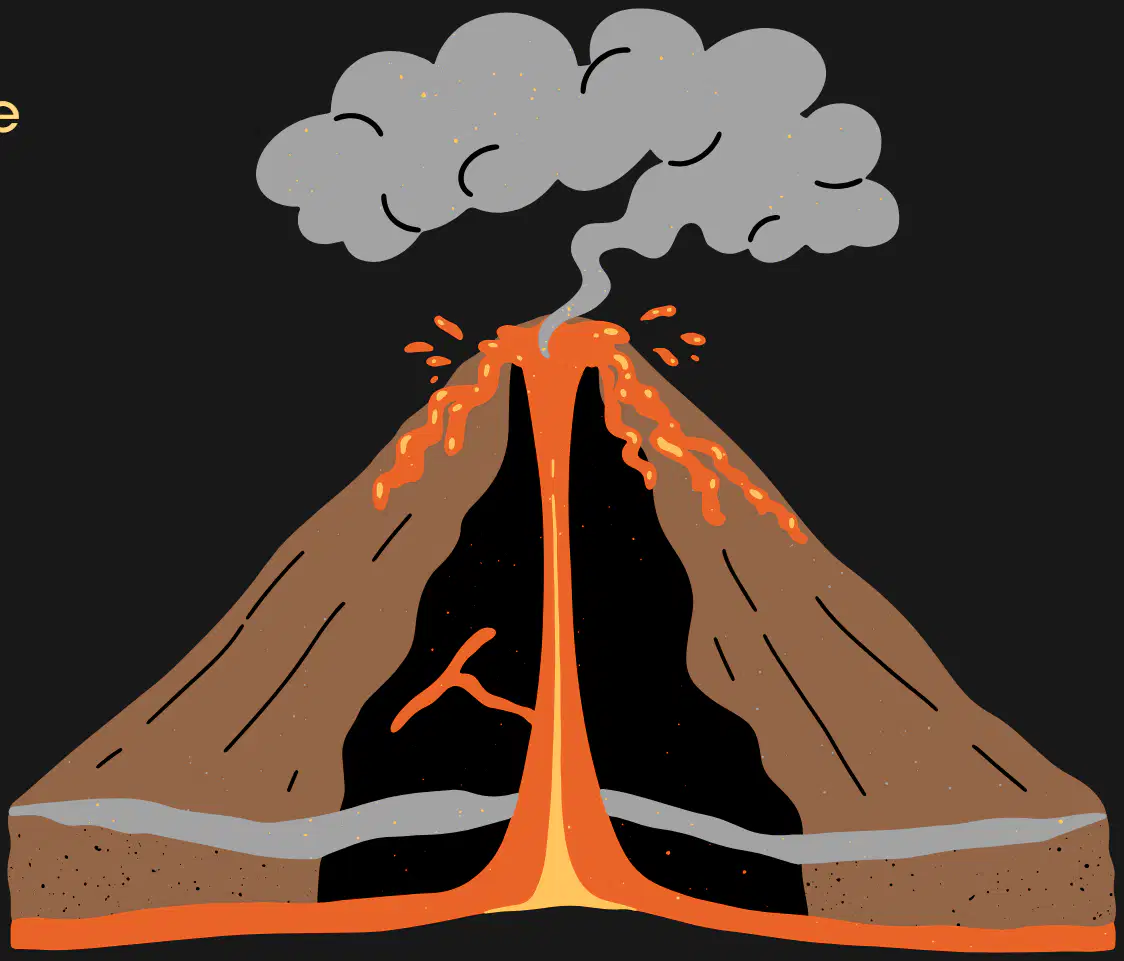
Which process best explains how a volcano forms, as shown in the diagram?
Molten materials and gases erupt through deep fissures
Glaciers melt and leave hollow craters in bedrock
Sediments compress to build layered hills on land
Wind erosion carves cone-shaped mountains over time

What is the term for the hot, molten material that flows out of a volcano?
Shale
Loess
Humus
Lava
Approximately how many active volcanoes exist worldwide?
About 13,500
About 350
About 150
About 1,350
Where are many of the world’s active volcanoes most commonly located?
Along mid-latitude desert basins
Interior of stable cratons and shields
Centers of large continental plains
Edges of the Pacific Ring of Fire
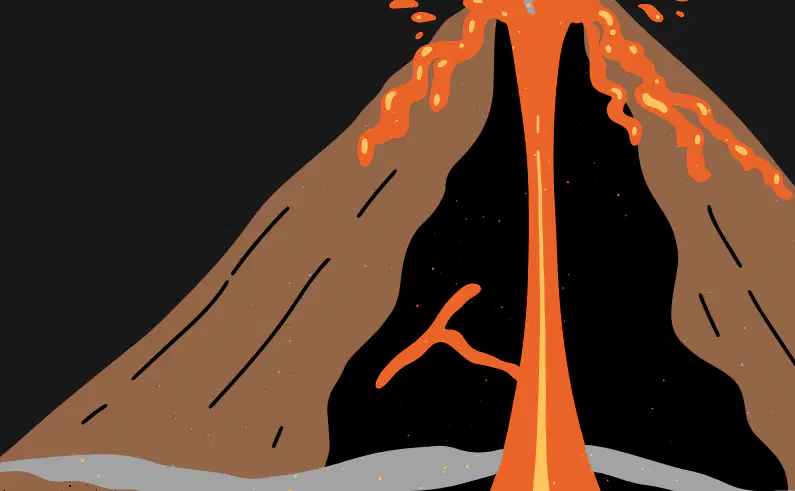
Which feature in the diagram provides a pathway for magma to reach the surface?
Clouds condensing above
Outer ash layer exclusively
Surface lava plateau only
Central vent through deep cracks

Which statement best distinguishes an active volcano from other mountains?
It ejects molten materials and gases
It is taller than nearby peaks
It is covered by permanent snowfields
It lies far from any tectonic boundary
Which tectonic context is most directly linked to frequent volcanic activity?
Ancient eroded mountain belts
Passive margins without uplift
Stable interiors of continents
Converging and subducting plate edges

A student claims volcanoes mostly form where wind breaks rocks into sand. What evidence best refutes this claim?
They form via molten materials erupting through fissures
They show layers of wind-blown dunes at the summit
They are tallest in windy coastal areas worldwide
They occur only in deserts with constant sandstorms
If a new volcano appears along the Circum‑Pacific belt, which hazard is also likely in that region?
Uniform plains with no crustal movement
Stable climate with minimal seismic activity
Thick loess deposits from glacial winds
Frequent earthquakes due to active plate boundaries

Which observation would most strongly indicate an imminent volcanic eruption?
Increasing gas emissions and rising magma pressure
Presence of sedimentary rocks around the base
Steady wind speeds over the crater area
Seasonal snowfall on the mountain slopes

Which statement best describes the Ring of Fire shown on the world map?
A horseshoe-shaped belt of intense geologic activity
A circular zone of permanent ice and tundra
A narrow desert corridor across Pacific coasts
A straight equatorial line of calm ocean waters
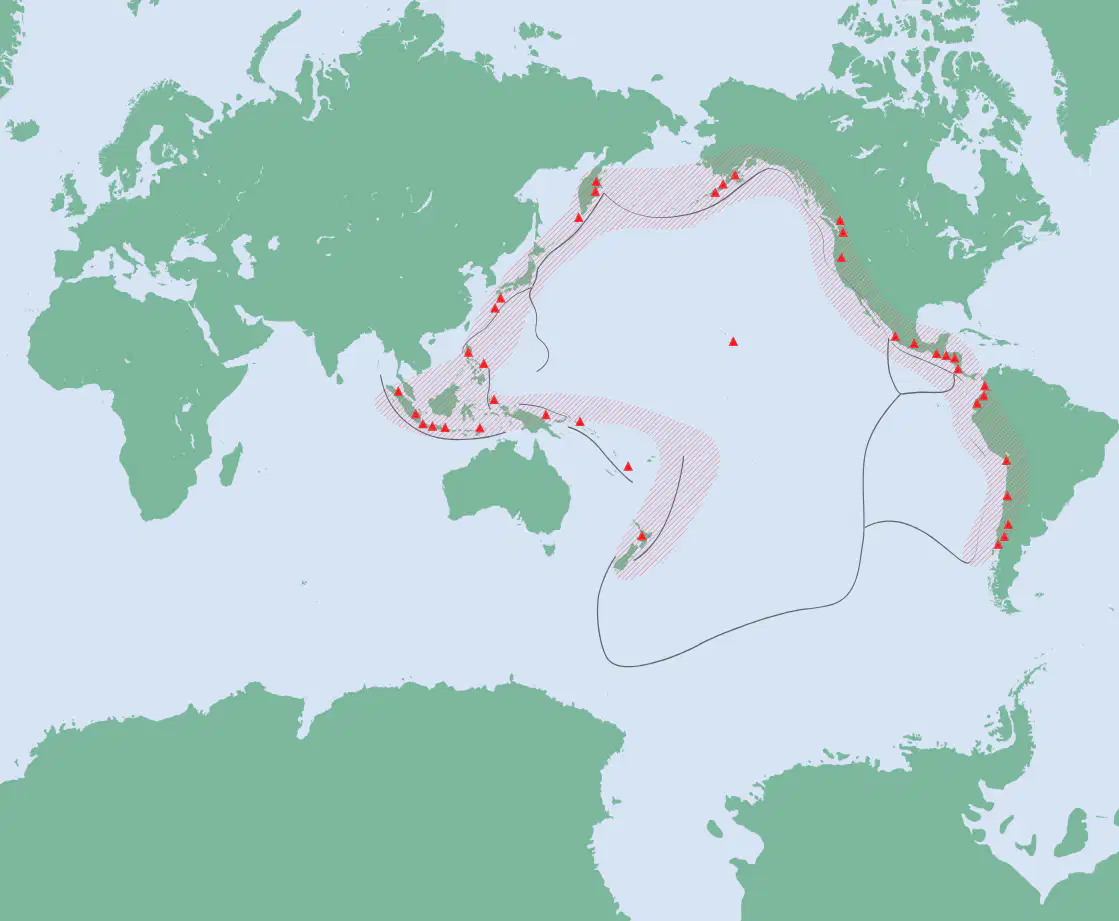
Approximately how long is the Ring of Fire?
Nearly 400,000 kilometers around Earth
Around 4,000 kilometers from pole to pole
About 40,000 kilometers in total length
Roughly 14,000 kilometers across the Pacific

Which physical features are commonly associated with the Ring of Fire?
Deep-sea trenches and fault zones
Wide river deltas and floodplains
Sand dunes and loess deposits
Karst caves and limestone plateaus
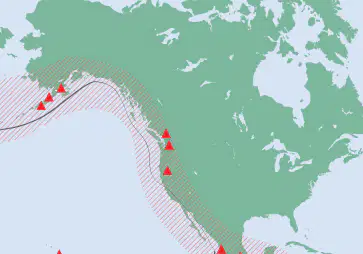
Which coasts are part of the Ring of Fire?
South Coast of Africa and North Coast of Europe
Central Atlantic islands and Arctic archipelagos
East Coast of the Americas and West Coast of Africa
West Coast of the Americas and East Coast of Siberia

Which island nations lie within the Ring of Fire?
Greenland, Bahamas, and Cuba
Iceland, Madagascar, and Sri Lanka
United Kingdom, Ireland, and Malta
Japan, the Philippines, and Indonesia

Which statement about global volcano distribution is accurate?
Around 75% of volcanoes are located in the Ring of Fire
Less than 10% of volcanoes lie in the Ring of Fire
Exactly 90% of volcanoes are in the Ring of Fire
About 25% of volcanoes occur in the Ring of Fire

Why do earthquakes frequently occur along the Ring of Fire?
Strong winds that shake coastal landforms
Active fault zones along tectonic plate boundaries
Magnetic storms disturbing Earth’s crust
Seasonal tides that stress continental shelves

Which continents are included within the Ring of Fire’s span?
Only Asia and North America together
All seven continents worldwide equally
Just North America and South America
Four continents bordering the Pacific Ocean
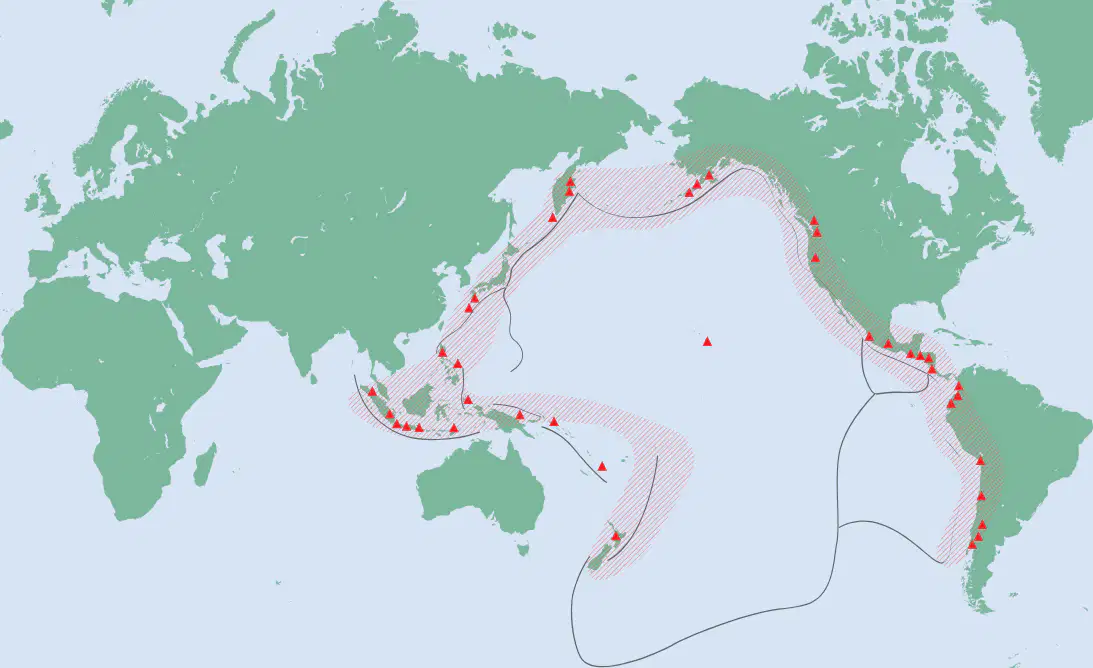
Which island chain from New Guinea connects to another country within the Ring of Fire?
Runs eastward to the Azores
Reaches northward to Iceland
Stretches westward to Madagascar
Extends southward to New Zealand

Looking at the map, what overall shape does the highlighted volcanic belt form around the Pacific?
A perfect circle surrounding continents
A zigzag strip across the equator
A thin line hugging one single coast
A broad horseshoe wrapping the ocean
Which statement best defines an earthquake in the context of Earth’s crust?
Sudden shaking or movement of the crust
Gradual uplift of mountain ranges
Slow rotation of tectonic plates
Continuous erosion by wind and water
What triggers the ground’s shaking during an earthquake?
Rapid cooling of molten magma
Sudden release of accumulated stress energy
Expansion of crust by solar heating
Continuous flow of groundwater beneath faults
Where are earthquakes most commonly located relative to tectonic plates?
Colliding, separating, and sliding boundaries
Stable interiors of continental plates
Centered within oceanic gyres
Uniformly across all crustal regions
Which region hosts nearly 90% of Earth’s earthquakes and over 80% of the strongest ones?
East African Rift
Pacific Ring of Fire
Mid-Atlantic Ridge
Himalayan Belt

In the diagram, what do the concentric red circles most likely represent?
Magma chambers expanding outward
Wind patterns crossing mountain ridges
Seismic waves radiating from the focus
Erosion zones around river valleys
Which process describes how rock masses lead to an earthquake over time?
Ice sheets melt and retreat
Stress accumulates until rocks yield
Crystals slowly form and harden
Sediments compact into bedrock
Why do plate boundaries affect the crust during earthquakes?
They stabilize crust to prevent motion
They concentrate movements like collision and sliding
They block ocean currents from circulating
They disperse heat evenly through the mantle
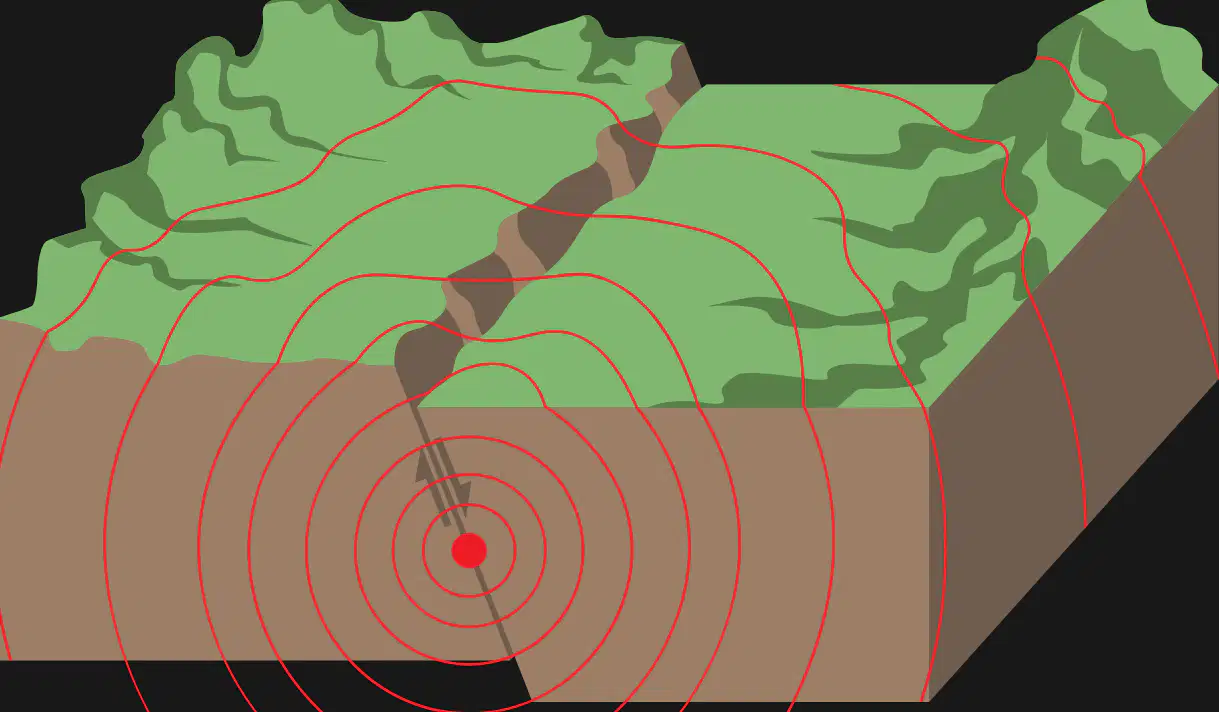
What feature in an earthquake represents the point where energy first releases underground?
Focus beneath the crust
Epicenter on the surface
Ridge along a coastline
Delta at a river mouth
Which boundary type is matched with the motion that can generate earthquakes?
Passive—continents drift without motion
Transform—plates slide past each other
Epeirogenic—broad crustal warping only
Isostatic—vertical balance without slip
A city near a transform fault installs strict building codes. Which reason best justifies this decision?
Transform faults create steady ground subsidence
Transform faults eliminate volcanic hazards
Transform faults stop tsunamis completely
Transform faults produce frequent shallow quakes

