
 Worksheets
HISTHEORY - Q1, Q2
Total questions: 99
Worksheet time: 50mins
Which of the following is the Ishtar gate? Select the image that shows the Ishtar Gate of Babylon characterized by glazed blue bricks and reliefs of animals.


Generally prehistoric structures are _________, or an architecture of stones in medium to large sizes placed together to create spaces.
Monolithic
Trilithon
Neolithic
Megalithic
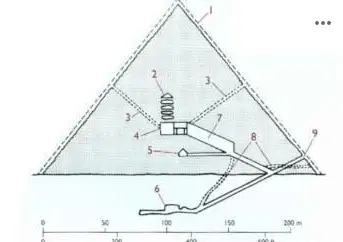
Identify part No. 5 of the pyramid based on the provided diagram of internal chambers.
Grand Gallery
King's Chamber
False Tomb Chamber
Queen's Chamber
A prehistoric monument consisting of at least 2–3 large standing stones is called:
Stonehenge
Cromlech
Dolmen
None among the choices
Evidences of pre-historic architecture are significant in the following countries/regions except for:
None among the choices
Asia
Middle East
Europe
The Stonehenge is a huge man-made circle of standing stones. One of the most important Megalithic Monuments in Europe; believed to have had religious and astronomical purposes.
True
False
Although few and not significant, it can be noted that that the West Asiatic Architecture had arched features in it.
Both true and false
True
False
None among the choices
Sphinxes are burial chambers with the pharaoh's body buried underneath.
True
False
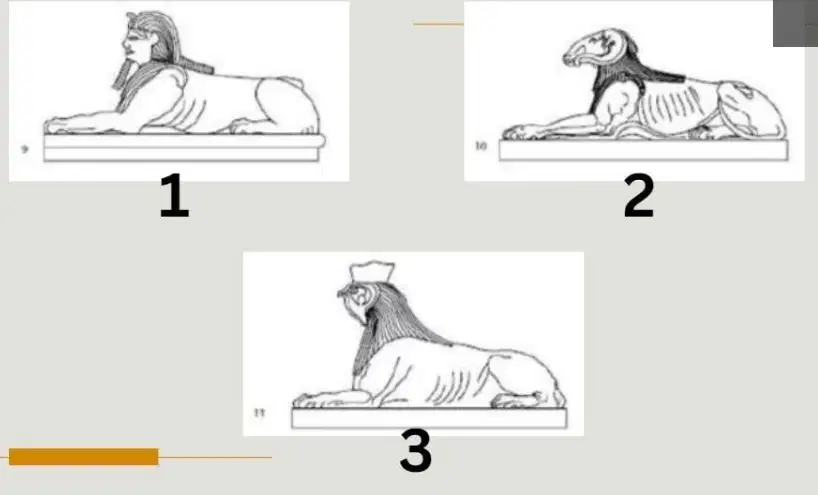
Which of the following is the Criosphinx?
2
3
1
Which among the following structures were never physically evidenced/excavated?
1. Ziggurat 2. Ishtar Gate 3. Hanging Garden of Babylon 4. Tower of Babel.
2 and 3
3 and 4
1 and 2
4 and 1
This landmark presents monumental round-oval and rectangular megalithic structures erected by hunter-gatherers in the Pre-Pottery Neolithic age between 9,600 and 8,200 BCE.
Göbekli Tepe, upper Mesopotamia
Kreisgrabenanlage, Germany
Newgrange, England
Stonehenge, in England
A tall stone put in a vertical position by people in prehistoric times.
Dolmen
Column
Stone Circles
Menhir
Imhotep was a sage, architect, astrologer, and chief minister to Djoser.
True
False
An Egyptian obelisk has similarities to the Menhir.
True
False
A burial mound in England that is circular in shape.
Newgrange
Silbury Hill
Stonehenge
Avebury
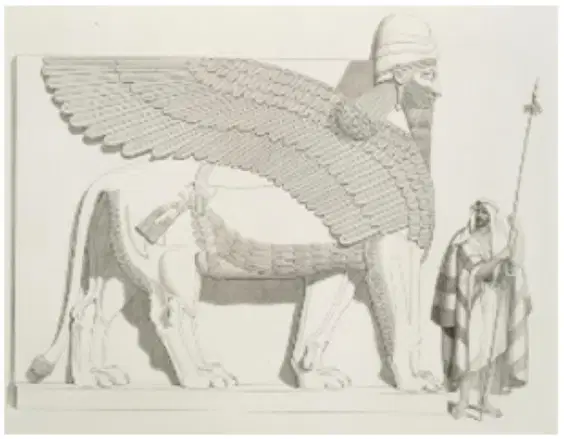
The image below is known to be.
Winged Human Headed Lion
Bas relief in a temple
The Trojan Horse
Winged Deity
Hypostyle meant an open space with a series of columns.
True
False
Egyptian columns were normally plain and smooth.
True
False
A monumental, four-sided stone mortuary structure that is usually monolithic.
Androsphinx
Obelisk
Mastaba
Pyramid
What were the first houses made of in ancient Egypt?
Mud and stone
Shaped bricks and wood
Stone and wood
Mud and matting
A primitive construction method where stone is placed on top of each other; it does not involve the usage of binding agents but rely only on balance and placement/positioning of stones for perfect balance.
Piling Technique
Carving Technique
Planting Technique
Stacking Technique
Private family apartment or womens quater.
Harem
Khan
Veterans
Haramlik
The Egyptians did not believe in the after life.
True
False
Which of the following is not a pre historic structure
Criosphinx
Stonehenge
Cromlech
Dolmen
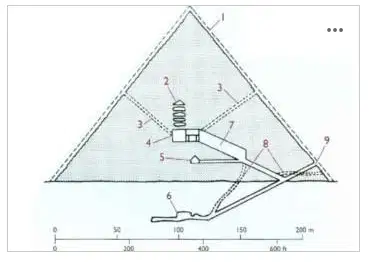
Identify part No. 6 of the pyramid:
King's Chamber
Grand Gallery
Queen's Chamber
False Tomb Chamber
Monumental pyramids, temples, and shrines. This architecture is classified under which historical design period
Classical
Mesopotamia
Ancient Egypt
Greek
A gateway to an Egyptian temple.
Pylon
Entryway
Avenue of Sphinx
Hall
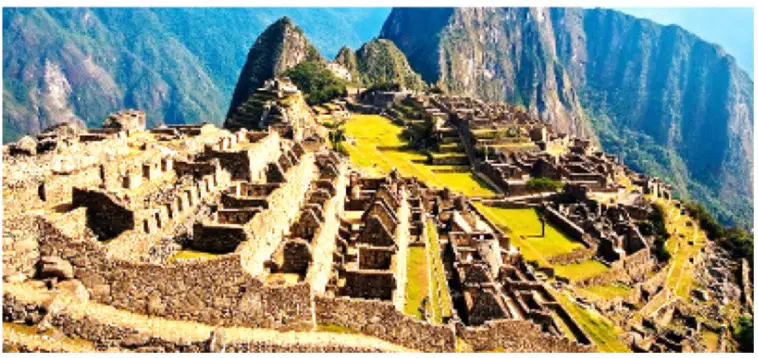
The image below is a prehistoric dwelling in Peru and is also called the Inca House. Another term for this development is:
Machu Pichu Houses
Lima Houses
Stone and hay houses
None among the choices
Papyrus is type of paper that ancient Egyptians use for writing.
True
False
Multiple Choice: An agricultural region from the Eastern shores of the Mediterranean Sea in the West to Iraq and in: location of human kinds earliest cultures.
Egypt
Garden of Eden
Fertile Crescent
Mesopotamia
True/False: Hypostyle meant an open space filled with Sphinxes.
True
False
Multiple Choice: A cave containing one of the most outstanding displays of prehistoric art yet discovered. Located above the Vézère River valley near Montignac, in Dordogne, France, the cave is a short distance upstream from the Eyzies-de-Tayac series of caves.
Grotto de Font-de-Gaume
Lascaux Cave, Dordogne, France
Altamira Cave
Magura Cave
True/False: Dolmen is a type of stone monument found in a variety of places throughout the world. Its is made of two or more upright stones with a single stone lying across them.
True
False
True/False: Hypostyle meant an open space with a series of columns.
True
False
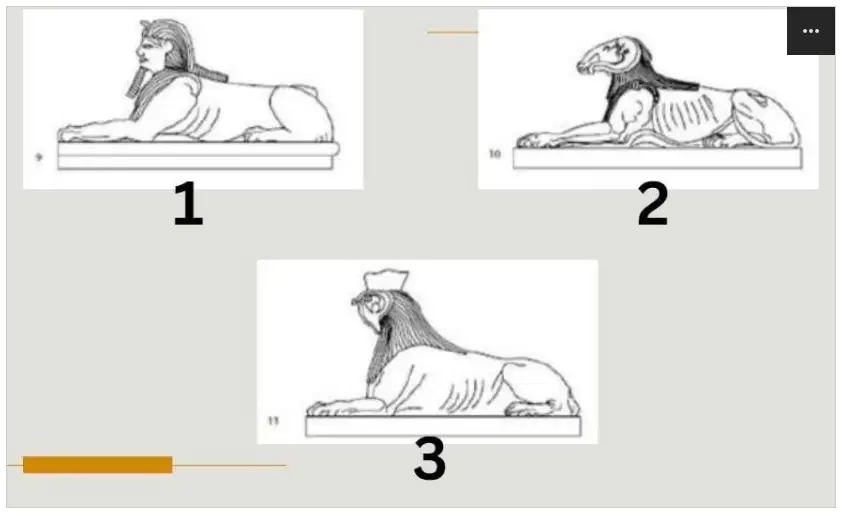
Multiple Choice: Which of the following is the Androsphinx?
3
1
2
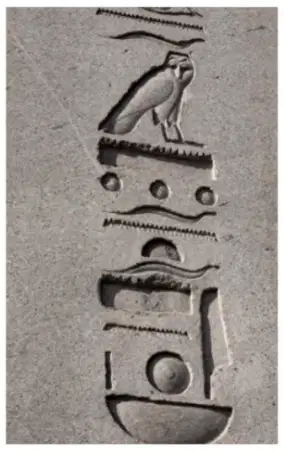
Multiple Choice: What is this called
Bas Relief
Hieroglyphics
Wall carvings
The famous cave in France housing various evidences of Ancient man's worship and art.
Lascaux Cave
Chauvet Cave
Altamira Cave
Cosquer Cave
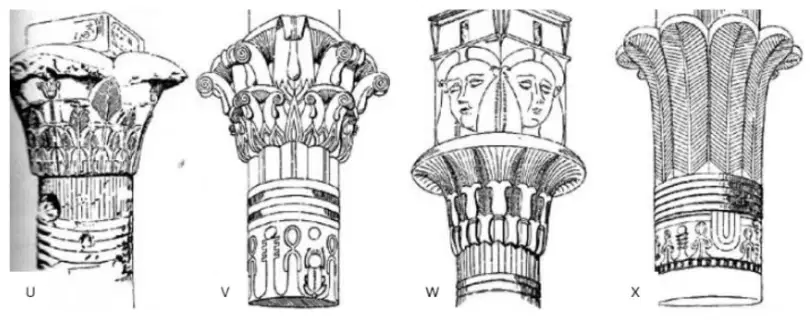
Which among the choices is the Palm-headed capital?
X
U
V
W
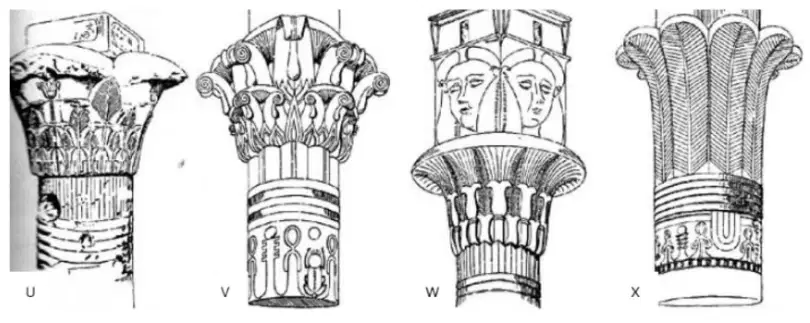
Which among the choices is the Volute-headed capital?
V
W
X
U
An ancient region in western Asia between Tigris and Euphrates rivers, comprising the land of Sumer and Akkad and occupied successively by the Sumerians, Babylonians, Assyrians and Persians (now part of Iraq).
West Asiatic Area
Mesopotamia
None among the choices
Fertile Crescent
Believed to be created by King Nebuchadnezzar for his wife, it is an evidence of having space features in palaces that appreciate vistas.
Ziggurat
None among the choices
Tower of Babel
Ishtar Gate
A housing development in Ancient Turkey where houses are available through the rooftop.
Catal Huyuk
Jericho
Skara Brae
Mohenjo-Daro
Burial Mound in Newgrange Ireland is an artificial hill of earth and stones built over the remains of the dead.
True
False
Which among the following building types or monumental structures are not built by the Egyptians.
Sphinx
Pyramid
Mastaba
Ziggurat
True/False: A mastaba is a typical Egyptian home.
True
False
True/False: Following the conquests of Alexander the Great, the architecture of West Asia was influenced by Hellenistic and later Roman styles. This period saw the construction of theaters, amphitheaters, and monumental public buildings.
True
False
Multiple Choice: It usually has one flat top rectangular mound carrying the upper temple.
Pyramid
Ziggurat
Sphinx
Holy Mountain
The Caryatid faced the Parthenon.
True
False
The most famous Byzantine church and recognized as the banner structure of the Byzantine era:
Hagia Sophia
Church of the Holy Sepulchre
St. Peter's Basilica
Church of the Apostle
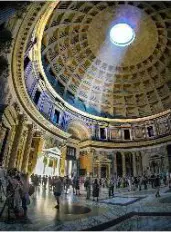
The image below is a structure or feature of Roman architecture. Refer to the image.
True
False
Among the principles of design, these two best describe Greek architecture:
Rhythm and Harmony
Scale and Balance
Balance and Proportion
Scale and Proportion
Which emperor of the Roman Empire initiated a change in their belief system that impacted the way structures were designed and developed?
Octavian
Caesar
Constantine
Caligula
Is the oldest and simplest of the Greek architectural orders. It is characterized by sturdy, fluted columns with no base, topped by a plain capital.
Ionic
Doric
Corinthian
Composite
From worship of gods and goddesses, the Romans adopted the Christian faith as enacted by this Roman ruler, who made Christianity the official religion of the Roman Empire:
Caligula
Marcus Aurelius
Maxentius
Constantine
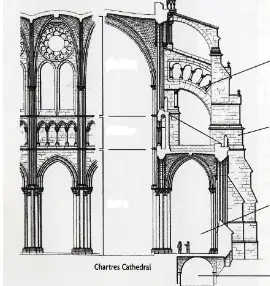
This is an upper zone of wall pierced with windows that admit light to the area. Refer to the image below.
Apse
Atrium
Narthex
Clerestory
The Parthenon is designed using which architectural order?
Doric
Corinthian
Ionic
None among the choices
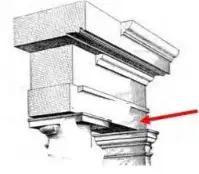
In the classical orders, the lowest member of the entablature—the beam that spans from column to column, resting directly upon their capitals. Refer to the image.
Dentils
Lintel
Pediment
Architrave
A venue for gladiator wars
Amphitheater
Colosseum
Thermae
Roman Forum
Ancient Greek architects used entasis in column design primarily to:
Strengthen the structural integrity of the column under heavy loads
Reduce the need for fluting and other decorative elements
Allow for easier construction and material efficiency
Create a sense of upward movement and visual perfection
The Erechtheion is asymmetrical.
True
False
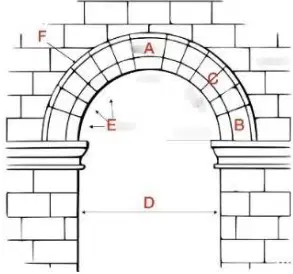
Identify part A
Intrados
Springer
Keystone
Voussoirs
Extrados
The Erechtheion is symmetrical.
True
False
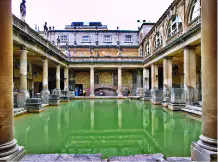
The image below is a structure or feature of Roman Architecture.
True
False
A venue for public baths.
Colosseum
Amphitheater
Thermae
Roman Forum
The monumental gateway to the Acropolis is known as.
Parthenon
Erechtheion
Temple of Athena
Propylaea
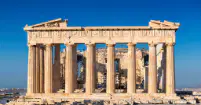
The image below is a structure or feature of Roman Architecture.
True
False
A venue for cultural and artistic affairs.
Thermae
Colosseum
Amphitheater
Roman Forum
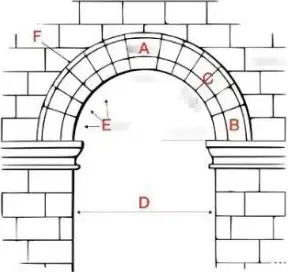
Identify part F in the labeled semicircular arch diagram showing voussoirs and supporting columns.
Intrados
Springer
Keystone
Voussoirs
Extrados
The Parthenon had a 2 storey colonnade in its interior.
True
False
The ancient Romans used this building material extensively.
Marble
Mud Bricks
None among the choices
Terra Cotta
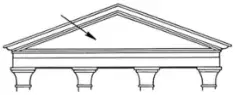
A triangular gable usually having a horizontal cornice above the entablature.
None among choices
Frieze
Lintel
Architrave
The Caryatid faced the South.
True
False
The most prominent structure in the Acropolis.
Temple of Athena Nike
Erechtheion
Odeon of Herodes Atticus
Parthenon
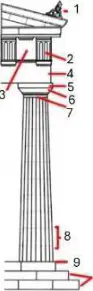
Identify no. 2 in the Doric order diagram.
Abacus
Stylobate
Triglyph
Architrave
Metope

Relating Greek Classical orders to historical Philippine Architecture, what is the order utilized by the Dela Salle University Main Building (By Tomas Mapua, 1920)?
Ionic
None among the choices
Doric
Corinthian
Most of the Greek temples are elevated above grade line to about 3–7 steps or more. That height from the grade line to the top of the temple floor, or simply the main level of the temple, is termed as:
Stylobate
Base
Stereobate
Uprise
A venue for political affairs
Roman Forum
Thermae
Amphitheater
Colosseum
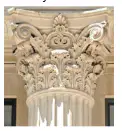
Identify the Greek classical order shown:
Doric
Ionic
Corinthian
Tuscan
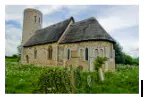
This refers to a semicircular (or nearly semicircular) or semi polygonal space, terminating an axis and intended to house an altar. Refer to the image below:
Clerestory
Atrium
Narthex
Apse
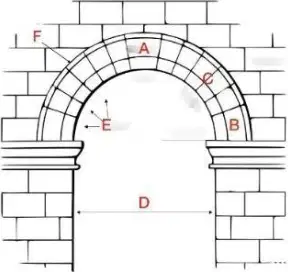
Identify part F
Intrados
Springer
Keystone
Voussoirs
Extrados
The Greek entablature is composed of:
Cornice–Frieze–Capital
Frieze–Shaft–Abacus
Architrave–Frieze–Cornice
These two temples are not based on the Doric Order:
Temple of Artemis – Parthenon
Parthenon – Temple of Hera
Temple of Hera – Propylaea
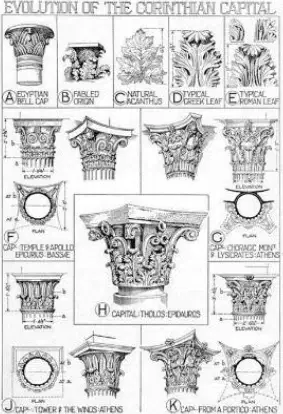
Observe the evolution of the Corinthian capital. Which among the statements have no basis or can be considered as an untrue statement.
Corinthian capital is heavily textured.
Later variations of the Corinthian capital showed volutes on it.
The plan view of the capital is always a perfect square.
There is a historical connection between the Egyptian Bell capital and the Corinthian capital.
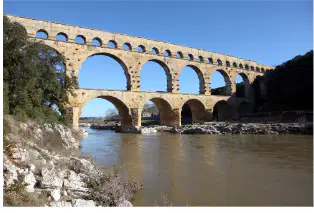
Identify this Image:
Aqueduct
Bridge
Viaduct
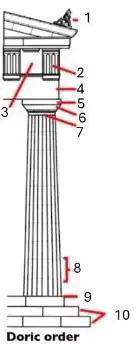
Identify no. 5
Abacus
Stylobate
Triglyph
Architrave
Metope
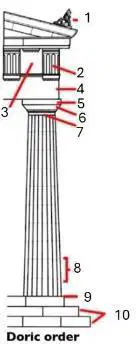
Identify no. 10
Abacus
Stylobate
Triglyph
Stereobate
Metope
Identify no. 3
Abacus
Stylobate
Triglyph
Stereobate
Metope
Which of the following best describes the purpose of entasis in classical columns?
To compensate for the optical illusion of concavity in straight-sided columns
To reinforce the column against lateral forces such as earthquakes
To create additional space for decorative carvings and inscriptions
To make column construction faster and more cost-effective
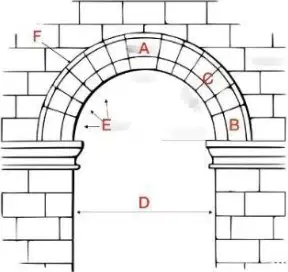
Identify part C in the arch diagram labeled A–F.
Keystone
Voussoirs
Extrados
Springer
Span
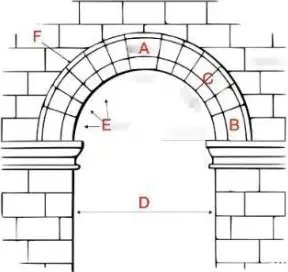
Identify part D in the arch diagram labeled A–F.
Span
Voussoirs
Extrados
Keystone
Intrados
The design and building direction of the ancient Greeks were mainly geared towards the following EXCEPT for:
Social and civic functions
Ceremonial functions
Honoring the dead
Worshipping gods
Which among the following is not a feature of Roman Architecture?
C
None among the choices
All of the above
B
A
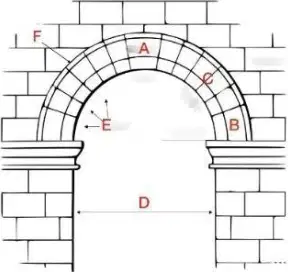
Identify part B in the arch diagram labeled A–F.
Keystone
Intrados
Extrados
Springer
Span
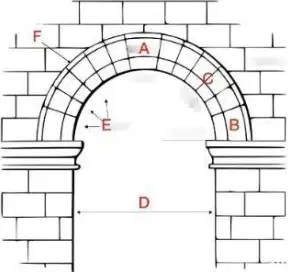
Identify part A in the arch diagram labeled A–F.
Springer
Voussoirs
Extrados
Keystone
Intrados
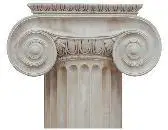
Identify the Greek classical order shown.
Doric
Tuscan
Corinthian
Ionic
What was the middle and main aisle of the early Christian Church?
Nave
Aisle
Narthex
Transept
The monumental gateway to the Acropolis is known as:
Propylea
Temple of Athena
Erechtheion
Parthenon
What is the primary function of a bouleuterion on ancient Greece?
Council meetings
Marketplace
Courtroom
Religious worship
These two temples are not based on the Doric Order
Temple of Artemis – Parthenon
Parthenon - Temple of Hera
Temple of Hera – Propylaea
Temple of Artemis - Temple of Zeus

