
 Worksheets
Quiz 1 Process Dynamics
Total questions: 61
Worksheet time: 31mins
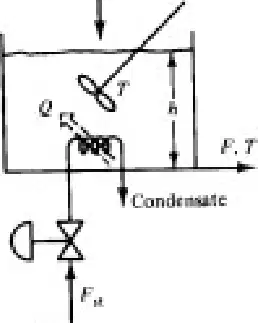
A liquid enters a stirred tank heater at a flow rate Fi and temperature Ti . What provides heat to the liquid inside the tank?
Condensing steam in a coil inside the tank
An electric immersion heater
Radiative heating from external lamps
Hot water circulating in an external jacket
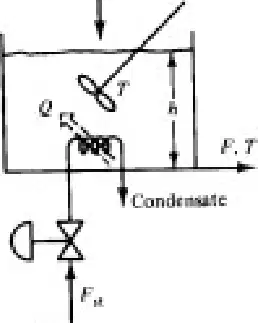
Because the tank is well-stirred, the outlet temperature is equal to which temperature?
The liquid temperature inside the tank
The inlet temperature Ti
The steam saturation temperature
The ambient room temperature
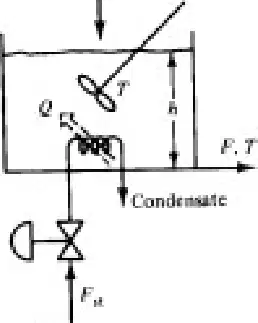
Select the control objectives stated for the stirred tank heater.
Maintain the outlet temperature T at a desired setpoint Ts
Maintain the liquid level (or volume) V in the tank at a desired value
Maximize the steam flow rate to the coil
Minimize the inlet flow rate Fi
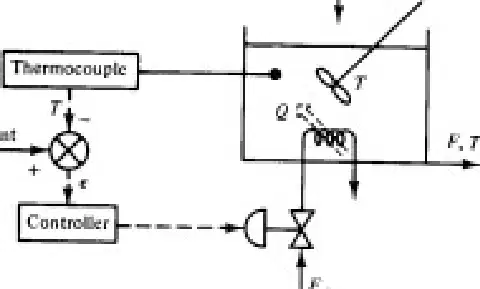
In the feedback temperature control for the tank heater, which device measures the tank temperature and sends a signal to the controller?
A thermocouple
A manometer
A rotameter
A tachometer
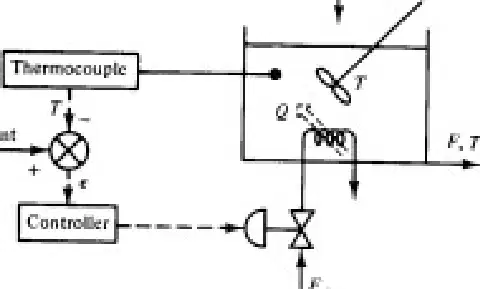
According to the feedback temperature control diagram, which inlet conditions are assumed constant?
Inlet temperature Ti and inlet flow rate Fi
Steam flow rate and steam pressure
Outlet flow rate F and outlet temperature T
Liquid level V and tank pressure
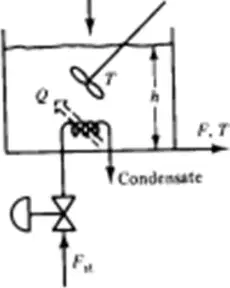
From the description: In real operation, disturbances such as changes in Fi (feed flow rate) or Ti (feed temperature) occur frequently. Without control, these variations would cause T and V to fluctuate, leading to poor product quality or unsafe conditions. Therefore, a control system is required to automatically adjust the steam flow rate Fs to maintain the desired temperature. Which variable does the control system automatically adjust to maintain the desired temperature?
Steam flow rate Fs
Feed flow rate Fi
Feed temperature Ti
Vessel volume V
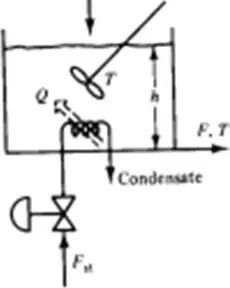
According to the text on why control is needed, which of the following is explicitly cited as a disturbance in real operation?
Change in feed flow rate Fi
Change in vessel volume V
Change in controller setpoint Ts
Presence of a thermocouple
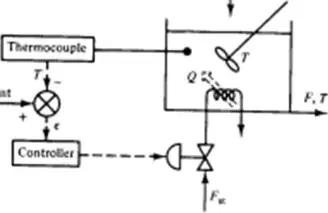
In a feedback control system: A thermocouple measures the actual liquid temperature T . The controller compares T with the setpoint Ts . The error, e=Ts−T , is sent to the controller. Which device measures the actual liquid temperature?
Thermocouple
Controller
Steam valve
Flow meter
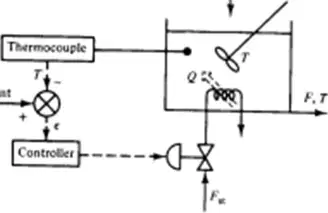
In the feedback temperature control description, how is the error e defined?
e=T−Ts
e=Ts−T
e=Fs−Fi
e=V−T
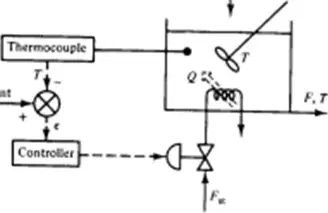
If T is too low ( e>0 ), what action does the controller take according to the feedback temperature control description?
Opens the steam valve to increase heating
Reduces steam flow
Disconnects the thermocouple
Lowers the setpoint Ts
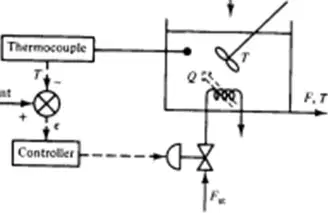
If T is too high ( e<0 ), what action does the controller take according to the feedback temperature control description?
Reduces steam flow
Opens the steam valve more
Increases feed flow rate Fi
Raises the setpoint Ts
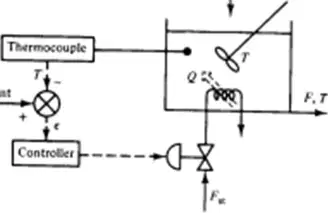
What is the stated outcome of automatic adjustment in the feedback temperature control system?
Keeps the process temperature close to the desired value despite disturbances
Maintains feed flow rate Fi at a constant value
Eliminates the need for a thermocouple
Maximizes vessel volume V
Key Concept: Feedback control acts after a disturbance affects the system—it measures the deviation and corrects it. In contrast, feedforward control anticipates the effect of disturbances (like changes in Fi or Ti ) and adjusts the steam valve before the process variable deviates. Which statement aligns with the description of feedback control in this passage?
It predicts disturbances and adjusts the valve before any deviation occurs.
It measures the deviation caused by a disturbance and then corrects the system.
It ignores disturbances and maintains a constant valve position.
It compensates by changing setpoints in advance of any change.
Key Concept: Feedback control acts after a disturbance affects the system—it measures the deviation and corrects it. In contrast, feedforward control anticipates the effect of disturbances (like changes in Fi or Ti ) and adjusts the steam valve before the process variable deviates. Which statement aligns with the description of feedforward control in this passage?
It waits for the process variable to deviate and then corrects it.
It anticipates disturbances and adjusts the steam valve before the process variable deviates.
It eliminates the need for measuring disturbances or process variables.
It only responds to deviations that have already occurred.
According to the passage, how are feedback and feedforward strategies commonly used in modern control systems for performance?
They are used independently and never combined.
They are often combined to improve performance.
They are avoided due to complexity.
They are only combined when disturbances cannot be measured.
The passage states that the stability of a process refers to its ability to return to its normal operating condition after being disturbed. Based on this, what does process stability mean?
The ability to return to normal operation after a disturbance
The ability to avoid any deviation from steady state under all conditions
The need for external intervention to recover from disturbances
The tendency to amplify disturbances over time
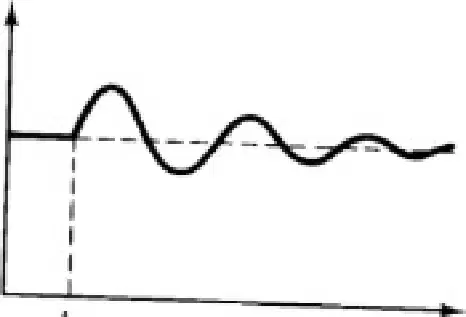
Consider the variable x shown in the figure described in the passage. At time t=t0 , the process experiences a disturbance that causes x to deviate from its steady-state value. Over time, x gradually returns to its original level without any external intervention. What is this type of system called?
Self-regulating (stable)
Unstable
Chaotic
Externally controlled
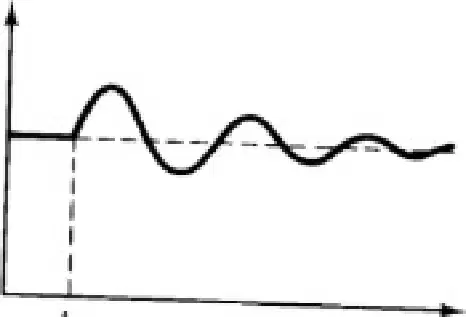
The plotted response of the variable x over time shows behavior after a disturbance at t0 . Which behavior best matches the figure described in the passage?
Damped return to steady-state after the disturbance
Constant offset maintained indefinitely after the disturbance
Growing oscillations moving away from steady-state
Immediate snap back to steady-state with no oscillation
The passage gives examples of self-regulating processes that automatically settle back after a small upset. Which of the following are examples of such self-regulating behavior? Select all that apply.
Temperature settling back after a small upset
Concentration automatically returning to its previous level
Flow rate stabilizing after a minor disturbance
An operator manually adjusting a valve to correct a disturbance
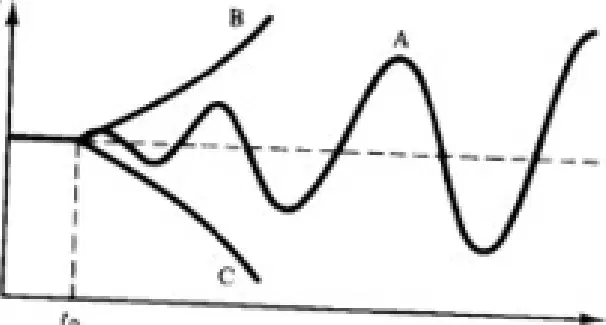
Refer to the figure labeled "Unstable," which plots y versus time after a disturbance at t0 with curves A, B, and C and a dashed equilibrium line. Which curve represents behavior that diverges away continuously from the equilibrium after the disturbance?
Curve A
Curve B
Curve C
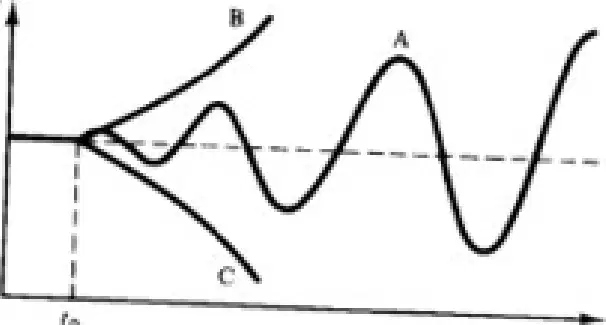
In the figure labeled "Unstable," which curve corresponds to oscillations with increasing amplitude after the disturbance at t0 ?
Curve A
Curve B
Curve C
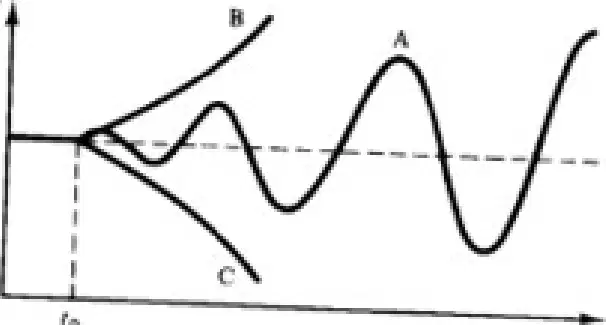
According to the figure labeled "Unstable," which curve shows decay without recovery toward the original value after the disturbance at t0 ?
Curve A
Curve B
Curve C
For systems exhibiting the "Unstable" behaviors described (divergence, increasing-amplitude oscillations, or indefinite decay), what is required to maintain stability?
External control
Passive observation
No control
Internal damping alone
Based on the passage, riding a bicycle is inherently which type of system with respect to stability?
Stable
Neutral
Unstable
Self-correcting
To keep a bicycle upright, which actions must be constantly adjusted according to the passage? Select all that apply.
Steering
Pedaling
Shifting body weight
Maintaining a fixed posture
From the excerpt: "Stable System: Returns naturally to steady state (self-regulating). Unstable System: Moves away from steady state unless corrected by control action. A control system plays a crucial role in ensuring that industrial processes remain stable, safe, and predictable despite disturbances." Which statement best defines a stable system?
A system that requires continuous external intervention to avoid drifting from steady state
A system that returns naturally to steady state without external correction
A system that amplifies disturbances to achieve a new operating point
A system that remains at any state regardless of inputs or disturbances
Based on the excerpt: "Stable System: Returns naturally to steady state (self-regulating). Unstable System: Moves away from steady state unless corrected by control action." What characterizes an unstable system?
It maintains steady state without any control action
It moves away from steady state unless corrected by control action
It immediately returns to steady state after a disturbance
It cannot be influenced by control action
According to the statement: "A control system plays a crucial role in ensuring that industrial processes remain stable, safe, and predictable despite disturbances," what is the primary role of a control system in industrial processes?
To introduce disturbances that test system resilience
To ensure processes remain stable, safe, and predictable despite disturbances
To eliminate the need for monitoring and maintenance
To maximize variability to improve flexibility
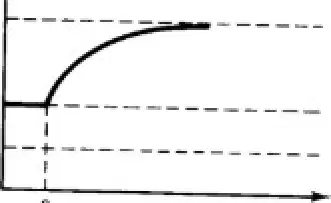
In Figure 1.9, which plot corresponds to operation near T3 where a small disturbance is followed by a gradual return to T3 , indicating a stable high-temperature steady state?
(a)
(b)
(c)
(d)
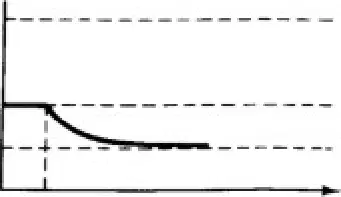
According to Figure 1.9, which plot depicts operation near T1 where a disturbance is followed by a smooth return to T1 , indicating a stable low-temperature steady state?
(a)
(b)
(c)
(d)
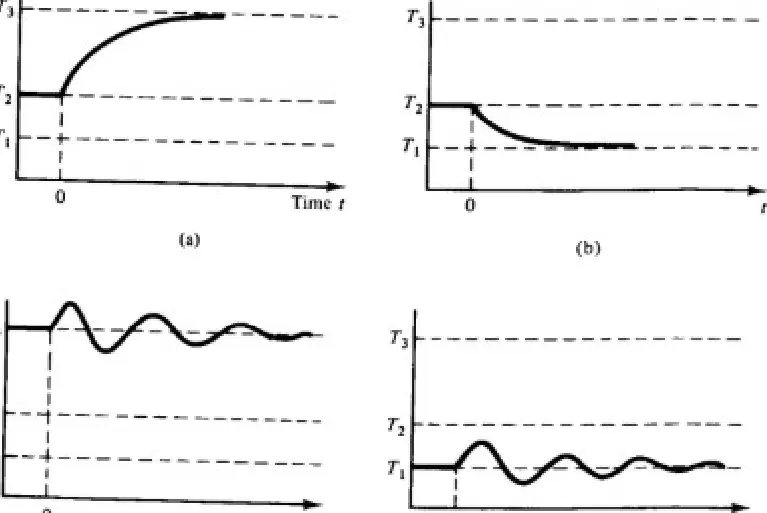
Which plots in Figure 1.9 illustrate responses when operating near T2 that diverge away from T2 after a small disturbance, demonstrating an unstable middle steady state? Select all that apply.
(a)
(b)
(c)
(d)
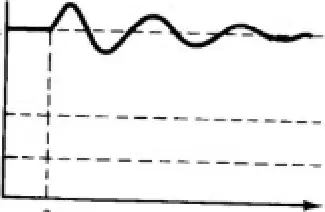
In Figure 1.9, for operation near T2 shown in plot (c), what is the final behavior of the temperature after oscillations caused by a small disturbance?
Settles near T3
Settles near T1
Remains near T2
Diverges without settling
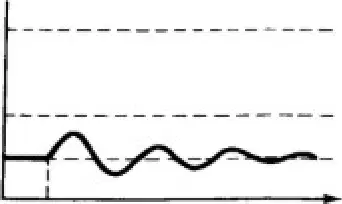
In Figure 1.9, for operation near T2 shown in plot (d), what is the final behavior of the temperature after oscillations caused by a small disturbance?
Settles near T3
Settles near T1
Remains near T2
Diverges without settling
In the batch reactor described, two consecutive endothermic reactions occur as shown: Ak1Bk2C . Which species is the desired product?
A
B
C
A and C
In the reaction sequence Ak1Bk2C , which species is identified as an undesired by-product?
A
B
C
None of the above
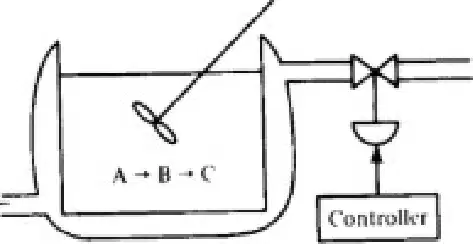
Heat for the reactions in the batch reactor is supplied by which method?
Direct electrical heating inside the vessel
Steam circulating through a jacket around the reactor
Microwave irradiation of the reacting mixture
Preheated feed continuously added to the reactor
What is the main manipulated variable used to achieve the economic objective in operating the reactor?
Initial concentration of A
Agitator speed
Steam flow rate Q(t)
Final cooldown time
The economic goal for operating the reactor is to maximize profit Φ over the total reaction period tR . Which statement best describes this objective?
Maximize Φ by minimizing the production of B and maximizing the production of C over tR .
Maximize Φ defined as the integral over tR of revenue from B minus the cost of steam and the cost of A.
Maximize Φ by keeping the reactor isothermal and minimizing energy usage without considering product revenue.
Maximize Φ by minimizing Q(t) irrespective of product formation.
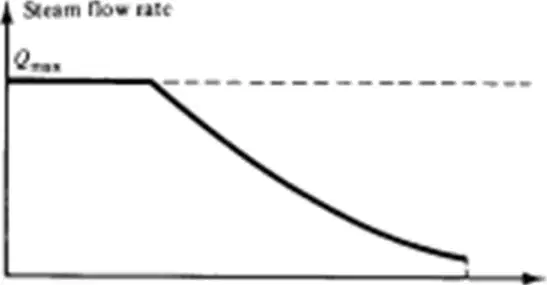
Refer to the figure showing the optimal profile of steam flow rate for a batch reactor. Which description best matches the profile over the batch time t_R?
Starts near Qmax and remains constant
Starts high and then decreases gradually toward near Qmin by the end
Increases steadily from near Qmin to Qmax
Stays at zero throughout the batch
Under a high steam flow rate (large Q), which outcome is stated for the reactor performance?
The reactor temperature rises quickly, leading to a high production rate of B
Steam cost is eliminated and the reaction stops
No B is produced
Secondary reactions are completely prevented
What action is recommended near the end of the batch to prevent B from converting into unwanted C?
Increase the steam rate to maintain high temperature
Reduce the steam rate
Keep the steam rate constant at a high level
Add additional reactants to the batch
Which statement about excessive heating due to high steam flow rate is correct?
It decreases steam costs and suppresses side reactions
It increases steam costs and promotes the secondary reaction that forms unwanted C
It has no effect on secondary reactions or costs
It ensures complete conversion of A to B without forming C
When Q(t)=0) (no steam flow), which outcomes are stated for the batch reaction? Select all that apply.
No heating occurs
Steam cost is eliminated
The reaction practically stops
B is produced at a high rate
In practice, how does the optimal steam flow rate vary during the batch cycle to balance production and side reactions?
It remains at Qmax to maximize production of B
It is kept at Qmin to minimize energy consumption
It starts high to accelerate production of B and then gradually decreases to minimize side reactions and energy use
It oscillates randomly to avoid secondary reactions
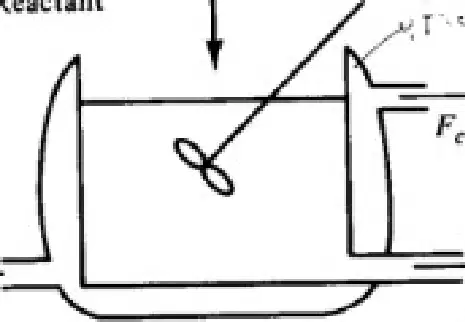
Refer to the diagram labeled "Figure 1.7 CSTR with cooling jacket," which shows a stirred tank with a cooling jacket, reactant feed, and product outlet. According to the accompanying list, which variable is identified as an input variable?
cAf
cA
V
T
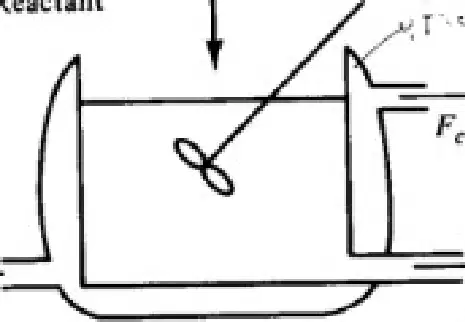
Refer to the diagram labeled "Figure 1.7 CSTR with cooling jacket," which shows a stirred tank with a cooling jacket, reactant feed, and product outlet. According to the accompanying list, which variable is identified as an output variable?
cA
Fb
Tcj
Tb
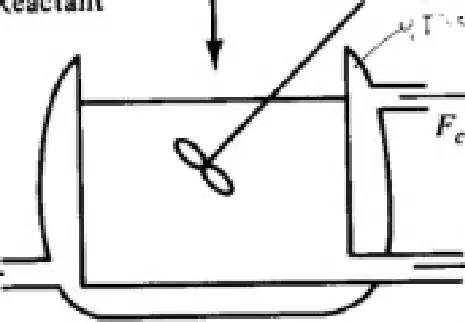
Based on the caption accompanying the diagram, what piece of equipment is depicted?
Continuous stirred-tank reactor (CSTR) with a cooling jacket
Plug flow reactor without heat exchange
Batch reactor with electrical heating
Distillation column with reflux
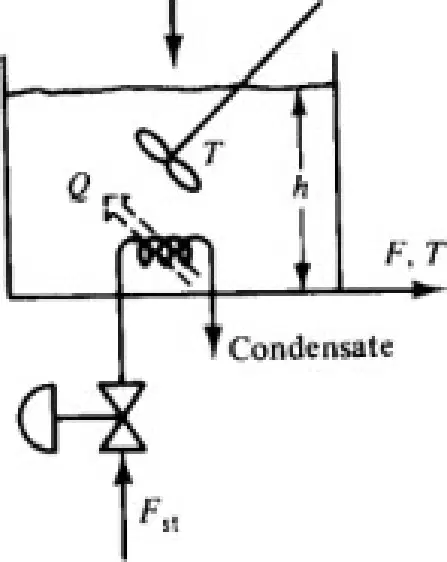
Based on the listed sets in the figure and text, which set contains the input variables for the shown process?
Fi, Ti, Fst (F)
F, V, T
Steam, Condensate, Volume
Q, h, T
According to the text, which set contains the output variables?
F, V, T
Fi, Ti, Fst (F)
Steam pressure, Coil temperature, Level h
Q, h, inlet temperature
Which statement correctly defines manipulated (or adjustable) variables as classified in the text?
Variables whose values can be adjusted freely by the human operator or a control mechanism
Variables whose values change only due to environmental noise
Variables that cannot be measured directly
Variables that remain constant throughout operation
Which statement correctly defines disturbances in the classification of input variables?
Variables whose values are not the result of adjustment by an operator or a control system
Variables set intentionally to achieve a desired output
Variables measured continuously by sensors
Variables that always equal the outputs
Which statement correctly defines measured output variables?
Output variables whose values are known by directly measuring them
Output variables that cannot be measured directly
Input variables set by the operator
Variables that are calculated but never observed
Which statement correctly defines unmeasured output variables?
Output variables that are not or cannot be measured directly
Output variables known from direct measurement
Input variables adjusted by a control mechanism
Variables whose values are always constant
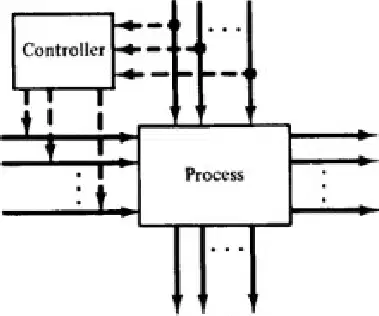
Based on the described feedback control configuration, which statement best characterizes how the controller operates relative to the controlled variable and set point?
It measures the controlled variable, compares it with the desired set point, and adjusts the manipulated variable to correct any error.
It predicts future values of the controlled variable using disturbance measurements and leaves the manipulated variable unchanged.
It measures unmeasured outputs and resets the set point to eliminate the error.
It adjusts disturbances directly to force the process to match the manipulated variable.
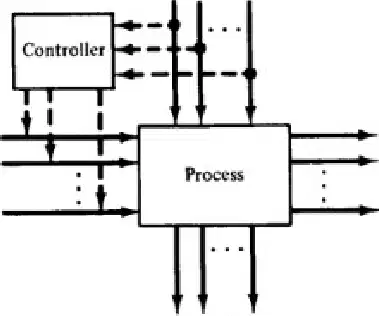
What is the main goal of the feedback control configuration as described?
To keep the controlled variable at its target value even when disturbances occur.
To maximize the effect of disturbances on the controlled variable.
To change the set point whenever the process output varies.
To avoid measuring the controlled variable.
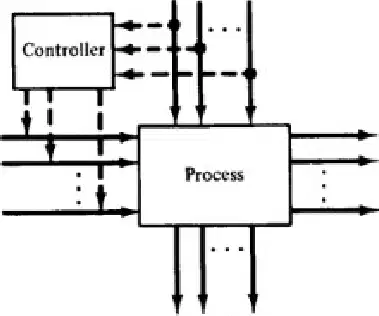
In the feedback control diagram, which signal is directly compared with the set point to produce an error for the controller?
Measured outputs (controlled variables)
Manipulated variables
Unmeasured outputs
Disturbance measurements
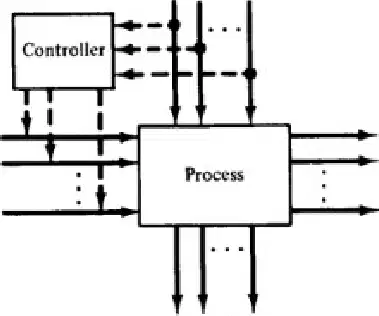
According to the feedback control description, which quantity does the controller adjust to correct the error?
Manipulated variable (e.g., valve opening or flow rate)
Set point value
Disturbance magnitude
Unmeasured outputs

Which configuration measures disturbances before they affect the process and adjusts the manipulated variable in advance?
Feedforward control configuration
Feedback control configuration
On–off control configuration
Open-loop scheduling
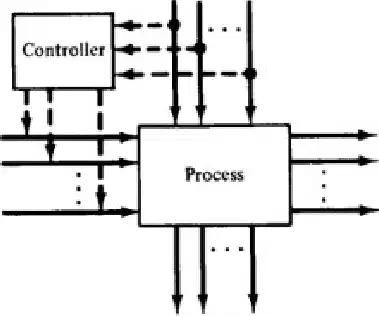
What is the stated purpose of feedforward control in the description?
To anticipate changes and take corrective action before an error occurs.
To wait for an error and then adjust the set point.
To eliminate the need for manipulated variables.
To measure only the controlled variable and ignore disturbances.
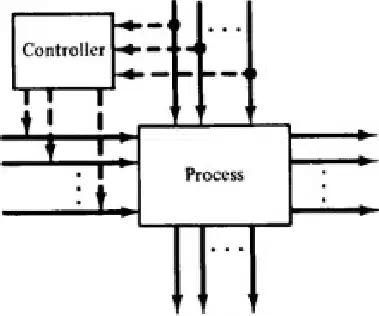
Which example is explicitly given as a feedback control application?
Tank heater temperature control
Flow prediction using disturbance measurements
Disturbance-only regulation
Unmeasured output tracking
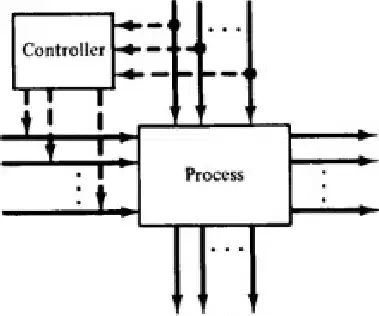
Considering the roles of measurement in the two configurations, which statement is correct?
Feedback measures the controlled variable; feedforward measures disturbances before they affect the process.
Both feedback and feedforward measure only unmeasured outputs.
Feedback measures disturbances; feedforward measures the controlled variable.
Neither configuration uses measurements to adjust manipulated variables.

