
 Worksheets
Course Outcomes and Module 1 Overview
Total questions: 51
Worksheet time: 26mins
Which statement best describes the use of Grübler’s formula in mechanism analysis?
It balances inertia forces in high-speed cam mechanisms
It estimates optimal transmission angle for power transfer
It evaluates mobility or degrees of freedom of linkages
It predicts gear tooth interference in spur gears
For a slider-crank mechanism, which analyses are commonly applied to study motion and dynamic behavior?
Velocity and acceleration analysis
Cam profile synthesis
Force equilibrium analysis
Grashof’s rule verification
Lower and higher pairs are primarily distinguished by which criterion?
Nature of relative motion constraints at the joint
Number of links connected within the pair
Requirement of lubrication during operation
Magnitude of forces transmitted through links
Which set lists mechanisms typically covered alongside slider-crank and four-bar inversions?
Rocker and universal joints
Planetary trains and harmonic drives
Steering linkages and cam-follower pairs
Quick return and straight-line generators
Which statement best distinguishes kinematics from dynamics in mechanical systems?
Dynamics ignores mass while analyzing motion
Kinematics focuses force and power relationships
Dynamics studies motion without considering forces
Kinematics studies motion without considering forces

In a mechanism where only positions, velocities, and accelerations are evaluated, which analysis is appropriate?
Kinematics analysis of motion variables
Dynamics analysis of applied forces
Energy audit of input and output
Power analysis using torque data

Which set of quantities is central to dynamics in machine analysis?
Geometry, linkage, path
Displacement, velocity, acceleration
Stress, strain, elasticity
Force, mass, and acceleration
Select all true statements about kinematics versus dynamics.
Kinematics does not consider mass of the body
Dynamics is used for force and power analysis
Dynamics applies Newton’s laws to motion
Kinematics explains why a body moves
A designer wants to size a motor for a mechanism. Which analysis should be performed first to estimate required power?
Material selection and heat treatment
Geometric tolerance analysis only
Kinematics analysis of link velocities
Dynamics analysis of forces and power
Which example best aligns with kinematics in mechanisms?
Power transmission efficiency study
Force analysis of mechanisms
Torque ripple in electric drive
Velocity analysis of mechanisms
Which statement correctly pairs field and role?
Kinematics is used for power analysis tasks
Dynamics ignores mass of moving systems
Kinematics applies Newton’s laws to bodies
Dynamics explains why a body moves
Which statement best defines a mechanism in kinematics?
A set of bodies forming a chain with one link fixed
Any group of moving parts without fixed joints
Two isolated rigid bodies moving independently in space
A structure with no relative motion between bodies
What is the minimum number of links required to obtain a mechanism with mobility?
Five links arranged without any fixed link
Four links with at least one link fixed
Three links connected into a closed chain
Two links connected by a single joint
A kinematic chain with fewer than four links behaves primarily as which of the following?
A structure with no relative mobility
A mechanism allowing continuous motion
A hydraulic actuator under pressure
A freely floating linkage in space
Which combination correctly distinguishes a rigid link from a flexible link?
Flexible link: cannot transmit motion across joints
Flexible link: undergoes deformation yet transmits motion
Rigid link: deforms noticeably while transmitting motion
Rigid link: resists deformation during motion transmission
Select all examples that are rigid links in typical machines.
Rope used for lifting a payload
Belt used in a belt drive system
Connecting rod in an engine assembly
Crank in a slider–crank mechanism
Which statement about a link is correct?
A link can connect parts but never transmits motion
A link cannot be fastened with other bodies rigidly
A link must provide at least two joints to connect
A link is always a single rigid body alone
Which description best characterizes a fluid link?
Motion transferred through thermal expansion of metals
Motion transferred through fluid pressure within elements
Motion transferred through dry frictional contact surfaces
Motion transferred through elastic deformation of solids
A component intended to connect other parts and transmit motion must have at least how many nodes, and why?
Two nodes to join with other links effectively
One node because motion passes through a single point
Four nodes to ensure closed-loop mobility
Three nodes to avoid becoming a determinate structure
Which statement best defines a mechanical joint in machines?
A coupler transmitting only rotary motion between links
An elastic element storing strain energy between links
A connection allowing controlled relative motion between links
A rigid fastening preventing any relative motion
Lower pairs are characterized primarily by what kind of contact between the two links?
Point contact between curved surfaces
Line contact along helical paths
Intermittent contact during impact
Surface contact over mating areas
Which combination correctly matches the joint type with the primary motion it permits?
Prismatic joint — sliding motion
Revolute joint — rotary motion
Cylindrical joint — sliding and rotary
Helical joint — rotation only
Spherical joint — rotation about all axes
A lead screw in a screw jack exemplifies which lower pair and associated motion?
Prismatic joint with constrained sliding only
Revolute joint with planar rotation only
Helical joint with rotary plus linear motion
Spherical joint with free spatial rotation
Compared to higher pairs, lower pairs typically show which performance trend?
Less wear but reduced load capacity
More wear and lower load capacity
Less wear and better load capacity
Similar wear with lower load capacity
Which application most appropriately uses a cylindrical joint?
Drill spindle guiding rotation and sliding
Crank connected to a connecting rod
Ball and socket in a robotic wrist
Piston moving inside engine cylinder
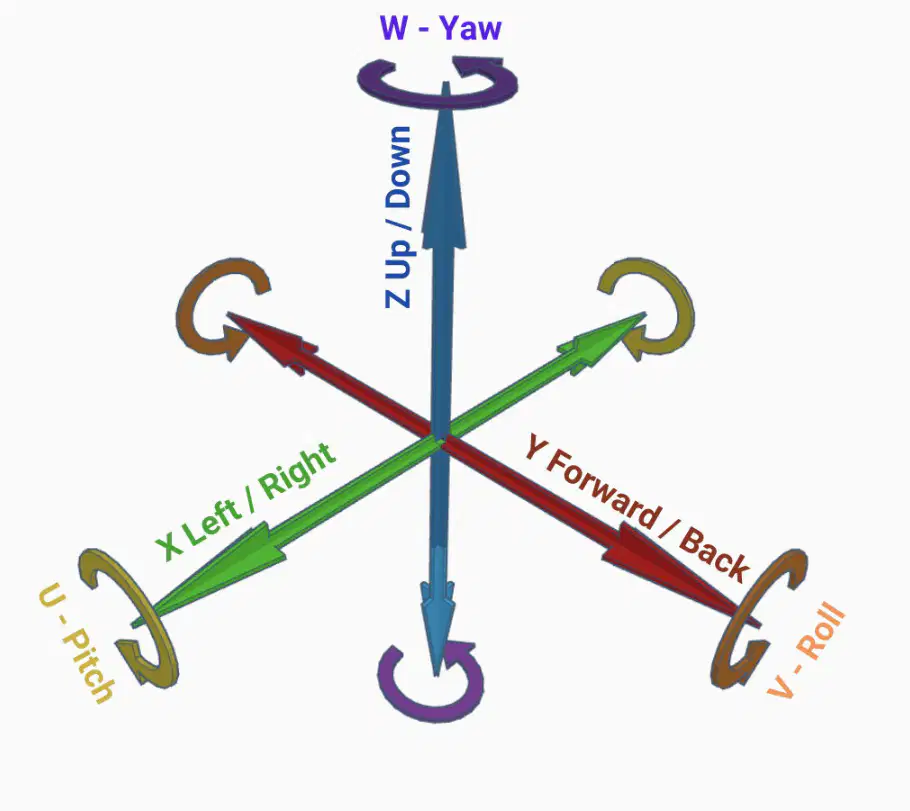
In the diagram of spatial motion, which axis-label pair correctly represents translation along the vertical axis?
V roll rotation
Z up or down translation
U pitch rotation
Y forward or back translation
X left or right translation
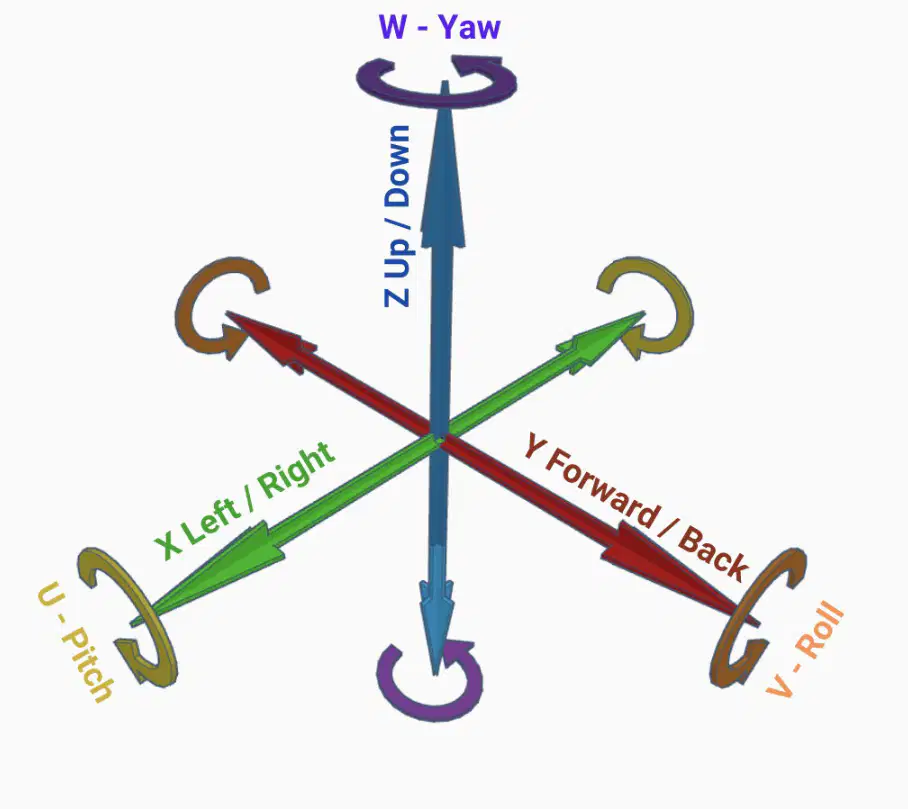
Which rotational degree of freedom is shown about the vertical axis in the diagram?
Pitch about vertical axis
Yaw about vertical axis
Spin about vertical axis
Twist about vertical axis
Roll about vertical axis
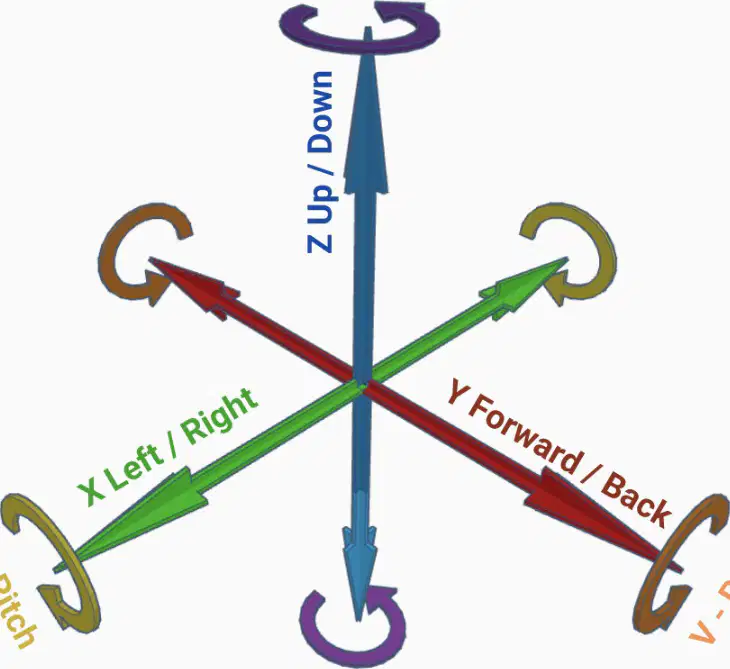
Select all motions that are pure rotations in the depicted 6-DOF model.
X left/right translation
W - Yaw rotation
U - Pitch rotation
Y forward/back translation
V - Roll rotation
Higher pair joints are characterized by what type of contact between two links?
Hydraulic film separated contact
Area contact between surfaces
Composite layered surface contact
Elastic contact with preload
Point or line contact between links

Which joints in the table are higher pairs with line contact? Choose all that apply.
Cam and follower joint
Belt and pulley joint
Gear pair joint
Rivet lap joint
Rolling contact joint

Which example correctly matches a higher pair to its application as shown?
Belt and pulley to crankshafts
Gear pair to ball screws
Rolling contact joint to ball bearings
Gear pair to valve mechanisms
Cam and follower to gear trains
Why do higher pairs typically have greater wear compared to lower pairs?
Point or line contact concentrates stresses
They rely on area contact reducing pressure
They require constant lubrication by default
They are limited to one degree of freedom
They operate at lower speeds always
Which statement best defines a completely constrained mechanism?
Motion between links depends only on external loads
Motion between links is partially limited sometimes
Motion between links is random and chaotic
Motion between links is definite and predictable
Identify the example that represents completely constrained motion.
Slider moving in a rectangular guide
Circular shaft in a circular hole
Free gear on a smooth shaft
Ball joint with three rotational freedoms
In an incompletely constrained mechanism, what characterizes the relative motion between links?
It is not definite and can vary
It is fixed to a single path
It is locked with zero movement
It is periodic with constant frequency
Which pairing correctly matches the mechanism type with a typical example?
Incompletely constrained — circular shaft in circular hole
Incompletely constrained — slider in rectangular guide
Completely constrained — piston and cylinder
Completely constrained — circular shaft in circular hole
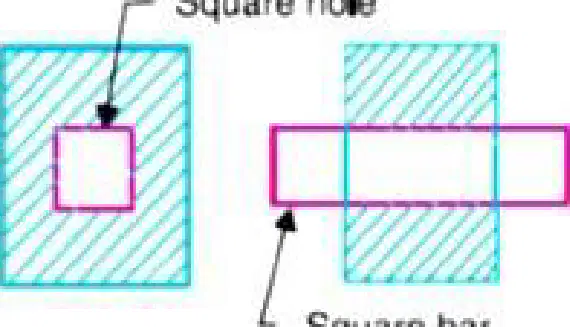
A square bar is fitted into a square hole allowing sliding along one axis only. What type of constraint is this and why?
Overconstrained, redundant pairs restrict all motion
Incompletely constrained, extra rotation is possible
Successfully constrained, uses external force only
Completely constrained, motion is single and predictable
Which statement best describes mechanisms for transmission of motion?
Store energy while smoothing input speed fluctuations
Transfer motion between links without altering its nature
Convert rotary motion into reciprocating motion as needed
Generate a prescribed locus for a coupler point
Which set lists ONLY mechanisms primarily used for motion transmission?
Ratchet and pawl, quick return, Whitworth
Slider–crank, cam and follower, rack and pinion
Gear trains, belt and pulley, chain drive
Cam and spring follower, Geneva, Scotch yoke
Select all mechanisms that transform one type of motion into another.
Rack and pinion
Cam and follower
Slider–crank mechanism
Simple gear train
In a slider–crank mechanism, what motion transformation occurs?
Rotary to reciprocating and vice versa
Rotary to oscillatory only
Reciprocating to intermittent indexing
Rotary to constant-velocity translation
A rack and pinion is primarily used for which functional purpose?
Store energy using elastic deflection
Generate complex coupler curves
Transmit motion without any speed change
Transform rotary motion into linear motion
Which mechanism category aims to keep the nature of motion unchanged while passing it along?
Path generation mechanisms
Transmission of motion mechanisms
Energy storage mechanisms
Transformation of motion mechanisms
In a basic four-bar linkage, which component is the fixed link anchoring the mechanism to ground?
Frame link acting as ground
Coupler link between moving bars
Follower link providing output
Crank link attached to motor
Which statement best describes the role of the crank in a four-bar mechanism?
It undergoes complete rotation driving motion
It provides oscillatory output motion
It serves as the stationary ground link
It converts linear motion into torque
In a four-bar linkage, what function does the coupler primarily serve?
Acts as the fixed frame of reference
Constrains the crank to rotate fully
Transfers motion between input and output
Dampens vibrations during motion
The follower (rocker) in a four-bar mechanism typically exhibits which motion characteristic?
Helical rotation about an axis
Pure translation along a line
Oscillatory angular displacement
Continuous full rotation
Kinematic inversion in mechanisms refers to which conceptual operation?
Changing the number of links entirely
Interchanging input and output links
Fixing a different link as ground
Replacing revolute pairs with prismatic
Which pair correctly matches component to typical motion in a four-bar linkage?
Coupler — complex planar motion
Rocker — oscillatory rotation
Frame — relative translation
Crank — continuous rotation
For path generation tasks, straight-line mechanisms are employed primarily to do what?
Produce a specific locus of a point
Increase torque in the output link
Minimize the number of moving joints
Ensure full rotation of all links
When applying kinematic inversion to a four-bar, what design change most directly alters input-output behavior while preserving geometry?
Fix a different link as the frame
Replace revolute joints with sliders
Change link lengths proportionally
Add an auxiliary spring element

