
Font size
 Worksheets
Page 1
Total questions: 77
Worksheet time: 39mins
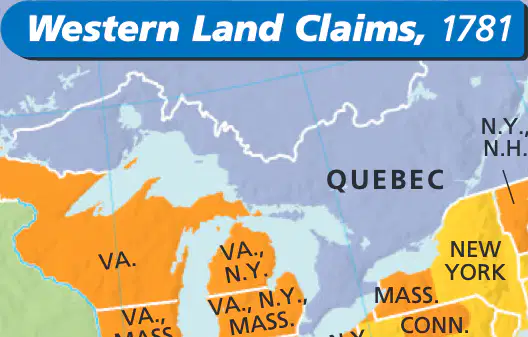
Geography Skillbuilder — Interpreting Maps: Using the map titled Western Land Claims, 1781, which of the original 13 states had Western land claims? Select all that apply from the options provided.
Virginia
New York
Massachusetts
Connecticut
North Carolina
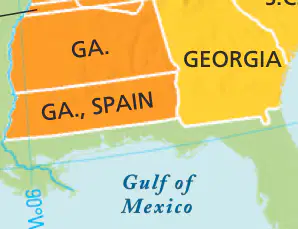
Geography Skillbuilder — Interpreting Maps: Using the map titled Western Land Claims, 1781, which of the original 13 states had Western land claims? Select all that apply from the options provided.
Georgia
Pennsylvania
New Jersey
Delaware
Maryland
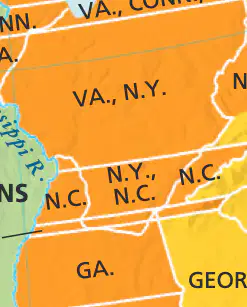
Geography Skillbuilder — Interpreting Maps: According to the map titled Western Land Claims, 1781, to what geographic feature did the Western land claims extend?
The Mississippi River
The Appalachian Mountains
The Great Lakes
The Atlantic Ocean

Skillbuilder Interpreting Charts: Based on the chart titled “Successes of the Confederation Congress,” which was the greatest success of the Confederation Congress?
Governed the nation during the Revolutionary War
Negotiated the Treaty of Paris at the end of the war
Passed the Land Ordinance of 1785
Passed the Northwest Ordinance (1787)
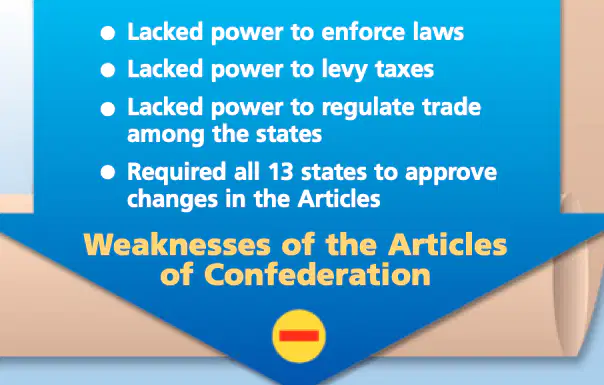
Skillbuilder Interpreting Charts: According to the chart titled “Weaknesses of the Articles of Confederation,” which was the greatest weakness of the Articles of Confederation?
Lacked power to enforce laws
Lacked power to levy taxes
Lacked power to regulate trade among the states
Required all 13 states to approve changes in the Articles
Explain the significance of Wilderness Road.
A trail through the Appalachian Mountains into Kentucky that opened the West to settlers
A trade route from Massachusetts to New Orleans used by merchants
A federally built highway across the Northwest Territory after 1800
A canal in New York that connected the Atlantic Ocean to the Great Lakes
Explain the significance of republic.
A government in which citizens elect representatives to make laws
A monarchy led by a hereditary king
A direct democracy where all citizens vote on each law
A military dictatorship run by generals
Explain the significance of Articles of Confederation.
The first national constitution creating a weak central government and strong state powers
A set of British laws that taxed the colonies before independence
The document that replaced the Constitution in 1791
An agreement that created a powerful national executive with veto over state laws
Main Ideas What were three successes of the Continental Congress?
Declaring independence and organizing the war effort
Forming the Continental Army under George Washington
Negotiating foreign support, including alliance with France
Passing the Northwest Ordinance of 1787
Main Ideas What was a major weakness of the Articles of Confederation?
Congress lacked the power to tax, leaving the national government weak
It created a powerful national executive
It abolished all state governments
It allowed Congress to regulate interstate commerce effectively
Critical Thinking Forming and Supporting Opinions Which action did the Massachusetts state militia take during Shays’s Rebellion?
Defended the federal arsenal and defeated Shays’s men
Joined the farmer protesters
Refused to respond to the uprising
Requested federal troops but did not act themselves

James Madison sidebar: How did Madison contribute to the Constitutional Convention? Choose the best description based on the sidebar profile of James Madison (1751–1836), which explains that he took thorough notes of the convention’s proceedings and was considered the best informed participant, earning the title “Father of the Constitution.”
He took thorough notes of the proceedings, providing the most detailed record of the debates and was a key participant.
He served as president of the Constitutional Convention and presided over all sessions.
He wrote the Declaration of Independence during the convention.
He led troops in battle outside Philadelphia while the convention met.
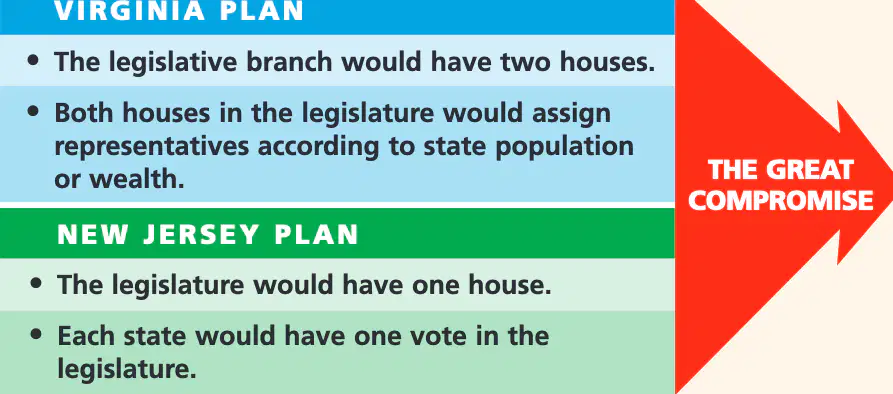
Skillbuilder: Interpreting Charts. Based on the chart comparing the Virginia Plan and the New Jersey Plan, which plan appealed more to the small states?
Virginia Plan
New Jersey Plan
Great Compromise
Articles of Confederation
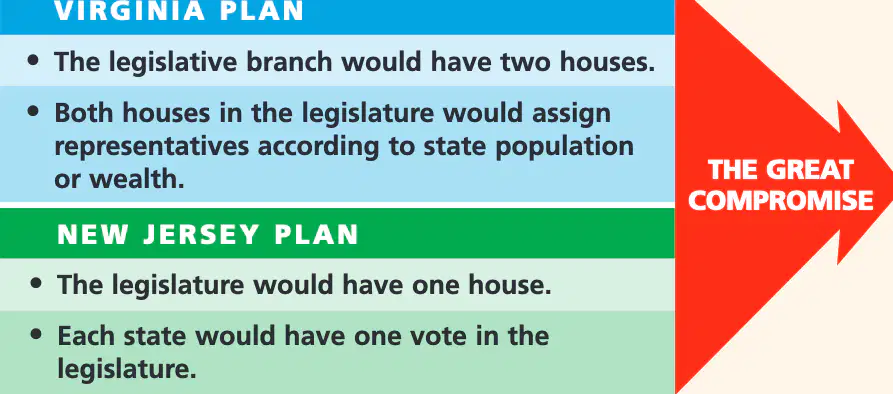
Skillbuilder: Interpreting Charts. Considering the outcomes shown in the chart titled The Great Compromise, did the Great Compromise include more of what the large states wanted or more of what the small states wanted?
More of the large states’ demands
More of the small states’ demands
About an equal balance of both sides’ demands
Mostly neither side’s demands
Explain the significance of Constitutional Convention.
A meeting in 1787 where delegates wrote a new U.S. Constitution to replace the Articles of Confederation
A gathering to declare independence from Britain in 1776
A court session that reviewed early Supreme Court cases
A convention to amend only the Articles of Confederation without changing the national structure
Explain the significance of James Madison.
A delegate known as the 'Father of the Constitution' for his key role in planning and drafting
The first president to serve under the Articles of Confederation
A foreign diplomat who negotiated the Treaty of Paris
A delegate who opposed all compromises at the convention
Explain the significance of Virginia Plan.
A proposal for a legislature with representation based on state population
A plan calling for equal representation of all states regardless of size
A proposal to keep the Articles of Confederation unchanged
A plan to give Congress power only to tax exports
Explain the significance of Great Compromise.
An agreement creating a bicameral Congress with a House based on population and a Senate with equal representation
A compromise that ended disputes over presidential elections by popular vote
An agreement that kept the Articles of Confederation intact
A compromise that required states to pay federal export taxes
Explain the significance of Three-Fifths Compromise.
An agreement to count a portion of enslaved people for representation and taxation
A decision to grant immediate citizenship to all enslaved people
A law banning slavery throughout all states in 1787
An agreement to count enslaved people fully for representation
What is the significance of the date 1787 ?
The year delegates met in Philadelphia and drafted the U.S. Constitution
The year the states completed ratification of the Constitution
The year Congress banned the slave trade
The year the Articles of Confederation were first adopted
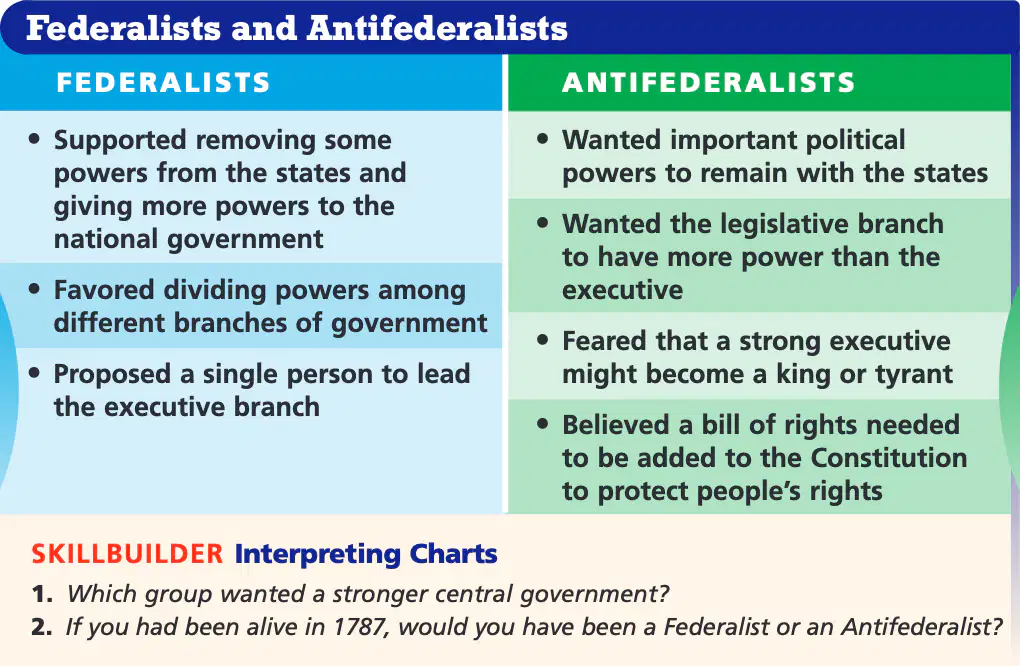
Skillbuilder — Interpreting Charts: Using the “Federalists and Antifederalists” comparison chart that summarizes each group’s positions on national versus state power and executive authority, which group wanted a stronger central government?
Federalists
Antifederalists
Both groups
Neither group

Skillbuilder — Interpreting Charts: Based on the “Federalists and Antifederalists” comparison chart that summarizes each group’s positions, which group would you most likely join if you preferred important political powers to remain with the states and wanted a bill of rights added to protect people’s rights?
Federalists
Antifederalists
Both groups
Neither group
Terms & Names — Explain the significance of: federalism. Choose the statement that best explains its significance in the U.S. Constitution.
It divides power between the national government and the states to prevent tyranny.
It gives all power to the national government so laws are uniform.
It ensures only the states can make laws and the national government simply enforces them.
It allows citizens to vote directly on every national law.
Terms & Names — Explain the significance of: Federalists. Choose the statement that best explains their role in ratification.
Supporters of the Constitution who argued for a strong national government.
Opponents of the Constitution who demanded stronger state governments.
Leaders who tried to stop the Bill of Rights from being added.
Activists who campaigned for independence from the Union.
Terms & Names — Explain the significance of: Antifederalists. Choose the statement that best explains their role in ratification.
Supporters of the Constitution and centralized power.
Opponents of the Constitution who feared strong national government and wanted a bill of rights.
Writers of The Federalist Papers promoting ratification.
Officials who enforced federal laws in the states.
Terms & Names — Explain the significance of: Bill of Rights. Choose the statement that best explains its significance.
It created the office of the president.
It established the system of federal courts.
It is the first ten amendments guaranteeing individual rights and limiting government power.
It replaced the Articles of Confederation with the Constitution.
Main Ideas — What was the significance of the Bill of Rights? Choose the best answer.
It guaranteed individual freedoms and limited the power of the national government as the first ten amendments.
It abolished state governments and centralized all power.
It created new states from existing territories.
It replaced the Constitution with a new document.
Which statement best explains the significance of the Great Compromise?
It created a Congress with a House based on population and a Senate with equal representation for states
It gave all legislative power to the House of Representatives
It required the president to be chosen by direct popular vote
It ended slavery in all states
Which statement best explains the significance of the Bill of Rights?
The first ten amendments that protect individual liberties and limit government power
A list of powers granted to Congress over the states
A set of war-time regulations for the army
A tax code adopted during the Confederation Era
Which problem did the Confederation Congress successfully address?
Organizing western lands through ordinances for settlement and statehood
Creating a powerful executive branch to enforce laws
Establishing a national currency backed by gold
Ending all trade disputes between states with federal courts
Under the Articles of Confederation, which powers did the national government have?
Conducting diplomacy, declaring war, and managing western territories, but limited power to tax
Levying direct taxes and regulating all interstate commerce
Appointing state governors and controlling local elections
Commanding a standing army funded by mandatory state payments
What groups of people were not represented at the Constitutional Convention?
Women, enslaved people, Native Americans, and most non-property-holding poor citizens
Delegates from large states
Foreign diplomats
Members of the army
Which statement best describes a compromise made during the Constitutional Convention?
Representation was divided between a population-based House and an equal-representation Senate
All enslaved people were granted immediate freedom
The president would serve for life
Small states would control all tax laws
What is federalism?
A system that divides power between national and state governments
Rule by a king with absolute authority
A government where all power rests solely with local towns
Military control over civilian government
Why did some states think it was necessary to add a bill of rights to the Constitution?
To protect individual liberties against potential government abuse
To expand the taxation powers of Congress
To guarantee lifetime terms for federal judges
To raise money for war debts
How do the Articles of Confederation and the Constitution each carry out democratic ideals?
Both establish government by the people; the Articles emphasize state sovereignty, while the Constitution creates a stronger federal system with representation and checks and balances
The Articles abolish legislatures, while the Constitution eliminates elections
Both concentrate power in a single ruler to ensure efficiency
The Articles guarantee judicial review, while the Constitution forbids it
Do you think the Founders were right to make compromises on representation and slavery in the Constitution, and why?
Yes; compromises enabled agreement among states and made ratification possible
No; compromises prevented any chance of ratification
Yes; compromises immediately abolished slavery nationwide
No; compromises forced small states to leave the union
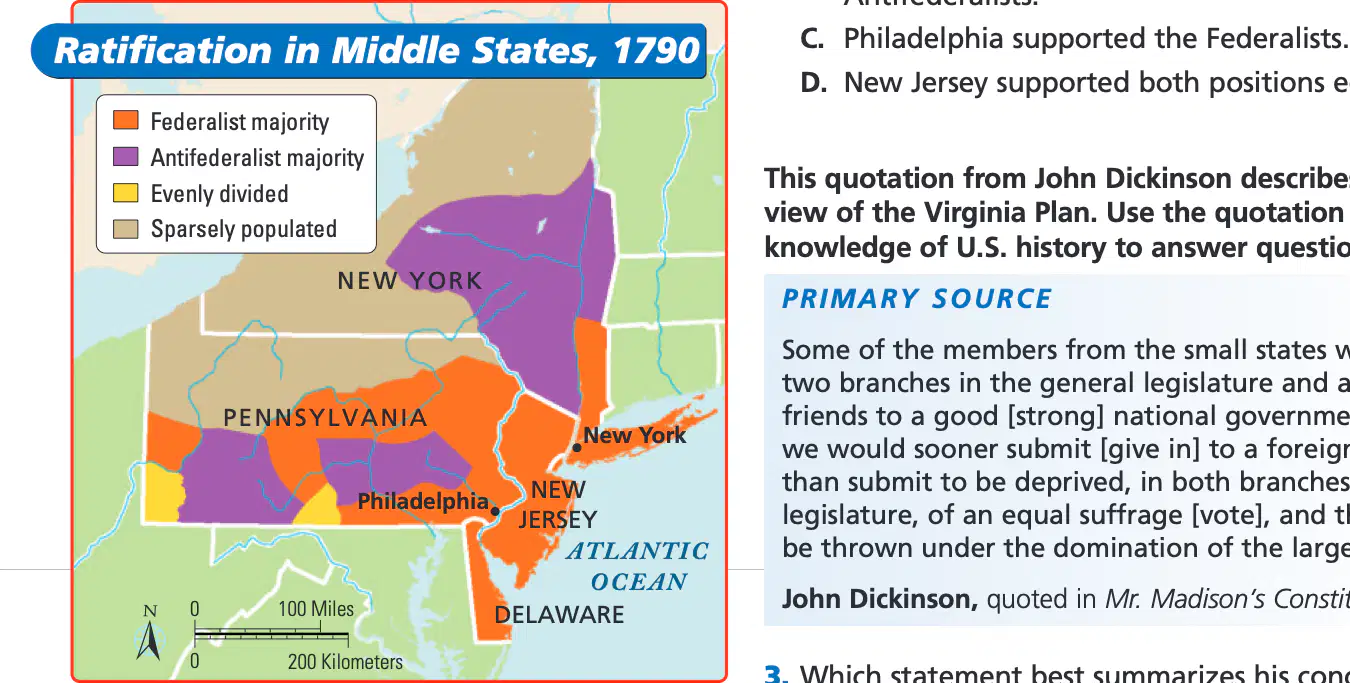
Use the map and your knowledge of U.S. history to answer: In which two states did the Federalists have statewide majorities? (8.2.4)
Delaware and New Jersey
Delaware and New York
New Jersey and Pennsylvania
New York and Pennsylvania
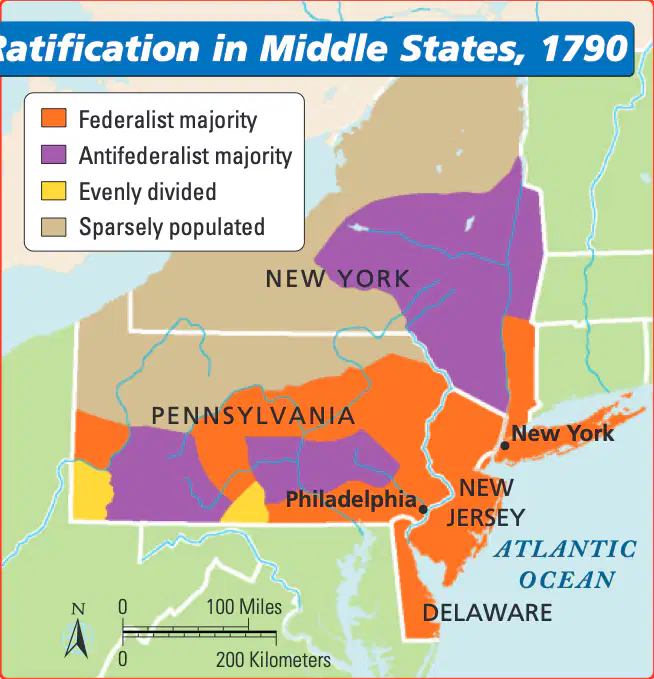
Use the map and your knowledge of U.S. history to answer: Which of the following is true? (8.2.4)
Most of New York supported the Federalists.
Most of Pennsylvania supported the Antifederalists.
Philadelphia supported the Federalists.
New Jersey supported both positions equally.

Based on the photo caption showing a person placing a ballot into a box labeled "City of Austin," what core feature of a republican government is highlighted?
Voting by citizens to make their voices heard
Appointment of leaders by military command
Selection of officials by foreign diplomats
Rule by a single monarch
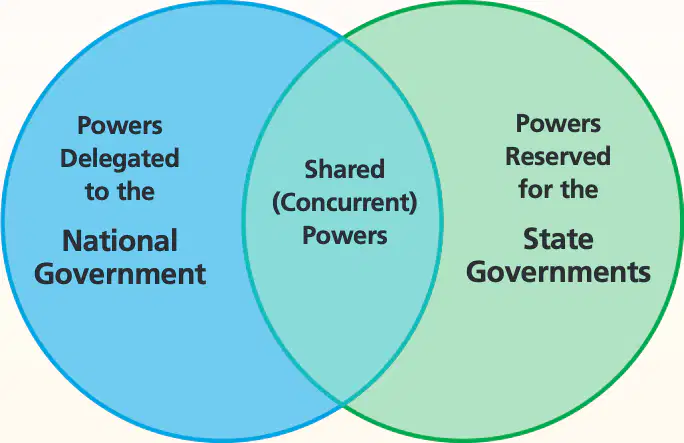
Refer to the Venn diagram labeled "Federalism" showing three areas: powers delegated to the national government, shared (concurrent) powers, and powers reserved for the state governments. What does the overlap in the diagram represent?
Powers only the national government holds
Powers only state governments hold
Powers shared by national and state governments
Powers held by local governments alone
Assessment: Principles of the Constitution — Main Ideas. How does the Constitution reflect the principle of separation of powers?
It divides the federal government into legislative, executive, and judicial branches with distinct powers and duties
It grants all governing authority to Congress, which appoints officials to carry out its laws
It allows the president to make laws, enforce them, and decide court cases when necessary
It gives states complete control over national policies while the federal government handles only foreign affairs
Assessment: Principles of the Constitution — Main Ideas. Why did the Framers include a system of checks and balances in the Constitution?
To prevent any one branch from becoming too powerful and to protect individual liberty
To ensure the executive branch can override Congress whenever efficiency requires it
To allow courts to set national policy without interference from elected officials
To let state governments veto all federal actions to preserve local control
Assessment: Principles of the Constitution — Critical Thinking, Forming Opinions. How do the rights and responsibilities of U.S. citizenship reflect American national identity?
They emphasize liberty, equality before the law, and civic duty through freedoms like speech and assembly and obligations like voting and jury service
They require citizens to obey a monarch and limit public participation to appointed councils
They focus mainly on economic productivity, with no expectation of civic participation or protection of personal freedoms
They prioritize regional traditions over national principles, discouraging involvement in federal institutions
Vocabulary — Briefly explain the significance of electors in U.S. government.
Members of Congress who directly choose the president
Officials who certify state election results
People chosen by states to cast official Electoral College votes for president and vice president
Supreme Court justices who review election challenges
Vocabulary — Briefly explain the significance of impeachment.
A process for selecting federal judges
A constitutional process to accuse and try government officials, potentially leading to removal from office
A requirement for passing federal laws
A method for resolving disputes between states
Vocabulary — Briefly explain the significance of naturalization.
The process of registering to vote
The procedure by which a noncitizen becomes a U.S. citizen
A system for choosing representatives
The certification of election results
Vocabulary — Briefly explain the significance of felonies.
Minor offenses punishable by small fines
Serious crimes typically punishable by more than one year in prison
Civil disputes resolved in small claims court
Infractions that carry no jail time
Vocabulary — Briefly explain the significance of a bill of attainder.
A budget bill funding the military
A legislative act that punishes a person without a judicial trial, which the Constitution prohibits
A bill that creates new federal courts
A law setting voting qualifications
Vocabulary — Briefly explain the significance of an ex post facto law.
A law that applies only to federal officials
A law that criminalizes actions retroactively or increases punishment after the fact, which the Constitution prohibits
A law that lowers penalties for future crimes
A law that sets deadlines for ratifying amendments
Vocabulary — Briefly explain the significance of suffrage.
The right to hold office
The right to a jury trial
The right to vote in political elections
The right to free legal counsel
Vocabulary — Briefly explain the significance of due process of law.
Government may act without court oversight
Fair legal procedures government must follow before depriving a person of life, liberty, or property
Exclusive powers of the executive branch
Rules for holding primaries
Vocabulary — Briefly explain the significance of servitude.
Voluntary community service
Forced labor or slavery, which is prohibited by the Thirteenth Amendment
Mandatory jury duty
Military enlistment
Vocabulary — Briefly explain the significance of a primary.
A final election to choose officeholders
An internal party election used to select candidates for the general election
A vote of the Electoral College
A referendum on constitutional amendments
Seven Principles of the Constitution — Provide the best definition for popular sovereignty.
Power is divided among three branches of government
Government powers are limited by law
Authority of government comes from the people, who are the ultimate source of power
Each branch can limit the others
Seven Principles of the Constitution — Provide the best definition for republicanism.
Citizens elect representatives to make laws on their behalf
All laws must be approved by the courts
States hold all governmental power
The president directly proposes legislation to Congress
Seven Principles of the Constitution — Provide the best definition for federalism.
Power is separated into legislative, executive, and judicial branches
Power is divided between national government and state governments
Citizens vote directly on all national laws
Only the national government may pass laws
Seven Principles of the Constitution — Provide the best definition for separation of powers.
The people authorize government through elections
Government power is divided among the legislative, executive, and judicial branches
States share power with local governments
Courts can strike down laws
Seven Principles of the Constitution — Provide the best definition for checks and balances.
The national government supervises state governments
Each branch of government can limit the powers of the other branches
Citizens may vote to repeal laws directly
Only Congress can check the president
Seven Principles of the Constitution — Provide the best definition for limited government.
Government has unlimited authority unless states object
Government powers are restricted by the Constitution and the rule of law
Only the courts can limit government
Congress may expand powers by simple majority
Seven Principles of the Constitution — Provide the best definition for individual rights.
Powers reserved to the states
Protections for people’s liberties, such as those listed in the Bill of Rights
Authority of elected officials to act for citizens
Privileges of federal officeholders
Review Questions (Article 1) — What are the constitutional requirements for becoming a member of the House of Representatives and the Senate? (REP4)
House: at least 30 years old, 9 years a citizen; Senate: at least 25 years old, 7 years a citizen
House: at least 25 years old, 7 years a citizen; Senate: at least 30 years old, 9 years a citizen
House: at least 21 years old, 5 years a citizen; Senate: at least 25 years old, 7 years a citizen
House: at least 18 years old, no citizenship requirement; Senate: at least 21 years old, 5 years a citizen
Review Questions (Article 1) — What are two military powers granted to Congress? (REP4)
Appoint generals and command troops
Declare war and raise and support armies and a navy
Negotiate treaties and deploy troops
Set military training standards and promote officers
Review Questions (Article 2) — How does the Electoral College choose the president? (REP4)
Members of Congress vote and select the president by majority
State governors cast votes based on population
Electors chosen by each state cast electoral votes; the candidate with a majority of electoral votes wins
The Supreme Court certifies the national popular vote winner
Review Questions (Article 2) — Which set lists three powers of the president? (REP4)
Declare war, levy taxes, ratify constitutional amendments
Veto legislation, serve as commander in chief of the military, negotiate treaties (with Senate approval)
Impose tariffs, appoint state governors, write court opinions
Control state elections, pass laws unilaterally, decide court cases
Review Questions (Article 3) — What are two of the most important powers of the federal courts? (REP4)
Draft federal laws and appoint judges
Interpret the Constitution and federal laws and determine their constitutionality
Ratify treaties and enforce executive orders
Set state tax rates and regulate elections
Review Questions (Articles 4–7) — How can the Constitution be changed? (REP4)
By executive order signed by the president
Through the amendment process: proposal by 2/3 of Congress or a national convention, and ratification by 3/4 of the states
By a national referendum approved by a majority of voters
By a unanimous vote of the Supreme Court
Review Questions (Articles 4–7) — If a state law and a federal law conflict, which law must be obeyed, and why? (REP4)
State law, because states are closer to the people
Federal law, because the Supremacy Clause makes the Constitution and federal laws the supreme law of the land
Neither, because both laws are invalid
Whichever law is newer, because it overrides the older one
Review Questions (Articles 4–7) — How was the Constitution ratified? (REP4)
By votes in state legislatures requiring a unanimous decision
By special state ratifying conventions, becoming effective when 9 of 13 states approved
By a national popular vote held in all thirteen states
By approval of the Continental Congress alone
Review Questions (Bill of Rights and Amendments 11–27) — What five freedoms are guaranteed in the First Amendment? (REP4)
Speech, press, privacy, travel, property
Religion, speech, press, assembly, petition
Religion, due process, counsel, jury, habeas corpus
Voting, speech, press, assembly, property
Review Questions (Bill of Rights and Amendments 11–27) — Which amendments extend voting rights to a broader range of Americans? (REP4)
Amendments 1 , 2 , 3 , and 4
Amendments 12 , 20 , and 22
Amendments 15 , 19 , 24 , and 26
Amendments 5 , 6 , 7 , and 8
Analyzing leadership: Think about the president’s roles described in the Constitution. What qualities does a president need to succeed as a leader in so many different areas?
Strong decision-making and communication skills
Knowledge of the law and willingness to work with Congress
Focus on a single issue while ignoring other responsibilities
Ability to manage diverse duties and act impartially
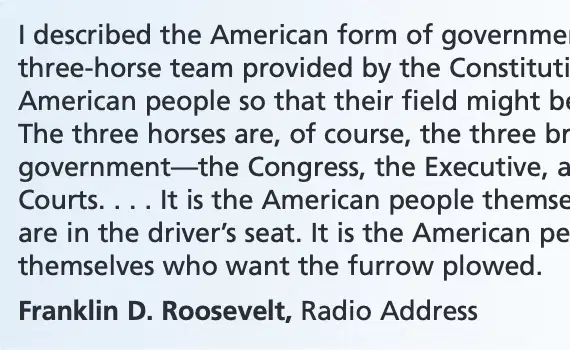
Interpreting primary sources: In a 1937 radio address, Franklin D. Roosevelt compared the federal government to a “three-horse team”—the Congress, the Executive, and the Courts—pulling together while the American people are in the driver’s seat. How does Roosevelt describe the separation of powers?
One branch commands the others and makes all decisions
The branches share identical duties with no distinctions
Three separate branches each have distinct roles and must work together without any one controlling the others
The people have no role in guiding the branches
Interpreting primary sources: In the same 1937 radio address, Roosevelt said “It is the American people themselves who are in the driver’s seat.” How does Roosevelt explain popular sovereignty?
The Supreme Court alone controls the direction of government
The president personally drives the government without public input
State legislatures are the sole drivers of national policy
The people ultimately guide and control the government by directing how the branches work together
What is a citizen?
A legal member of a nation who pledges loyalty and has rights, protections, and responsibilities
A visitor without legal status or responsibilities
A person who lives temporarily in a place and has no duties to any nation
A resident who only enjoys freedoms and has no responsibilities
What citizenship status is described for children born in the United States to parents who are not U.S. citizens?
Dual citizenship in the United States and their parents’ country
Only United States citizenship
Only their parents’ country’s citizenship
No citizenship until age 18
Which statements describe requirements to become a naturalized citizen of the United States? Select all that apply.
Be at least 18 years old
Enter the United States legally
Live in the United States for at least five years immediately prior to application
Read, write, and speak English
Show knowledge of American history and government

