
 Worksheets
Page 1
Total questions: 42
Worksheet time: 21mins

Based on the passage, what is the primary purpose of the peer review in the design process?
To collaborate and consider feedback to improve designs so they meet intended purpose and requirements
To assign final grades for the design project
To replace the evaluation stage of the project
To document and approve manufacturing costs

According to the passage, how is the peer review assessed and what is required from students?
It is not marked, but it must be submitted to the assessor
It is marked and only submitted to peers
It is neither marked nor submitted
It requires only an oral discussion without any submission

How is the peer review used later in the project, according to the passage?
To inform design changes in Task 4 (Evaluation)
To finalize the production schedule for manufacturing
To determine team roles and responsibilities
To set the overall project budget

According to the slide titled Roles and Responsibilities, which group must manage their time?
Candidates being assessed
Peer reviewers
Both groups
Neither group

According to the slide titled Roles and Responsibilities, how are candidates expected to present their design?
Verbally using annotated sketches and diagrams
By submitting a written report only
Through a live software demo without sketches
By emailing slides after the discussion

Based on the Roles and Responsibilities slide, which action is required of peer reviewers?
Proactively engage in the discussion
Manage their time
Present and explain the design
Record feedback on the feedback record form provided

From the Roles and Responsibilities slide, what must candidates do regarding feedback during the discussion?
Seek clarity in the feedback given and be prepared to ask questions
Respond constructively and fairly
Complete the peer review feedback form
Avoid asking questions until the end
According to the Roles and Responsibilities slide, what must be done with the peer review feedback form?
Ensure it is completed fully and handed to the assessor
Keep it for personal reference only
Give it to the candidate being assessed
Complete it only if issues arise

According to the Roles and Responsibilities slide, what are candidates expected to do during the discussion?
Proactively participate in the discussion
Only listen and avoid speaking
Leave once their presentation ends
Let peer reviewers lead without input

According to the slide section titled "Actively Participate in the discussion," what should you do if a reviewer asks about the stability of the lifting platform?
Respond with a well-thought-out explanation, referencing your design and any calculations
Defer the question until the end of the session without explanation
Provide a brief answer without referencing design details
Direct the reviewer to read the written report later

Which behaviors are emphasized for engaging with peer reviewers under "Actively Participate in the discussion"?
Being present, attentive, and responsive to questions
Focusing only on the slides and avoiding interaction
Speaking only when prompted and avoiding follow-up questions
Redirecting all questions to another teammate

According to the section titled "Manage your time," how long is allocated for presenting?
10 minutes
5 minutes
15 minutes
20 minutes

What benefit of good time management is stated under "Manage your time"?
Ensuring a comprehensive review process
Making the presentation shorter than required
Avoiding any questions from reviewers
Impressing reviewers with rapid delivery

Under "Manage your time," what do you need to manage during the session?
The timing of the presentation and discussion
Only the technical setup of the room
Seating arrangements for the audience
The reviewers’ availability schedules

According to the slide titled Candidate Responsibilities 3/3, after the presentation you must take a specific action regarding any unclear feedback points. What must you do?
Ignore unclear points and move on to the next task
Actively seek clarification on any feedback points that are unclear
Wait until the next meeting to address unclear items
Only summarize the feedback without asking questions

Under Seek clarity in feedback and ask questions, what is the main purpose of asking questions after the presentation?
To challenge the reviewers and defend the design
To ensure you understand the reviewers' perspectives, such as why they think the system could be optimised or improved
To shorten the feedback session
To collect personal opinions for unrelated tasks

What benefit does seeking clarity and asking questions provide, as stated on the slide?
It helps in the subsequent design revision
It removes the need for future reviews
It guarantees approval without changes
It reduces the number of team members needed

According to Record feedback notes on the slide, what is the primary purpose of the feedback record form?
To track attendance at presentations
To document all feedback and be used as part of the evidence in Task 4
To calculate the project budget
To schedule future meetings

In the example provided under Record feedback notes, reviewers suggest changing the handle of the lifting platform. What should you do with this suggestion?
Implement the change immediately without documentation
Ignore the suggestion unless it is repeated
Note the suggestion on the feedback form along with the reason for the suggestion
Ask a peer to remember it for you

According to the slide titled Responsibilities of the Peer Reviewers 2/2, what are peer reviewers expected to do with the peer review feedback form?
Fill it out completely with detailed and thoughtful feedback and hand it to the assessor afterwards
Skim it, leave most sections blank, and email it to the designer
Discuss it verbally without writing and keep it for personal records
Submit anonymous ratings without explanations online

What should the feedback provided on the peer review form address, as stated on the Responsibilities of the Peer Reviewers 2/2 slide?
All key questions on the form, such as how well the design meets the criteria and how it could be improved
Only spelling and punctuation errors in the document headings
Personal preferences of the assessor unrelated to stated criteria
Budget allocations and staffing for future projects

After completing the peer review feedback form, to whom should reviewers hand it, as described on the Responsibilities of the Peer Reviewers 2/2 slide?
The assessor
The original designer
The project sponsor
Their peer reviewer supervisor

Which example of a key question is explicitly mentioned for peer review feedback on the Responsibilities of the Peer Reviewers 2/2 slide?
How well the design meets the criteria
How the design aligns with current marketing trends
The designer’s years of professional experience
The printing speed of the final report
Based on the “Assessor’s Role” diagram, which role is defined as ensuring access to candidate resources as directed in the task information?
Resource Management
Facilitation
Time Management
Quality Control
According to the “Assessor’s Role” diagram, which role involves ensuring the task is candidate-led while the assessor may prompt to support engagement and feedback?
Facilitation
Intervention
Feedback Distribution
Evidence Collection
From the “Assessor’s Role” diagram, which duty focuses on monitoring timings as directed by the task?
Time Management
Resource Management
Quality Control
Intervention

Which role on the “Assessor’s Role” diagram requires checking all completed peer review forms for appropriateness before sharing with the candidate whose evidence is being reviewed?
Quality Control
Feedback Distribution
Evidence Collection
Resource Management

In the “Assessor’s Role” diagram, which role states that assessors may intervene at their discretion if they believe there is a risk of the candidate not receiving sufficient feedback, making sure feedback is meaningful and can inform design choices?
Intervention
Facilitation
Quality Control
Time Management
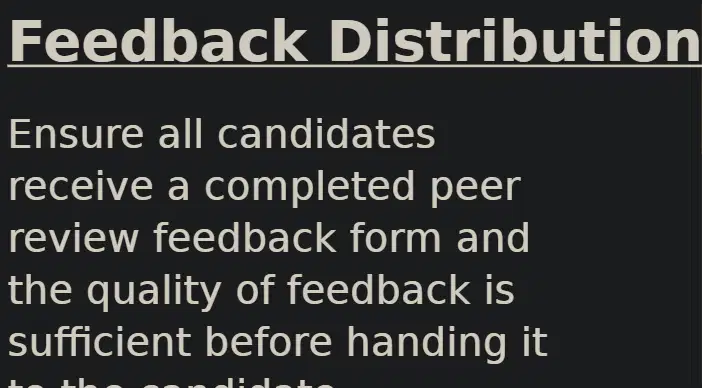
According to the “Assessor’s Role” diagram, which role ensures all candidates receive a completed peer review feedback form and that the quality of feedback is sufficient before handing it to the candidate?
Feedback Distribution
Evidence Collection
Resource Management
Facilitation

From the “Assessor’s Role” diagram, which role ensures that copies of the feedback record form completed by the candidate, and the peer review form, are submitted as evidence for marking?
Evidence Collection
Quality Control
Feedback Distribution
Resource Management

Based on the slide titled "Required Submissions" listing two forms, which form is completed by the peer reviewers to provide feedback on the design?
Peer Review Feedback Form
Feedback Record Form

According to the slide titled "Required Submissions," which form is completed by the individual being assessed to note feedback received?
Peer Review Feedback Form
Feedback Record Form
Peer Review Form Guidance — Design Criteria Alignment: How well do the diagrams and drawings meet the design criteria? Reviewers should assess how well the drawings align with the requirements of the design brief.
Compare the drawings to the design brief to confirm alignment with stated requirements
Focus on the aesthetic style and color palette without referencing the brief
Measure only the physical dimensions, ignoring the brief’s goals
Check spelling and grammar in annotations as the primary criterion
Peer Review Form Guidance — Specification Criteria: How well do the diagrams and drawings meet the specification criteria? Reviewers should check if the drawings satisfy the technical specifications of the project.
Verify that the drawings satisfy the project’s technical specifications
Evaluate the creativity of the concept regardless of specs
Prioritize visual appeal over compliance with specifications
Ignore tolerances and materials listed in the specs
Peer Review Form Guidance — Convention Conformity: How well do the diagrams and drawings conform to the relevant conventions? Reviewers should evaluate if the drawings follow industry standards and protocols.
Confirm that the drawings follow industry standards and protocols
Assess only whether the drawings are easy to understand for classmates
Replace symbols with custom icons for uniqueness
Disregard line weights and annotation standards
Peer Review Form Guidance — Optimisation Potential: How can the system be optimised or improved? Reviewers should suggest ways to develop the design, making it more efficient or effective.
Propose improvements that increase efficiency or effectiveness of the design
Leave the design unchanged to preserve the original concept
Remove features without assessing performance impact
Focus only on aesthetics rather than performance

Based on the example of a presentation during a peer review, which element best demonstrates the candidate’s justification of material choice for the lifting device design using a screw jack mechanism? The scenario states that the individual explains the rationale for selecting a specific material, for example, high‑tensile steel for its strength, and supports the design with load‑capacity calculations and annotated sketches.
Explaining the rationale for selecting high‑tensile steel for its strength
Including a decorative rendering of the lifting device
Listing unrelated materials without comparison
Focusing only on the color scheme of the device

During the discussion phase of the peer review example, which concern is specifically addressed by the candidate to demonstrate consideration of stability in the lifting device design? The dialogue includes reviewers’ questions about operation and risk of tipping and the candidate’s response highlighting a broader base and supporting components.
Risk of the device tipping and how stability is provided
Only the aesthetics of the device’s exterior
Battery life of the device’s electronics
Marketing strategy for launching the device

In the feedback stage of the peer review example, which suggestion is focused on improving ergonomics? The example describes reviewers proposing a redesigned handle for better ergonomics and a safety lip on the platform to enhance functionality.
Redesigning the handle to be more ergonomic
Adding decorative decals to the frame
Applying a glossy paint finish
Reducing the size of the annotations in sketches
According to the slide titled Feedback Use, how should peer review feedback be applied to Task 4 (Evaluation)?
Use it to make changes to the design in Task 4 (Evaluation)
Ignore it until the final presentation is complete
Use it only to grade your peers, not your own work
Archive it for future projects without altering the current design
Under Feedback Use, which document must you produce to justify the changes you would make (or not) because of peer review feedback?
A revision control document
A project charter
A user manual
A marketing brief
Within your evaluation, what should be provided about the changes made or not made, according to Feedback Use?
Detailed reasoning for the decisions
Only the final design files without explanation
A budget summary replacing explanations
A meeting attendance list

