
NEW
Font size
 Worksheets
Introduction and Essence of Physical Security
Total questions: 59
Worksheet time: 30mins
Which pillar of physical security is most directly concerned with preventing theft or damage to equipment and facilities?
Regulatory compliance with legal standards
Information integrity and data confidentiality
Personnel safety and evacuation planning
Asset protection of tangible resources
Which measure best supports personnel safety within a secured facility?
Deploy intrusion detection sensors
Audit adherence to statutory requirements
Maintain emergency response and evacuation plans
Encrypt all stored paper documents
A company installs access controls and surveillance to protect server rooms and paper records from unauthorized access. Which pillar is primarily addressed?
Asset protection against theft and damage
Information integrity safeguarding sensitive information
Regulatory compliance meeting industry rules
Personnel safety for employees and visitors
Why is regulatory compliance considered a pillar of physical security in many industries?
It primarily trains guards in basic patrol routines
It ensures alignment with legal requirements and standards
It replaces the need for technical controls entirely
It focuses solely on protecting digital network traffic
An attacker attempts unauthorized entry to sabotage equipment. Which two countermeasures together best form a robust physical defense?
Encryption and password complexity
Barriers and human vigilance
Marketing and public relations
Outsourcing and vendor contracts
You are planning a physical security program for a campus. Which action sequence demonstrates strategic thinking across all four pillars?
Install CCTV; ignore safety drills; archive files; skip audits
Map assets; train evacuation; secure data; verify compliance
Hire guards; remove barriers; open files; avoid regulators
Buy alarms; disable access; share passwords; delay inspections
Which action best characterizes a physical intruder aiming to access a restricted server room?
Uploading malware through a remote exploit
Impersonating helpdesk staff to gain sympathy
Cloning RFID cards from a short distance
Using lockpicking tools to bypass door locks
Social engineers primarily achieve unauthorized access by
Sniffing wireless traffic from cameras
Brute forcing keypad codes using hardware
Defeating biometric sensors with synthetic prints
Exploiting human psychology and persuasion techniques
Why are insider threats often harder to detect than external attackers?
They only operate during non-business hours
They always use encrypted command-and-control servers
They already possess legitimate access and procedural knowledge
They rely on slow network scans to avoid alerts
RFID skimming enables attackers to
Disable wireless cameras without physical contact
Read and clone access cards to create duplicates
Inject malware into IoT devices via firmware
Bypass face recognition using voice recordings
Which scenario best illustrates wireless hacking against physical security?
Manipulating access control systems remotely via vulnerabilities
Planting surveillance bugs inside ceiling tiles
Tailgating through doors behind authorized personnel
Creating synthetic fingerprints for sensor bypass
A facility integrates many smart locks and cameras into a single network. What risk emerges from IoT exploitation?
Unauthorized badge duplication becomes easier
Multiple access points can be compromised simultaneously
Only biometric readers are vulnerable to spoofing
Physical barriers become immune to brute force
Which tactic directly targets biometric systems to bypass access controls?
RFID readers jammed with high-frequency noise
Phishing emails sent to security administrators
Synthetic fingerprints or facial masks used for spoofing
Shoulder surfing PINs at entry keypads
You are designing a defense plan for a high-security lab. Which combined countermeasure best mitigates social engineering and RFID skimming?
Replace all sensors with voice-based recognition
Deploy mutual-authentication badges with human verification
Install more wireless cameras around the perimeter
Increase door hinge strength and thicker frames
Which action best defines reconnaissance in a physical security breach lifecycle?
Copying documents after gaining access
Jamming sensors to force door failures
Following staff through secured doors
Observing routines to map vulnerabilities
Tailgating and piggybacking primarily exploit which weakness to gain entry?
Human courtesy and social compliance
Firewall misconfiguration at gateways
Unpatched operating system kernels
Weak cryptography on smart cards
During security system manipulation, which tactic is most aligned with bypassing electronic controls?
Exploiting software flaws in door controllers
Politely asking guards for temporary badges
Surveying employee coffee break times
Sharing files via removable drives
Which scenario best illustrates data exfiltration after physical access is obtained?
Installing covert devices for long-term collection
Shadowing employees to learn their names
Testing badge readers for green lights
Practicing evacuation routes and procedures
A facility experiences repeated unauthorized entries without forced openings. Which ordered plan most effectively reduces tailgating risk?
Implement anti-passback, train staff, add turnstiles
Deploy IDS sensors, patch servers, change VLANs
Increase HVAC capacity, repaint lobbies, replace chairs
Rotate encryption keys, update firmware, add RAID
Which feature makes RFID-enabled key cards suitable for granular facility access control?
Requires physical tokens for validation
Programmable with time or zone restrictions
Biometric uniqueness guarantees identity
Unchangeable static credentials for users
What is a primary security advantage of biometric systems over PIN codes?
Less dependent on sensor accuracy
Cheaper to deploy at large scale
Easier to remember than numbers
Harder to forge unique physical traits
Which risk most directly affects PIN code-only entry systems?
Power fluctuations causing false alarms
Hardware tampering of RFID readers
Observation and social engineering attacks
Biometric template replay attacks
Mobile access control most commonly enhances security by enabling which capability?
Purely local door logic with no cloud
Offline storage of analog badges
Passive identification using gait
Multi-factor and real-time management
Which CCTV features support comprehensive coverage in varied lighting conditions?
Pan-tilt-zoom, night vision, motion detection
Thermal barriers, anti-climb, bollards
RFID encoding, PIN rotation, NFC relay
Fiber fence sensors, infrared tripwires
AI-powered analytics in surveillance primarily enable which outcome?
Hardware-only encryption keys
Real-time detection of anomalies
Manual review of weekly logs
Static zone-only alerts
Linking surveillance with access control helps security personnel do what more effectively?
Verify authorized entries and investigate breaches
Replace physical barriers entirely
Disable CCTV during maintenance windows
Avoid storing any access control data
Remote monitoring capabilities allow authorized staff to achieve which benefit?
Operate without network connectivity
Secure off-site access to live and recorded footage
Eliminate the need for on-premise cameras
Prevent all false positives automatically
Which design factor most improves the deterrent effect of physical perimeter barriers?
Shared default admin passwords
Unencrypted wireless signals
Height and anti-climbing features
Opaque indoor lighting policies
Electronic monitoring along a perimeter provides early warning using which devices?
Biometric badges, magnetic stripe cards
PTZ joysticks, DVRs, RAID arrays
Smartphone MFA, SMS codes, email tokens
Motion detectors, infrared cameras, fiber sensors
What combination best controls entry and exit at perimeter access points?
Single CCTV camera without authentication checks
Open turnstiles with posted visitor instructions
Unstaffed gates with paper logs and weekly audits
Manned checkpoints with vehicle barriers and electronic access
Which practice optimizes lighting for perimeter security while conserving energy?
Disable lights during night to avoid glare
Use motion-activated lights in low-traffic areas
Rely on window reflections for illumination
Install decorative lights without shields

Which door feature most directly helps resist forced entry attempts at building entrances?
Lightweight hollow-core panels
Decorative handles on door sets
Reinforced frames on door assemblies
Tinted glass on sidelights

A facility wants windows that delay intruders and reduce injury from flying debris. Which option best meets both goals?
Laminated or tempered glass panes
Uncoated standard float glass
Single-pane acrylic windows
Frosted privacy film only
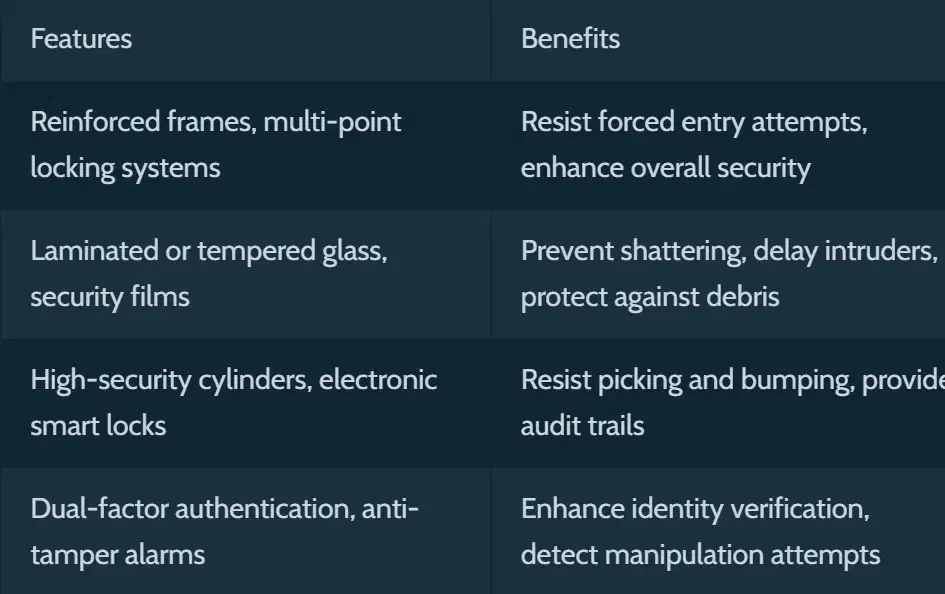
Which lock upgrade best addresses picking and bumping while also supporting audit trails?
High-security cylinders or smart locks
Magnetic catches without keys
Simple latch bolts with knobs
Padlocks with thin shackles
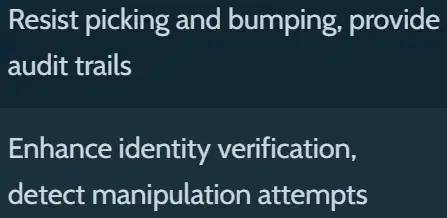
You must strengthen identity verification at access points and detect tampering attempts without adding more guards. Which deployment aligns with these goals?
Single PIN pads without alarms
Badge-only readers with no logging
Mechanical keys issued to all staff
Access readers with dual-factor and anti-tamper
Which element is essential in a comprehensive employee security awareness program?
Coverage of incident reporting procedures
Annual policy memo circulation
Exclusive focus on malware signatures
Strict dress code enforcement
What is a key practice to keep employee security skills sharp over time?
Annual password length reduction
Regular refresher courses and simulations
Monthly badge color changes
Quarterly office layout redesigns
Which step strengthens visitor management in sensitive facilities?
Open lobby access during events
Pre-registration and identity verification
Unescorted self-guided tours
Verbal-only check-in with reception
Why audit authorized visitor lists regularly?
To reduce parking lot congestion
To speed cafeteria service times
To maintain tight control over facility access
To expand marketing outreach
Which action best fosters a strong security culture across an organization?
Restricting communication from leadership
Outsourcing all awareness activities
Rewarding proactive security measures
Discouraging incident reporting to avoid panic
What is the primary goal of encrypted RFID systems with rolling codes?
Reduce card manufacturing costs
Prevent card cloning attempts
Increase card battery drain
Enhance card glossy finish
Which AI capability most improves real-time security operations?
Animating dashboards aesthetically
Randomizing camera angles hourly
Replacing all human analysts entirely
Detecting anomalies across multiple sources
How does blockchain strengthen access log integrity?
By anonymizing all user identities
By compressing logs for easy deletion
By creating tamper-proof audit trails
By enabling editable entries for flexibility
What is the purpose of quantum-safe encryption for organizations today?
Reduce network latency during backups
Make legacy ciphers obsolete immediately
Prepare for threats from quantum advancements
Eliminate the need for key management
Which statement best describes physical security integration in a unified platform?
Combining access control, video, and intrusion detection
Running each domain on isolated islands
Separating cameras from access control systems
Outsourcing monitoring to multiple vendors
What is cybersecurity convergence aiming to achieve?
A purely physical perimeter focus
Decentralization of communication protocols
A comprehensive posture by integrating cyber and physical
Elimination of all IoT devices from networks
Which approach enables security teams to respond from anywhere while maintaining integrity of access?
Unencrypted mobile notifications
Mobile integration with secure authentication and encryption
Text messages to team group chats
Public Wi-Fi for incident dashboards

Which step in incident response prioritizes vulnerabilities and allocates resources effectively?
Regular drills to test response effectiveness
Protocol development for containment procedures
Risk assessment to identify high-impact scenarios
Response team formation for coordinated actions

What is the primary purpose of assembling a dedicated incident response team?
To replace legal counsel during investigations
To coordinate roles across security and IT
To automate containment and recovery fully
To eliminate the need for external communication
Which protocol component most directly guides communication during a breach?
Guidelines for internal and external updates
Budget approval and procurement routing
Asset inventory and patch documentation
Forensic imaging and chain-of-custody forms

Drills and tabletop exercises primarily help organizations do what?
Replace formal incident protocols
Identify areas needing improvement
Avoid all breaches indefinitely
Remove the need for KPIs entirely

Which metric type is established to evaluate physical security effectiveness?
Quality assurance scores for HR
Service-level objectives for finance
Key performance indicators for measures
Return on investment for vendors

Vulnerability assessments should include which activity to test human factors?
Network segmentation audits
Role-based access provisioning
Social engineering exercises
Firmware signing verification

Why are regular technology updates critical for security systems?
They avoid compliance audits entirely
They reduce the need for monitoring teams
They incorporate new features against risks
They ensure devices remain under warranty

Compliance audits performed by third parties mainly provide what benefit?
Elimination of internal reviews
Automated remediation scripts
Objective assessment of measures
Guaranteed breach prevention

AI-driven security systems primarily enable which capability?
Manual log review by analysts
Predictive threat analysis at scale
Static rule enforcement only
Paper-based incident documentation

The proliferation of IoT devices introduces what challenge for security teams?
Lower network throughput everywhere
New vulnerabilities needing management
Guaranteed interoperability of systems
Removal of legacy authentication methods

Next-generation biometrics offer which primary advantage for access control?
Complete anonymity for all users
More secure and convenient verification
Cheaper hardware than key cards
Infinite scalability without training

What role will autonomous security systems most likely play in large facilities?
Run quarterly audits without oversight
Focus solely on off-site data backups
Provide rapid response with 24/7 surveillance
Replace all human personnel immediately

