
Font size
 Worksheets
A-levels chapter 13
Total questions: 43
Worksheet time: 22mins
Which set lists only private sector forms of business ownership?
State schools, public hospitals, ministries
Sole traders, partnerships, limited companies
Societies, charities, cooperatives
Local authorities, central government, NHS
Public sector organisations are best described as entities that are
Owned by individuals seeking dividends
Owned and operated by the government
Created to avoid paying any taxes
Run by volunteers without revenue
Which statements correctly describe private sector organisations?
Funded entirely by taxation revenues
Owned and operated by individuals or groups
Always provide free universal services
Primarily pursue profit-oriented goals
Not-for-profit organisations, such as societies and charities, typically
Aim solely to maximise short-term profit
Distribute profits to private shareholders
Reinvest surpluses to advance a mission
Operate as ministries within government
Which feature best explains why many entrepreneurs choose a sole trader structure?
Mandatory shareholder meetings
Complex governance and reporting
Shared control with partners
High independence in decision-making
A key advantage for a sole trader operating a small business is the ability to:
Outsource all operations to managers
Avoid any involvement in daily tasks
Provide personal service and supervise all areas
Rely on multiple co-owners for input
Which statement about establishing a sole trader is most accurate?
It requires issuing shares to raise equity first
It must register as a limited company immediately
It is easy to set up legally with a business name
It needs approval from a board of directors
What does the income statement of a sole trader primarily show?
Market share and growth rate
Cash budgets for next year
List of owners and employees
Profit or loss for the period
The statement of financial position for a sole trader reports:
Assets of the business
Liabilities of the business
Owner’s capital balance
Projected future revenues
Which pair correctly matches a financial statement with what it shows?
Statement of financial position – tax expense only
Income statement – assets and liabilities
Statement of financial position – daily sales
Income statement – profit or loss
Which statement best reflects the legal definition of a partnership under the Partnership Act 1890?
A relation between persons carrying on a business in common for profit
A contract to share assets without business activity
A company formed by shareholders with limited liability
A temporary joint venture with no profit motive
In a partnership, which aspect is inherently shared among partners?
Personal hobbies and vacations
Voting rights in public elections
Ownership of unrelated properties
Profits, responsibilities, and risks
Under the default rules of the Partnership Act 1890, how are profits and losses divided if no agreement states otherwise?
Proportionate to capital only
Based on seniority of partners
Equally among all partners
At the discretion of the managing partner
Which item is NOT allowed by default under the Partnership Act 1890 unless an agreement states otherwise?
Sharing profits equally each year
Charging interest on partners’ drawings
Recording partners’ capital accounts
Contributing capital to the business
By default, what entitlement do partners have regarding salaries?
A salary proportional to effort
No partner is entitled to a salary
A salary only for managing partners
A fixed monthly salary for all
What is the default position on interest on partners’ capital under the Act of 1890?
Interest must be paid at five percent
Interest is not allowed on capital
Interest rate follows bank prime rate
Interest is paid if profits exceed target
If a partner contributes more capital than agreed, what default interest applies to the excess?
Three percent per year on excess
Five percent per year on excess
No interest allowed on excess
Market rate set by bank on excess
Which matters are commonly specified in a partnership agreement to vary default rules?
Division of profits and losses
Partners’ salaries
Depreciation methods of national tax law
Interest on capital and drawings
Which scenario correctly illustrates shared risks in a partnership?
Risks are transferred to suppliers only
Only newest partner bears all risks
Each partner bears risks jointly
One partner bears all losses alone
Which statement about advantages and disadvantages of partnerships is most accurate?
They offer shared responsibility but never conflicts
They diversify expertise yet may share liabilities
They guarantee limited liability for all partners
They prevent any need for decision sharing
Which change would require an explicit partnership agreement rather than relying on default rules?
Sharing profits equally among partners
Paying salaries to selected partners
Keeping capital accounts for partners
Recording business revenue and expenses
Which charge is prohibited by default on partners’ drawings?
Sales tax on merchandise
Depreciation on fixed assets
Interest on amounts withdrawn
Late fees on supplier invoices
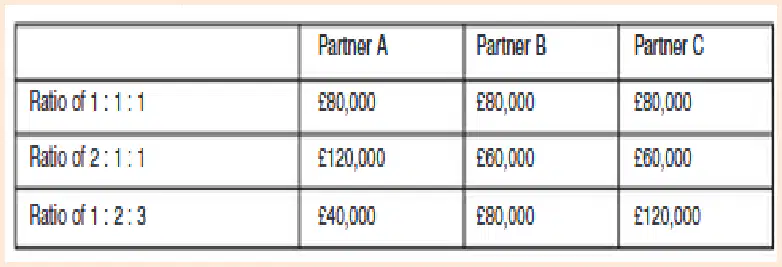
In the table, a partnership has capital contributed in the ratio 1:1:1 with each partner investing £80,000. What is the total partnership capital?
£160,000 total capital
£200,000 total capital
£320,000 total capital
£240,000 total capital
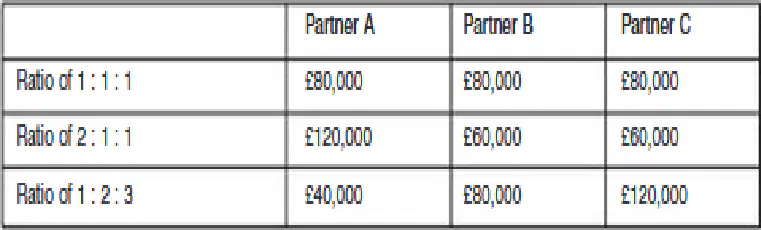
Using the 1:2:3 ratio row, what is Partner C's share of total capital expressed as a simplified fraction?
3/7 of total capital
1/3 of total capital
1/2 of total capital
3/6 of total capital
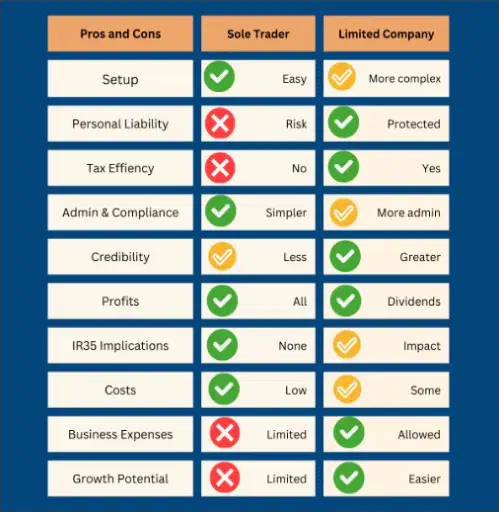
Which statement best describes a limited company in the diagram?
A business identical to its owners
A sole trader with shared profits
A separate legal entity from owners
A partnership with unlimited liability
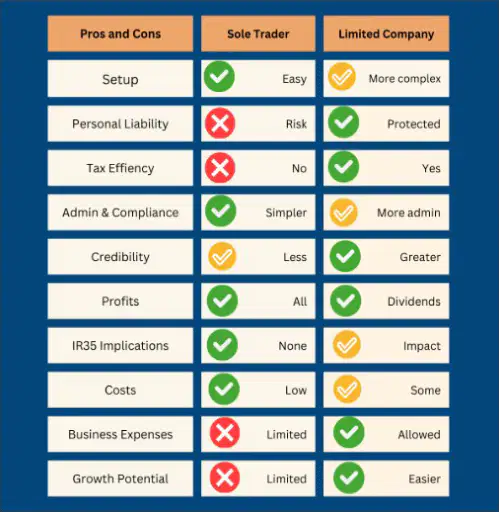
According to the comparison chart, which features are advantages of a limited company over a sole trader?
Protected personal liability
Greater credibility with clients
Simpler administration overall
Ability to pay dividends

Which feature is a typical trade-off when moving from sole trader to limited company, as shown in the chart?
More complex setup process
Lower administrative burden overall
No tax efficiency benefits
No change in compliance duties
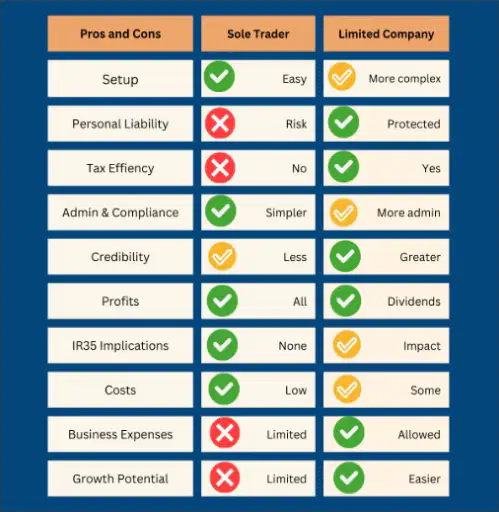
A founder wants limited personal risk and the option to distribute profits via dividends. Based on the diagram, which structure fits these goals best?
Operate as a sole trader
Remain an unregistered business
Form a limited company
Create an informal partnership
Which requirement is specific to becoming a public limited company (plc) in the UK?
At least one shareholder only
Must avoid listing on any market
Issued share capital over £50,000
Shares cannot be transferred privately
A private limited company (Ltd) must have which minimum governance structure?
At least two members and two directors
Two directors who are not shareholders
A board of at least five directors
At least one member and one director
Which statement best describes share trading for a private limited company?
Shares can only be issued to the government
Shares must be quoted on the Stock Exchange
Shares are not publicly traded but transferable privately
Shares are freely traded without valuation issues
Which statement about a plc is accurate?
It cannot have more than one director
It may raise capital publicly on stock markets
It has no minimum issued share capital
It must float shares on a public exchange
Identify all true statements about private limited companies (select all that apply).
At least one member and one director required
No minimum issued share capital requirement
Often small and family-owned businesses
Shares are publicly quoted for easy valuation
Which set lists the core financial statements prepared internally by a limited company?
Income statement and statement of financial position
Cash budget and capital maintenance schedule
Trial balance and bank reconciliation
Statement of cash flows only
What is the primary additional statement that follows the income statement for a limited company?
Notes on accounting policies
Director’s remuneration report
Statement of cash flows
Statement of changes in equity
The statement of changes in equity mainly shows which of the following?
How profit is distributed and linked to equity
Only the closing cash and bank balances
The fair values of marketable securities
Tax computations for the fiscal year
Dividends are best described as which of the following?
Distributions of profit to shareholders
Mandatory interest paid to lenders
Capital raised from issuing shares
Government grants for listed firms
Which combination correctly differentiates plc from Ltd status?
Plc: public capital raising allowed; Ltd: private share transfers
Plc: no directors needed; Ltd: two directors minimum
Plc: shares never issued; Ltd: shares must be quoted
Plc: no capital threshold; Ltd: £50,000 minimum
Which role primarily checks that financial statements comply with standards and laws rather than preparing day‑to‑day records?
Accountant within the finance department
Auditor responsible for independent review
Controller overseeing internal controls
Treasurer managing cash and liquidity
In a limited company, who is most responsible for maintaining accurate accounting records and producing reports for management?
External auditor conducting statutory audits
Controller supervising accounting systems
Equity investor providing share capital
Loan officer from the commercial bank
Which sources count as internal financing for a business?
Retained profits kept in the business
Bank overdraft used for operations
Depreciation funds set aside internally
Owner’s personal injection as equity
Which statement best distinguishes equity from loans as funding methods?
Equity exchanges ownership for capital
Loans permanently dilute voting control
Equity requires fixed interest and collateral
Loans provide funds without future obligations
Which situation is most appropriate for seeking a grant over other financing options?
A routine purchase of inventory
A temporary cash flow shortfall
A leveraged buyout of a competitor
A project matching public policy goals

