
NEW
Font size
 Worksheets
Introduction to Materials Testing
Total questions: 10
Worksheet time: 5mins

A steel sample’s load–extension graph shows a clear linear region, then a yield point, followed by strain hardening and a final drop before fracture. Your task is to select the most appropriate test method and key parameter to report if the goal is to compare how two steels resist permanent deformation before necking begins.
Tensile testing reporting elastic limit value
Toughness testing reporting impact energy value
Hardness testing reporting Brinell number value
Fatigue testing reporting endurance limit value

A manufacturer must verify weld quality on sample coupons while also learning yield strength and fracture toughness, even though the samples will be consumed. Which approach best fits this plan, and why?
Use non-destructive testing because it confirms properties without sample loss
Use destructive testing because it avoids consuming samples during testing
Use non-destructive testing because it cannot measure yield or toughness at all
Use destructive testing because it confirms properties with full failure data

A plant wants to inspect operating equipment weekly with minimal disruption, identify safety issues early, and keep costs low. Which set of methods best aligns with this goal?
Destructive testing methods like tensile, impact, and bend
Shutdown-only inspections using detailed sectioning and polishing
Post-failure analysis using fracture surface microscopy alone
Non-destructive testing methods like UT, RT, MT, and VT
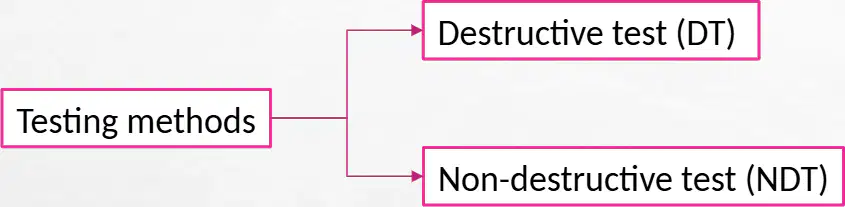
During surface inspection of a finished component, the team notices inconsistent indications on a highly polished part, and the method needs electricity and only works on conductive materials. What limitation is most likely affecting the inspection and how should they plan around it?
Porosity-only access; switch to a method for porous ceramics only
High depth sizing accuracy; rely on readings without any changes
DT sample destruction risk; keep all parts intact during testing
NDT sensitivity and material constraints; choose a compatible method or adjust surface prep

A manufacturer must quickly screen welds during fabrication without damaging parts. Which method best fits this need and why?
Tensile testing for precise material strength values
Ultrasonic immersion for subsurface flaw volumetric mapping
Visual testing for fast naked-eye flaw detection
Chemical etching for microstructure grain boundary study
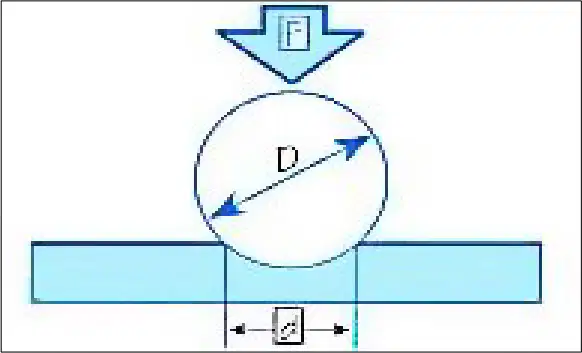
A hardness test uses a hard spherical indenter pressed at 90 degrees under a known load P, leaving an impression of diameter d with a ball of diameter D. Which expression correctly reasons how the Brinell Hardness Number scales when the same material is tested with a larger ball diameter while keeping the same load and impression diameter ratio d/D?
BHN remains constant because it depends on P and d/D
BHN doubles because contact area halves with larger D
BHN increases because larger D reduces indentation curvature
BHN decreases because larger D increases impression area
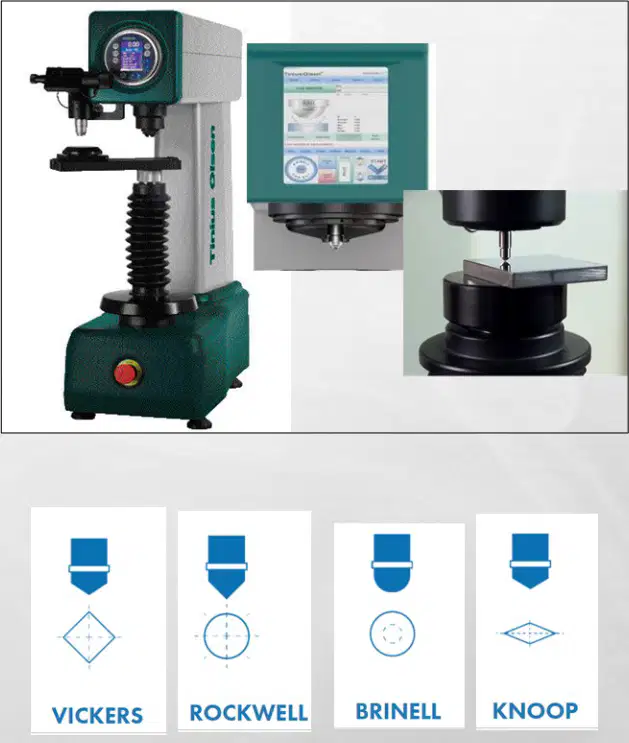
An engineer must choose between Vickers and Brinell to compare hardness of several alloys with thin surface case hardening layers. Which choice and justification is most appropriate?
Vickers, because a pyramid indenter suits thin layers
Brinell, because a large ball averages surface hardness
Knoop, because elongated indentations suit very thick parts
Rockwell, because depth measurement avoids optical reading
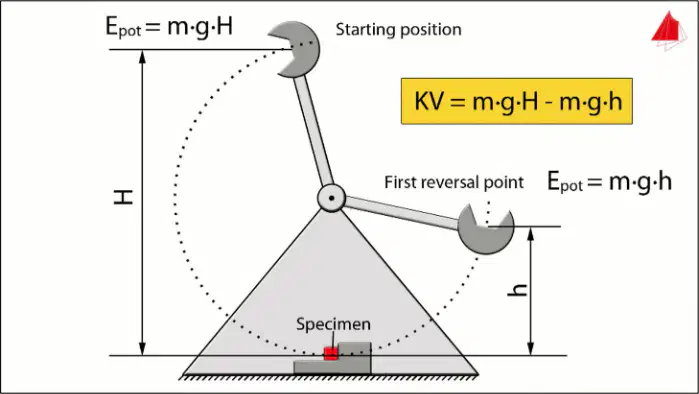
A Charpy V‑notch test uses a pendulum to strike a notched specimen. The hammer starts at height H and rises to height h after fracture, as shown. Which reasoning best estimates the absorbed impact energy?
Compute m·g·(H−h) from potential energy loss
Compute 21 ·m·(H^2−h^2) from velocity change
Use m·g·(H+h) because energy increases
Use 21 ·k·(H−h)^2 assuming spring storage
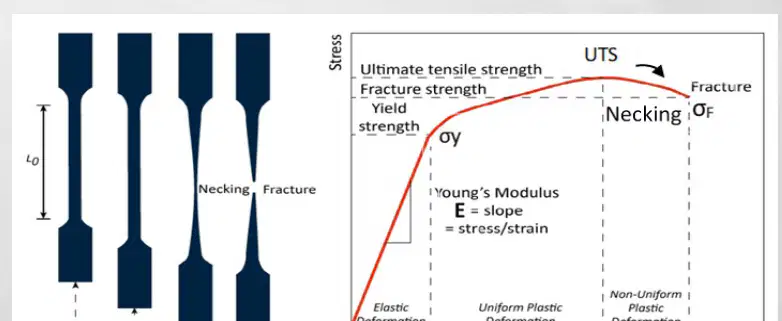
A steel specimen is pulled in a tensile tester as shown. You record force and elongation, then plot engineering stress versus strain. On the initial straight-line segment, you estimate the slope. Which conclusion best justifies using this slope to predict small elastic deformations for design?
It equals ultimate tensile strength at maximum uniform load
It equals yield strength where plastic flow first occurs
It equals fracture strength after necking begins
It equals Young’s modulus relating stress to strain linearly
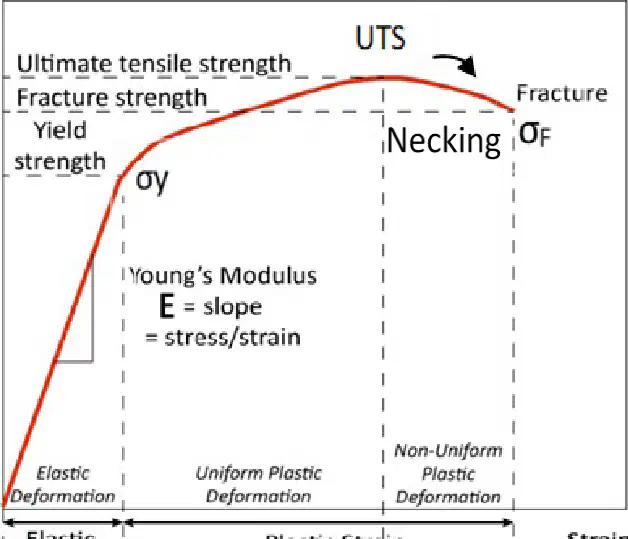
Examine the stress–strain curve provided. If a specimen is loaded to the point just past the yield strength and then unloaded, what outcome should you expect and why?
Specimen immediately fractures because it reached ultimate strength
Permanent plastic strain remains due to nonelastic deformation
Necking begins immediately because curve is still in linear zone
No residual strain remains because behavior is fully elastic

