
 Worksheets
CSP_CH01_IntroToCompSci
Total questions: 15
Worksheet time: 8mins
Which statement best characterizes computer science in this course context?
Fixing device issues and software installation
Building computer hardware and microprocessors
Study of processes, data, and problem solving
Only learning programming syntax and languages
A hospital wants to reduce patient wait times using computer science. Which approach aligns with CS applications mentioned?
Design fashion catalogs for staff uniforms
Use data processes to optimize scheduling
Replace doctors with non-digital paper charts
Limit appointments to fewer patients daily
Which term refers to breaking a complex problem into smaller, manageable parts?
Algorithm design
Pattern recognition
Decomposition
Abstraction
A developer notices repeated structures in several datasets and groups them to simplify processing. Which pillar is primarily being used?
Decomposition of tasks
Pattern recognition
Algorithm design
Abstraction of details
You hide implementation details of a simulation and expose only inputs and outputs through a clean interface. Which pillar does this exemplify?
Algorithm design
Pattern recognition
Abstraction
Decomposition
Which statement best describes decomposition in computational thinking?
Translating parts into code to automate tasks
Testing parts repeatedly to find performance issues
Combining parts into one to reduce duplication
Breaking problems into parts to manage complexity
When designing a navigation app, engineers show only the route and current traffic while hiding raw GPS satellite data. Which pillar is exemplified and why?
Decomposition, grouping sensors into modules
Pattern recognition, spotting repeated trip paths
Algorithm design, listing turn-by-turn procedures
Abstraction, focusing on what matters to users
Which statement best defines an algorithm in computing?
An endless loop of trial steps
A clear, finite sequence of steps
A random list of possible steps
A vague plan for solving tasks
A program reads a number list, sorts it ascending, then prints the list. Which part corresponds to the process stage in input–process–output?
Sorting the list values
Saving the numbers to disk
Typing the number list
Displaying the sorted list
In a PB&J algorithm activity, why must instructions be extremely specific?
Specificity lets humans improvise missing steps freely
Specificity entertains readers without affecting execution
Specificity reduces ambiguity that computers cannot resolve
Specificity shortens algorithms by removing detailed steps
An algorithm fails because it says 'assemble sandwich' before 'open bread bag.' Which failure reason fits best?
Missing required steps
Incorrect order of steps
Ambiguity in word meaning
Excessive specificity used
Which statement best describes pseudocode in programming practice?
Plain English steps for program logic
Executable code for a specific compiler
Mathematical notation for algorithms only
Graphical flowchart shapes and arrows
In the provided keywords list, which pair represents a conditional structure?
IF / ELSE
WHILE
START / END
FOR EACH
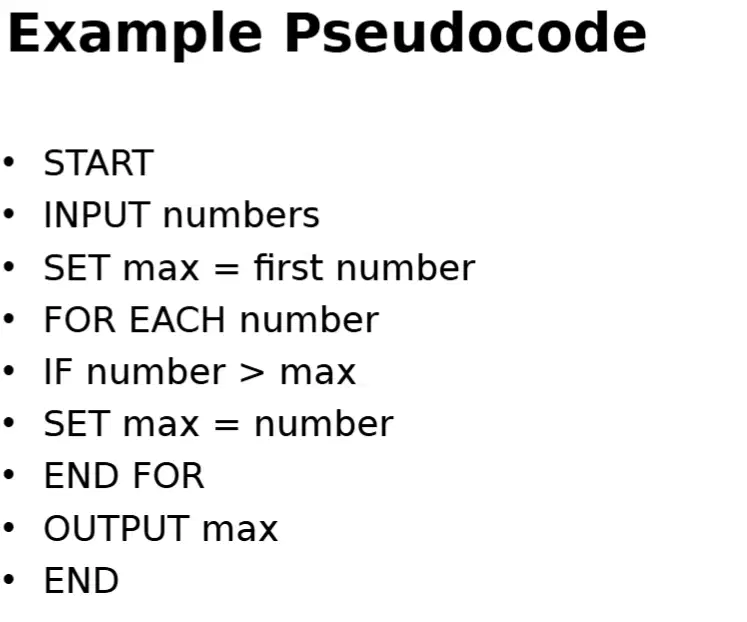
Given this pseudocode: START; INPUT numbers; SET max = first number; FOR EACH number; IF number > max; SET max = number; END FOR; OUTPUT max; END. What result does this algorithm produce?
The first number entered unchanged
The average of all input numbers
The count of numbers processed
The largest value from the inputs
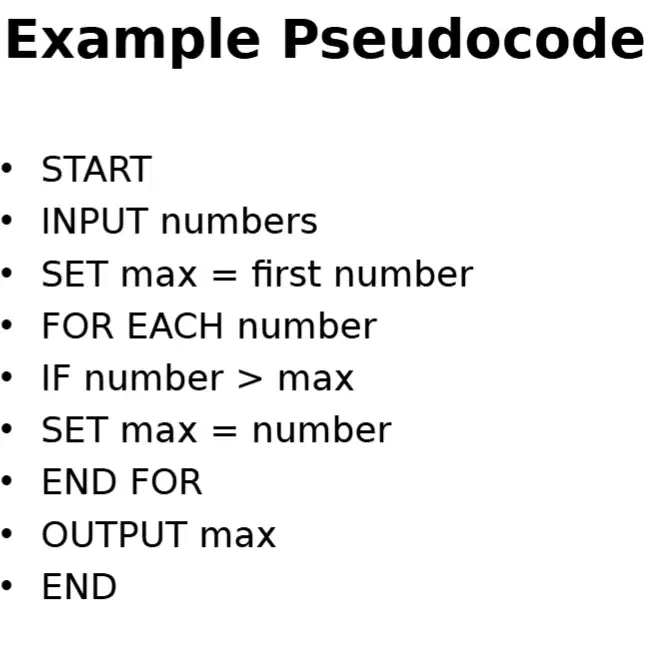
Which modification correctly changes the example pseudocode to compute the minimum value instead of the maximum?
Initialize max to first number, update when number <= max
Initialize min to first number, update when number < min
Initialize max to zero, update when number >= max
Initialize min to last number, update when number > min

